Software Development Company in Qatar: Complete Guide to Choosing the Right Developer

A practical guide to evaluating and choosing the right software development company in Qatar.
Software Development Company in Qatar: Complete Guide to Choosing the Right Developer
Choosing a software development company in Qatar is an important business decision. The developer you select can influence not only how your software looks and functions at launch, but also how securely it operates, how easily it can integrate with other systems, and how effectively it can scale as your business grows.
For many businesses, software development now goes far beyond building a website. Companies may need custom business software, CRM systems, ERP platforms, mobile applications, customer portals, e-commerce platforms, AI solutions, workflow automation, dashboards, APIs, or cloud-based applications.
The challenge is knowing which developer is actually capable of delivering the solution your business needs.
A strong development partner should understand your business problem before recommending technology. They should be able to explain the development process, provide evidence of relevant experience, discuss security and integrations, clarify ownership, and provide a realistic plan for support after launch.
This guide explains how businesses in Qatar can evaluate a software development company, what questions to ask before signing a contract, how to compare proposals, and which warning signs should be taken seriously.
If you are looking for custom software development services, the first step is not choosing a programming language. It is understanding what your business actually needs to achieve.
What Does a Software Development Company Do?
A software development company designs, builds, tests, deploys, and maintains digital products and business systems.
Depending on the company and project, services can include:
Custom business software
Web applications
Mobile applications
CRM systems
ERP systems
E-commerce platforms
Customer portals
Employee portals
Business dashboards
API integrations
Cloud applications
AI-powered applications
Workflow automation
Database development
Software maintenance and support
A development company may work on a small application for a startup or a large interconnected platform used by multiple departments.
The important point is that software development is not simply about writing code.
A professional project usually involves several stages:
Business analysis → Requirements → Architecture → UI/UX → Development → Integration → Testing → Deployment → Maintenance
The quality of each stage can affect the final result.
Why Choosing the Right Developer Matters
Two companies can receive the same software requirements and produce very different outcomes.
One development team may focus mainly on getting the application launched. Another may spend more time understanding workflows, security, scalability, integrations, user experience, and future requirements.
The difference becomes especially important when software becomes part of daily business operations.
For example, imagine a company needs a system connecting:
Sales → CRM → Inventory → Accounts → Employees → Management Reports → Mobile Application
If the system is designed without understanding how these departments interact, the business may eventually face duplicated data, manual work, integration problems, or expensive redevelopment.
Choosing the right development company therefore involves evaluating more than technical skills.
You should also consider:
Business understanding
Relevant project experience
Development methodology
Technology expertise
Security
Scalability
Integration capabilities
Communication
Project management
Documentation
Ownership
Maintenance
Long-term support
Step 1: Define Your Software Requirements Before Contacting Developers
One of the biggest mistakes businesses make is contacting developers without clearly understanding the problem they want to solve.
You do not need to prepare a complete technical specification yourself.
However, you should be able to explain the business requirement.
Start with five basic questions:
What problem are you trying to solve?
For example:
Too much manual data entry
Leads are being lost
Employees use spreadsheets
Customers cannot track orders
Multiple systems do not communicate
Management lacks real-time reports
Customers need a mobile application
Business processes require too many manual approvals
Who will use the software?
Identify the users.
They could include:
Customers
Sales representatives
Managers
Accountants
HR employees
Warehouse employees
Administrators
Delivery staff
External partners
What should users be able to do?
Create a basic list of required functions.
For example, a CRM may need:
Lead capture
Lead assignment
Customer profiles
Sales pipeline
Follow-up reminders
Communication history
Reports
Notifications
Role-based access
What systems need to connect?
Think about existing technology.
Your software may need to connect with:
Accounting software
CRM
ERP
Payment gateways
Website
Mobile application
Email
SMS
WhatsApp or communication platforms
Third-party APIs
Cloud services
What should the software become in the future?
You may only need five features today, but your system could eventually require fifty.
Discussing the future helps developers design an architecture that does not unnecessarily restrict future growth.
Step 2: Decide Whether You Need Custom or Ready-Made Software
Before hiring a developer, determine whether custom development is actually necessary.
Ready-Made Software
Ready-made software can be appropriate when your business requirements closely match an existing product.
Potential advantages include:
Faster implementation
Existing features
Established workflows
Lower initial development effort
Existing documentation
However, limitations can include:
Restricted customization
Subscription costs
Limited control over functionality
Difficult integrations
Features your business does not need
Workflows that do not match your processes
Custom Software
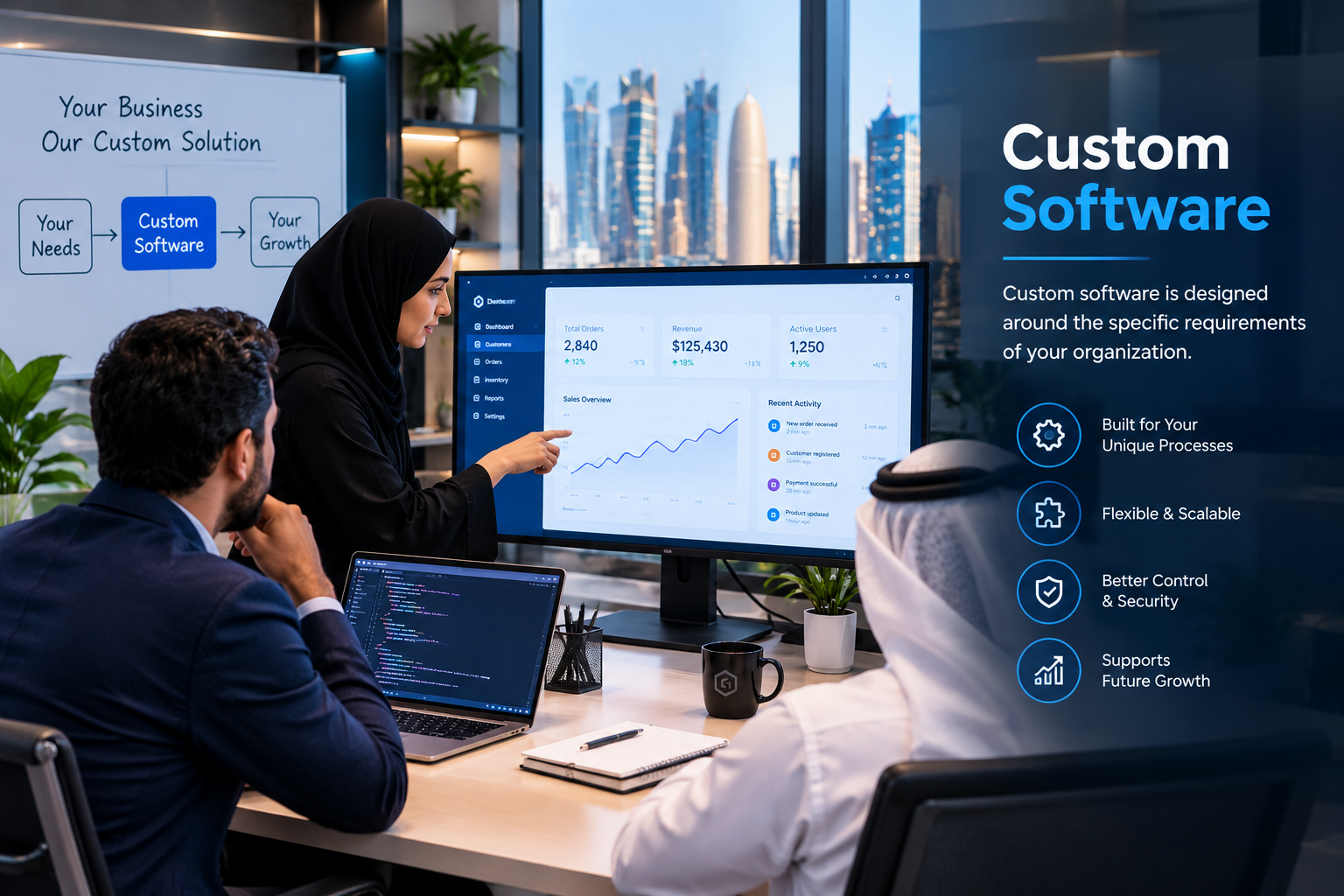
Custom software is designed around the specific requirements of your organization.
Potential advantages include:
Business-specific workflows
Greater flexibility
Custom integrations
Scalable architecture
Custom user roles
Ability to add new functionality
Greater control over the product
The disadvantages can include greater initial development effort, more planning, and the need for professional maintenance.
The decision should therefore be based on business requirements rather than the assumption that custom software is always better.
For a business with highly specific processes, custom software development may provide the flexibility that a generic product cannot.
Step 3: Check the Company's Previous Projects
A development company's portfolio is one of the most useful sources of evidence when evaluating its capabilities.
Do not only look at screenshots.
Ask to see actual projects where possible.
Look for experience with:
Business software
Web applications
Mobile applications
CRM systems
ERP platforms
E-commerce
AI applications
API integrations
Dashboards
Customer portals
Employee systems
The most relevant experience is not necessarily the largest number of projects.
Instead, look for projects that demonstrate experience with problems similar to yours.
For example, a company that has primarily developed brochure websites may not necessarily have the same experience as a company that has built a multi-department ERP system.
Businesses can also review Galaxium Coding's projects and portfolio to understand the types of technology solutions the company presents.
Step 4: Evaluate Technical Expertise
The developer should have the technical skills required for your specific project.
Depending on the application, this could involve:
Frontend Development
Common technologies may include:
React
Next.js
Angular
Vue
Backend Development
Depending on requirements, a project may use:
Node.js
Laravel
.NET
Java
Python
Mobile Development
Mobile projects may involve:
Flutter
React Native
Kotlin
Swift
Databases
Possible database technologies include:
PostgreSQL
MySQL
SQL Server
MongoDB
Cloud and Infrastructure
More complex systems may require:
Cloud infrastructure
Containers
CI/CD
Monitoring
Backup systems
Scalable server architecture
The key question is not:
“Which technology is the most popular?”
Instead, ask:
“Why is this technology appropriate for our project?”
A good development partner should be able to explain the technical choice in business terms.
Step 5: Look Beyond the Frontend
A visually attractive application does not automatically mean it is a strong software product.
The backend is equally important.
A business application may require:
Databases
Authentication
APIs
User permissions
Business rules
Notifications
Data processing
Reporting
Integrations
Logging
Backups
For example, an e-commerce application may appear simple to a customer.
Behind the interface, however, the system may need to manage:
Products → Customers → Orders → Payments → Inventory → Shipping → Notifications → Reporting
Ask the development company how these components will work together.
Step 6: Ask How Security Will Be Handled
Security should be considered from the beginning of development rather than added immediately before launch.
This becomes particularly important when software handles customer information, employee records, financial data, business documents, or other sensitive information.
Ask potential developers about:
Authentication
Authorization
Role-based access
Password security
API security
Database security
Encryption
Backup procedures
Access controls
Server security
Monitoring
Logging
Disaster recovery
Security updates
You should also understand where data will be hosted and who will have administrative access.
For businesses operating in Qatar, legal and regulatory requirements should be reviewed according to the nature of the data and the industry involved.
Step 7: Check Integration Capabilities
Modern businesses rarely operate with a single software system.
A new application may need to communicate with existing technology.
For example:
Website ↔ CRM ↔ ERP ↔ Accounting ↔ Payment Gateway ↔ Mobile App
This requires API and integration expertise.
Before selecting a developer, ask:
Have you integrated similar systems?
Can the new application connect to our existing software?
Which APIs will be required?
How will authentication work?
How will failed transactions be handled?
How will data synchronization work?
How will integrations be monitored?
A development company that understands integrations can help prevent your new system from becoming another isolated application.
Businesses needing connected systems can also explore web application development and related software integration capabilities according to their requirements.
Step 8: Consider Mobile Requirements
Some businesses need their software to work primarily through a browser.
Others may require dedicated mobile applications.
A mobile project can involve much more than creating mobile screens.
It may require:
Android development
iOS development
Backend APIs
Authentication
Push notifications
Payment integration
Location services
Camera functionality
Offline capabilities
Analytics
App Store deployment
Ongoing updates
If your business needs a customer-facing or employee-facing mobile application, ask the development company how the mobile product will connect with your broader software ecosystem.
Galaxium Coding provides mobile application development as part of its technology services.
Step 9: Understand the Development Process
A professional software project should have a clear process.
Although methodologies can differ, the project should generally move through defined stages.
Stage 1: Discovery
The team learns about:
Your business
Users
Workflows
Goals
Existing technology
Problems
Stage 2: Requirements
Requirements are documented and prioritized.
Stage 3: Planning
The team determines:
Architecture
Technology
Development phases
Integrations
Testing requirements
Stage 4: UI/UX Design
The user experience and interface are planned before the complete product is developed.
Stage 5: Development
Developers build the agreed functionality.
Stage 6: Testing
The software is tested for:
Functionality
Security
Performance
Compatibility
Usability
Integration problems
Stage 7: Deployment
The system is released to its intended environment.
Stage 8: Maintenance
After launch, the software may require:
Bug fixes
Security updates
Performance improvements
New features
Compatibility updates
Infrastructure maintenance
Understanding this process helps you identify companies that have a structured approach rather than treating development as a single coding task.
Step 10: Ask About Communication and Project Management
Even technically strong developers can struggle with projects if communication is poor.
Before signing a contract, clarify:
Who will be your primary contact?
How frequently will you receive updates?
How will feedback be collected?
How will changes be documented?
How will milestones be approved?
What happens if requirements change?
How are delays communicated?
Who makes technical decisions?
A software project involves continuous communication between the business and technical team.
You should know how that communication will happen before development starts.
Step 11: Compare Proposals Carefully
Do not compare proposals only by their final price.
Two quotations may have very different scopes.
One proposal might include:
UI/UX
Backend
Database
Testing
Deployment
Documentation
Maintenance
Another might only cover development.
Create a comparison table before making a decision.
Evaluation Area | Developer A | Developer B | Developer C |
|---|---|---|---|
Relevant experience | |||
Technical expertise | |||
Project scope | |||
UI/UX | |||
Integrations | |||
Security | |||
Testing | |||
Deployment | |||
Documentation | |||
Source-code ownership | |||
Maintenance | |||
Communication | |||
Total cost |
This approach makes the comparison more useful than simply selecting the lowest quotation.
What Should Be Included in a Software Development Proposal?
A professional proposal should explain what you are actually purchasing.
Look for details such as:
Project Scope
What exactly will be built?
Features
Which functions are included?
Technology
Which technologies are proposed and why?
Integrations
Which third-party systems will be connected?
Timeline
What are the expected phases and milestones?
Testing
What testing is included?
Deployment
Who will deploy the system?
Documentation
Will technical and user documentation be provided?
Support
How long is support included?
Maintenance
What happens after the included support period?
Ownership
Who owns the source code and intellectual property?
Payment Terms
When are payments due?
The more clearly these items are documented, the easier it becomes to manage expectations.
Source-Code and Data Ownership: Questions You Should Ask
Ownership is one of the most important subjects to clarify before development starts.
Ask:
Who owns the source code?
Who owns the database?
Who controls the hosting account?
Who owns the domain?
Who controls API credentials?
Who owns design files?
Who owns app-store accounts?
Can another developer maintain the software later?
Will documentation be provided?
These questions are particularly important for software that becomes central to daily operations.
Your business should understand exactly what assets it receives when the project is completed.
Scalability: Can the Software Grow With Your Business?
A software system that works for a small operation may need to support much greater usage later.
For example, a business may start with:
50 employees → 500 employees
or:
1,000 customers → 100,000 customers
The system should be designed with realistic future requirements in mind.
Scalability can involve:
Database architecture
Server capacity
Cloud infrastructure
Application architecture
Caching
API design
Storage
Monitoring
Load management
This does not mean every startup needs an extremely complex architecture.
The goal is to build an appropriate foundation without paying for unnecessary complexity.
Businesses interested in infrastructure and deployment can also review cloud and DevOps solutions when planning scalable applications.
Qatar-Specific Considerations When Choosing a Developer
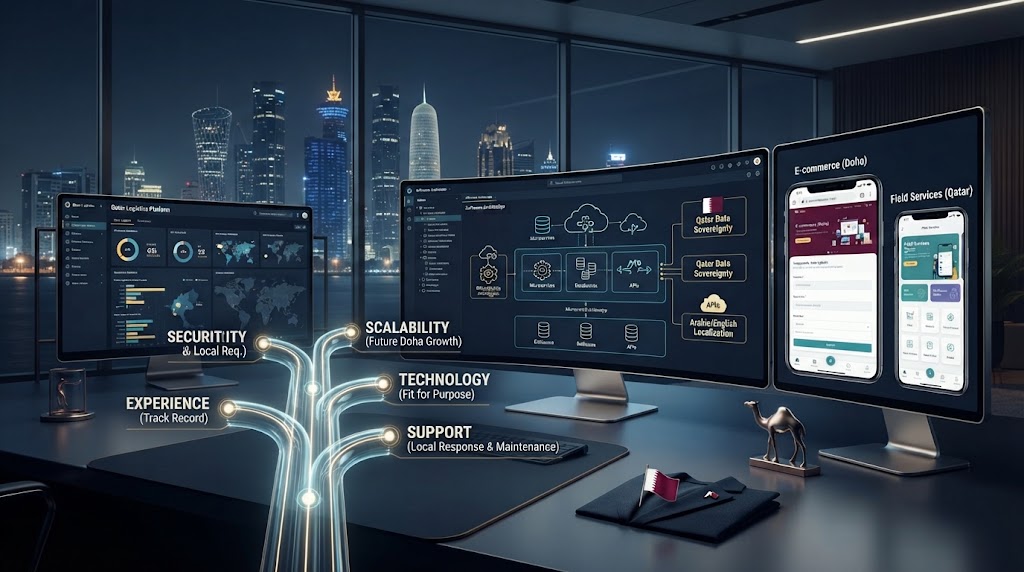
A software development company serving businesses in Qatar should understand that local requirements can influence technology decisions.
Depending on the business, requirements may include:
Arabic and English interfaces
Local payment options
Qatar-based business workflows
Multi-branch operations
Customer portals
Employee systems
Mobile access
Business automation
Local reporting requirements
Data and security considerations
Integration with existing enterprise systems
Not every project requires every feature.
The important point is that the development company should ask the right questions rather than applying the same solution to every business.
Qatar businesses may operate across industries including:
Real estate
Retail
Hospitality
Healthcare
Education
Logistics
Construction
Professional services
Finance
E-commerce
Manufacturing
Each industry can have very different workflows.
How Much Does Software Development Cost in Qatar?
There is no single price for software development.
The cost depends on factors such as:
Project complexity
Number of features
Number of users
UI/UX requirements
Mobile applications
Backend complexity
Integrations
AI functionality
Security requirements
Cloud infrastructure
Data migration
Testing
Maintenance
Development timeline
A simple application and a multi-department enterprise platform should not be expected to have the same development cost.
Instead of asking only:
“How much does software development cost?”
ask:
“What will it cost to build the specific solution my business needs?”
A detailed requirements document usually produces a more meaningful estimate than a general request for a software price.
Common Mistakes When Hiring a Software Developer
Choosing Only on Price
The cheapest proposal may not include the same scope, testing, support, or infrastructure as a more comprehensive proposal.
Starting Development Without Requirements
Unclear requirements can lead to repeated changes and delays.
Choosing Technology Before Defining the Problem
Technology should support the business requirement, not replace it.
Ignoring Security
Security should be considered throughout the architecture and development process.
Not Checking Previous Work
A company's portfolio provides useful evidence of what it can actually deliver.
Ignoring Integrations
Existing systems should be considered before development begins.
Forgetting Maintenance
Software requires updates and improvements after launch.
Failing to Clarify Ownership
Source code, databases, hosting, credentials, and intellectual property should be addressed in the agreement.
Trying to Build Everything at Once
A large first release can increase complexity.
A phased approach can sometimes make more sense.
When Should You Choose a Local Software Development Company?
A local development partner can be useful when your project requires strong understanding of the Qatar business environment, frequent communication, or local business workflows.
However, location should not be the only selection criterion.
Evaluate:
Technical capabilities
Relevant experience
Communication
Portfolio
Security
Support
Scalability
Cost
Understanding of your business
The best fit depends on the project's requirements.
What Does a Good Long-Term Development Partner Look Like?
Software development should not necessarily end when the application launches.
As your business changes, your software may also need to change.
Future requirements may include:
New features
New integrations
Mobile applications
AI capabilities
New user roles
Additional branches
Advanced reporting
Performance improvements
Security updates
Cloud migration
A long-term technology partner should be able to understand the existing system and support its evolution.
This is particularly important for custom business software that becomes part of daily operations.
Why Galaxium Coding?
Galaxium Coding is a Qatar-based technology company providing software and digital solutions for businesses.
Its technology services include:
Custom software development
Web applications
Mobile applications
AI solutions
Business automation
CRM
ERP-style business platforms
E-commerce
API integrations
Cloud solutions
The selection of a technology partner should always begin with the business requirement.
For organizations evaluating a potential development project, Galaxium Coding's approach can be explored through its software development services, web application solutions, and mobile application development.
Businesses can also review the company's projects and portfolio before discussing a potential project.
A Practical Checklist Before Hiring a Software Development Company
Before signing an agreement, ask yourself:
Business
Is the developer clear about the problem we are solving?
Does the proposed solution match our workflow?
Have the key users been identified?
Technical
Does the company have the required technical expertise?
Is the proposed technology appropriate?
Can the system integrate with our existing tools?
Can it scale with our business?
Security
How will our data be protected?
Who has administrative access?
How are backups handled?
How will security updates be managed?
Project Management
Is the scope clearly documented?
Are milestones defined?
How will changes be handled?
Who is responsible for communication?
Ownership
Who owns the source code?
Who owns the database?
Who controls hosting?
Who owns the domain and third-party accounts?
Post-Launch
Is maintenance included?
What happens when bugs are discovered?
How are future improvements handled?
Is technical support available?
If you cannot get clear answers to these questions, the project may need more planning before development begins.
Frequently Asked Questions
How do I choose a software development company in Qatar?
Start by defining your business requirements and then compare development companies based on relevant experience, technical capabilities, portfolio, security practices, communication, integrations, scalability, ownership, pricing, and post-launch support.
How much does it cost to hire a software developer in Qatar?
There is no universal price. The total cost depends on the project's complexity, features, technology, integrations, security requirements, development time, infrastructure, and maintenance requirements.
Should I choose custom or ready-made software?
Ready-made software can work well when its features and workflows match your business. Custom software may be more appropriate when your processes, integrations, or requirements are highly specific.
What should I ask a software development company before hiring it?
Ask about previous projects, technical expertise, development methodology, project scope, timeline, security, integrations, testing, deployment, source-code ownership, documentation, maintenance, and support.
Why is source-code ownership important?
Source-code ownership and access can affect your ability to maintain, modify, transfer, or expand the software in the future. These terms should be clearly defined in the agreement.
Do software developers provide maintenance after launch?
Some companies provide maintenance and support while others treat them as separate services. Always clarify what is included in the project agreement.
Can a software company integrate new software with existing systems?
Yes, depending on the systems involved and the availability of suitable APIs or integration methods. Integration requirements should be discussed during the planning stage.
Does every business need custom software?
No. Some businesses can operate effectively with ready-made software. Custom development becomes more relevant when existing products cannot adequately support the company's workflows or integration requirements.
Should I choose a developer based on price?
Price is one factor, but it should be compared alongside scope, experience, technology, security, scalability, support, ownership, and long-term requirements.
What is the first step before starting software development?
The first step is to clearly define the business problem, users, workflows, required functionality, existing systems, and desired outcome. Once these are understood, a development company can help determine the appropriate technical solution.
Final Thoughts
Choosing a software development company in Qatar is not simply a matter of finding someone who can write code.
You are selecting a partner to turn a business requirement into a working technology system.
The strongest selection process starts with the business problem and then evaluates the development partner against practical criteria:
Experience + Technology + Security + Integration + Scalability + Communication + Support + Ownership
A company may have excellent technical skills but limited experience with your industry. Another may understand your industry but lack the technical capabilities required for a complex project.
That is why a structured evaluation is important.
Define your requirements. Review real projects. Ask technical and business questions. Compare proposals based on scope rather than price alone. Clarify ownership and security. Understand the maintenance model. And make sure the proposed technology can support the business beyond the initial launch.
For businesses ready to discuss a software, web, mobile, AI, or automation project, you can contact Galaxium Coding to discuss your requirements and explore a suitable development approach.
The goal should not simply be to build software.
The goal should be to build technology that solves a real business problem and can continue creating value as the business grows.