Smart Technology vs. Bigger Technology: What the India-Pakistan Air Conflict Can Teach Businesses
What modern technology systems can teach businesses about information, integration, automation and intelligent decision-making.
In business, people often assume that the biggest company has the biggest advantage.
More employees.
More offices.
More money.
More equipment.
More customers.
More resources.
But technology has changed the rules.
A smaller organization can now use cloud computing, artificial intelligence, automation, real-time analytics and integrated software to compete against companies that are many times larger.
A useful illustration can be found in the lessons emerging from the May 2025 India-Pakistan conflict.
The military outcome itself remains contested, and different sides have presented different figures regarding aircraft losses. Reuters reported that U.S. officials assessed that Pakistani J-10 fighters had shot down at least six Indian military aircraft, while Pakistan claimed a larger number of Indian aircraft and India acknowledged losses without accepting Pakistan's full account.
But there is a much more interesting technology lesson behind the headlines.
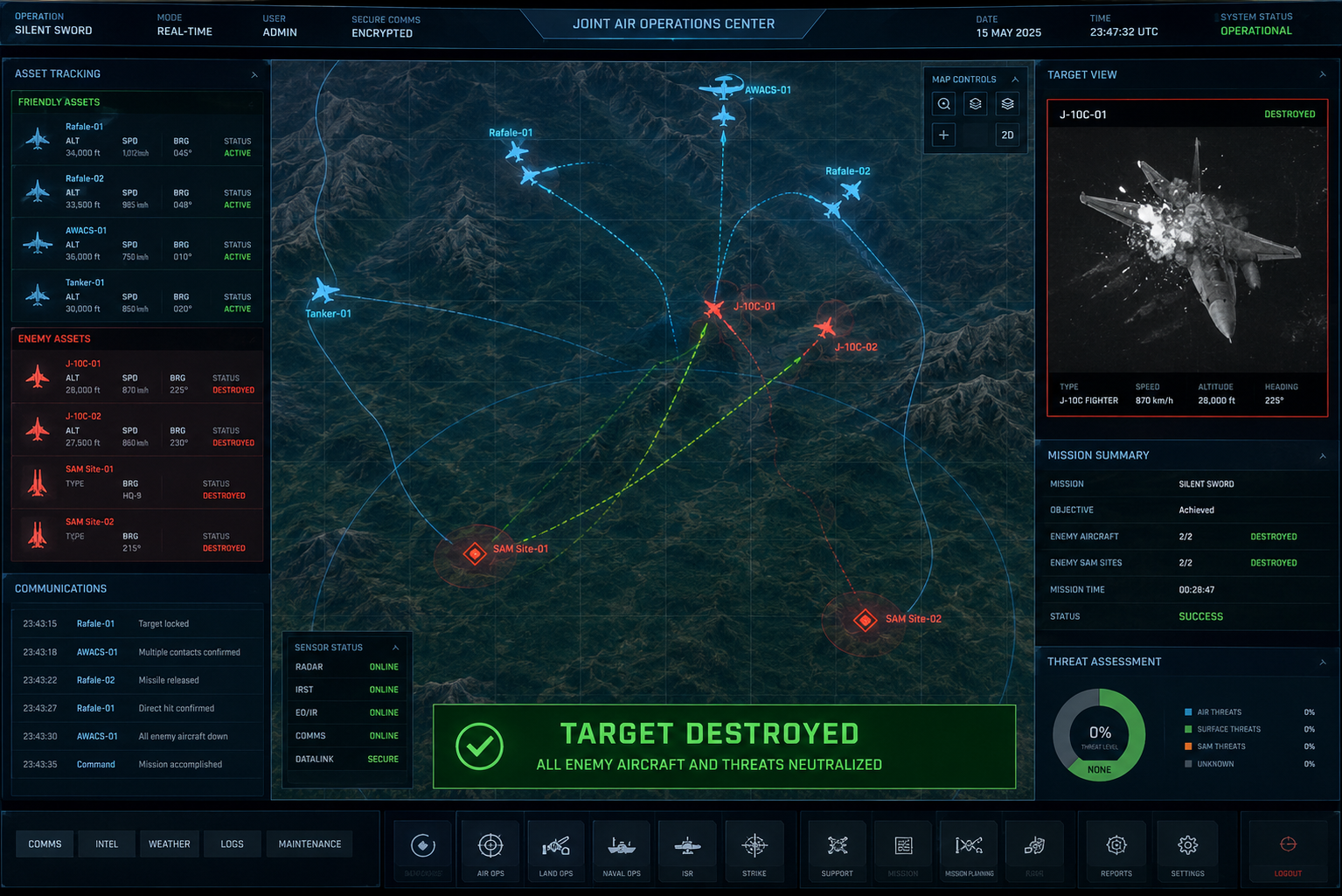
Modern competition is increasingly about connected systems.
And that lesson applies far beyond the battlefield.
The Rafale Question
India operates advanced French-made Rafale fighter aircraft.
The Rafale is an extremely sophisticated modern fighter, equipped with advanced sensors, electronic warfare capabilities, weapons and communications systems.
Pakistan, meanwhile, operates Chinese-made J-10 fighters.
During the May 2025 fighting, Reuters reported that U.S. officials assessed that Pakistani J-10s had shot down at least six Indian military aircraft. Later reporting indicated that at least three Rafale was among the aircraft lost, while the precise number and circumstances of aircraft losses remained disputed.
This created a fascinating question:
How can a platform that appears technologically superior on paper still be vulnerable?
The answer is not simply:
"One aircraft is better than another."
Modern warfare doesn't work that way.
An aircraft doesn't operate in isolation.
It operates inside a system of systems.
The Real Power Is the Network
Imagine an aircraft as one computer.
Now imagine connecting it to:
Radar
Sensors
Satellites
Command centers
Other aircraft
Ground systems
Communications networks
Intelligence systems
Weapons systems
Real-time information
Suddenly, you don't have one computer.
You have a networked intelligence system.
Each individual component contributes information.
The system combines that information.
Decision-makers receive a more complete picture.
And decisions can be made faster.
That is the concept businesses need to understand.
The Most Expensive Machine Doesn't Necessarily Win
This is where the lesson becomes particularly interesting.
Imagine two companies.
Company A
1,000 employees
20 departments
Huge office
Large budget
Multiple software systems
Information stored separately
Employees communicate manually
Reports prepared every week
Company B
100 employees
Cloud-based software
Central database
AI assistant
Automated workflows
Real-time dashboards
Integrated CRM
Mobile application
Automated customer notifications
Connected financial and operational systems
Which company is more technologically powerful?
The answer isn't necessarily Company A.
Company B may have less physical scale but greater information efficiency.
And that can be a tremendous competitive advantage.
Information Is the New Advantage
One of the most valuable resources in modern business is information.
A company may have thousands of pieces of information:
Customer data.
Sales.
Inventory.
Employees.
Projects.
Payments.
Complaints.
Appointments.
Marketing.
Financial performance.
But information sitting in separate systems isn't necessarily useful.
The real value appears when that information can be connected, analyzed and turned into action.
From Separate Systems to One Digital Ecosystem
Consider a traditional business.
The customer database is in one system.
Accounting is somewhere else.
Salespeople use another application.
Employees communicate through WhatsApp.
Inventory is maintained in spreadsheets.
Management receives reports at the end of the month.
The systems may all be individually good.
But the company itself is disconnected.
Now imagine connecting them.
Customer
↓
CRM
↓
Sales
↓
Inventory
↓
Accounting
↓
Employee management
↓
Mobile application
↓
AI
↓
Management dashboard
Now information can move between systems.
A customer places an order.
The system records it.
Inventory changes.
Accounting receives the transaction.
The salesperson can see the customer activity.
Management sees the updated numbers.
The customer receives a notification.
AI can assist where appropriate.
This is the business equivalent of creating a connected information environment.
Real-Time Information Changes Decision-Making
Imagine a manager running a company without real-time information.
They ask:
"How are sales doing?"
Someone prepares a report.
Several hours later, the manager receives it.
Then the manager asks:
"Which branch is performing best?"
Another report.
Then:
"Why are sales declining?"
Another analysis.
This is slow.
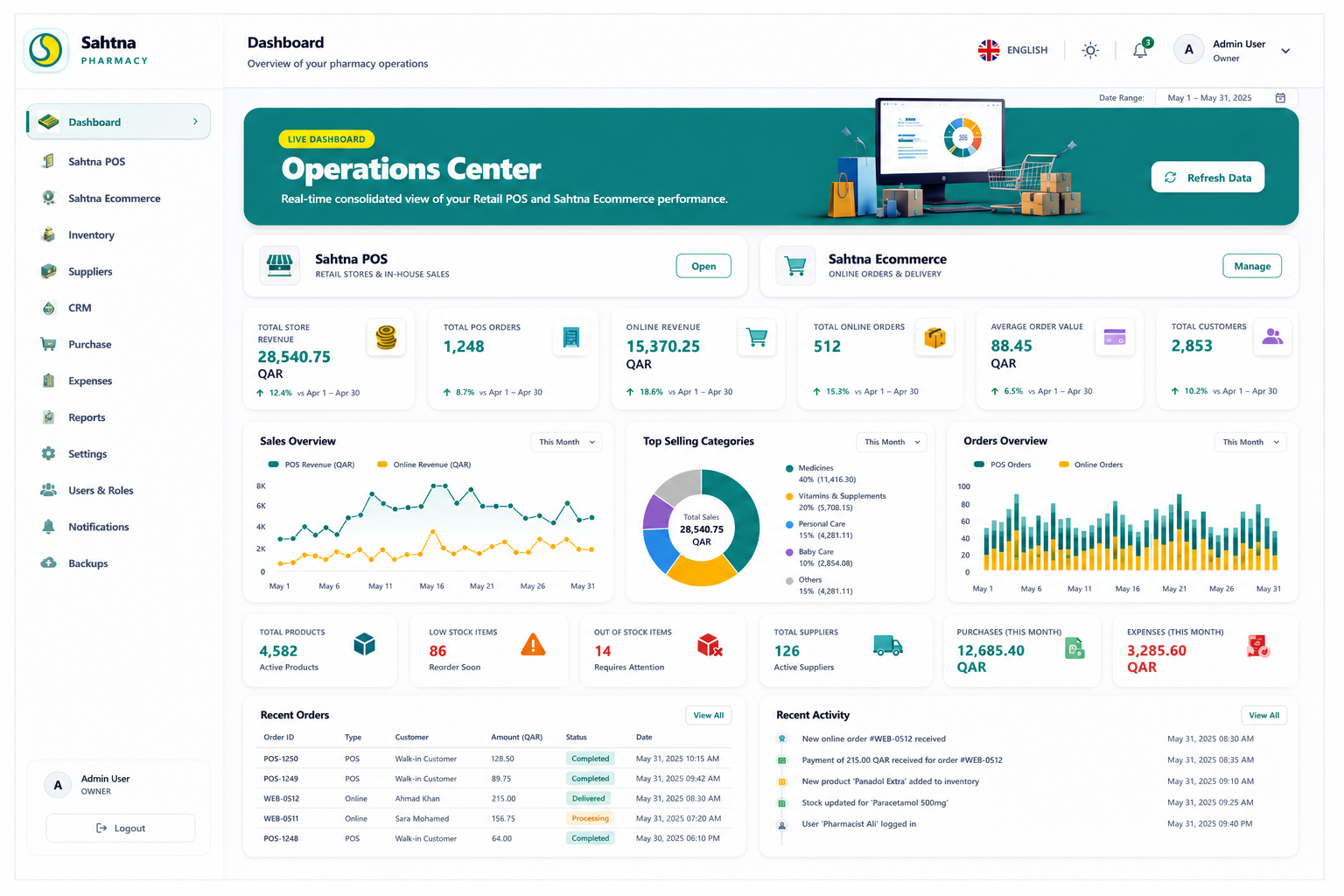
Now imagine a live dashboard.
The manager opens the system and immediately sees:
Sales: QAR 485,000
Orders: 3,821
Customers: 14,250
Inventory: 92% healthy
Pending orders: 47
Branch performance: Live
Employee performance: Live
Customer activity: Live
The manager isn't waiting for information.
The information is waiting for the manager.
That's a completely different way of running a business.
Integration Is More Powerful Than Isolation
One of the biggest mistakes companies make is purchasing software one department at a time without thinking about integration.
The company gets:
CRM software.
Accounting software.
HR software.
Inventory software.
Project management software.
Communication software.
Marketing software.
Each system solves a problem.
But the company ends up with ten systems and ten separate sources of information.
The future is increasingly about integration.
Instead of asking:
Businesses should ask:
"How can my entire business operate as one connected system?"
Where AI Changes Everything
Now add artificial intelligence to the connected environment.
This is where things become even more interesting.
Imagine your software already knows:
Customer information
Sales history
Inventory
Projects
Employees
Financial data
Appointments
Communications
An AI assistant can potentially help employees interact with this information using natural language.
A manager could ask:
"Which customers haven't purchased from us in the last six months?"
The system can analyze the authorized data.
Or:
"Which products are approaching low stock?"
The system can identify them.
Or:
"Show me the branches where sales have declined."
The system can provide the relevant information.
AI becomes much more useful when it isn't isolated.
AI + Data + Software + Automation = Intelligent Business
The Lesson From Modern Warfare Is Not About One Jet
This is an important distinction.
It would be wrong to conclude that a Rafale is simply "worse" than a J-10 because of one engagement.
Aircraft operate within complex systems involving pilots, sensors, weapons, intelligence, electronic warfare, communications and command structures.
Reuters' reporting on the May 2025 conflict specifically found that the Rafale's performance itself was not necessarily the central issue; interviews pointed to intelligence about the range of China's PL-15 missile as a key factor in at least one Rafale loss.
The broader lesson is therefore much more interesting:
A powerful individual component is not enough.
The surrounding system matters.
The Same Rule Applies to Business
You can have the best salesperson.
But if your CRM is terrible, opportunities can be lost.
You can have the best accountant.
But if your financial systems are disconnected, information can still be delayed.
You can have excellent employees.
But if they spend half their day entering information manually, productivity suffers.
You can have a beautiful website.
But if it isn't connected to your CRM, sales process and customer database, its potential may be limited.
You can even have AI.
But if your AI has no useful access to the systems it needs, it may remain nothing more than a chatbot.
Technology becomes powerful when everything works together.
Don't Build a Big Company. Build a Smart Company.
This is the message businesses should take from the story.
You don't necessarily need:
10,000 employees.
You don't necessarily need:
100 offices.
You don't necessarily need:
the biggest budget in your industry.
You need to know how to use your resources intelligently.
A smaller company with:
Better information
Faster decisions
Better automation
Integrated software
AI assistance
Real-time analytics
Strong customer experience
can compete against much larger organizations.
Small Teams Can Now Achieve What Once Required Large Organizations
Technology has changed the economics of business.
A small team can now access:
Cloud computing
Without building its own data center.
AI
Without employing a huge research department.
Automation
Without manually processing every transaction.
Mobile applications
Without maintaining traditional distribution infrastructure.
Analytics
Without spending days creating reports.
Digital marketing
Without opening physical offices everywhere.
Global communication
Without having employees in every country.
The tools are increasingly accessible.
The competitive advantage comes from knowing how to combine them intelligently.
Qatar and the New Digital Economy
This is particularly relevant for businesses in Qatar.
Qatar National Vision 2030 emphasizes economic diversification, innovation, knowledge and human development.
The country's digital transformation strategy is also pushing businesses and government toward a more digitally enabled economy.
That means the future isn't simply about building bigger organizations.
It's about building more capable organizations.
A company that can respond faster.
Understand its customers better.
Automate repetitive work.
Use data intelligently.
And make decisions based on real-time information.
The New Definition of Business Strength
For decades, business strength was often measured by:
Employees
Revenue
Buildings
Branches
Equipment
Market share
These things still matter.
But another form of strength is becoming increasingly important:
Digital capability.
How quickly can you access information?
How quickly can you make decisions?
How much of your operation is automated?
How connected are your systems?
How intelligently can you use your data?
How effectively can AI assist your employees?
How quickly can you respond to customers?
These questions increasingly define modern competitiveness.
Don't Compete With Big Companies on Their Terms
If you're a small or medium-sized business, don't try to copy everything a large corporation does.
You probably can't outspend them.
You probably can't out-hire them.
You probably can't out-build them.
But you can potentially outsmart them in specific areas.
You can move faster.
You can change your software faster.
You can automate faster.
You can provide personalized service.
You can adopt new technology without navigating enormous organizational structures.
That's your opportunity.
The Smart Business of Tomorrow
Imagine a company where:
A customer sends a message.
↓
AI understands the request.
↓
The CRM identifies the customer.
↓
The system checks their history.
↓
The appropriate employee receives the task.
↓
The employee handles the complex part.
↓
The system updates the customer record.
↓
The customer receives a notification.
↓
Management sees the progress in real time.
↓
Analytics measure the outcome.
That company may not be the biggest company in its industry.
But it can be extremely efficient.
Technology Is About Connection
The future isn't simply about buying more software.
It's about connecting what you already have.
Your:
Website
CRM
Mobile App
Business Software
Customer Database
Payments
AI
Analytics
Automation
should work toward one objective:
Making the business smarter.
The Final Lesson
The India-Pakistan air conflict of May 2025 generated enormous discussion about aircraft, missiles and technology. The exact number of aircraft lost remains disputed, and it would be misleading to reduce the outcome to a simple comparison between one fighter jet and another.
But there is a broader lesson worth studying.
Modern competition is increasingly about systems.
A powerful machine is valuable.
But a powerful machine connected to sensors, information, communication, intelligence and decision-making can become something much greater.
The same principle applies to business.
You don't have to be the biggest.
You don't have to have the most employees.
You don't have to have the largest office.
You don't have to have the biggest budget.
You need to become smarter.
Use technology.
Connect your systems.
Centralize your information.
Automate repetitive processes.
Give your employees better tools.
Use AI where it genuinely creates value.
Make decisions using real-time information.
And build an organization that can react faster than its competitors.
Don't Just Build a Big Company. Build a Smart Company.
The companies that succeed in the next decade may not simply be the companies with the most resources.
They may be the companies that know how to connect those resources intelligently.
A small organization with the right technology can challenge a much larger organization.
A small team with the right software can serve thousands of customers.
A business with integrated systems can move faster than one with ten disconnected platforms.
And a company that combines human intelligence with artificial intelligence can create capabilities that were previously available only to much larger organizations.
The question isn't:
"How big is your company?"
The question is:
"How intelligently does your company operate?"