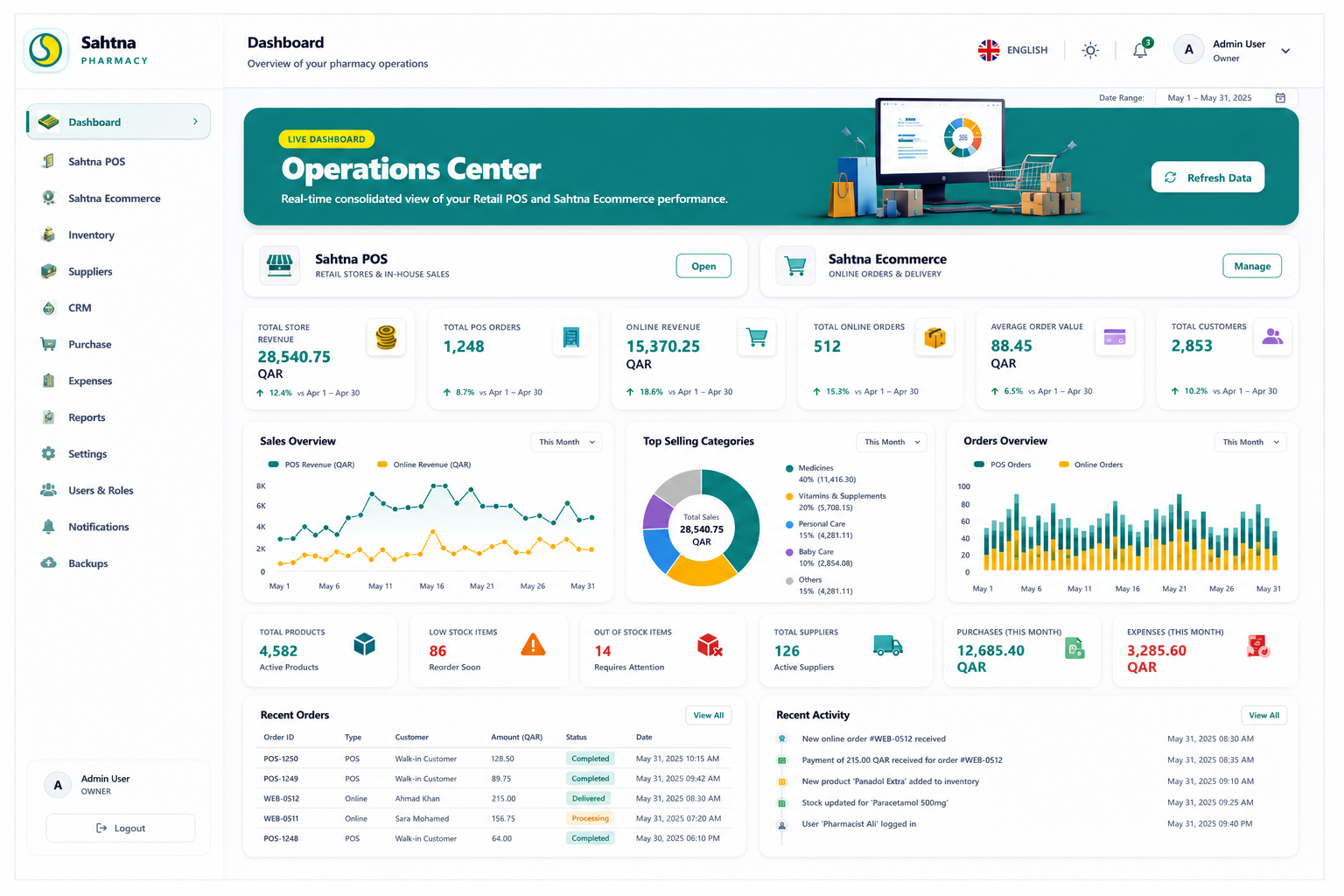
How Much Does Custom Software Development Cost in Qatar in 2026?
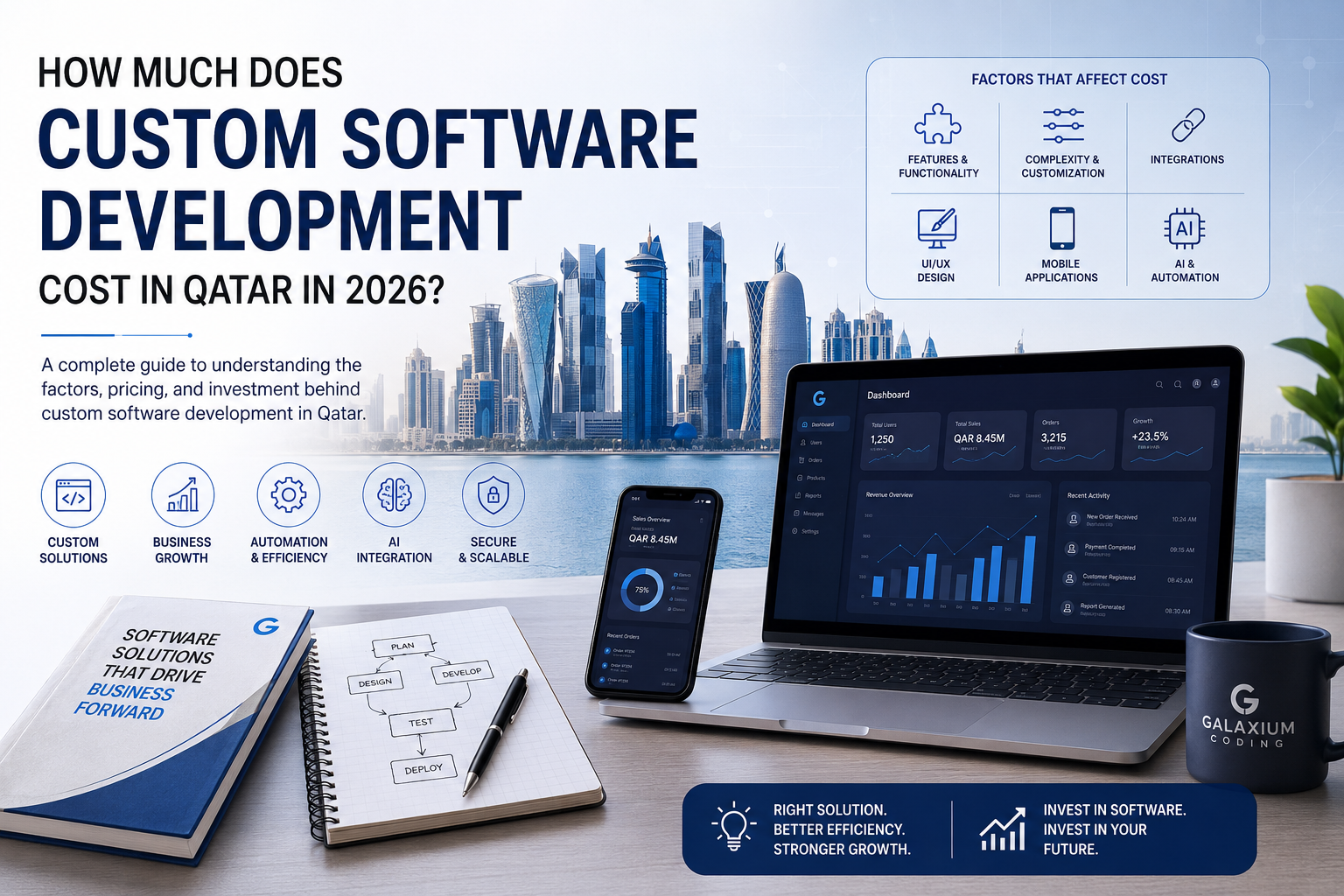
Explore the factors that determine custom software development costs for businesses in Qatar in 2026.
How Much Does Custom Software Development Cost in Qatar in 2026?
Businesses today are increasingly moving away from manual processes and disconnected systems.
A company may have one system for customers, another for accounting, spreadsheets for inventory, WhatsApp for communication, and separate tools for employees.
As a business grows, managing all of these systems can become complicated.
This is where custom software development can make a significant difference.
Instead of changing the way your business operates to fit an existing software package, custom software can be designed around the way your company actually works.
But one of the first questions businesses ask is:
How much does custom software development cost in Qatar in 2026?
There is no single price.
The cost depends on the complexity of the system, number of users, required features, integrations, security requirements, mobile applications, AI functionality, database architecture and many other factors.
Let's look at what businesses should consider before investing in custom software.
What Is Custom Software?
Custom software is a digital system developed specifically for the requirements of a particular business or organization.
Instead of purchasing a ready-made product and adapting your processes around it, the software is designed to support your existing workflows.
For example, a company might need software containing:
Customer management
Employee management
Sales
Inventory
Procurement
Accounting
Projects
Reports
Notifications
Customer portals
Mobile applications
AI assistants
Business automation
These modules can be connected into one centralized platform.
Why Are Businesses Choosing Custom Software?
As businesses grow, their requirements become more complicated.
A small company may initially manage its operations using spreadsheets and standard applications.
Eventually, problems can appear:
Duplicate data
Manual data entry
Lost information
Communication gaps
Lack of reporting
Difficulty monitoring employees
Multiple disconnected systems
Limited customer visibility
Custom software can bring these processes together.
Instead of employees moving between several different systems, information can be managed through one centralized platform.
What Determines the Cost of Custom Software?
The most important factor is complexity.
A simple internal application is very different from an enterprise platform used by hundreds of employees.
Some of the main factors include:
1. Number of Modules
A software system with three modules will generally require less development than one containing ten or twenty interconnected modules.
For example:
Basic system
Customers + Sales + Reports
versus:
Advanced system
CRM + HR + Sales + Projects + Procurement + Inventory + Accounting + Dashboard + Mobile App + AI + Automation
The second system requires significantly more planning, development and testing.
2. User Accounts and Permissions
Many business systems require different levels of access.
For example:
Administrator
Can access everything.
Manager
Can monitor departments and employees.
Employee
Can access only the functions required for their role.
Customer
Can access their own information and services.
A sophisticated permission system adds complexity to the development process.
3. Database Requirements
Most modern business software depends on databases.
The database may contain:
Customers
Employees
Products
Orders
Transactions
Documents
Projects
Payments
Reports
The larger and more interconnected the database becomes, the more important the architecture, security and performance become.
4. Mobile Applications
A company may want employees or customers to access the system from their smartphones.
This could involve:
Android application
iOS application
Customer application
Employee application
Push notifications
Mobile authentication
Real-time updates
A mobile application can therefore become an additional development component alongside the main software platform.
5. Third-Party Integrations
Businesses rarely operate completely independently.
Software may need to communicate with external services such as:
Payment gateways
Accounting systems
CRM platforms
Email services
WhatsApp
SMS providers
Maps
Cloud services
Shipping platforms
Government or business APIs
Each integration needs to be evaluated individually.
6. AI Integration
Artificial intelligence is becoming an increasingly important part of business software.
AI can potentially be integrated to:
Answer customer questions
Analyze business information
Assist employees
Summarize documents
Automate repetitive tasks
Generate reports
Classify information
Support customer service
Assist with scheduling
Connect information across business systems
However, adding an AI assistant to software is different from building an AI-powered workflow or autonomous AI agent.
The complexity depends on what the AI is expected to do and what systems it needs to access.
7. Automation
One of the biggest advantages of custom software is the ability to automate repetitive processes.
For example:
A customer submits a request.
↓
The system creates a record.
↓
The appropriate employee receives a notification.
↓
The manager can monitor the progress.
↓
The customer receives status updates.
↓
The system generates reports automatically.
A workflow like this can reduce manual work and make the business easier to manage.
How Much Does Custom Software Cost?
The price should be based on the actual scope of the project, rather than simply the number of pages.
A rough way to think about software projects is:
Basic Custom Software
Suitable for a smaller business with a limited number of modules.
Possible features:
Login
Dashboard
Customer management
Basic reports
Basic administration
Typical complexity: Low
Medium-Level Business Software
Suitable for businesses that need multiple connected departments.
Possible features:
CRM
Sales
Inventory
Employees
Projects
Reports
User roles
Notifications
API integrations
Typical complexity: Medium
Advanced Business Platform
Designed for organizations requiring a complete digital ecosystem.
Possible features:
Multiple departments
Advanced dashboards
Customer portal
Employee portal
Android and iOS applications
Payment integration
Multiple APIs
AI assistants
Business automation
Advanced reporting
Complex permissions
Cloud infrastructure
Typical complexity: High
Because every project is different, businesses should request a detailed specification and quotation instead of relying on a generic software price.
Custom Software vs Buying Existing Software
This is an important decision.
Existing Software
Advantages:
Faster to start
Usually lower initial cost
Established features
Existing support
Potential disadvantages:
Limited customization
Subscription costs
You may pay for features you don't need
Your business may have to change its workflow
Integrations may be limited
Custom Software
Advantages:
Designed around your business
Full control over functionality
Can integrate with existing systems
Can evolve with your company
Can automate specific workflows
Potential disadvantages:
Higher initial development investment
Longer development period
Requires proper planning
Requires ongoing technical maintenance
The right choice depends on the business.
When Should a Business Consider Custom Software?
Custom development may make sense when:
1. Your existing software doesn't fit your workflow.
2. Employees spend too much time doing repetitive tasks.
3. Your company uses too many disconnected systems.
4. You need a centralized database.
5. Your customers need an online portal or application.
6. You require specific integrations.
7. You need advanced reporting.
8. You want to introduce AI into your business processes.
9. Your business model is unique.
10. You expect your digital operations to grow significantly.
Don't Start With Technology — Start With the Problem
One of the biggest mistakes businesses make is beginning a software project by listing technologies.
Instead, start by asking:
What problem are we trying to solve?
Then identify:
Who will use the system?
What information needs to be stored?
What processes should be automated?
What departments need access?
What should customers be able to do?
What reports are required?
What existing systems need to connect?
What could AI improve?
Once these questions are answered, the technology becomes much easier to define.
The Importance of Scalability
A business system should not only work today.
It should be capable of supporting tomorrow's requirements.
A company might start with 10 employees and eventually grow to 100.
It might start with one branch and eventually open several.
It might initially have 1,000 customers and eventually have 100,000.
Good software architecture should take future growth into consideration.
Security Is Essential
Business software can contain highly valuable information.
This may include:
Customer information
Employee information
Financial records
Business documents
Orders
Transactions
Internal communications
Security should therefore be considered from the beginning of the development process.
Depending on the project, this can include:
Secure authentication
Role-based permissions
Data encryption
Secure APIs
Backups
Access controls
Monitoring
Secure hosting
What Should You Ask a Software Development Company?
Before starting a project, ask:
What technologies will you use?
Understand the proposed technology stack.
How will my data be protected?
Security should be clearly discussed.
Can the software integrate with my existing systems?
This is particularly important if you already use accounting, CRM, payment or other platforms.
Can the software be expanded later?
Your requirements will probably change as your business grows.
What happens after launch?
Ask about maintenance, updates, technical support and future development.
Software Is an Investment, Not Just an Expense
It is easy to look at software development only as a cost.
But the better question is:
What can the software save or generate for the business?
If software reduces hours of manual work every week, improves customer retention, reduces errors, increases sales or gives managers better control over operations, its value can extend far beyond its initial development cost.
The objective should therefore not be to find the cheapest software.
The objective should be to build the right software for the business.
The Future of Business Software
Business software is becoming increasingly connected.
A future business platform may combine:
Website
Mobile Application
CRM
Business Management
Automation
AI
Analytics
Payments
Cloud Infrastructure
Instead of operating as separate tools, these technologies can work together as one digital ecosystem.
This is where custom software can provide significant value.
Final Thoughts
There is no universal price for custom software development in Qatar.
The final cost depends on what you need the software to accomplish.
A simple internal system may require only a few modules, while an advanced business platform may involve multiple departments, mobile applications, AI, automation, databases and third-party integrations.
The best approach is to define your business problems first and then work with a development company to design the appropriate solution.
At Galaxium Coding, we develop custom software, websites, mobile applications, AI solutions and business automation systems designed around individual business requirements.
If your business has a process that is difficult to manage manually, there may be a software solution for it.The question is not simply:
"How much does software cost?"
It is:
"How much could the right software save, improve or grow my business?"