How Can AI Help Your Business? 10 Practical AI Applications in 2026
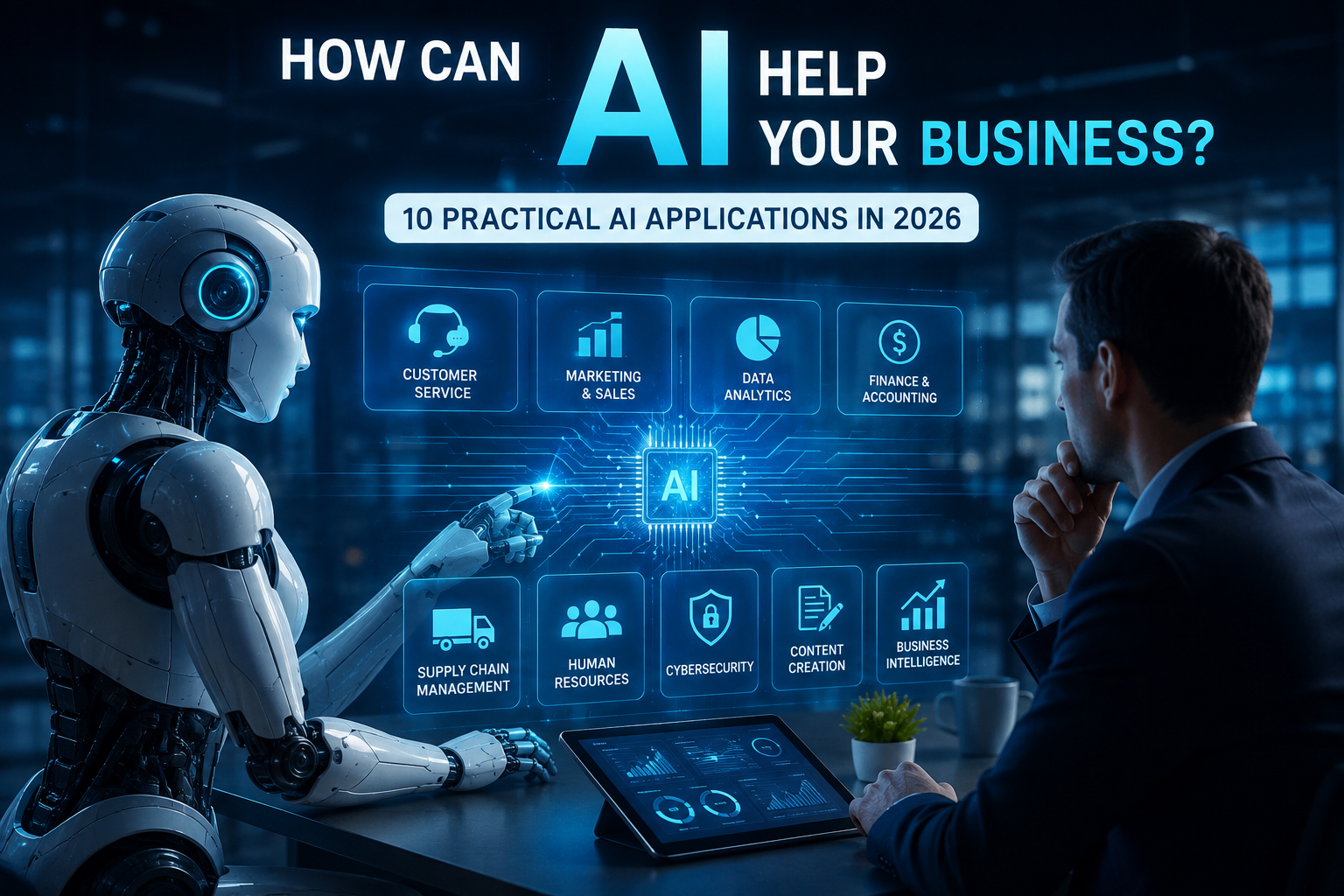
Discover practical ways businesses can use artificial intelligence to improve productivity, customer service, automation and decision-making.
How Can AI Help Your Business? 10 Practical AI Applications in 2026
Artificial intelligence has moved from being something people only discussed in technology conferences to becoming a practical business tool.
Companies are using AI to communicate with customers, process information, support employees, automate workflows, generate content and improve decision-making.
According to McKinsey's 2025 global survey, 88% of respondents said their organizations were regularly using AI in at least one business function, although most organizations were still in the experimentation or pilot stage when it came to scaling AI across the enterprise.
That tells us something important.
AI is no longer simply about asking a chatbot a question.
The real opportunity is integrating AI into the way a business operates.
So how can AI actually help your business in 2026?
Let's look at 10 practical applications.
1. AI Customer Service
One of the most obvious applications of AI is customer support.
Businesses receive questions every day:
What are your prices?
Where are you located?
What services do you provide?
When can I book an appointment?
What is the status of my order?
How can I make a payment?
What documents do I need?
Instead of requiring an employee to answer every basic question manually, an AI assistant can handle many routine conversations.
An AI assistant can potentially operate through:
Website + WhatsApp + Mobile App + Voice + Business Software
This creates a more connected customer experience.
The employee can then focus on more complicated requests that require human judgment.
Customer-service automation is already among the commonly reported business AI use cases.
2. AI Voice Agents
Imagine a customer calling your company after business hours.
Instead of hearing:
"Our office is currently closed."
the customer could interact with an AI voice assistant.
The AI could:
Understand the customer's request
Answer common questions
Collect customer information
Create a request
Schedule an appointment
Check certain information
Transfer complicated cases to an employee
Send follow-up information
This creates an opportunity to provide customer assistance beyond traditional working hours.
Voice AI can become particularly powerful when it is connected to the company's actual software rather than operating as an isolated chatbot.
3. AI-Powered Business Automation
AI becomes much more valuable when it is connected to business workflows.
For example:
Customer submits a request
↓
AI understands the request
↓
System creates a customer record
↓
Appropriate department receives the task
↓
Employee receives notification
↓
Customer receives an update
↓
Manager can monitor the progress
This is more than simply using AI to generate text.
It is using AI as part of an automated business process.
McKinsey's research indicates that organizations gaining more value from AI are increasingly redesigning workflows rather than simply adding AI tools on top of existing processes.
4. AI Sales Assistance
AI can also support sales teams.
For example, an AI system could help businesses:
Organize leads
Summarize customer conversations
Identify potential customers
Draft follow-up messages
Answer product questions
Recommend relevant services
Analyze sales information
Remind sales employees about follow-ups
Instead of replacing the sales team, AI can become an additional assistant.
The salesperson still makes the important decisions.
AI helps reduce the repetitive work around those decisions.
Marketing and sales are among the business functions where organizations report significant AI use and potential value.
5. AI for Data and Business Analysis
Businesses generate enormous amounts of information.
Consider a company with:
Thousands of customers
Sales transactions
Employee records
Inventory
Expenses
Projects
Support requests
Marketing campaigns
Traditionally, employees may need to create reports manually.
AI can help businesses interact with their data in more natural ways.
For example, a manager could ask:
"Which products generated the highest revenue this month?"
Or:
"Which branch had the highest sales growth?"
Or:
"Which customers haven't purchased from us in six months?"
Instead of searching through multiple spreadsheets, the system could help analyze the information.
This can make business data much easier to understand.
6. AI Document Processing
Many businesses deal with documents every day.
Invoices.
Contracts.
Applications.
Forms.
Identification documents.
Reports.
Purchase orders.
Customer files.
AI can assist with extracting and organizing information from documents.
For example:
Upload document
↓
AI reads the information
↓
Important fields are extracted
↓
Information is added to the business system
↓
Employee reviews the result
This can reduce repetitive data-entry work.
However, sensitive business documents should be handled with appropriate security, access controls and human review.
7. AI Employee Assistant
AI doesn't have to be customer-facing.
It can also become an internal assistant for employees.
Imagine an employee asking:
"What is our procedure for handling this type of customer request?"
The AI could search approved company information and provide the relevant procedure.
Or an employee could ask:
"Summarize the latest project updates."
The AI could organize information from the company's authorized data sources.
This is particularly useful for organizations with large amounts of internal knowledge.
Knowledge management is now one of the areas where organizations report substantial AI use.
8. AI Marketing and Content
Marketing teams can use AI to accelerate many activities.
AI can assist with:
Blog ideas
Social media content
Advertising concepts
Email drafts
Product descriptions
Customer segmentation
Campaign analysis
Content personalization
But businesses should not simply produce large quantities of generic AI-generated content.
The real value comes from combining AI with human expertise, brand knowledge and customer understanding.
AI can make the process faster.
Humans should still provide strategy, judgment and quality control.
9. AI Appointment and Booking Systems
Businesses that depend on appointments can integrate AI into their booking process.
For example:
A customer says:
"I need to speak with a lawyer tomorrow afternoon."
The AI could understand the request, identify available appointment options and guide the customer through the booking process.
The same concept could apply to:
Clinics
Law firms
Salons
Consultants
Real estate companies
Repair companies
Cleaning companies
Training centers
When AI is connected to a real booking system, it can become much more useful than a simple question-and-answer chatbot.
10. AI Agents That Take Action
This is where AI becomes particularly interesting in 2026.
A traditional chatbot may answer:
"Your appointment is tomorrow at 3 PM."
An AI agent could potentially take action:
Find available appointments → select an appropriate option → create the booking → update the customer record → send confirmation.
The difference is important.
Chatbot
Answers.
AI Assistant
Assists.
AI Agent
Can potentially plan and execute actions within authorized systems.
McKinsey's 2025 research found that 62% of surveyed organizations were at least experimenting with AI agents, while 23% reported scaling an agentic AI system somewhere in the enterprise.
This doesn't mean every business needs an AI agent.
It means businesses should start thinking about which processes could benefit from intelligent automation.
AI Doesn't Have to Replace Your Employees
One of the biggest misconceptions about AI is that implementing it means removing people from the business.
That's not necessarily the best way to think about it.
A better model is:
Human + AI
The employee handles:
Judgment
Relationships
Strategy
Complex decisions
Sensitive situations
AI handles:
Repetitive work
Information processing
Routine questions
Data organization
First-level assistance
Automated workflows
The result can be a more productive team.
AI Should Be Connected to Your Business
Installing an AI chatbot on your website is only the beginning.
Imagine instead:
Website
↕
AI Assistant
↕
CRM
↕
Customer Database
↕
Business Software
↕
Mobile Application
↕
↕
Voice AI
Now AI isn't just answering questions.
It becomes part of the company's digital ecosystem.
That is where AI integration becomes significantly more interesting for businesses.
What Can AI Do for a Small Business?
You don't need thousands of employees to benefit from AI.
A small company could start with just one process.
For example:
Before AI
Customer sends WhatsApp message.
↓
Employee reads it.
↓
Employee checks information.
↓
Employee responds.
↓
Employee creates a record.
With an integrated AI system
Customer sends message.
↓
AI understands request.
↓
System retrieves permitted information.
↓
AI responds.
↓
Customer record is updated.
↓
Employee is notified if human intervention is required.
One process has now become significantly more automated.
What About Qatar?
Qatar is actively positioning itself as a technology and AI hub.
Government communications around Qatar National Vision 2030 highlight AI, IoT, blockchain, innovation and digital transformation as part of the country's transition toward a knowledge-based, digital-first economy.
Qatar also launched Qai in December 2025, a national artificial intelligence company intended to develop and invest in AI infrastructure and systems and support the country's ambitions around AI and a knowledge-based economy.
For businesses operating in Qatar, this creates an important opportunity.
Digital transformation isn't simply about having a modern website.
It can mean building systems that allow businesses to operate smarter, faster and more efficiently.
How Should Your Business Start With AI?
Don't start by asking:
"How can we put AI everywhere?"
Instead ask:
"Which business problem should AI solve?"
Look for tasks that are:
Repetitive
Time-consuming
Data-heavy
Rule-based
Customer-facing
Difficult to scale manually
Then choose one process.
Test it.
Measure the results.
Improve it.
Then expand.
This is usually more practical than trying to transform the entire company overnight.
AI Is a Tool — Your Business Idea Still Matters
AI doesn't automatically make a business successful.
You still need:
A good product
A real customer problem
Good service
Strong execution
Marketing
Technology
AI can strengthen these areas, but it cannot replace the fundamentals of running a business.
The companies that benefit most may not necessarily be those using the most AI.
They may be the companies that know where AI actually creates value.
The Future Is AI-Integrated
The next generation of business software will increasingly combine traditional software with AI.
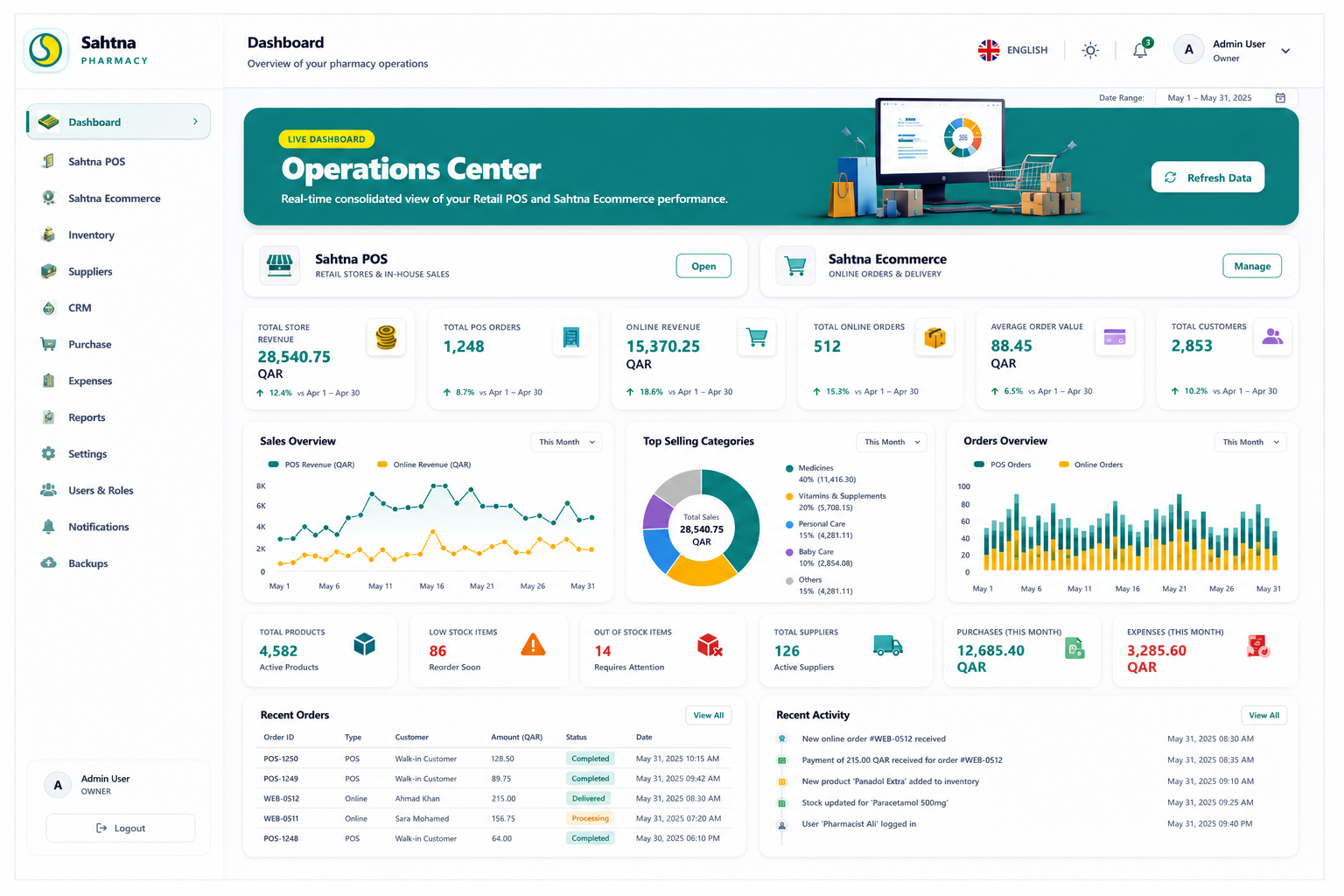
Imagine opening your business dashboard and seeing:
Sales increased 18% this month.
Then asking:
"Why?"
The system analyzes the available data and explains the major factors.
You ask:
"Which customers should our sales team follow up with?"
The system identifies relevant customers based on your configured criteria.
You ask:
"Schedule meetings with the highest-priority leads."
The system can potentially prepare the required actions for approval or execute them where appropriate permissions allow.
This is the direction business software is moving toward.
Not simply software that stores information.
But software that can understand information and assist with action.
Final Thoughts
Artificial intelligence is no longer something businesses should look at only as a futuristic concept.
It can already be applied to practical business problems:
Customer service
Voice assistance
Business automation
Sales assistance
Data analysis
Document processing
Employee assistance
Marketing
Appointment booking
AI agents
The most important question isn't:
"Does my business need AI?"
It is:
"Where could AI make my business better?"
That question can lead to something much more valuable than simply adding an AI chatbot.
It can lead to a smarter business system.
At Galaxium Coding, we develop custom software, AI integrations, AI assistants, business automation systems, websites and mobile applications designed around the needs of individual businesses.
Your business doesn't have to adopt everything at once.
Start with one problem.
Then build from there.