React Native App Development in Qatar: Complete Guide for Businesses in 2026
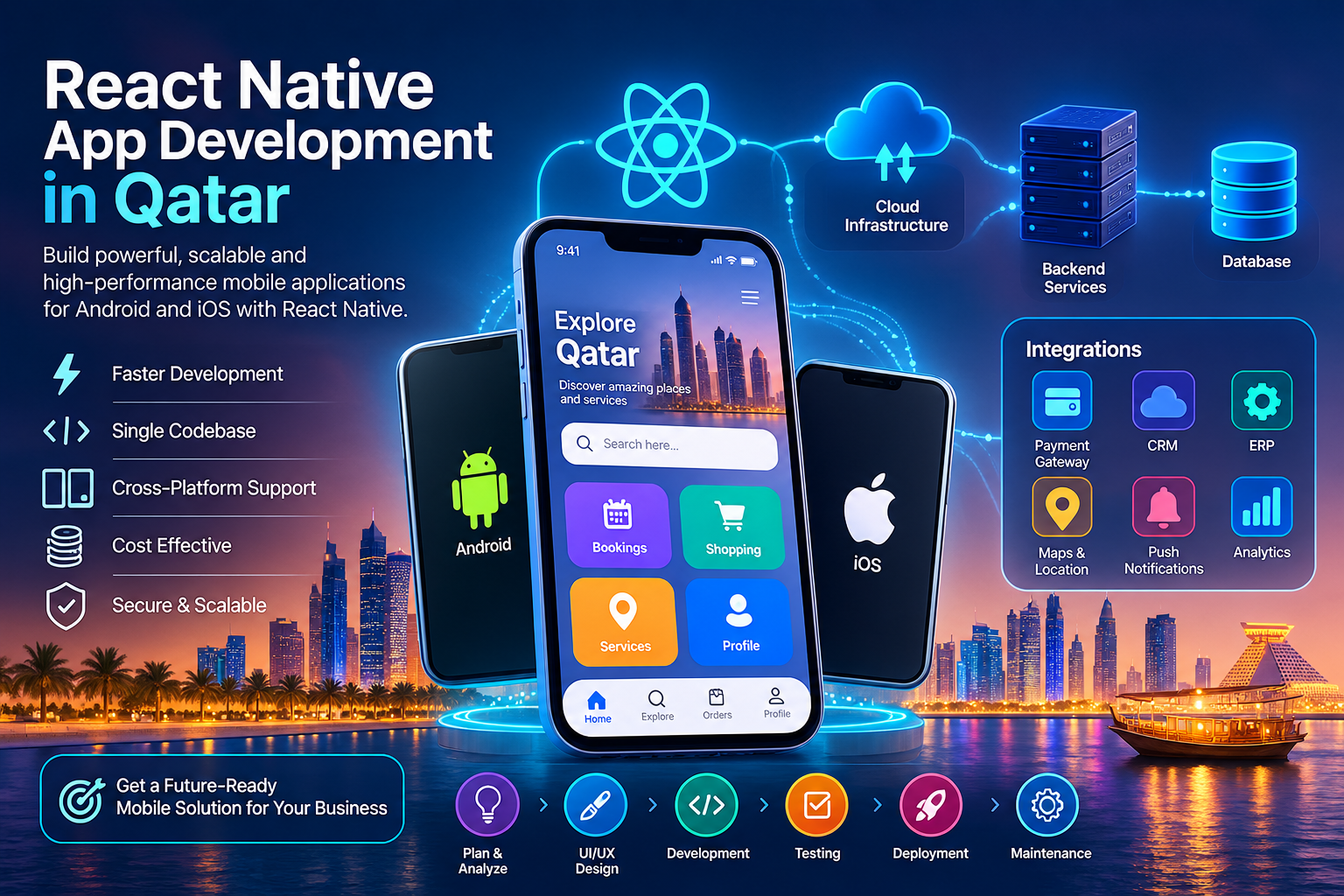
React Native app development can connect Android and iOS experiences with APIs, cloud platforms and business systems.
React Native App Development in Qatar: Complete Guide for Businesses in 2026
Businesses in Qatar are increasingly using mobile applications to connect with customers, manage operations, process bookings, sell products, provide services, and create more convenient digital experiences.
For companies planning both Android and iOS applications, one important technology decision is whether to build separate native applications or use a cross-platform framework such as React Native.
React Native app development in Qatar can be an attractive option for businesses that want to develop applications for multiple platforms while sharing a significant portion of their application code.
However, React Native is not automatically the right solution for every project.
The best technology depends on the application's functionality, user experience, integrations, performance requirements, security needs, development budget, and long-term maintenance strategy.
This guide explains what businesses in Qatar should know before investing in React Native app development.
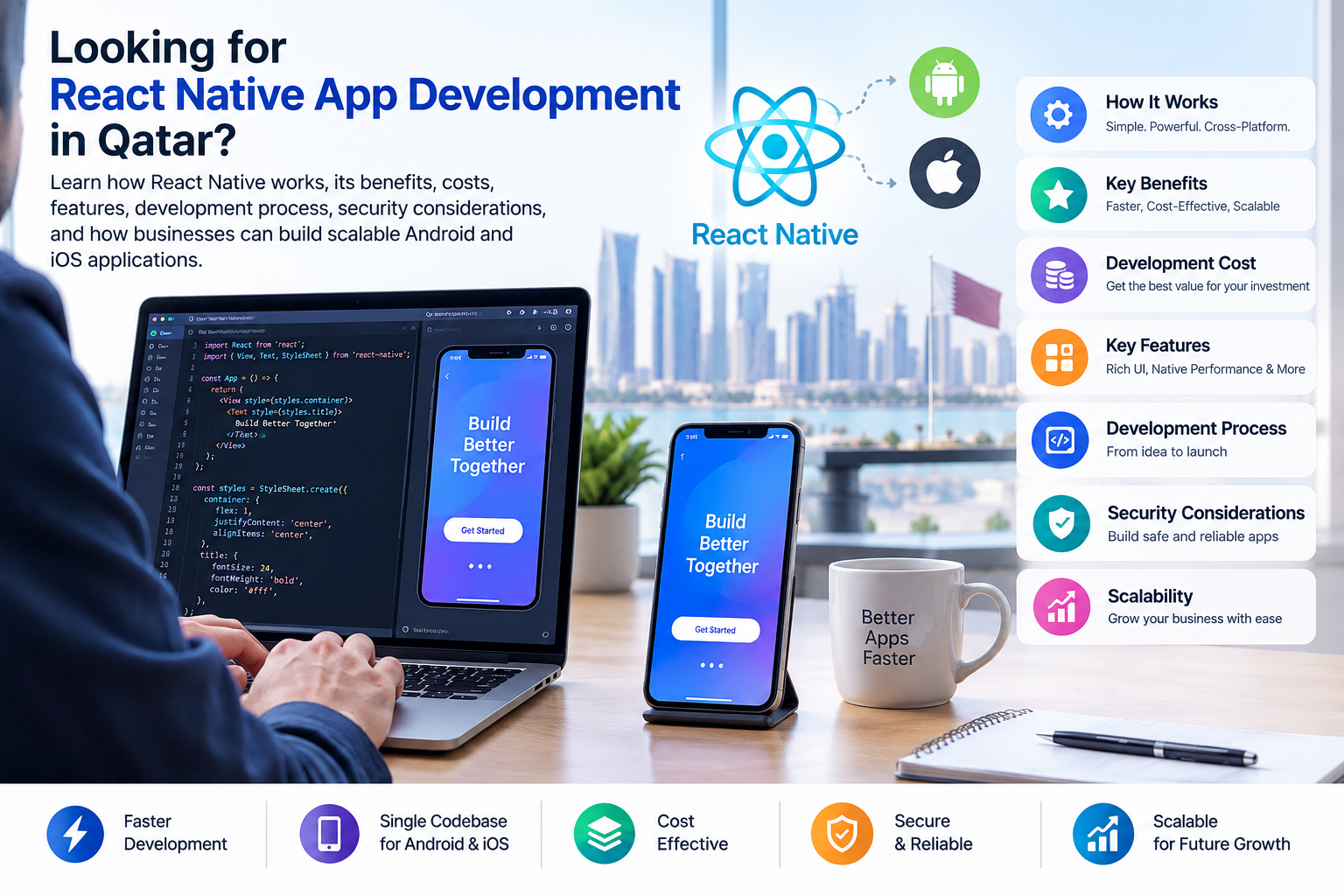
What Is React Native App Development?
React Native is a framework for building mobile applications using React and JavaScript or TypeScript while rendering application interfaces using native platform components.
Instead of maintaining completely separate application codebases for Android and iOS, a development team can share substantial portions of application logic and UI code.
A simplified architecture can look like this:
React Native Application → API Layer → Backend → Database
The mobile application can communicate with business systems through APIs for functions such as:
User registration and login
Customer profiles
Product catalogues
Orders
Bookings
Payments
Notifications
Customer support
Employee workflows
Reporting
AI-powered features
React Native also provides access to platform-specific functionality when required. Its official documentation describes ways to share code while separating Android- or iOS-specific implementation where necessary.
For businesses, the important point is that React Native is not simply a website placed inside a mobile application. It is a framework for developing mobile experiences that interact with the underlying mobile platforms.
Why Are Businesses in Qatar Considering React Native?
Qatar's digital transformation environment creates opportunities for businesses to build connected digital products across websites, mobile applications, cloud systems, business software, and automation.
Qatar's Digital Agenda 2030 includes strategic pillars covering digital infrastructure, digital government, digital technologies, digital innovation, digital economy, and digital society.
For businesses, this means a mobile application may increasingly be part of a broader digital ecosystem rather than an isolated product.
For example:
Customer → Mobile App → API → CRM → ERP → Payment System → Analytics
A restaurant might use an application for ordering and loyalty.
A property company could use one for property listings, enquiries, appointments, and customer management.
A healthcare organization might use an application for appointments, notifications, documents, and patient-facing services, subject to its applicable regulatory and privacy requirements.
An education company could connect students, parents, teachers, payments, schedules, and learning systems.
React Native can be considered when the business needs to support Android and iOS while maintaining a practical shared development strategy.
Key Benefits of React Native App Development
1. Android and iOS Development From One Technology Stack
One of the major attractions of React Native is the ability to share application code between platforms.
Instead of creating two completely independent projects, developers can structure the application so that common business logic and many interface components are shared.
This can simplify:
Development
Testing
Maintenance
Feature updates
Bug fixing
Product management
However, “one codebase” does not mean that every line of code will always be identical.
Some functionality may require platform-specific implementation.
2. Faster Product Development
Sharing code can reduce duplicated development work.
For example, suppose a company wants to build:
Login
Customer profiles
Product browsing
Shopping cart
Orders
Notifications
Account settings
Much of the application structure can potentially be shared between Android and iOS.
That can make React Native useful for businesses that want to bring a product to market without maintaining two completely separate application implementations.
3. Strong Ecosystem
React Native has a large ecosystem around React, JavaScript, TypeScript, native modules, development tools, and third-party libraries.
React Native's official documentation also provides built-in components and APIs for common application interfaces and platform functionality.
This ecosystem can be particularly useful when a project requires integrations such as:
Camera
Location
Push notifications
Authentication
Maps
Payments
File uploads
Bluetooth
Analytics
Device permissions
The exact library or native integration should still be evaluated for compatibility, maintenance, security, and support before being included in a production application.
4. Easier Maintenance Across Platforms
A mobile product does not end when it is published.
Applications require:
Bug fixes
Operating-system compatibility updates
Security improvements
Dependency updates
Performance optimization
New features
UI improvements
API changes
A shared technology strategy can make ongoing maintenance easier to organize.
5. Suitable for Many Business Applications
React Native can be appropriate for many types of applications, including:
E-commerce apps
Booking applications
Restaurant applications
Delivery applications
Customer portals
Employee applications
Business management apps
Education applications
Service applications
Loyalty applications
Marketplace applications
Appointment applications
Field-service applications
The framework should still be selected after evaluating the application's actual technical requirements.
React Native vs Native App Development
One of the most important decisions is whether to use React Native or develop separately using the native technologies of each platform.
Factor | React Native | Native Development |
|---|---|---|
Android + iOS | Shared development approach | Separate platform development |
Code reuse | High potential | Lower between platforms |
Development model | Cross-platform | Platform-specific |
Platform-specific features | Supported with native integration | Direct access |
Maintenance | Potentially simpler for shared functionality | Separate platform maintenance |
Performance | Can be excellent when properly engineered | Maximum platform-specific control |
Complex native requirements | May require native code | Naturally suited |
Suitable for | Many business and consumer apps | Highly platform-specific applications |
Neither approach is universally better.
React Native can be a strong choice when a company values cross-platform development and shared code.
Native development may be preferable when the application depends heavily on highly specialized platform capabilities or requires extremely platform-specific optimization.
The decision should be based on the product—not on framework popularity.
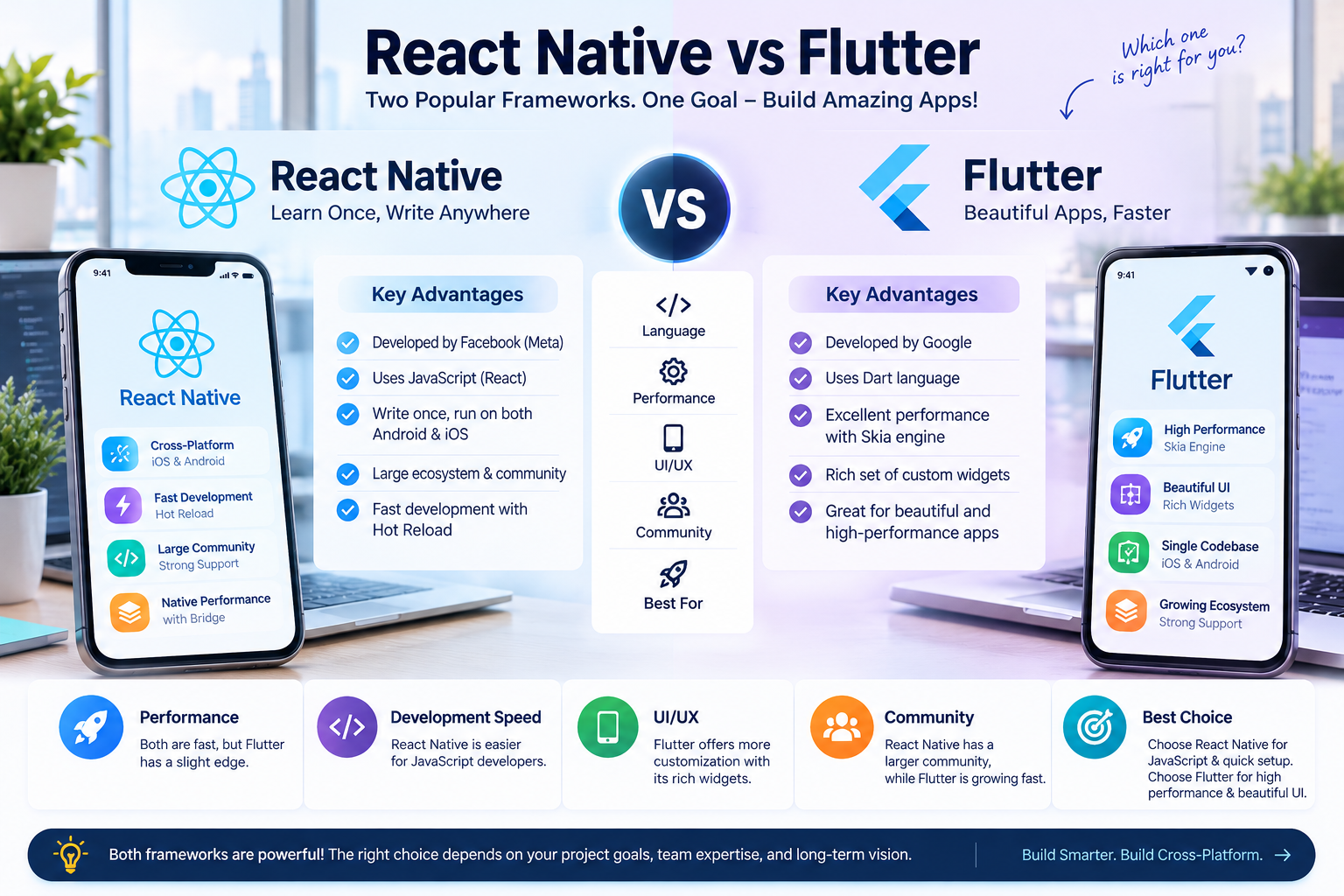
React Native vs Flutter
Businesses often compare React Native with Flutter when planning cross-platform mobile applications.
Both approaches can be used to develop applications for multiple platforms, but their technologies and development ecosystems differ.
Factor | React Native | Flutter |
|---|---|---|
Primary technology | React + JavaScript/TypeScript | Dart |
Cross-platform development | Yes | Yes |
Ecosystem | Strong React/JavaScript ecosystem | Strong Flutter/Dart ecosystem |
Native integration | Available | Available |
Existing React expertise | Can be advantageous | Requires Flutter/Dart expertise |
UI approach | React-based native components | Flutter rendering approach |
Best choice | Depends on project | Depends on project |
A company already using React, JavaScript, TypeScript, or React-based web applications may find React Native particularly attractive.
A team with strong Flutter and Dart expertise may prefer Flutter.
The important question is not “Which framework is best?”
The better question is:
Which technology best fits the application, development team, integrations, performance requirements, and long-term maintenance plan?
Important Features for a React Native Business App
A professional React Native application can include a wide range of features.
User Authentication
Applications may support:
Email and password
Phone-based authentication
OTP
Social login
Multi-factor authentication
Role-based access
Authentication should be designed together with backend security rather than treated as only a mobile UI feature.
Push Notifications
Push notifications can help businesses communicate:
Order updates
Booking confirmations
Promotions
Appointment reminders
Delivery updates
Account notifications
Employee tasks
Notification systems should be designed carefully so users receive useful information rather than excessive messages.
Payment Integration
E-commerce and service applications may need payment functionality.
Depending on the business model, a React Native application may connect to an external payment gateway through a secure backend architecture.
Payment processing should not be designed by placing sensitive payment credentials directly inside the mobile application.
Maps and Location
Location-based functionality can support:
Delivery tracking
Driver applications
Service requests
Store locators
Property searches
Field-service management
Appointment navigation
Location permissions and background location functionality should be implemented according to platform requirements and the application's legitimate use case.
Camera and File Uploads
Applications can use the camera for:
Document uploads
Identity workflows
Product images
Service reports
Property listings
Employee documentation
Businesses handling personal documents should consider storage, access controls, encryption, retention, and deletion requirements.
Arabic and English Support
For many businesses operating in Qatar, multilingual design may be important.
An application may need:
English
Arabic
Right-to-left layouts
Localized dates
Currency formatting
Multilingual notifications
Localized content
Arabic support should be considered during UI/UX design rather than added as an afterthought.
React Native App Development Process in Qatar
A successful application normally requires more than writing mobile code.
Step 1: Business and Product Analysis
The first stage is understanding what the application needs to accomplish.
Questions include:
Who will use the application?
What problem does it solve?
What are the main user journeys?
What features are essential?
What systems already exist?
What information must be stored?
What integrations are required?
Will the application support Android, iOS, or both?
The objective is to define the product before development begins.
Businesses can also consider custom software development when the mobile application is part of a larger business system.
Step 2: Define the MVP
Not every feature needs to be launched on day one.
An MVP—or minimum viable product—can focus on the most important functionality.
For example, a booking application might initially include:
Registration
Service catalogue
Appointment booking
Payment
Notifications
Customer account
Advanced analytics, loyalty programs, AI assistants, and complex automation could potentially be introduced later.
This approach can help businesses validate the product before investing in a much larger platform.
Step 3: UI/UX Design
The interface should be designed around the target users.
Important considerations include:
Navigation
Accessibility
Typography
Arabic/English layouts
Forms
Error messages
Loading states
Empty states
Mobile screen sizes
Touch interactions
Brand identity
A visually attractive application is not enough.
The user should be able to complete important tasks quickly and confidently.
Step 4: Technical Architecture
The development team defines how the application will communicate with other systems.
A typical architecture might be:
React Native App → API → Backend → Database
Additional services may include:
Payment Gateway
Push Notification Service
Cloud Infrastructure
CRM
ERP
Analytics
AI APIs
The architecture depends on the business requirements.
Step 5: React Native Development
Developers then implement the application's:
Screens
Navigation
Components
State management
API communication
Authentication
Business logic
Forms
Notifications
Native functionality
React Native's modern architecture has evolved substantially, including its newer rendering and native-module systems.
The official React Native documentation explains that the New Architecture became the default in React Native 0.76 and introduced significant changes to rendering and JavaScript/native interoperability.
Step 6: Backend and API Development
The mobile application is usually only one part of the product.
For example:
Mobile App → API → Backend → Database
The backend may manage:
Users
Products
Orders
Bookings
Payments
Permissions
Notifications
Reports
Business rules
This is why choosing a development company that understands both mobile and backend architecture can be important.
Step 7: Integration
Businesses may need to connect their application with existing systems.
Examples include:
CRM
ERP
Accounting software
Payment gateways
E-commerce systems
WhatsApp-related workflows
Email systems
Maps
Analytics
Cloud services
For businesses with multiple platforms, API integration services can be part of the broader architecture.
Step 8: Testing
Testing should take place throughout development.
Important testing areas include:
Functional testing
UI testing
API testing
Authentication testing
Security testing
Performance testing
Device testing
Network testing
Regression testing
Android testing
iOS testing
The application should be tested under realistic conditions rather than only on a developer's device.
Step 9: Deployment
Once the application is ready, the development team prepares the required production builds and store submissions.
The launch process should include:
Production configuration
Application signing
Store assets
Privacy information
App descriptions
Screenshots
Release testing
Backend deployment
Monitoring
Step 10: Maintenance and Improvement
After launch, businesses should continue monitoring:
Crashes
Performance
User feedback
API failures
Security issues
Operating-system changes
Application-store requirements
A successful mobile application is a product that evolves over time.
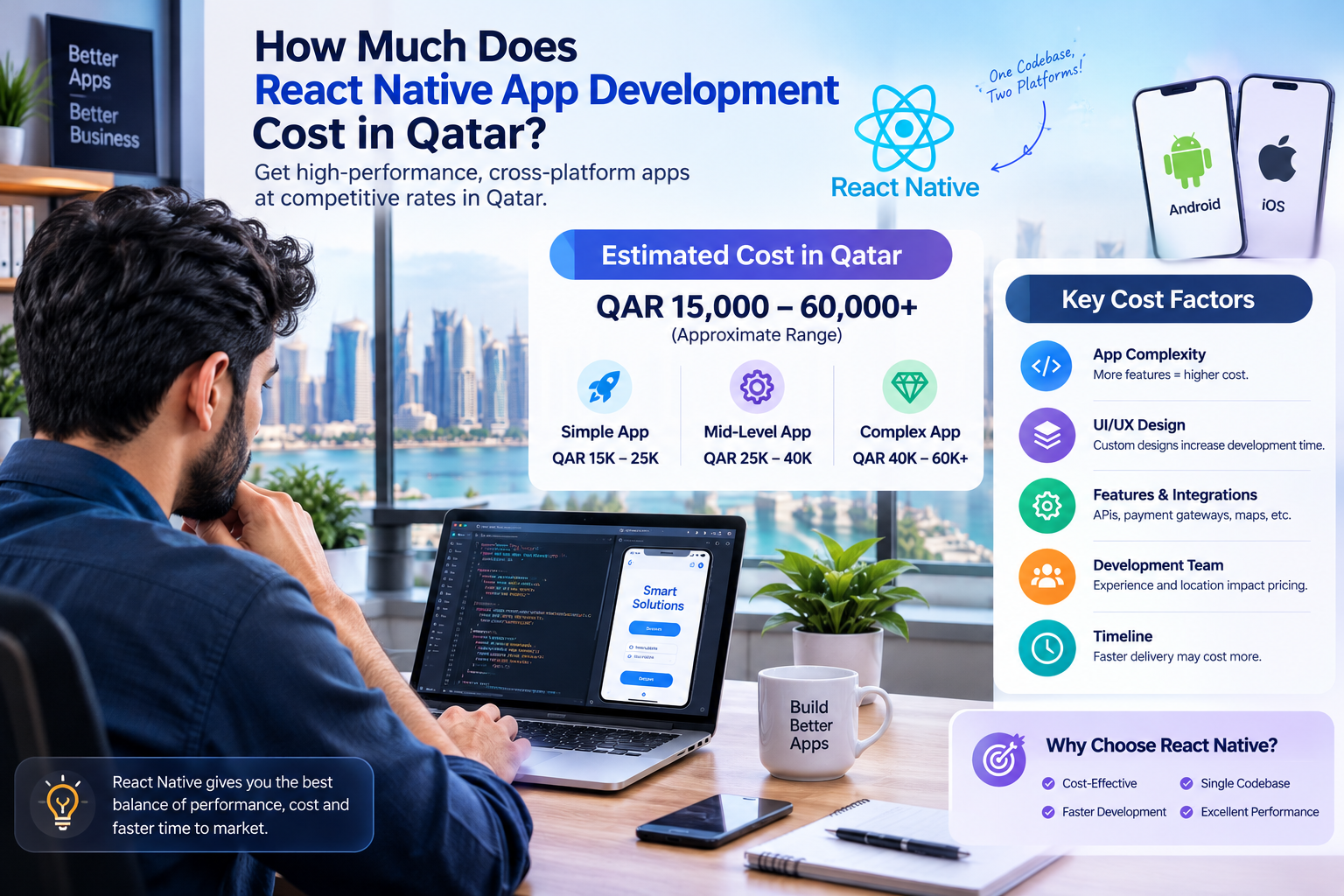
How Much Does React Native App Development Cost in Qatar?
There is no single fixed price for React Native app development in Qatar.
The cost depends on the complexity of the application.
A basic application with a small number of screens and limited backend functionality can be significantly less expensive than a large marketplace, banking-related platform, delivery ecosystem, or enterprise application.
Main Factors Affecting Cost
1. Number of Features
More functionality usually means more design, development, testing, and maintenance.
2. UI/UX Complexity
A simple application may have straightforward screens.
A sophisticated application may require:
Custom animations
Complex dashboards
Advanced navigation
Interactive maps
Personalized experiences
Complex forms
3. Backend Requirements
A mobile application requiring a sophisticated backend will cost more than a simple application consuming a small number of APIs.
4. Third-Party Integrations
Payment gateways, CRM systems, ERP systems, maps, analytics, AI services, and other integrations add development and testing requirements.
5. Arabic and English Support
Multilingual applications require additional design and testing considerations, especially when Arabic right-to-left layouts are involved.
6. Security Requirements
Applications handling sensitive customer, employee, financial, or business information may require more sophisticated:
Authentication
Authorization
Encryption
Logging
Monitoring
Backup
Access control
7. Post-Launch Support
Maintenance contracts, updates, monitoring, bug fixes, and new functionality can affect the overall cost of ownership.
The best way to estimate a React Native project is therefore to define the requirements first and then obtain a project-specific proposal.
What Industries in Qatar Can Use React Native?
React Native is not limited to one industry.
E-Commerce
Businesses can build applications for:
Product browsing
Shopping carts
Payments
Orders
Delivery tracking
Loyalty programs
Real Estate
A property application could provide:
Property listings
Search and filtering
Property images
Location
Agent contact
Viewing requests
Lead management
Hospitality
Hotels, restaurants, and hospitality businesses may use mobile applications for:
Reservations
Room services
Food ordering
Loyalty programs
Customer communication
Healthcare
Healthcare applications may support:
Appointment booking
Notifications
Patient-facing information
Telehealth-related workflows
Documents
Healthcare applications require particularly careful attention to privacy, security, regulatory obligations, and data handling.
Education
Education providers can build applications for:
Students
Parents
Teachers
Courses
Schedules
Notifications
Payments
Learning resources
Logistics and Delivery
Applications can support:
Driver assignments
Delivery status
GPS functionality
Customer notifications
Proof of delivery
Order management
Professional Services
Law firms, consultants, agencies, maintenance companies, and other service businesses can use applications for:
Appointments
Customer accounts
Documents
Requests
Payments
Support
Security Considerations for React Native Applications
Security should be considered from the beginning of development.
Important areas include:
Authentication
Use secure authentication mechanisms and avoid storing sensitive credentials insecurely on the device.
Authorization
Users should only be able to access information and functionality appropriate to their role.
For example:
Customer ≠ Employee ≠ Administrator
API Security
The mobile application should communicate with secure backend services.
APIs should implement appropriate:
Authentication
Authorization
Validation
Rate limiting
Logging
Error handling
Data Storage
Sensitive information should not be stored casually inside the application.
Developers should evaluate:
Local storage
Encryption
Secure credentials
Tokens
Cached information
Logs
Dependency Security
React Native projects may depend on third-party libraries.
These dependencies should be reviewed and maintained because vulnerabilities in dependencies can create risks for production applications.
Privacy
Businesses operating in Qatar should evaluate applicable data-protection and privacy obligations for their specific application, industry, data types, and processing activities.
Security is not a feature that can simply be added immediately before launch.
It should be part of the architecture from the beginning.
React Native and Existing Business Systems
A common mistake is treating the mobile application as an independent product.
In many business projects, the application is actually a new interface for existing systems.
For example:
Customer
↓
React Native Mobile App
↓
API
↓
CRM / ERP
↓
Database
↓
Business Dashboard
This architecture can allow employees to continue using internal systems while customers or field workers interact through the mobile application.
For businesses already using software systems, integration planning should happen before development begins.
Galaxium Coding's mobile application development services can be considered when a business needs a custom mobile product connected to its broader digital infrastructure.
Common Mistakes to Avoid
Choosing React Native Only Because It Is Popular
Popularity should not determine the architecture.
The framework must fit the project.
Building Without a Proper Backend Plan
A beautiful mobile interface cannot compensate for a poorly designed backend.
Ignoring Arabic UX
For Qatar-facing applications, Arabic support may be important.
It should be considered during the design stage.
Treating Security as a Final Step
Authentication, permissions, data protection, API security, and secure storage should be considered during architecture and development.
Overloading the First Version
Trying to launch every possible feature at once can increase cost and complexity.
An MVP can provide a more manageable starting point.
Ignoring Maintenance
Mobile operating systems, dependencies, APIs, and security requirements change.
A long-term maintenance plan should be part of the project.
Not Planning Integrations Early
If the application eventually needs CRM, ERP, payment, accounting, or other integrations, those requirements should be considered during architecture.
How to Choose a React Native App Development Company in Qatar
Choosing the right development partner is as important as selecting the framework.
Before hiring a company, ask:
Does the company understand your business?
A developer should understand what the application is supposed to achieve—not just the technical specification.
Can they build the backend too?
If the application requires a backend, API, database, authentication, and admin dashboard, ensure the team can handle the complete architecture.
Have they worked with integrations?
Ask about experience with:
APIs
Payment gateways
CRM
ERP
Cloud services
Analytics
AI services
How do they approach security?
Ask about authentication, authorization, API security, data protection, backups, and monitoring.
Do they provide post-launch support?
Clarify what happens after deployment.
Who owns the source code?
Ownership, access, documentation, hosting, accounts, and deployment credentials should be clearly defined in the agreement.
How will the project be tested?
Ask whether testing covers both Android and iOS devices and realistic production scenarios.
Why Businesses May Choose Galaxium Coding
Galaxium Coding is a Qatar-based technology and software development company providing solutions including custom software, web applications, mobile applications, AI, automation, CRM, ERP, integrations, and cloud solutions.
For a React Native project, the broader question should not simply be:
“Can you build my mobile application?”
It should be:
“Can you build and support the complete digital system behind my mobile application?”
A business application may require:
Mobile application
Backend
APIs
Database
Admin dashboard
CRM
ERP integration
Payment gateway
Cloud infrastructure
Notifications
Analytics
Security
Ongoing maintenance
This broader perspective can help businesses avoid building an application that works in isolation but cannot support their actual operations.
Businesses can review Galaxium Coding's projects and portfolio to understand the types of technology solutions the company presents.
Future of React Native App Development
Cross-platform development is likely to remain important as businesses continue to support multiple devices and digital channels.
React Native itself continues to evolve.
Its New Architecture has introduced changes to rendering, native modules, JavaScript/native interoperability, and React capabilities.
For businesses, however, the most important trend is not a specific framework version.
It is the move toward connected digital products.
A modern business application may combine:
Mobile + Web + Cloud + APIs + AI + Automation + Business Software
For example, a customer could place an order through a mobile application.
The application sends the order to an API.
The backend processes the order.
The ERP updates inventory.
The payment gateway confirms payment.
The customer receives a notification.
The management dashboard displays the transaction.
AI could later be added for customer support, recommendations, forecasting, or workflow automation.
This is where mobile development becomes part of broader digital transformation.
Final Thoughts
React Native can be a practical technology choice for businesses in Qatar that need Android and iOS applications and want to share substantial development resources across platforms.
It can support applications ranging from e-commerce and booking platforms to employee tools, customer portals, delivery applications, education products, and business management systems.
But the framework is only one part of the project.
Successful React Native app development depends on:
Clear business requirements
Strong UI/UX
Appropriate architecture
Reliable APIs
Secure backend systems
Proper integrations
Testing
Deployment
Monitoring
Long-term maintenance
If you are planning a React Native application in Qatar, start by defining the business problem, target users, essential features, integrations, security requirements, and long-term product roadmap.
Businesses interested in building a custom mobile application can contact Galaxium Coding to discuss their requirements and determine the appropriate technology approach.
Frequently Asked Questions
Is React Native good for business applications?
Yes. React Native can be suitable for many business applications, including e-commerce, booking, customer-service, employee, delivery, education, and management applications. The suitability depends on the project's technical requirements.
Can React Native build both Android and iOS apps?
Yes. React Native is designed for cross-platform application development, allowing developers to share substantial portions of application code between Android and iOS while supporting platform-specific implementation where necessary.
How much does React Native app development cost in Qatar?
There is no universal price. Cost depends on features, UI/UX complexity, backend requirements, integrations, security, number of platforms, testing, and post-launch support.
Is React Native cheaper than native app development?
It can reduce duplicated development work when one application needs to support Android and iOS, but total project cost still depends on complexity. A project requiring significant native functionality may require additional platform-specific development.
Can React Native apps support Arabic?
Yes. React Native applications can be designed for Arabic interfaces and right-to-left layouts. Arabic support should be included in the UX and technical planning from the beginning.
Can React Native integrate with a CRM or ERP?
Yes. A React Native application can communicate with CRM, ERP, and other business systems through APIs and integration layers, assuming the systems provide suitable integration capabilities.
Can React Native applications use payment gateways?
Yes. Payment functionality can be integrated into mobile applications, but the exact implementation depends on the payment provider and should follow secure payment architecture and applicable requirements.
Is React Native suitable for e-commerce applications?
React Native can be suitable for e-commerce applications that require product catalogues, customer accounts, carts, orders, payments, notifications, and other features. The backend and payment architecture are equally important.
Is React Native secure?
React Native can be used to build secure applications, but security depends on the complete implementation. Authentication, authorization, API security, dependency management, secure storage, backend security, and data protection all need to be considered.
Should a Qatar business choose React Native or Flutter?
There is no universal answer. Both can support cross-platform applications. The decision should consider the existing technology stack, developer expertise, application requirements, integrations, performance needs, and long-term maintenance strategy.
Can Galaxium Coding develop React Native applications in Qatar?
Galaxium Coding provides mobile application development and broader software development services. A React Native project should be evaluated according to the application's requirements, backend architecture, integrations, and business objectives.