Flutter App Development in Qatar
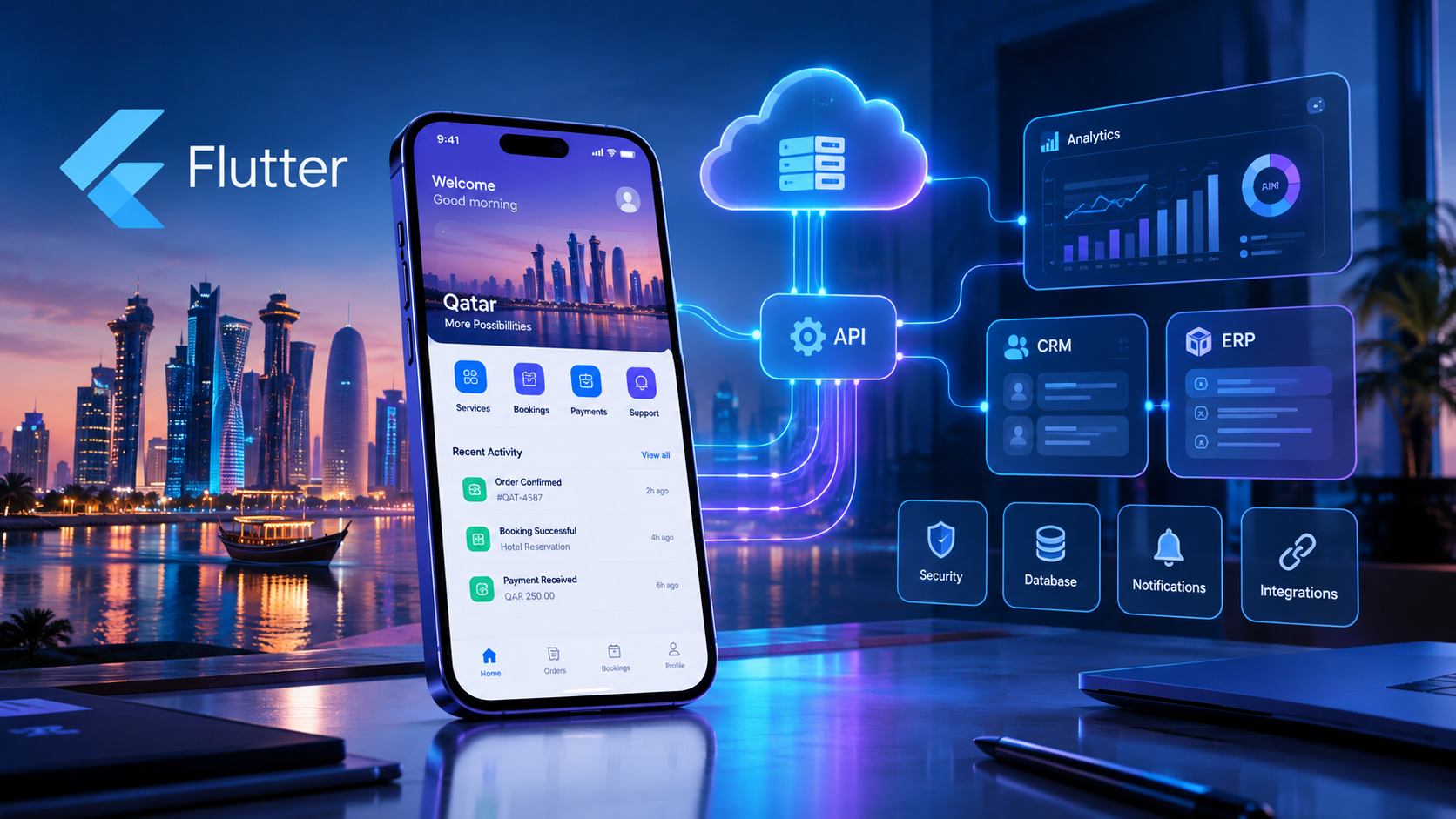
Flutter app development can help Qatar businesses build connected Android and iOS applications with scalable backend systems and business integrations.
Flutter App Development in Qatar: A Complete Guide for Businesses in 2026
Businesses in Qatar are increasingly using mobile applications to sell products, manage bookings, communicate with customers, support employees, process payments, and connect digital services with their internal business systems.
For companies planning an Android and iOS application, one of the biggest technology decisions is whether to build separate native applications or use a cross-platform framework such as Flutter.
Flutter has become an important option for businesses that want to create applications for multiple platforms while maintaining a shared development foundation. Flutter's official documentation describes it as a framework for building multi-platform applications from a single codebase, with support extending across mobile, web, desktop, and other supported platforms.
For Qatar-based businesses, however, choosing Flutter should not simply be a technology decision. The more important question is whether Flutter fits the application's users, integrations, performance requirements, security model, budget, and long-term roadmap.
This guide explains what businesses should know before starting Flutter app development in Qatar, including benefits, features, architecture, development stages, integrations, security, costs, common mistakes, and how to choose a development partner.
If your project requires a complete business application rather than only a mobile interface, you can also explore mobile application development services designed around specific business requirements.
What Is Flutter App Development?
Flutter is an open-source application development framework that allows developers to build applications for multiple platforms using a shared codebase.
Instead of maintaining completely separate application projects for Android and iOS, a development team can use Flutter as the foundation for building a common application experience.
Flutter uses Dart as its programming language and provides a large collection of widgets and development tools for creating user interfaces and application functionality.
According to the official Flutter documentation, applications can be built for Android, iOS, web, Windows, macOS, and Linux, depending on the project requirements and supported platform capabilities.
This makes Flutter particularly interesting for businesses that want to launch across multiple platforms without automatically creating completely independent development teams for every platform.
Flutter in simple terms
A traditional approach might look like:
Android application → Android development
iOS application → iOS development
With Flutter, the architecture can instead begin with:
Flutter application → shared application code → Android + iOS
This does not mean every part of an application will always be identical.
Some applications require platform-specific functionality, native integrations, or additional configuration. Flutter supports platform-specific integrations when necessary.
The goal is therefore not to eliminate native development completely.
The goal is to reduce unnecessary duplication while still providing access to platform-specific capabilities when required.
Why Are Businesses in Qatar Considering Flutter?
The technology choice for a mobile application should be connected to business objectives.
For a Qatar-based company, the application may need to support customers, employees, managers, suppliers, delivery teams, or other users.
A single application could potentially provide:
Customer registration
Product browsing
Online ordering
Booking
Payments
Delivery tracking
Notifications
Customer support
Loyalty programs
Employee workflows
Internal approvals
Sales operations
Inventory information
Business dashboards
Document access
CRM functionality
ERP connectivity
The exact requirements depend on the organization.
For example, a restaurant may need ordering and delivery functionality, while a property company may require property listings, enquiries, appointments, document management, and customer communication.
A field-service company may need an employee application where technicians receive jobs, update status, upload images, collect customer information, and complete service reports.
The technology should therefore follow the business requirement rather than the other way around.
Key Benefits of Flutter App Development
Flutter is not automatically the right choice for every application. However, it can provide several advantages when the project is a good fit.
1. Shared Development Foundation
One of Flutter's major advantages is the ability to build applications for multiple platforms from a shared codebase.
This can reduce duplicated development work in projects where Android and iOS applications share most business logic and user experience requirements.
It can also make coordinated feature development easier.
For example, if a company introduces a new customer loyalty feature, the development team can structure the feature around the shared application architecture rather than maintaining two completely separate application implementations.
2. Consistent User Experience
Businesses often want their application to provide a consistent brand experience across devices.
Flutter provides a widget-based approach to building interfaces, giving developers significant control over the visual presentation and interaction model.
This can be useful for companies that want a branded application rather than an interface that simply looks like a generic mobile application.
3. Faster Development Cycles
Flutter includes development features such as hot reload that can help developers see changes quickly during development.
Faster feedback can make it easier to refine:
User interfaces
Forms
Navigation
Layouts
Interactions
Application workflows
Development speed should not be confused with guaranteed project completion time, however.
The total timeline still depends on the application's complexity, integrations, design requirements, testing, approvals, backend development, and deployment requirements.
4. Multi-Platform Potential
Flutter can support mobile applications as well as web and desktop targets.
This can be valuable when a company eventually wants to expand an application beyond smartphones.
For example:
Customer application
→ Android
→ iOS
Management platform
→ Web
Internal desktop requirement
→ Windows or macOS
Not every project should use Flutter for every platform. The correct architecture depends on the intended user experience and business requirements.
5. Custom Interface Design
Flutter provides extensive control over application interfaces.
This can help businesses create:
Custom navigation
Branded dashboards
Interactive cards
Custom forms
Booking interfaces
Product catalogues
Management dashboards
Data visualizations
Custom animations
For customer-facing applications, this flexibility can be particularly valuable because the application becomes an important part of the company's digital brand.
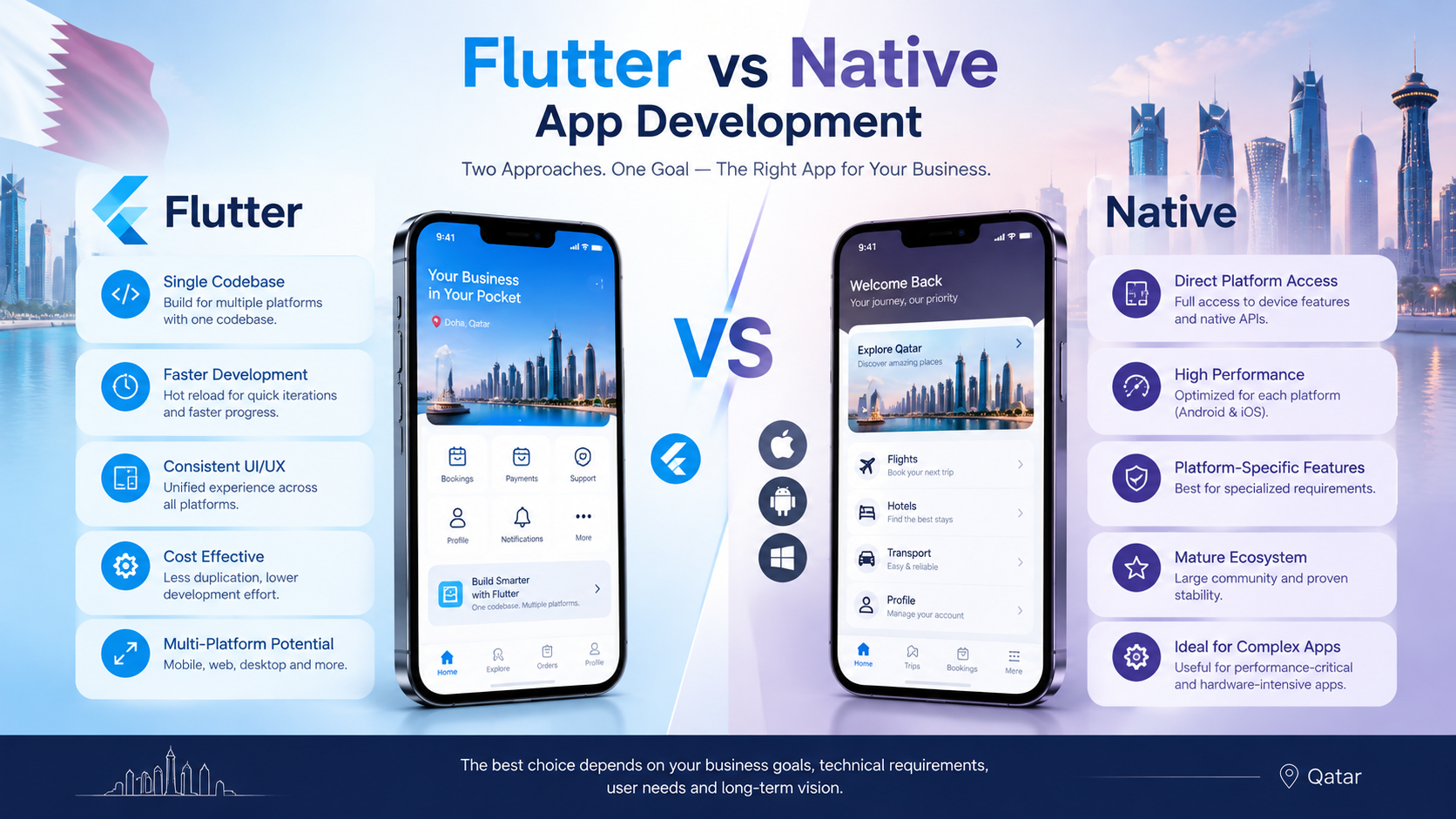
Flutter vs Native App Development
One of the most common questions businesses ask is whether Flutter is better than native Android and iOS development.
There is no universal answer.
The right choice depends on the project.
Requirement | Flutter | Native Development |
|---|---|---|
Android + iOS | Strong fit | Strong fit |
Shared application code | Major advantage | Usually requires separate platform implementations |
Custom UI | Strong | Strong |
Platform-specific features | Supported, with native integration when needed | Direct platform access |
Development team structure | Can support a shared cross-platform team | Usually platform-specific expertise |
Performance requirements | Strong for many business applications | Strong |
Highly specialized native features | May require additional native code | Often more direct |
Multi-platform expansion | Strong potential | Usually separate platform strategy |
Best for | Many business and consumer applications | Highly platform-specific applications |
The important point is not to select Flutter simply because it is popular.
A professional development process should evaluate the application's:
Performance requirements
Hardware access
User experience
Integrations
Security requirements
Offline functionality
Platform-specific features
Development budget
Maintenance strategy
Long-term roadmap
What Types of Apps Can Be Built With Flutter?
Flutter can be used for many different business and consumer applications.
E-Commerce Applications
A Flutter e-commerce application can include:
Product catalogues
Categories
Search
Filters
Customer accounts
Shopping carts
Checkout
Payment integration
Order tracking
Notifications
Promotions
Loyalty programs
For a Qatar-based retailer, the application may also need Arabic and English interfaces, localized business workflows, delivery management, and integration with existing inventory or ERP systems.
Booking Applications
Businesses can build booking applications for:
Clinics
Salons
Restaurants
Hotels
Service companies
Fitness businesses
Consultants
Events
Property services
A booking application may include availability, calendars, customer accounts, payments, reminders, cancellation policies, and administrative controls.
Customer Service Applications
A business application can provide customers with:
Support requests
Chat
Service tickets
Account information
Notifications
Documents
Payment history
Service history
Employee Applications
Flutter can also be used for internal applications.
For example, employees might use an application to:
Check attendance
Submit leave requests
Receive tasks
Update job status
Access customer information
Upload documents
Submit expenses
View announcements
Complete inspections
Record field activity
Delivery Applications
A delivery platform may require several connected applications:
Customer App
↓
Order System
↓
Restaurant / Merchant Dashboard
↓
Delivery App
↓
Admin Dashboard
A Flutter application can form one or more components of this ecosystem, while APIs and backend systems manage the underlying business logic.
Flutter App Architecture for a Qatar Business
A mobile application is rarely just an app.
In many business projects, the mobile application is the front end of a larger technology ecosystem.
A typical architecture might look like:
Flutter Mobile App
↓
API Layer
↓
Backend Application
↓
Database
↓
Business Systems
The business systems may include:
CRM
ERP
Inventory
Accounting
Payment gateway
E-commerce platform
Customer support
Cloud services
AI services
Analytics
Notification systems
This is why businesses should evaluate the complete architecture before development starts.
A beautiful application with poor backend architecture can become difficult to maintain.
A well-designed Flutter application connected to a scalable backend can become a much more valuable business system.
Businesses requiring this type of connected technology can also consider custom software development alongside mobile application development.
Flutter App Features Businesses May Need
The feature set depends on the industry and business model.
User Authentication
Applications may require:
Email login
Phone authentication
Password management
Social authentication
Multi-factor authentication
Role-based access
Push Notifications
Notifications can be used for:
Orders
Bookings
Promotions
Payment updates
Service reminders
Employee tasks
Approval requests
Notifications should be implemented carefully so they provide useful information rather than overwhelming users.
Payment Integration
Commercial applications may need online payment capabilities.
The appropriate payment provider and implementation depend on the business model, market, compliance requirements, and available payment infrastructure.
Payment functionality should be planned early because it can influence backend architecture, security, transaction handling, and testing.
Maps and Location
Location-based functionality can be useful for:
Delivery applications
Real estate
Field services
Transportation
Travel
Store locators
Service requests
Camera and File Uploads
Applications may require customers or employees to upload:
Identification-related documents where legally appropriate
Receipts
Product images
Service photographs
Forms
Reports
Supporting documents
Sensitive information should be protected through appropriate authentication, authorization, encryption, storage, and retention practices.
Admin Dashboard
Many mobile applications need a web-based administration system.
An administrator may need to manage:
Users
Products
Orders
Bookings
Payments
Content
Notifications
Employees
Reports
Permissions
This means a mobile application project can become a complete software development project rather than simply an app-building exercise.
Arabic and English Flutter Applications in Qatar
For many businesses operating in Qatar, bilingual support can be an important requirement.
A bilingual application may need:
English
and
Arabic
Arabic support involves more than translating individual words.
The interface may need to support right-to-left presentation, including:
Navigation
Text alignment
Buttons
Forms
Icons
Menus
Lists
Tables
Notifications
Spacing
Layout direction
The application should therefore be designed for localization from the beginning.
Adding Arabic support at the end of development can create unnecessary redesign and testing work.
A better approach is to consider localization during the UI/UX and architecture stages.
Flutter App Integrations
Modern applications rarely operate independently.
A business may already have several systems that the new mobile application must communicate with.
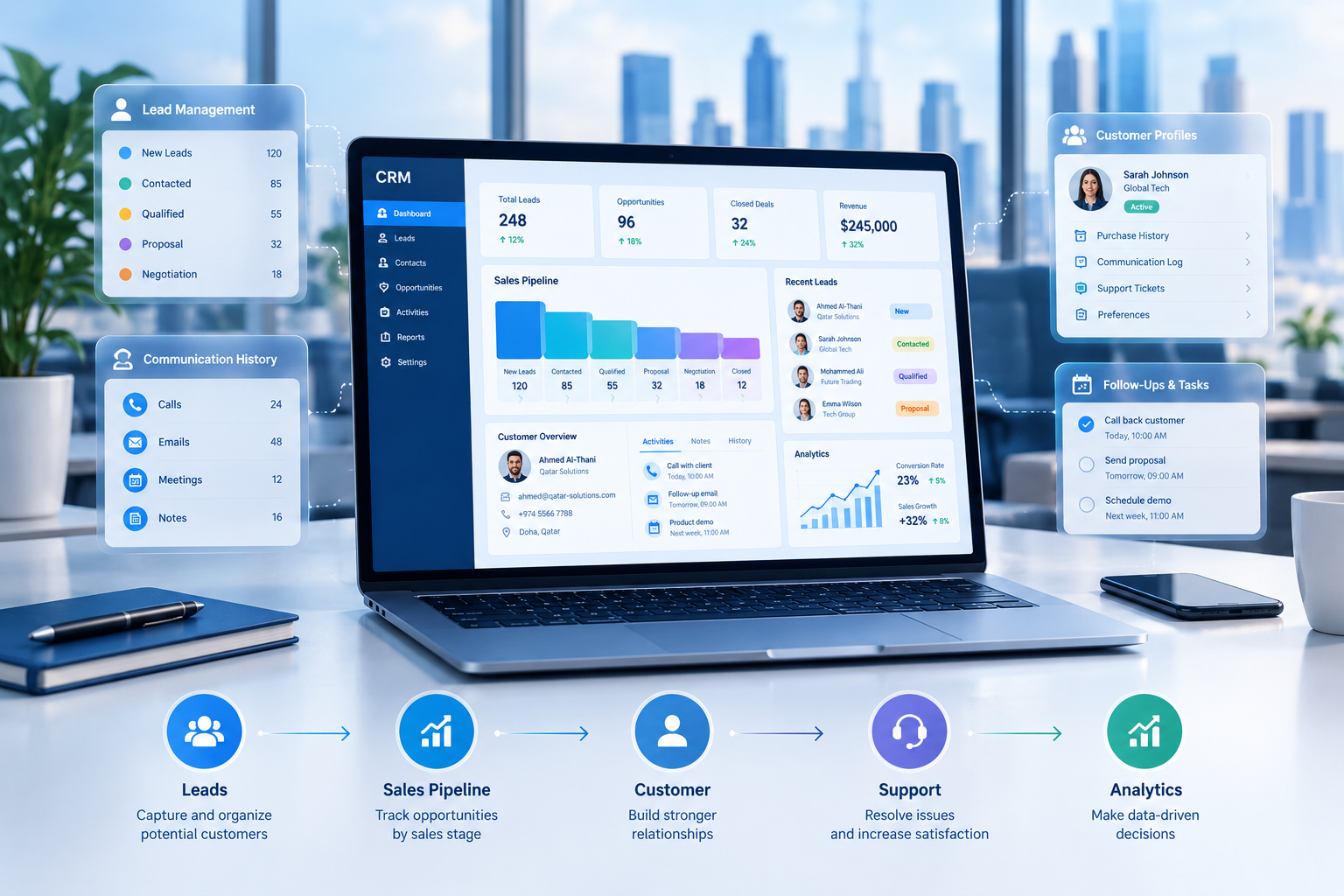
CRM Integration
A mobile application can connect to a CRM to provide customer information, enquiries, sales activity, service records, and communication workflows.
ERP Integration
A mobile application can connect with ERP systems to access information such as:
Products
Inventory
Orders
Customers
Purchasing
Finance
Employees
Payment Integration
Payment services can allow customers to complete transactions inside the application.
API Integration
APIs provide a structured way for the mobile application to communicate with backend systems.
For businesses that have multiple disconnected systems, API integration services can be part of a broader digital architecture.
AI Integration
Businesses may also integrate AI into mobile applications for functions such as:
Customer support
Search
Recommendations
Document processing
Intelligent assistants
Content generation
Business queries
The AI component should be connected to appropriate data, permissions, and business processes rather than added simply as a marketing feature.
Security Considerations for Flutter Applications
Security should be considered throughout the development lifecycle.
A mobile application may handle:
Customer information
Employee information
Payment information
Business records
Documents
Location information
Authentication credentials
Operational data
Important security considerations can include:
Secure Authentication
Users should only receive access to the information and functionality appropriate to their role.
API Security
Mobile applications often communicate with backend APIs.
APIs should be protected through appropriate authentication, authorization, validation, rate limiting, monitoring, and secure communication.
Data Protection
Sensitive information should be protected during transmission and storage.
Role-Based Access
A customer should not have the same access as an administrator.
Similarly, an employee should only be able to access the data required for their role.
Secure Updates
Applications should be maintained as operating systems, dependencies, libraries, APIs, and security requirements evolve.
Security is not a feature that can simply be completed once and forgotten.
How Much Does Flutter App Development Cost in Qatar?
There is no single fixed price for Flutter app development in Qatar.
The cost depends on the scope and complexity of the application.
A simple application with a small number of screens may require significantly less development effort than a multi-role business platform with payments, ERP integration, dashboards, notifications, AI, and advanced security requirements.
Major Factors Affecting Flutter App Cost
Factor | Potential Impact |
|---|---|
Number of screens | More screens increase design and development effort |
UI/UX complexity | Custom interfaces require additional design and development |
User roles | Multiple roles increase logic and testing requirements |
Backend | A custom backend increases overall project scope |
API integrations | Each integration requires development and testing |
Payment systems | Adds transaction and security requirements |
Arabic/English support | Requires localization and RTL testing |
Admin dashboard | Adds another application layer |
AI features | Can introduce additional architecture and integration work |
Offline functionality | Requires additional data synchronization logic |
Security | Advanced requirements increase engineering and testing |
Cloud infrastructure | Hosting, deployment, monitoring and scaling affect ongoing costs |
Maintenance | Post-launch updates require continuing resources |
The best way to estimate a Flutter application is therefore to define the requirements first.
A development company should ideally provide an estimate based on:
Features
User roles
Platforms
Integrations
Design
Backend
Security
Testing
Deployment
Maintenance
Businesses should be cautious about choosing a development provider based only on the lowest quotation.
A cheaper initial project can become expensive if the architecture is difficult to maintain or important functionality was excluded from the original scope.
Flutter App Development Process
A professional Flutter project should move through structured stages.
Step 1: Business Discovery
The first stage is understanding the business.
Questions may include:
Who will use the application?
What problem does it solve?
What are the main workflows?
What systems already exist?
What information needs to be stored?
What integrations are required?
What are the business goals?
Step 2: Requirements Planning
The requirements are converted into a defined product scope.
This may include:
Functional requirements
User roles
Application screens
Admin requirements
Backend requirements
Integrations
Security requirements
Reporting
Step 3: UI/UX Design
The user experience is designed before development progresses too far.
This stage can include:
Wireframes
User journeys
Navigation
Visual design
Responsive layouts
Arabic/English considerations
Prototypes
Step 4: Architecture
The technical architecture is planned.
This can include:
Flutter application
↓
API
↓
Backend
↓
Database
↓
External systems
The architecture should be designed around scalability, security, maintainability, and the expected business workload.
Step 5: Flutter Development
Developers implement the application interface and functionality.
Development may cover:
Screens
Navigation
Authentication
Forms
API communication
State management
Notifications
Payments
Device capabilities
Local storage
Step 6: Backend Development
If the project requires a custom backend, developers build the APIs, business logic, database structures, permissions, and administration functionality.
Step 7: Integration
External systems are connected.
Examples include:
CRM
ERP
Payment services
Maps
SMS
Email
Cloud services
AI APIs
Step 8: Testing
Testing should cover different devices and realistic user workflows.
Testing can include:
Functional testing
UI testing
Integration testing
Performance testing
Security testing
Device testing
User acceptance testing
Step 9: Deployment
After testing and approval, the application can be prepared for the relevant distribution channels.
Deployment requirements differ depending on the platform and organization.
Step 10: Maintenance
Launch is not the end of the project.
Applications need ongoing attention for:
Bug fixes
Operating-system compatibility
Dependency updates
Security improvements
New features
Performance optimization
Backend maintenance
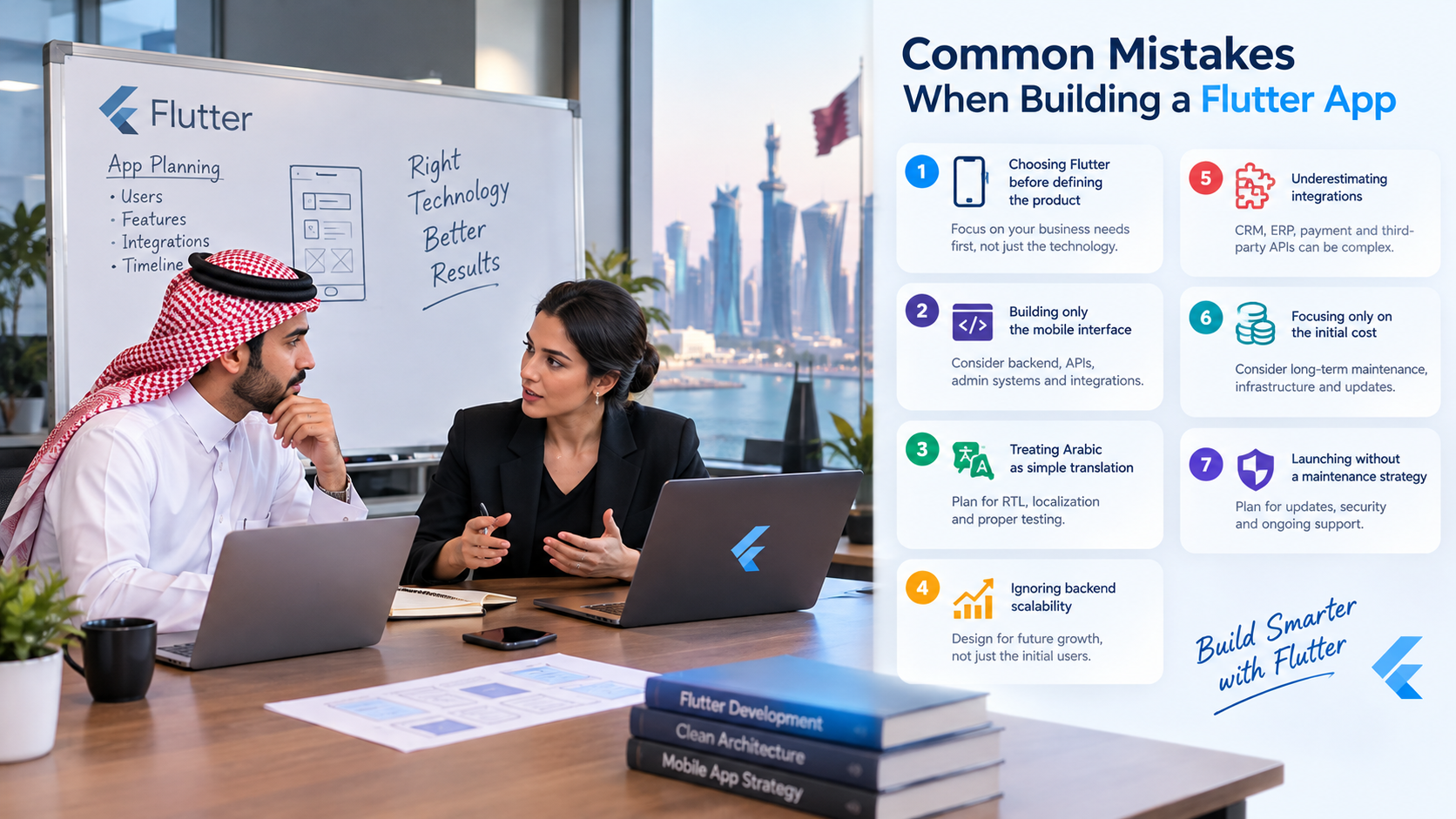
Common Mistakes When Building a Flutter App
Choosing Flutter Before Defining the Product
The first question should not be:
"Should we use Flutter?"
It should be:
"What does the business actually need?"
Flutter can then be evaluated against those requirements.
Building Only the Mobile Interface
A business application may require a backend, database, APIs, administration system, analytics, and integrations.
Ignoring these components can create problems later.
Treating Arabic as Simple Translation
Arabic support requires proper RTL interface planning and testing.
Ignoring Backend Scalability
An application that works with 100 users may require a different architecture when the user base becomes much larger.
Underestimating Integrations
Connecting a mobile app to an ERP, CRM, payment system, or third-party API can involve significant technical work.
Focusing Only on the Initial Development Price
The long-term cost of a mobile application includes maintenance, infrastructure, updates, security, and future development.
Launching Without a Maintenance Strategy
Operating systems, libraries, dependencies, backend systems, and business requirements change.
A maintenance plan should therefore be part of the project strategy.
When Is Flutter a Good Choice?
Flutter can be a strong option when a business needs:
Android and iOS applications
A shared development foundation
A consistent branded interface
Rapid iteration during development
Custom application experiences
API-driven applications
Business applications
Customer applications
E-commerce applications
Booking systems
Employee applications
Applications that may later expand to additional platforms
However, Flutter may not be the best solution for every specialized requirement.
Projects involving highly platform-specific functionality, unusual hardware capabilities, or other specialized technical constraints should be evaluated individually.
The right technology should be selected after technical discovery.
Flutter for Different Qatar Industries
Retail
Retail businesses can use mobile applications for:
Product catalogues
Orders
Loyalty
Promotions
Customer accounts
Delivery
Payments
Restaurants and Hospitality
Applications can support:
Menu browsing
Ordering
Reservations
Loyalty
Delivery
Customer notifications
Healthcare
Healthcare-related applications may include:
Appointment booking
Patient communication
Documents
Notifications
Service information
Healthcare applications require particularly careful consideration of privacy, security, access controls, and applicable requirements.
Real Estate
Property applications can provide:
Property listings
Search
Filters
Enquiries
Viewing appointments
Agent communication
Customer accounts
Logistics
Logistics applications can support:
Driver workflows
Delivery tracking
Orders
Status updates
Customer notifications
Proof of delivery
Education
Education applications may include:
Student accounts
Course information
Attendance
Assignments
Notifications
Communication
Learning resources
Business Services
Professional service companies can build applications for:
Booking
Customer portals
Service requests
Document exchange
Employee workflows
Notifications
Payments
The technology should always be adapted to the industry's actual workflow.
Flutter App Development and Business Automation
A mobile application becomes more valuable when it is connected to the wider business.
Consider a service company.
A customer submits a service request through a Flutter application.
↓
The request reaches the backend.
↓
The system creates a task.
↓
A technician receives the task.
↓
The technician updates the status.
↓
The customer receives a notification.
↓
The completed service is recorded.
↓
The finance system receives the relevant information.
This is no longer simply a mobile app.
It is a connected business workflow.
Businesses that need broader automation can combine mobile applications with business software and custom development to create technology around their operational processes.
Flutter, Cloud and DevOps
A mobile application also depends on infrastructure behind the scenes.
Cloud services may support:
APIs
Databases
File storage
Authentication
Notifications
Monitoring
Backups
Deployment
As the application grows, businesses may need more structured cloud and DevOps practices.
This can include:
Automated deployment
Monitoring
Logging
Environment management
Backup strategies
Performance monitoring
Infrastructure scaling
For projects where the mobile application is part of a larger cloud architecture, businesses can also explore cloud and DevOps solutions.
How to Choose a Flutter App Development Company in Qatar
Choosing a development partner should involve more than asking:
"How much will the app cost?"
Consider the following.
1. Technical Capability
Ask whether the development company understands:
Flutter
Backend development
APIs
Databases
Cloud infrastructure
Security
Mobile deployment
2. Business Understanding
A good development team should understand what the application is supposed to accomplish.
They should be able to discuss workflows rather than only screens.
3. Integration Experience
If your application must connect to an ERP, CRM, payment gateway, or existing website, integration capability is important.
4. UI/UX Capability
A technically functional application can still fail if the user experience is confusing.
5. Security Approach
Ask how the provider handles authentication, permissions, APIs, data protection, logging, and security updates.
6. Maintenance
Find out what happens after launch.
Ask about:
Bug fixes
Updates
Monitoring
Feature development
Technical support
7. Portfolio
Review relevant projects rather than relying only on marketing claims.
You can explore Galaxium Coding's projects and portfolio to understand the broader types of technology solutions the company works with.
8. Long-Term Scalability
Your application may start with a small user base but grow considerably.
The development partner should therefore consider the future architecture rather than building only for today's requirements.
Why Businesses Should Think Beyond the Mobile App
A mobile application is often one component of a much larger digital system.
For example:
Customer
↓
Flutter Mobile App
↓
API
↓
Business Platform
↓
CRM + ERP + Inventory + Payments
↓
Management Dashboard
This approach allows the application to become part of the company's infrastructure.
The goal should not simply be to launch an app.
The goal should be to create a reliable digital product that supports the business.
For organizations considering a broader digital transformation project, Galaxium Coding also provides web application development for portals, dashboards, business platforms, and other web-based systems.
Flutter App Development in Qatar: Practical Checklist
Before starting development, businesses should be able to answer these questions:
Business
What problem will the application solve?
Who are the primary users?
What business process will it improve?
What does success look like?
Product
What are the core features?
Which features are essential for launch?
Which features can be added later?
Will the application require Arabic and English?
Technology
Does Flutter fit the project?
Does the application require native functionality?
What backend will be used?
Which APIs are required?
Which database is required?
Integration
Does the application need CRM integration?
Does it need ERP integration?
Does it need payment integration?
Does it need maps or location?
Does it need AI?
Security
What data will be collected?
Who can access it?
How will authentication work?
How will APIs be protected?
How will sensitive information be stored?
Operations
Who will manage the application?
Who will maintain the backend?
Who will handle updates?
What happens when the user base grows?
Answering these questions before development can significantly improve project planning.
Frequently Asked Questions About Flutter App Development in Qatar
Is Flutter good for business applications?
Flutter can be a strong option for many business applications, particularly when Android and iOS applications share similar functionality and the project benefits from a common development foundation.
However, every project should be evaluated according to its technical requirements.
Can Flutter build both Android and iOS apps?
Yes. Flutter is designed to support applications across multiple platforms, including Android and iOS.
The official Flutter documentation also provides platform-specific guidance for mobile development and other supported targets.
Can Flutter applications support Arabic?
Yes. Flutter applications can be designed for Arabic interfaces, but proper RTL layout, localization, typography, navigation, forms, and testing should be considered during the design and development process.
Can a Flutter app connect to an ERP?
Yes. A Flutter application can communicate with an ERP through APIs or other supported integration mechanisms.
The exact approach depends on the ERP system and its available integration capabilities.
Can Flutter apps integrate with payment systems?
Yes. Payment functionality can be integrated into applications when the selected payment provider offers appropriate technical integration options.
Payment architecture should be planned carefully because transactions involve security, backend processing, validation, and testing.
How much does Flutter app development cost in Qatar?
There is no universal price.
The cost depends on features, design complexity, backend requirements, integrations, security, user roles, testing, deployment, and ongoing maintenance.
A proper estimate should be based on a defined project scope.
How long does it take to develop a Flutter app?
The timeline depends on the complexity of the application.
A simple application with a limited number of screens can require much less time than an enterprise application involving multiple user roles, backend systems, payments, ERP integration, dashboards, and advanced workflows.
Is Flutter better than native app development?
Neither approach is universally better.
Flutter can be attractive when businesses want Android and iOS applications with a shared development foundation.
Native development can be preferable when an application has highly specialized platform-specific requirements.
The correct choice should come from the project's technical requirements.
Can Flutter be used for web applications?
Yes. Flutter supports web applications and can also target desktop platforms.
However, Flutter's own documentation notes that not every web scenario is equally suitable for Flutter. Text-heavy, document-oriented websites may be better suited to traditional web technologies.
Should a startup in Qatar use Flutter?
A startup may consider Flutter when it needs Android and iOS applications and wants to manage development around a shared application foundation.
The decision should still be based on the product requirements, available resources, expected users, integrations, and future roadmap.
What should I ask a Flutter development company before hiring them?
Ask about:
Relevant experience
Flutter expertise
Backend development
APIs
Security
UI/UX
Integrations
Source-code ownership
Testing
Deployment
Maintenance
Post-launch support
Also ask how they would approach your specific business problem.
Final Thoughts
Flutter can be a practical technology choice for businesses in Qatar that need modern mobile applications across Android and iOS.
Its shared development approach can help teams create consistent applications while reducing unnecessary duplication. At the same time, Flutter should not be selected simply because it is a popular framework.
The strongest mobile projects begin with the business problem.
They define the users, workflows, integrations, security requirements, and future roadmap before selecting the technology.
For a Qatar business, the project may also need Arabic and English support, payment functionality, local business workflows, CRM or ERP integrations, cloud infrastructure, administration dashboards, and ongoing maintenance.
That is why successful Flutter app development is about more than building screens.
It is about creating a complete digital product that works with the business.
Galaxium Coding helps businesses evaluate and build technology solutions including mobile applications, custom software, web applications, cloud solutions, integrations, and business automation.
If you are planning a Flutter application in Qatar, the best first step is to define what the application needs to accomplish, who will use it, and how it will connect to the rest of your business.
You can contact Galaxium Coding to discuss your application requirements and determine the right development approach.