HR Digital Transformation for Businesses in Qatar: A Complete Guide
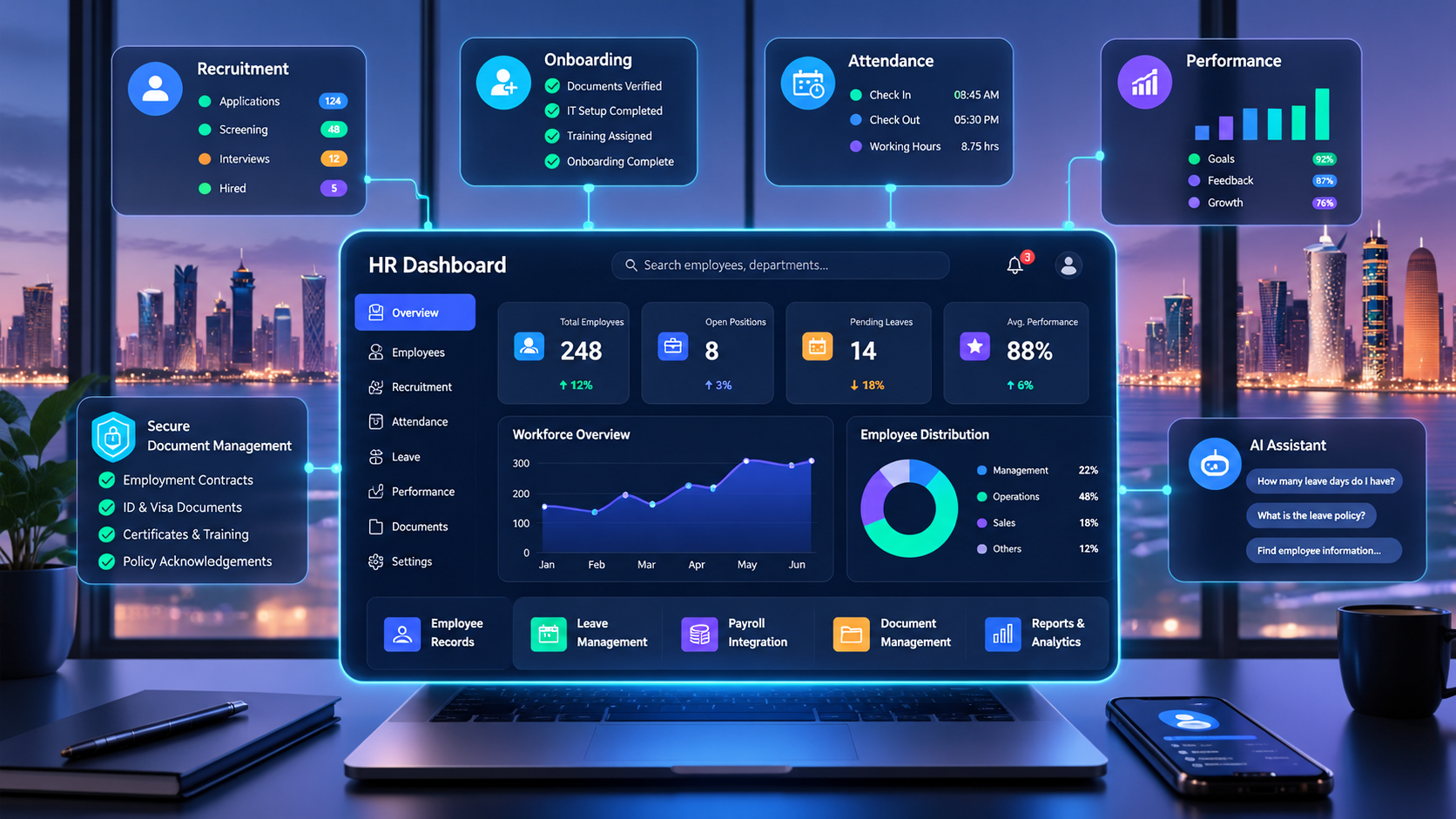
HR digital transformation connects employee management, recruitment, attendance, analytics, and automated workflows to help businesses modernize their HR operations.
HR Digital Transformation for Businesses in Qatar: A Complete Guide
Human resources is no longer limited to maintaining employee files, processing leave applications, and coordinating recruitment. For growing businesses, HR has become a strategic function that influences productivity, employee experience, compliance, and long-term business performance.
HR digital transformation is the process of using digital platforms, automation, data analytics, and connected software to improve how an organization manages its workforce. Instead of relying on disconnected spreadsheets, paper documents, emails, and repetitive administrative tasks, businesses can build connected HR workflows that make employee information easier to manage and decisions easier to support.
For businesses in Qatar, this transformation can be particularly useful when managing multiple departments, locations, employee categories, recruitment activities, and approval processes.
A company might begin with a digital employee database, then introduce attendance management, leave automation, recruitment software, payroll integrations, and employee self-service portals. Over time, these tools can become part of a connected business management system.
Businesses exploring wider custom software development services can also consider how HR technology fits into their existing digital infrastructure.
This guide explains what HR digital transformation means, which processes can be modernized, how AI and automation can help, what Qatar-based businesses should consider, and how to implement an effective HR technology strategy.
What Is HR Digital Transformation?
HR digital transformation is the modernization of human resources processes through technology.
It goes beyond converting paper documents into digital files. The objective is to improve the complete employee lifecycle, from recruitment and onboarding to performance management, training, retention, and offboarding.
A digitally enabled HR department may use:
Human resource management systems (HRMS).
Human capital management platforms (HCM).
Recruitment and applicant tracking systems (ATS).
Digital attendance and leave management.
Employee self-service portals.
Payroll and accounting integrations.
Performance management and KPI tracking.
Learning management systems.
Employee document management.
Automated approval workflows.
Workforce analytics and reporting.
AI-assisted HR tools.
These systems can operate independently or connect through integrations, depending on the company's requirements.
Traditional HR vs. Digital HR
HR activity | Traditional approach | Digitally transformed approach |
|---|---|---|
Employee records | Paper files and separate spreadsheets | Centralized digital profiles |
Recruitment | Email-based applications and manual tracking | Applicant tracking and recruitment workflows |
Attendance | Manual registers and spreadsheet calculations | Digital attendance records and configured rules |
Leave management | Paper forms or email requests | Online requests and automated approval routing |
Onboarding | Manual document collection and follow-ups | Digital checklists, notifications, and task assignment |
Performance reviews | Paper forms and scattered feedback | Structured review cycles and KPI dashboards |
Reporting | Manually compiled spreadsheets | Reports generated from connected data |
Employee requests | Emails and individual messages | Employee portal and trackable workflows |
Digital systems do not eliminate the need for HR professionals. Instead, they can reduce repetitive administration and allow HR teams to spend more time on workforce planning, employee development, and organizational improvement.
Why HR Digital Transformation Matters for Businesses in Qatar
Businesses in Qatar operate across industries such as construction, hospitality, healthcare, retail, education, finance, real estate, and professional services. Their workforce requirements can differ significantly.
A small professional services company may need straightforward employee records and leave management. A larger organization may require multiple approval levels, different work schedules, branch-based reporting, and integration with payroll or enterprise resource planning systems.
A well-planned HR digital transformation strategy helps organizations select technology according to their operational needs rather than purchasing software simply because it offers a long list of features.
1. Reduce Repetitive Administrative Work
HR teams often spend considerable time updating employee records, checking leave balances, collecting documents, preparing reports, and sending reminders.
A digital workflow can automate many routine steps.
For example:
An employee submits a leave request through a portal.
The system checks the configured leave rules and available balance.
The relevant manager receives an approval notification.
The manager approves or rejects the request.
The HR record is updated.
The employee receives the decision.
The workflow reduces unnecessary email exchanges and creates a consistent record of the request.
2. Improve Workforce Visibility
When employee information is distributed across spreadsheets, emails, and individual files, management may struggle to obtain a reliable overview of the workforce.
A centralized HR platform can help authorized users review information such as:
Employee headcount.
Department and job roles.
Recruitment pipeline.
Leave balances.
Attendance records.
Training completion.
Performance review status.
Contract and document expiry dates.
Access should be controlled according to job responsibilities so that managers only see the information they are authorized to access.
3. Support Growing and Multi-Location Businesses
As a company grows, HR administration becomes more complex. New departments, branches, managers, and employee categories can introduce additional approval and reporting requirements.
Digital HR systems can standardize processes while allowing appropriate differences between teams and locations.
For example, a company operating in Doha and other locations in Qatar might use one employee database while assigning different reporting permissions and approval routes to each department.
4. Improve Employee Experience
Employees often need quick answers to simple questions: How many leave days remain? Has a request been approved? Which documents must be submitted? When is a performance review due?
An employee self-service portal can provide access to approved information without requiring HR to respond to every routine request manually.
The result can be a more convenient and transparent employee experience.
Core Technologies Behind HR Digital Transformation
HR digital transformation is not a single product. It is a combination of technologies selected to solve specific workforce management challenges.
Human Resource Management System (HRMS)
An HRMS provides a centralized environment for managing employee information and HR administration.
Depending on the platform, features may include:
Employee profiles and employment history.
Leave and attendance management.
Document storage.
Recruitment records.
Payroll-related information.
Employee requests.
HR reports.
An HRMS is often a practical starting point for businesses moving away from manual HR processes.
Human Capital Management (HCM)
HCM platforms generally extend beyond administrative HR to support the broader employee lifecycle.
Depending on the product, they may include workforce planning, talent management, learning, compensation processes, performance management, and succession planning.
Businesses should compare actual modules and licensing terms rather than assuming every HCM product includes every capability.
Applicant Tracking Systems (ATS)
An ATS helps recruitment teams organize job applications and manage candidates throughout the hiring process.
Typical capabilities include:
Vacancy management.
Application collection.
Candidate profiles.
Interview scheduling.
Recruitment stage tracking.
Communication records.
Hiring reports.
A connected ATS can reduce the need to maintain separate candidate spreadsheets for every vacancy.
Cloud-Based HR Platforms
Cloud-based HR software allows authorized users to access the platform through supported web browsers or mobile applications.
Potential benefits include centralized updates, remote access, easier collaboration, and reduced dependence on locally maintained systems.
However, cloud hosting does not automatically guarantee security or regulatory compliance. Businesses must evaluate access controls, data storage, backup policies, contractual terms, and vendor security practices.
Employee Self-Service Portals
Employee portals allow staff to complete common HR activities independently.
Depending on the system, employees may be able to:
Update permitted personal information.
Request leave.
View attendance records.
Download authorized documents.
Access company policies.
Review payslips where supported.
Submit HR enquiries.
Track request status.
These capabilities can reduce administrative workload while giving employees greater visibility into their own records.
AI-Powered HR Tools
Artificial intelligence can support selected HR activities, including document classification, policy search, recruitment administration, and summarization.
For example, an internal HR assistant might help an employee locate the company's leave policy or explain the steps required to submit a request.
AI should not automatically make consequential employment decisions. Recruitment, promotion, disciplinary action, and performance assessment require appropriate human oversight, clear criteria, and safeguards against unfair or inaccurate outcomes.
HR Processes Businesses Can Digitize and Automate
A successful HR transformation focuses on real workflow problems. The following areas often provide useful starting points.
1. Recruitment and Candidate Management
Recruitment involves multiple activities, from publishing a vacancy to evaluating applicants and preparing an offer.
A digital recruitment workflow can connect these steps.
Example workflow:
Vacancy approved → Job published → Applications collected → Candidates reviewed → Interviews scheduled → Hiring decision recorded → Onboarding initiated.
The system can notify recruiters when applications arrive, track interview stages, and provide visibility into recruitment progress.
Automation can support administrative tasks, but candidate evaluation should use job-related criteria and appropriate human review.
2. Employee Onboarding
Employee onboarding often requires coordination between HR, IT, finance, department managers, and the new employee.
A digital onboarding process can create a checklist when a new hire is registered.
The checklist might include:
Collection and verification of required documents.
Preparation of employment paperwork.
Assignment of equipment.
Creation of authorized system accounts.
Scheduling of orientation.
Assignment of role-specific training.
Confirmation that required tasks are complete.
Each department can receive its own tasks, deadlines, and notifications.
This makes it easier to identify incomplete activities before they create operational problems.
3. Attendance and Leave Management
Attendance management can become difficult when employees follow different schedules, shifts, or approval procedures.
A digital system can record attendance information, apply configured rules, route exceptions for review, and prepare reports.
Leave management can use a similar workflow, with balances, eligibility rules, and approval permissions configured according to the organization's policies and applicable requirements.
Businesses should validate attendance calculations, overtime rules, shift arrangements, and payroll handoffs before relying on automated outputs.
4. Payroll and Finance Integration
Payroll involves sensitive employee information and calculations that require careful validation.
HR digital transformation can improve the flow of approved information between HR and payroll systems.
For example, a system might pass verified employee changes, approved leave, attendance summaries, and compensation updates to the appropriate payroll process.
The integration should define which system owns each data field, who approves changes, and how errors are detected and corrected.
Automation should support payroll accuracy, not replace necessary verification. Businesses must ensure that payroll calculations, deductions, reporting, and employment-related requirements reflect the rules applicable to their workforce in Qatar.
5. Performance Management and KPIs
Performance management can be more consistent when objectives, feedback, review dates, and development plans are recorded in a structured system.
A digital platform may support:
Individual and departmental objectives.
Review schedules.
Manager feedback.
Employee self-assessments.
Training recommendations.
Performance documentation.
Progress dashboards.
KPIs should reflect actual responsibilities and measurable business objectives. They should not be selected merely because a system can display them.
6. Employee Document Management
HR departments often manage employment agreements, identity documentation, qualifications, policy acknowledgements, and other confidential records.
A digital document management system can organize files by employee, categorize documents, and generate reminders for important dates.
Access permissions, retention policies, secure sharing, and deletion procedures should be defined before the system goes live.
7. Offboarding and Exit Management
Employee departures involve several teams and administrative steps.
A digital offboarding workflow can coordinate:
Exit documentation.
Return of company property.
Revocation of system access.
Transfer of work responsibilities.
Relevant payroll and administrative tasks.
Exit interviews where appropriate.
Record retention.
Access revocation should be timely and verified, particularly when employees have access to financial systems, customer records, or confidential company information.
How AI Can Improve HR Digital Transformation
AI can help HR teams work with information more efficiently, but the most effective use cases are usually specific and well controlled.
AI-Assisted HR Policy Search
Employees may ask recurring questions about leave policies, working arrangements, benefits, or internal procedures.
An AI assistant connected to approved HR documents can help locate relevant information and explain policy content in plain language.
The assistant should identify the source of its answer, respect document permissions, and direct employees to HR when the information is incomplete or the question requires a formal decision.
Recruitment Administration
AI tools may help organize application information, summarize candidate-provided experience, or support interview scheduling.
However, automated rankings can introduce bias or exclude qualified applicants. Organizations should evaluate these systems carefully and ensure that human decision-makers remain accountable.
Document Processing
AI-assisted document processing can help classify incoming documents, extract selected fields, or identify missing information.
Extracted data should be validated before it is added to an official employee record, particularly when errors could affect employment or payroll.
HR Reporting and Workforce Insights
Analytics tools can help HR teams identify patterns in staffing, recruitment timelines, training completion, or employee absence.
AI may assist with summarization and exploration, but correlation does not prove causation. Workforce predictions should be reviewed for data quality, bias, and relevance before influencing management decisions.
Where AI Should Not Replace Human Judgment
Businesses should exercise particular care when AI is used for:
Hiring and candidate rejection.
Promotion decisions.
Disciplinary recommendations.
Employee performance ratings.
Termination decisions.
Sensitive employee investigations.
These activities can affect people's livelihoods and opportunities. Any technology used in these contexts needs careful governance, appropriate human review, and assessment of applicable legal obligations.
HR Digital Transformation Considerations for Qatar
A successful HR implementation in Qatar requires attention to the company's actual workforce structure and the requirements applicable to its operations.
Employment and HR Compliance
Before automating employment processes, businesses should review the current requirements that apply to their organization and employee categories.
Relevant topics may include employment documentation, working hours, leave entitlements, wage payment processes, recordkeeping, and applicable procedures for employment changes or termination.
Businesses should consult the relevant official authorities and qualified legal or HR advisers when interpreting specific requirements.
The Qatar Government's official Hukoomi portal is a useful starting point for locating government services and public information.
Automation should reflect verified requirements rather than assumptions embedded in a software template.
Arabic and English Support
Depending on the workforce, a business may benefit from bilingual interfaces, employee communications, policies, and documentation.
Before selecting an HR platform, verify whether it supports the languages needed for employee screens, reports, notifications, search, and administrative workflows.
Translation alone may not be sufficient when a process requires precise legal or contractual wording.
Workforce Structure and Shift Management
Organizations in hospitality, construction, healthcare, retail, and other operational sectors may manage shift-based teams, site assignments, multiple departments, or different approval structures.
The HR platform should support the organization's actual scheduling and reporting requirements.
For example, a business may need a central HR team to manage employee records while site supervisors submit attendance exceptions and department managers approve leave.
Data Protection and Employee Privacy
HR systems contain sensitive information, making privacy and security essential parts of digital transformation.
Businesses should assess the requirements of Qatar's applicable personal data protection framework, including Law No. 13 of 2016 on Protecting Personal Data Privacy, and verify current guidance with qualified advisers.
Useful official starting points include the Qatar National Cyber Security Agency and relevant government resources.
Practical safeguards include:
Role-based access controls.
Multi-factor authentication where appropriate.
Encryption in transit and at rest.
Audit logs for sensitive actions.
Secure backup and recovery.
Controlled integrations and API access.
Documented retention and deletion rules.
Vendor security assessments.
Incident response procedures.
Employee privacy notices and appropriate handling of data requests.
Organizations should also evaluate cloud hosting locations, international data transfers, third-party access, and contractual responsibilities according to the applicable legal framework.
Integrating HR Software With Existing Business Systems
HR software becomes more useful when approved information can move reliably between the systems a business already uses.
However, integration should be planned carefully. Connecting systems without defining data ownership can create duplicate records, inconsistent calculations, and security gaps.
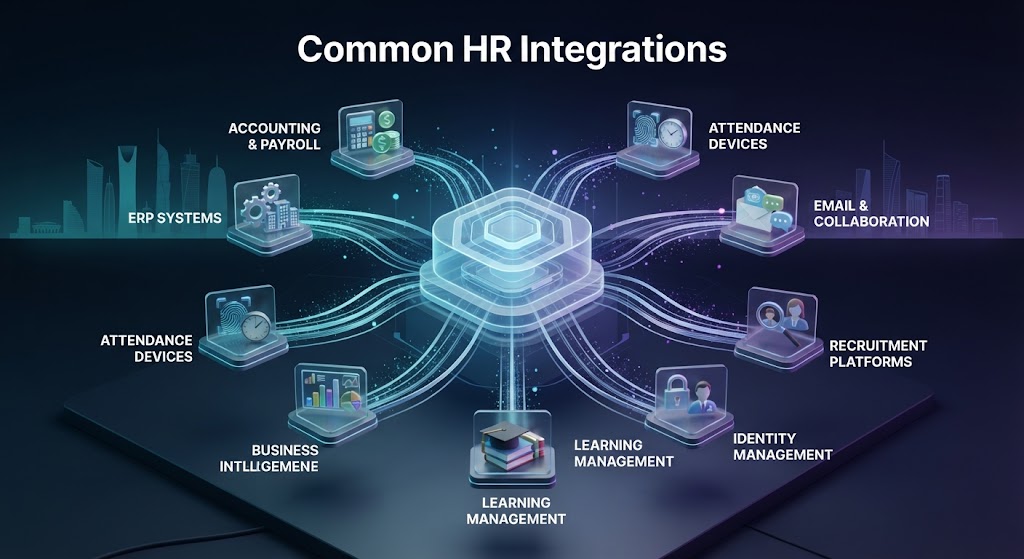
Common HR Integrations
System | Potential integration |
|---|---|
Accounting and payroll | Approved employee changes and payroll inputs |
ERP | Employee information relevant to operational planning |
Attendance devices | Attendance records and exceptions |
Recruitment platforms | Candidate and hiring information |
Learning management systems | Training assignments and completion |
Identity management | User provisioning and access removal |
Business intelligence | Authorized workforce reporting |
Email and collaboration tools | Notifications and approval requests |
Businesses can explore web application development when they need browser-based portals or interfaces tailored to their workflows.
Where information must move between several platforms, integration design should establish a clear source of truth for each data type.
For example, the HRMS may own employee job details, the attendance system may collect clock-in events, and the payroll platform may calculate final pay. The integration should define how verified information moves between these systems and how discrepancies are handled.
Custom HR Software vs. Ready-Made HR Platforms
Businesses generally have two main options: adopt an existing HR platform or build a custom solution.
Neither approach is automatically better. The decision depends on the complexity of the business, the available budget, the required features, and the need to integrate with existing systems.
Factor | Ready-made HR software | Custom HR software |
|---|---|---|
Initial implementation | Often faster when requirements fit | Requires discovery, design, and development |
Features | Based on the vendor's available modules | Designed around agreed business requirements |
Customization | Limited by the product and plan | Greater control over workflows and interfaces |
Integrations | Depends on available connectors and APIs | Can be designed for specific integration needs |
Maintenance | Shared with or managed by the vendor, depending on the agreement | Requires an agreed development and maintenance arrangement |
Cost structure | May include subscriptions, implementation, and add-ons | May include discovery, development, hosting, and ongoing support |
Best suited for | Businesses whose needs match an established product | Businesses with specialized workflows or integration requirements |
A hybrid approach is also possible. A business can use a ready-made HR platform for standard functions and develop a custom employee portal or integration for a specific operational requirement.
Before making the decision, businesses can review the differences between custom software and off-the-shelf software.
How to Implement HR Digital Transformation Step by Step
A phased implementation can help businesses control complexity, test workflows, and improve adoption.
Step 1: Assess Existing HR Processes
Document how recruitment, onboarding, attendance, leave, payroll handoffs, performance reviews, and employee records are currently managed.
Identify duplicated work, recurring errors, delays, and processes that depend too heavily on individual employees.
Step 2: Define Measurable Objectives
Set clear goals before selecting technology.
Examples include:
Reducing the time required to complete onboarding.
Improving employee record accuracy.
Shortening leave approval times.
Reducing manual report preparation.
Increasing completion of scheduled performance reviews.
Record the current baseline so that progress can be measured after implementation.
Step 3: Prioritize High-Value Workflows
Do not attempt to digitize every HR activity at once.
Start with workflows that have clear requirements and manageable implementation risks. Employee records, leave requests, and onboarding checklists may be suitable starting points for some businesses.
More complex payroll integrations or AI-supported decision processes may require additional planning.
Step 4: Choose the Right Platform
Compare potential systems against a documented requirements list.
Evaluate usability, security, reporting, localization, integration options, support, scalability, pricing, and data export capabilities.
Request demonstrations based on real company workflows rather than relying only on generic product presentations.
Step 5: Clean and Validate Employee Data
Before migrating records, identify duplicate profiles, missing fields, outdated information, and inconsistent formats.
Assign responsibility for validating important employee data and establish a controlled process for correcting errors.
Poor-quality data can undermine even a technically sound HR platform.
Step 6: Configure Roles and Workflows
Define who can view employee information, submit requests, approve changes, and administer the system.
Test common scenarios and exceptions, including rejected leave requests, changes in managers, incomplete onboarding documents, and employee departures.
Step 7: Integrate Required Systems
Identify which systems need to exchange information and define how the integrations should behave.
Test successful transactions, duplicate submissions, missing data, access failures, and recovery from interruptions.
Step 8: Train Employees and Managers
Provide clear instructions for employees, supervisors, HR staff, and system administrators.
Use practical examples and simple guidance. Employees should know where to submit requests, how to track their status, and whom to contact when something goes wrong.
Step 9: Launch in Phases
Where practical, begin with a pilot department or a limited group of users.
Collect feedback, resolve issues, and verify that workflows operate as expected before expanding access.
Step 10: Measure and Improve
Review the agreed KPIs after launch.
Track administrative effort, workflow completion, error rates, user feedback, and adoption. Use these findings to prioritize improvements rather than adding features without a clear purpose.
How Much Does HR Digital Transformation Cost in Qatar?
There is no single price for HR digital transformation. Costs depend on whether a business adopts existing software, configures an HR platform, integrates several products, or develops a custom system.
Potential cost components include:
Software subscriptions or licenses.
Implementation and configuration.
Employee data migration.
Custom development.
Payroll and third-party integrations.
Hosting and infrastructure.
Security and testing.
Staff training.
Ongoing support and maintenance.
A basic HR platform with employee records and leave management will generally involve a different level of investment from a custom enterprise system connecting recruitment, payroll, attendance, ERP, analytics, and employee portals.
When comparing proposals, consider the total cost of ownership rather than only the initial price.
Ask providers to clarify implementation fees, recurring charges, user limits, customization costs, support arrangements, data export, and future upgrade requirements.
A phased implementation can help businesses invest in the most important capabilities first and expand when measurable needs justify the additional expense.
Common HR Digital Transformation Mistakes
1. Automating Inefficient Processes
Digitizing a confusing workflow does not automatically improve it.
Review the process first, remove unnecessary steps, and then configure the software.
2. Ignoring Employee Adoption
A system that employees find difficult to use may result in workarounds and incomplete records.
Choose an understandable interface and provide appropriate training.
3. Overlooking Data Security
Employee records should not be accessible to every user by default.
Define permissions, logging, retention, and incident response requirements before launch.
4. Choosing Software Without Checking Integrations
A platform may offer attractive features but still fail to connect properly with the business's payroll, attendance, or finance systems.
Verify integrations and test them using realistic data.
5. Migrating Inaccurate Data
Duplicate or outdated records can produce unreliable reports and administrative problems.
Clean and validate the data before migration.
6. Automating High-Impact Decisions Without Oversight
AI-generated recommendations should not be treated as automatically correct.
Employment-related decisions require appropriate human judgment, documented procedures, and safeguards against unfair outcomes.
7. Failing to Measure Results
Without baseline metrics, businesses cannot determine whether a new HR system has improved operations.
Define success criteria before implementation and review them regularly.
Future Trends in HR Digital Transformation
HR technology continues to evolve, but businesses should adopt new capabilities according to their actual needs.
More Connected HR Ecosystems
Organizations are increasingly interested in connecting employee information, recruitment, attendance, learning, payroll, and workforce reporting rather than maintaining isolated systems.
AI-Assisted Employee Services
AI assistants may help employees find policies, locate approved information, and navigate routine HR processes.
Clear permissions, reliable source documents, and human escalation remain important.
Workforce Analytics
Better reporting can help organizations understand recruitment pipelines, training completion, staffing patterns, and workforce planning needs.
The usefulness of analytics depends on data quality and responsible interpretation.
Mobile-Friendly HR Experiences
Mobile-friendly interfaces can make it easier for employees to submit requests, access permitted documents, and receive notifications, particularly when they are not regularly working at a desk.
Greater Focus on Governance
As organizations collect and connect more workforce information, data privacy, cybersecurity, access controls, retention, and responsible AI use will remain important priorities.
The most successful strategy is not to adopt every new feature. It is to build a secure, maintainable HR environment that supports employees and business objectives.
How Galaxium Coding Can Support HR Digital Transformation
Businesses planning to modernize HR may need more than a standalone application. Depending on their requirements, they may need a custom employee portal, workflow automation, API integrations, reporting dashboards, or a connection between existing business systems.
Galaxium Coding provides technology and software development services that businesses can explore when assessing these requirements.
Its software development services may be relevant to organizations considering tailored business systems, while web application development can be relevant when a browser-based employee or management portal is needed.
For businesses with wider infrastructure requirements, cloud and DevOps solutions may also be worth evaluating.
The right approach depends on the problem being solved. Some businesses will be best served by an established HR platform; others may benefit from carefully scoped customization or integration.
Before starting a project, document the current workflow, desired improvements, existing systems, security requirements, and expected outcomes.
You can contact Galaxium Coding to discuss your software requirements and explore an appropriate digital solution.
Conclusion
HR digital transformation helps businesses move from fragmented administrative processes toward connected, consistent, and more manageable workforce operations.
For businesses in Qatar, useful opportunities include employee self-service, digital onboarding, attendance management, recruitment workflows, performance tracking, document management, and carefully planned integrations with payroll and other business systems.
Success depends on more than choosing software. Businesses need clear objectives, accurate employee data, secure access controls, suitable integrations, employee training, and ongoing performance measurement.
A practical starting point is to identify one recurring HR problem, understand why it occurs, and select a digital solution that addresses it. Once the first workflow is working reliably, the organization can expand its HR capabilities according to its needs.
The goal is not simply to make HR digital. It is to make HR processes more reliable, transparent, secure, and useful to both employees and management.
Frequently Asked Questions (FAQs)
1. What is HR digital transformation?
HR digital transformation is the use of software, automation, analytics, and connected digital systems to improve HR activities such as recruitment, onboarding, attendance, leave management, employee records, and performance reviews.
2. Why is HR digital transformation important for businesses in Qatar?
It can help businesses in Qatar reduce repetitive administration, improve workforce visibility, standardize HR workflows, and manage employee information more effectively. The specific benefits depend on the organization's size, industry, and existing processes.
3. What is the difference between HRMS and HCM?
An HRMS generally focuses on HR administration and employee information, while HCM often includes broader workforce capabilities such as talent management, learning, performance, and workforce planning. Exact features vary by provider.
4. Can HR processes be automated?
Yes. Suitable processes include leave approvals, onboarding checklists, document reminders, recruitment notifications, employee requests, and routine report generation. Sensitive calculations and high-impact decisions still require appropriate verification and oversight.
5. Can AI be used in HR management?
AI can assist with policy search, document processing, summarization, and selected administrative tasks. Its use in hiring, performance evaluation, and other consequential employment decisions requires careful risk assessment, human oversight, and appropriate safeguards.
6. Is custom HR software better than ready-made HR software?
Not necessarily. Ready-made platforms can be suitable when their features match the business's requirements. Custom software may be useful when workflows, integrations, or reporting needs are not adequately supported by existing products.
7. How much does HR software cost in Qatar?
The cost depends on licensing, user numbers, implementation, data migration, customization, integrations, training, and ongoing support. Businesses should compare complete proposals and total ownership costs rather than assume a single standard price.
8. Is cloud-based HR software secure?
It can be secure when appropriately configured and managed, but cloud hosting alone does not guarantee security. Businesses should assess authentication, permissions, encryption, backups, vendor practices, data location, and applicable privacy requirements.
9. How long does HR digital transformation take?
The timeline depends on the scope, data quality, number of users, integration requirements, and complexity of existing processes. A focused HR workflow may be implemented more quickly than a multi-department enterprise system. A realistic schedule should follow a requirements assessment.
10. How should a business start its HR digital transformation journey?
Begin by mapping current HR processes, identifying the biggest operational problems, defining measurable goals, and prioritizing one or two high-value workflows. Then evaluate suitable software, plan data migration and security, train users, and measure results after launch.
Call to Action
Ready to modernize your HR operations?
Explore Galaxium Coding's software development services to learn about potential technology solutions for business workflows, integrations, and digital systems. To discuss your specific requirements, contact the Galaxium Coding team.