Mobile App Maintenance Cost: What Businesses Need to Know
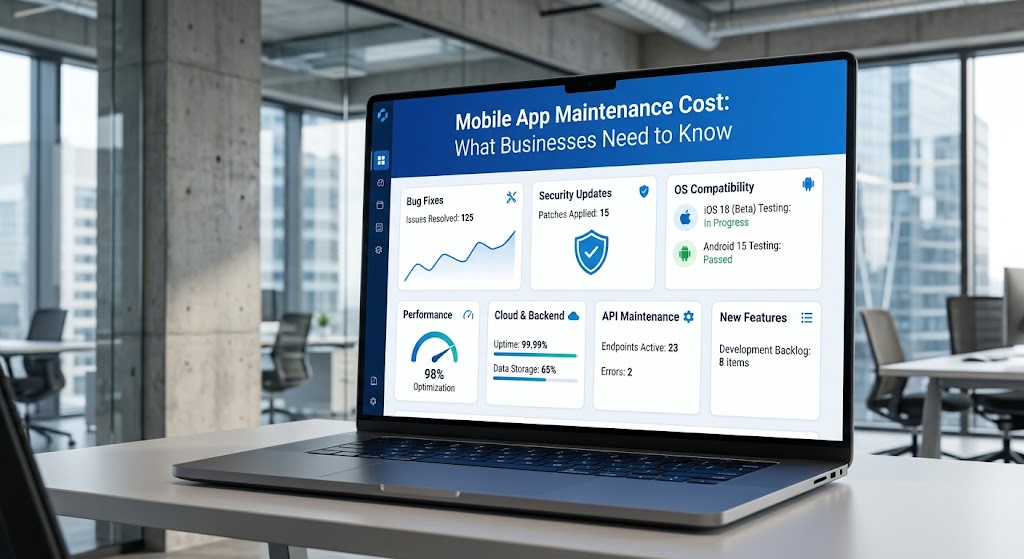
Mobile app maintenance keeps applications secure, compatible, reliable and ready for future business requirements.
Mobile App Maintenance Cost: What Businesses Need to Know
A mobile application is not finished when it is launched.
After an app goes live, businesses need to keep it secure, compatible with new operating-system versions, responsive to users, connected to APIs and backend systems, and updated as business requirements change. These ongoing activities are generally referred to as mobile app maintenance.
For businesses planning a mobile application, understanding maintenance cost is just as important as understanding the original development cost.
A relatively simple app may require occasional bug fixes and compatibility updates, while a business application connected to payments, CRM, ERP, inventory, location services, APIs, cloud infrastructure, and third-party platforms may require continuous technical support.
This guide explains what mobile app maintenance includes, what affects its cost, how businesses can budget for it, and what companies in Qatar should consider before launching an Android or iOS application.
What Is Mobile App Maintenance?
Mobile app maintenance is the ongoing technical work required to keep an application functional, secure, compatible, and useful after launch.
Maintenance can include:
Bug fixing
Security updates
Operating-system compatibility
Performance optimization
API maintenance
Database maintenance
Third-party integration updates
App Store and Google Play updates
Server and cloud maintenance
UI improvements
Analytics monitoring
New features
Technical support
Backup and recovery
Device compatibility testing
Maintenance is therefore broader than simply fixing bugs.
For example, an application may work correctly when it launches, but a future Android or iOS update could introduce compatibility issues. A payment provider may change its API. A business may introduce a new CRM. Customers may request a new feature. A security vulnerability may require an urgent update.
These situations can all create maintenance work.
Galaxium Coding's current mobile application guidance similarly emphasizes that applications may require bug fixes, security updates, OS compatibility updates, performance improvements, API updates, dependency updates, analytics monitoring, and new features after launch.
Businesses planning a new application can also review mobile application development services to understand how the application itself can be designed around long-term business requirements.
Is Mobile App Maintenance Really Necessary?
Yes.
A mobile application interacts with several constantly changing environments:
Mobile App → Operating System → Device → Backend → APIs → Database → Third-Party Services
Any part of this environment can change.
For example:
Apple releases an iOS update.
The application uses an outdated dependency.
A payment API changes.
The app starts producing errors.
Users report the problem.
Developers investigate and release an update.
Without an appropriate maintenance process, these issues can remain unresolved.
Maintenance also helps businesses avoid allowing small technical problems to become expensive redevelopment projects.
What Does Mobile App Maintenance Include?
Mobile app maintenance can be divided into several categories.
1. Bug Fixes
Bug fixing is one of the most obvious forms of maintenance.
Bugs can affect:
Login
Registration
Payments
Notifications
Forms
Search
Checkout
Profile management
File uploads
Maps
Product information
Synchronization
Reporting
Some bugs are minor and affect only a small part of the application.
Others can prevent customers from completing important actions.
For example, if an e-commerce application crashes during checkout, the problem can directly affect sales.
2. Operating-System Updates
Android and iOS continue to evolve.
New versions can introduce changes to:
Permissions
Background processing
Notifications
Security
APIs
Device capabilities
User-interface behavior
Privacy controls
An application therefore needs to be tested against supported operating-system versions.
This is particularly important for businesses that want their application to remain available to customers over several years.
3. Security Maintenance
Security should not be treated as a one-time development task.
Ongoing security maintenance may include:
Dependency updates
Authentication improvements
Authorization checks
API security
Encryption-related updates
Vulnerability fixes
Session management
Access-control reviews
Secure configuration
Server updates
A business application may also store sensitive customer or employee information.
That makes security maintenance an important part of the overall technology budget.
4. Performance Optimization
Application performance can change over time.
As the number of users, records, products, transactions, images, or API requests increases, the original architecture may need optimization.
Maintenance may involve:
Reducing app loading time
Optimizing API requests
Improving database queries
Reducing unnecessary network calls
Optimizing images
Improving caching
Reducing crashes
Monitoring server performance
An application that worked well with 1,000 users may require additional optimization when usage grows significantly.
5. API and Integration Maintenance
Modern mobile applications rarely operate independently.
They may connect to:
CRM systems
ERP systems
Accounting platforms
Payment gateways
Maps
Delivery platforms
SMS services
Email services
Authentication systems
Cloud platforms
AI services
Analytics platforms
If one of these services changes its API, the mobile application may require updates.
For example:
Mobile App → Payment API → Payment Provider
If the provider changes authentication requirements, the application's integration may need to be modified and tested.
This is one reason integration complexity can have a significant impact on maintenance cost.
6. App Store and Google Play Updates
Publishing an application is not the end of the process.
Businesses may need to manage:
New application versions
Store metadata
Screenshots
Privacy information
Release notes
Version compatibility
Review requirements
Platform-specific updates
The technical team may need to prepare and test releases before they are submitted.
7. Database and Backend Maintenance
The mobile application is only one part of the system.
A typical architecture may look like:
Mobile App → API → Backend → Database
If the backend becomes slow, unstable, outdated, or difficult to scale, the mobile experience can also suffer.
Backend maintenance may therefore include:
Database optimization
Server updates
API improvements
Backup monitoring
Error monitoring
Infrastructure maintenance
Scaling
Security updates
Businesses should therefore avoid calculating mobile maintenance as if only the smartphone application needs support.
Types of Mobile App Maintenance
Not every maintenance activity happens for the same reason.
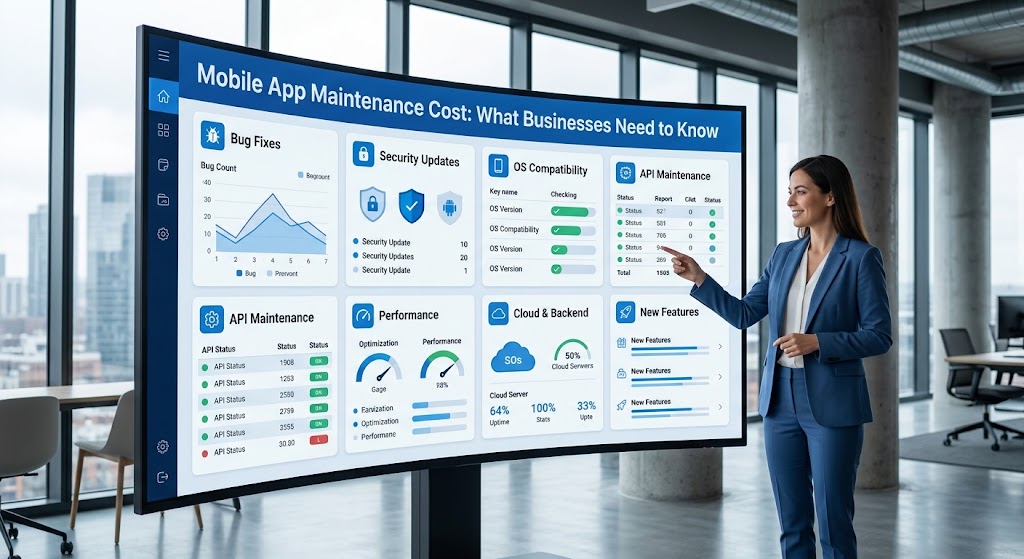
Four common categories are useful when planning a maintenance budget.
Corrective Maintenance
Corrective maintenance addresses problems that have already appeared.
Examples include:
Fixing crashes
Correcting calculation errors
Repairing broken buttons
Fixing login problems
Resolving payment errors
Adaptive Maintenance
Adaptive maintenance changes the application because its environment has changed.
Examples include:
New Android versions
New iOS versions
API changes
New device specifications
Cloud platform changes
Third-party service changes
Perfective Maintenance
Perfective maintenance improves the application even when it is technically working.
Examples include:
Improving navigation
Redesigning a screen
Adding search filters
Improving checkout
Adding dashboards
Improving user experience
Preventive Maintenance
Preventive maintenance focuses on reducing future problems.
Examples include:
Refactoring outdated code
Updating dependencies
Improving monitoring
Strengthening security
Improving automated testing
Optimizing database structure
A good maintenance strategy normally considers all four categories.
How Much Does Mobile App Maintenance Cost?
There is no universal mobile app maintenance price.
The cost depends on the application itself and the level of support required.
A useful way to think about maintenance cost is:
Maintenance Cost = Application Complexity + Infrastructure + Integrations + Support Level + Future Changes
A small application with limited functionality may require relatively little ongoing work.
A large business platform may require a dedicated maintenance process involving developers, backend engineers, QA specialists, cloud support, security monitoring, and product management.
A Simple Cost Model
Businesses can divide maintenance into several budget categories:
Maintenance Area | Typical Cost Impact |
|---|---|
Bug fixes | Depends on issue frequency and severity |
OS compatibility | Depends on supported platforms and testing requirements |
Security | Higher for sensitive or business-critical applications |
API integrations | Depends on number and complexity of integrations |
Cloud/backend | Depends on infrastructure and usage |
New features | Depends on development scope |
UI/UX improvements | Depends on design and implementation |
Monitoring | Depends on application size and availability requirements |
Technical support | Depends on required response time |
App Store management | Usually part of ongoing release management |
This approach is more useful than relying on a single percentage or generic maintenance price.
Why There Is No Fixed Maintenance Price
Consider two applications.
Application A
A basic informational application may contain:
Company information
Services
Contact form
About page
Basic notifications
Its maintenance requirements may be relatively limited.
Application B
A business platform may contain:
Customer accounts
Payments
Orders
CRM
Inventory
GPS
Push notifications
Chat
AI
Real-time updates
Admin dashboard
Multiple APIs
Cloud infrastructure
The second application requires a much larger maintenance effort.
The difference illustrates why businesses should request maintenance estimates based on actual requirements rather than an arbitrary industry percentage.
What Factors Affect Mobile App Maintenance Cost?
Several factors can influence the total cost.
1. App Complexity
More features generally mean more components to maintain.
A simple application with ten screens is fundamentally different from a platform containing dozens of workflows, dashboards, integrations, and user roles.
2. Android and iOS Support
Supporting both major mobile platforms can increase maintenance requirements because testing and release processes need to account for both environments.
Businesses should also consider whether they need:
Phones only
Tablets
Multiple device sizes
Older operating systems
New operating systems
Different screen resolutions
3. Number of Integrations
An application connected to several external systems can require more maintenance than a standalone app.
For example:
App → CRM → ERP → Payment → Delivery → Analytics
Every additional connection can create another dependency.
4. Backend Complexity
If the mobile application relies on a sophisticated backend, maintenance must include the backend environment.
This can involve:
APIs
Databases
Authentication
Cloud infrastructure
File storage
Business logic
Background processes
5. User Base
A larger user base can create additional operational requirements.
More users can mean:
More traffic
More database activity
More support requests
More analytics
More performance monitoring
Greater infrastructure requirements
6. Security Requirements
Applications dealing with sensitive information generally require stronger security controls and monitoring.
Examples include:
Financial applications
Healthcare applications
Employee applications
Customer portals
Business management applications
Security requirements should be considered when estimating long-term maintenance.
7. Frequency of New Features
Some businesses want their application to remain relatively stable.
Others want continuous development.
For example:
Maintenance-only model
Bug fixes + security + compatibility + monitoring
Continuous-improvement model
Maintenance + UI improvements + new features + integrations + analytics
The second model naturally requires a larger ongoing budget.
Mobile App Maintenance Cost vs New Feature Development
One important distinction is between maintenance and new development.
Suppose a restaurant application already supports:
Menu browsing
Customer accounts
Ordering
Payments
The business later wants to introduce:
Loyalty points
AI recommendations
Subscription plans
Table reservations
These are not simply bug fixes.
They may require new product development.
A maintenance agreement should therefore clearly define what is included and what is considered additional development.
What Should a Mobile App Maintenance Contract Include?
Before signing a maintenance agreement, businesses should understand exactly what they are paying for.
A maintenance contract can specify:
Technical Support
Support channels
Working hours
Response times
Emergency support
Bug Fixing
What qualifies as a bug
Severity levels
Resolution targets
Testing requirements
Platform Updates
Android updates
iOS updates
Device compatibility
Store submission
Security
Vulnerability fixes
Dependency updates
Security monitoring
Access-control reviews
Infrastructure
Server maintenance
Database monitoring
Backups
Cloud support
Feature Development
The agreement should clarify whether new features are included or billed separately.
This prevents misunderstandings later.
How to Budget for Mobile App Maintenance
A practical budgeting approach is to divide the expected yearly technology spending into categories.
Core Maintenance
Budget for:
Bug fixing
Security updates
OS compatibility
Monitoring
Infrastructure
Budget for:
Hosting
Database
Storage
Traffic
Third-party services
Product Improvements
Budget separately for:
New features
UI/UX improvements
New integrations
Business automation
Emergency Reserve
It is also sensible to maintain a contingency budget for unexpected issues.
For example, an urgent third-party API change could require development work outside the normal maintenance schedule.
Mobile App Maintenance for Businesses in Qatar
Businesses in Qatar should consider maintenance as part of the application's long-term digital strategy.
A business application may need to support:
Local customers
Arabic and English interfaces
Online payments
Delivery workflows
Customer accounts
Business dashboards
CRM integrations
ERP integrations
Employee workflows
Cloud services
The exact requirements depend on the industry and application.
For example, a retail business may prioritize inventory, orders, payments, loyalty, and delivery.
A real estate company may need:
Property listings
Leads
Customer profiles
Viewing appointments
Agents
Notifications
Documents
CRM integration
A healthcare business may require:
Appointments
Patient accounts
Notifications
Secure records
Doctor workflows
Payment functionality
This means maintenance planning should start with the business workflow rather than a generic mobile-app package.
Businesses can also consider custom software development when the mobile application needs to become part of a broader business system.
Arabic and English Mobile Applications
For businesses serving Qatar's diverse customer base, bilingual support may be an important consideration.
If an application supports both Arabic and English, maintenance may involve:
Translation updates
Right-to-left interface testing
Layout testing
Font compatibility
Notification translation
New feature localization
Adding a new feature is therefore not always only a development task.
The feature may also need to be tested across both languages.
Mobile App Maintenance and Cloud Infrastructure
Many applications depend on cloud infrastructure for:
APIs
Databases
File storage
Authentication
Notifications
Analytics
Background processing
Cloud maintenance can therefore become part of the overall application maintenance budget.
Businesses with significant cloud requirements may benefit from integrating their mobile application strategy with Cloud and DevOps solutions.
The goal is to ensure that the mobile application, backend, infrastructure, deployment process, monitoring, and security work together.
Mobile App Maintenance and APIs
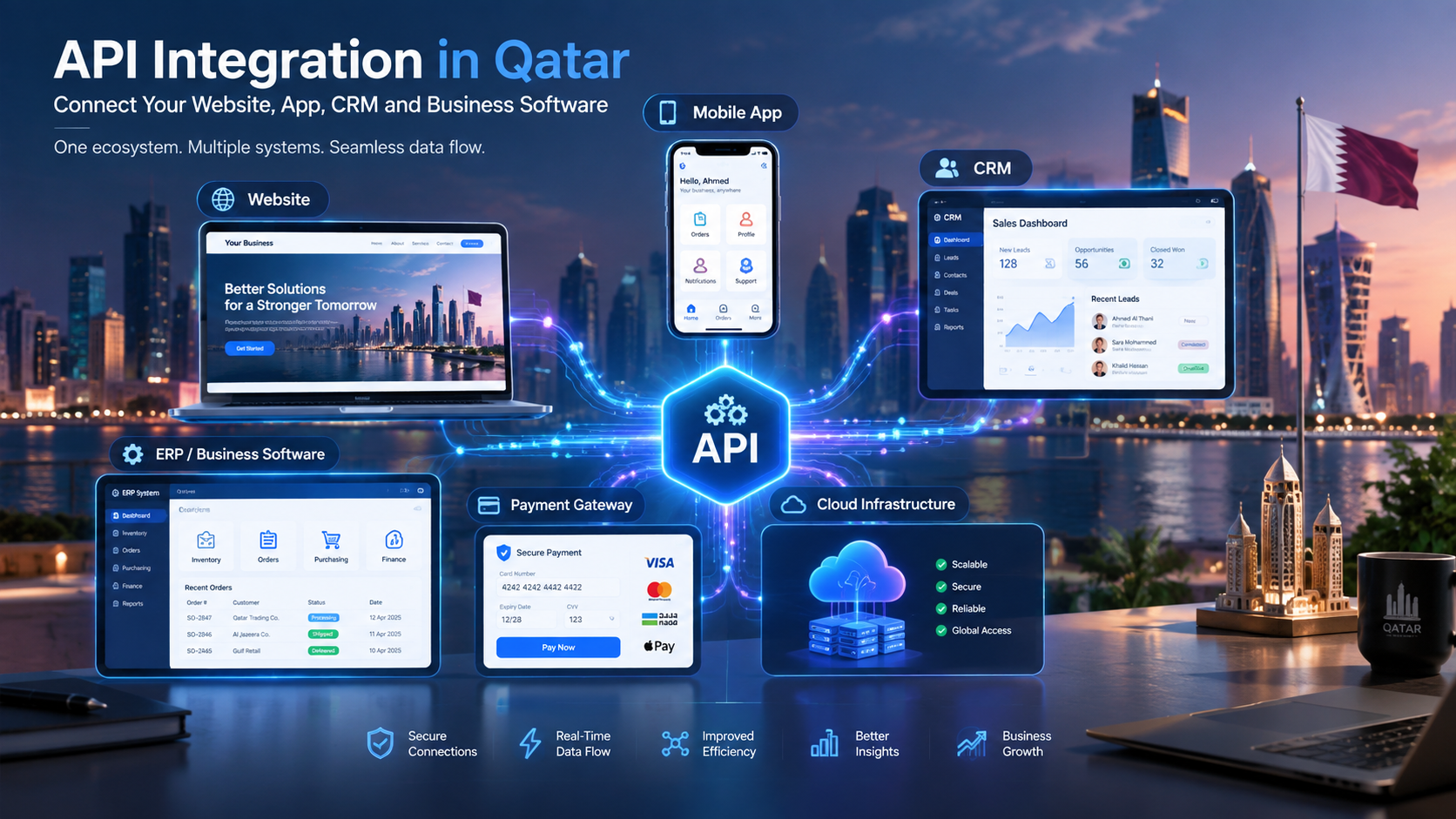
APIs are particularly important for modern applications.
Consider:
Mobile App → API → CRM
or:
Mobile App → API → ERP → Inventory
If the API changes, the application may need to change as well.
A well-maintained API strategy should include:
Version management
Authentication
Documentation
Error handling
Monitoring
Security
Testing
This becomes especially important when a mobile application is connected to several business systems.
Mobile App Maintenance and Security
Security should be treated as an ongoing process.
A maintenance strategy should consider:
Authentication
Make sure user authentication remains secure.
Authorization
Users should only access information and actions they are permitted to use.
API Security
APIs should be protected against unauthorized access.
Dependency Updates
Outdated libraries and dependencies can introduce technical and security risks.
Data Protection
Businesses should understand what information the app collects, where it is stored, and who can access it.
Monitoring
Logs and monitoring can help identify suspicious behavior and technical problems.
Security requirements vary by application, so businesses should assess their specific architecture and data.
Mobile App Maintenance and Performance Monitoring
Fixing problems after customers report them is not always enough.
Monitoring can help businesses identify problems earlier.
Useful metrics may include:
Crash frequency
API response time
App loading time
Failed transactions
Login failures
Server availability
Database performance
Error rates
For example, if checkout failures suddenly increase, the technical team can investigate before the issue affects an even larger percentage of customers.
Should Businesses Build Maintenance Into the Original Development Budget?
Absolutely.
Maintenance should be discussed before development begins.
During the planning stage, businesses should ask:
Who will maintain the application?
How will bugs be reported?
Who handles Android updates?
Who handles iOS updates?
Who manages backend infrastructure?
Who manages APIs?
Who handles security updates?
How quickly are critical issues addressed?
How are new features priced?
Who manages app-store releases?
These questions can prevent unexpected costs after launch.
Galaxium Coding's existing mobile-development guidance also recommends asking development partners who will maintain the application after launch and clarifying bug fixes, security updates, server maintenance, new features, store updates, performance monitoring, and technical support.
Mobile App Maintenance vs App Redesign
Maintenance does not necessarily mean rebuilding the entire application.
Sometimes a business only needs:
Bug fixes
Performance improvements
Security updates
Small UI changes
A redesign may become necessary when the application has larger problems such as:
Outdated architecture
Poor user experience
Difficult-to-maintain code
Unsupported dependencies
Serious performance limitations
Major business changes
A professional technical assessment can help determine whether maintenance is sufficient or whether redevelopment is more practical.
Common Mobile App Maintenance Mistakes
Mistake 1: Assuming Launch Means Completion
Launching the application is the beginning of its operational life.
Mistake 2: Budgeting Only for Bug Fixes
Maintenance also includes security, compatibility, infrastructure, APIs, monitoring, and improvements.
Mistake 3: Ignoring Backend Maintenance
The mobile interface depends on backend systems.
Mistake 4: Not Defining Support Levels
Businesses should know whether their provider offers standard support, priority support, or emergency response.
Mistake 5: Treating New Features as Maintenance
New functionality can require separate development resources.
Mistake 6: Ignoring Third-Party Dependencies
Payment providers, maps, analytics, authentication services, and APIs can change.
Mistake 7: Waiting Until Something Breaks
Preventive maintenance can help reduce avoidable technical problems.
How to Reduce Mobile App Maintenance Costs
Reducing maintenance does not mean choosing the cheapest development option.
Instead, businesses should reduce avoidable complexity.
Start With Clear Requirements
Unclear requirements can result in unnecessary development and future changes.
Build a Maintainable Architecture
Good architecture can make future updates easier.
Use Appropriate Technologies
The technology stack should match the application's requirements and long-term plans.
Automate Testing
Automated tests can help identify regressions when new code is introduced.
Monitor Performance
Monitoring helps identify problems before they become major incidents.
Document the System
Documentation can reduce dependency on individual developers.
Plan APIs Carefully
Well-structured APIs can make future integrations easier.
Keep Dependencies Updated
Regular updates are generally easier than allowing technical debt to accumulate for years.
Example: Estimating Maintenance for a Business App
Imagine a Qatar-based retail company launches an application containing:
Customer accounts
Product catalogue
Shopping cart
Online payments
Order tracking
Push notifications
CRM integration
Inventory integration
Admin dashboard
Its maintenance plan might include:
Area | Maintenance Requirement |
|---|---|
Mobile app | Bug fixes and OS compatibility |
Payments | API and transaction monitoring |
CRM | Integration maintenance |
Inventory | API synchronization |
Backend | Server and database maintenance |
Security | Dependency and access reviews |
Store | Android and iOS releases |
Analytics | Performance and usage monitoring |
Product | New features based on business needs |
The important lesson is that the maintenance budget should be based on the entire technology ecosystem, not only the mobile interface.
How to Choose a Mobile App Maintenance Company
When comparing maintenance providers, look beyond the monthly price.
Consider:
Technical Expertise
Does the provider understand mobile development, APIs, databases, cloud infrastructure, and security?
Platform Support
Can they maintain both Android and iOS if required?
Integration Experience
Can they work with your CRM, ERP, payment systems, APIs, and other services?
Response Time
How quickly will critical problems be addressed?
Documentation
Will the business have access to technical documentation?
Source Code Access
Make sure ownership and access arrangements are clearly defined.
Monitoring
Ask whether application and infrastructure monitoring are included.
Future Development
Find out how new features are handled.
Businesses can also review Galaxium Coding's projects and portfolio when evaluating experience and technical capabilities.
Mobile App Maintenance Checklist
Before launching an application, businesses should have answers to the following:
Who provides post-launch support?
What is included in maintenance?
What is considered a new feature?
How are critical bugs handled?
How are security updates handled?
Who manages backend infrastructure?
Who manages databases?
Who manages APIs?
Who handles Android updates?
Who handles iOS updates?
How are app-store releases managed?
Is monitoring included?
Are backups included?
How are third-party integrations maintained?
What happens if the original development team changes?
Who owns the source code?
How are emergency changes billed?
A clear maintenance plan can make the long-term cost of an application much easier to manage.
Why Mobile App Maintenance Is an Investment
It can be tempting to treat maintenance as an unwanted additional expense.
However, the application represents an ongoing business asset.
If customers use it to:
Place orders
Make payments
Book services
Communicate with the company
Track deliveries
Access accounts
Receive important notifications
then keeping the application reliable directly supports the customer experience.
Maintenance also protects the original investment made in development.
A well-maintained application can evolve as the business grows instead of becoming obsolete after a few years.
Why Choose Galaxium Coding for Mobile App Development and Maintenance?
Mobile application development should be approached as a long-term technology project rather than a one-time coding exercise.
Galaxium Coding provides technology solutions including mobile applications, web applications, custom software, cloud solutions, and business automation.
For businesses that need a mobile platform connected to existing business systems, the development strategy should consider the complete ecosystem:
Mobile App → Backend → APIs → CRM/ERP → Cloud → Analytics → Business Operations
This approach helps businesses plan not only how the application will launch, but also how it will evolve.
If your organization is planning a new application or needs support for an existing platform, you can contact Galaxium Coding to discuss the technical requirements and long-term maintenance strategy.
Final Thoughts
Mobile app maintenance is an essential part of the total cost of owning an application.
The cost is influenced by far more than the number of screens. Application complexity, operating systems, integrations, backend architecture, security, cloud infrastructure, user volume, support requirements, and future feature development can all affect the long-term investment.
The best approach is to plan maintenance before development begins.
Businesses should define what support is required, which systems need to be maintained, how security will be handled, what happens when operating systems change, and how new features will be treated.
For Qatar businesses building customer-facing or internal mobile applications, long-term planning can be especially valuable when the app needs to connect with CRM, ERP, payments, inventory, cloud systems, or other business platforms.
A successful mobile application is not simply launched.
It is maintained, monitored, secured, improved, and adapted as the business grows.
Frequently Asked Questions
How much does mobile app maintenance cost?
There is no fixed price. Cost depends on the app's complexity, platforms, integrations, backend infrastructure, security requirements, support level, and frequency of updates.
Is mobile app maintenance included in development?
It depends on the development agreement. Some providers offer separate maintenance plans, while others may include a limited support period after launch.
How often should a mobile app be updated?
There is no single schedule that applies to every application. Updates may be required when operating systems change, security issues are discovered, dependencies need updates, bugs appear, or new business requirements are introduced.
Does Android and iOS maintenance cost more?
Supporting both platforms can increase testing, compatibility, release, and development requirements compared with maintaining a single platform.
Does backend maintenance count as mobile app maintenance?
For many applications, yes. The mobile app depends on APIs, databases, authentication, and backend services, so backend health directly affects the mobile experience.
Are new features included in maintenance?
Not necessarily. Basic maintenance may cover bug fixes, compatibility, security, and technical support, while significant new features may be treated as separate development work.
Can an old mobile app still be maintained?
Often yes, but it depends on the application's architecture, code quality, dependencies, backend, supported platforms, and available documentation. In some cases, redevelopment may be more practical than continued maintenance.
How can businesses reduce mobile app maintenance costs?
Businesses can reduce avoidable maintenance costs by defining requirements clearly, using maintainable architecture, monitoring performance, keeping dependencies updated, documenting the system, automating testing, and planning integrations carefully.
Should businesses choose the cheapest maintenance provider?
Not necessarily. A lower price may not provide the response time, technical expertise, security support, infrastructure knowledge, or platform coverage required by a business-critical application.
What should businesses ask before signing a maintenance contract?
Ask what is included, how bugs are handled, what response times apply, whether security and OS updates are included, how infrastructure is maintained, how new features are priced, and who owns the source code and technical assets.