How to Choose the Best App Development Company in 2026
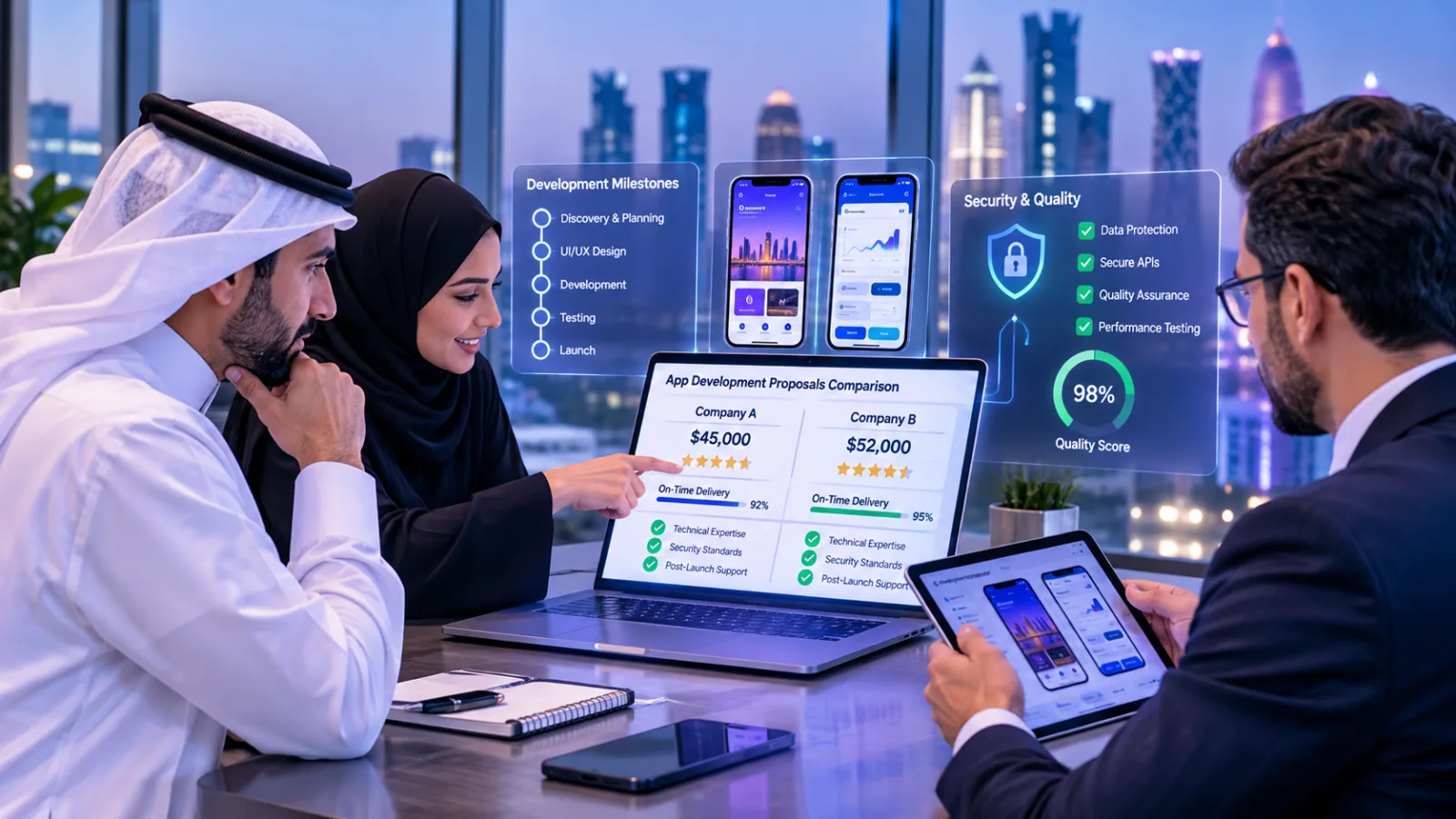
Compare app development companies by evaluating technical capabilities, project proposals, costs, security, contracts, and long-term support.
How to Compare App Development Companies in 2026: Cost, Quality, Contracts & Delivery
Choosing an app development company is an important investment decision for any business planning to launch a mobile application. However, comparing development companies can become difficult when every provider offers different prices, technologies, timelines, and service packages.
One company may offer a low development quotation but exclude backend development, testing, or ongoing maintenance. Another may provide a higher quotation that includes application architecture, UI/UX design, integrations, quality assurance, deployment, and post-launch support.
So, how can businesses identify which proposal offers the best value?
The answer is to compare app development companies based on the complete project rather than focusing only on the initial quotation.
A reliable development partner should understand your business requirements, explain its technical approach, provide a transparent project plan, protect your application and business data, and clarify what happens after launch.
In this guide, we explain how to compare app development companies in 2026, evaluate development proposals, understand pricing differences, review contracts, and make a more informed hiring decision.
Whether you are developing an e-commerce application, business management platform, customer portal, booking system, or enterprise mobile solution, these considerations can help you select the right technology partner.
Why Is Comparing App Development Companies Important?
Mobile applications involve several connected components, including frontend development, backend systems, databases, APIs, authentication, integrations, security, testing, and deployment.
A company that focuses only on the application interface may not have the capabilities required to deliver the complete solution.
For example, imagine a Qatar-based retail business planning to launch a shopping application.
The application may require:
Customer registration and login
Product browsing and search
Shopping cart and checkout
Payment gateway integration
Order tracking
Push notifications
Inventory synchronization
CRM integration
An administration dashboard
Analytics and reporting
Two development companies might provide very different proposals for the same requirements.
One might quote only for Android and iOS application screens, while another includes the backend, integrations, testing, and deployment.
Comparing their total project scope helps businesses understand what they are actually purchasing.
The objective is not necessarily to select the most expensive or cheapest provider. It is to identify the company that can deliver the required functionality, quality, and long-term value within a realistic budget.
1. Compare Technical Expertise and Development Capabilities
The first step is to understand whether each company has the technical capabilities required for your application.
Different applications require different development approaches.
For example, a simple information application may have limited backend requirements, while a financial application may require advanced authentication, transaction processing, secure APIs, and detailed activity records.
Before comparing quotations, check whether the development companies understand your application's technical requirements.
Important Technical Capabilities to Evaluate
Technical Area | What to Check |
|---|---|
Android development | Experience building Android applications |
iOS development | Experience with Apple platforms |
Cross-platform development | Flutter or React Native capabilities |
Backend development | Server-side logic and business operations |
Database development | Secure and structured data management |
API integration | Communication with external systems |
Cloud infrastructure | Hosting, deployment, and scalability |
Application security | Authentication, authorization, and data protection |
Quality assurance | Functional, performance, and security testing |
Ask each company to explain why its proposed technology is suitable for your requirements.
A good development partner should explain the technical decisions in understandable language rather than recommending a technology simply because it is popular.
Businesses planning interconnected digital platforms can also explore custom software development services to understand how mobile applications can work alongside broader business systems.
2. Evaluate Portfolios and Relevant Project Experience
A company's portfolio provides useful evidence of its development capabilities.
However, the number of projects is not the only factor that matters.
Look for examples that demonstrate experience with applications similar to your business requirements.
For example:
E-commerce businesses should examine shopping and payment functionality.
Healthcare businesses should evaluate appointment and patient-management workflows.
Real estate companies should look for property listings, customer management, and inquiry features.
Logistics businesses should examine delivery tracking and location-based functionality.
Educational institutions should consider student portals, learning features, and notifications.
What Should You Ask About Previous Projects?
Before selecting a company, ask:
Can you demonstrate applications you have developed?
What functionality did your team implement?
Did the project require backend development?
Which third-party systems were integrated?
How was application security addressed?
Does the application receive ongoing maintenance?
Can you explain the technical challenges involved?
Where possible, request a live demonstration rather than relying entirely on presentation images.
You can also explore Galaxium Coding's projects and portfolio to review its presented technology solutions.
Remember that a portfolio should demonstrate relevant capabilities. It should not be treated as proof of experience in areas that a company has not actually delivered.
3. Compare Development Proposals, Not Just Prices
One of the biggest mistakes businesses make is comparing quotations without checking what each proposal includes.
A lower quotation may appear attractive, but it could exclude important project components.
For a fair comparison, request proposals based on the same requirements document.
Example: Comparing Two Development Proposals
Imagine a business receives two quotations for the same mobile application.
Project Component | Company A | Company B |
|---|---|---|
UI/UX design | Included | Included |
Android application | Included | Included |
iOS application | Extra cost | Included |
Backend development | Limited | Included |
API integration | Not specified | Included |
Testing | Basic | Detailed testing plan |
App-store submission | Extra cost | Included |
Documentation | Not specified | Included |
Maintenance | Separate agreement | Defined support package |
This example is illustrative, not an actual market quotation.
Company A may initially appear less expensive. However, once the additional services are included, the total project cost could become higher.
What Should a Complete Proposal Include?
A professional development proposal should explain:
Project objectives
Application features
Supported platforms
UI/UX design requirements
Frontend development
Backend architecture
Database requirements
API integrations
Security considerations
Testing responsibilities
Deployment requirements
Project milestones
Deliverables
Payment structure
Maintenance arrangements
If a proposal contains vague descriptions such as "complete application development" without explaining the deliverables, request clarification before signing.
4. Compare Development Costs and Pricing Structures
App development costs depend on the application's complexity, features, technology, integrations, design requirements, and development effort.
There is no universal price that applies to every mobile application.
A simple application with basic information screens will generally require a different level of development effort from an enterprise application involving payments, real-time updates, multiple user roles, and business-system integrations.
What Influences Mobile App Development Costs?
Application complexity
More advanced functionality generally requires additional planning, implementation, and testing.
Platform selection
Developing for Android, iOS, or both can affect the project scope.
UI/UX design
Custom interfaces, interactive components, accessibility, and complex user journeys influence design effort.
Backend development
Applications requiring databases, authentication, business logic, and administration systems need additional engineering.
Third-party integrations
Payment gateways, CRM platforms, ERP systems, maps, and external APIs can add development and testing requirements.
Security requirements
Applications handling sensitive information or financial transactions may require additional security controls and reviews.
Maintenance
Ongoing bug fixes, operating-system compatibility, security updates, infrastructure management, and improvements should be considered separately or included in a clearly defined support agreement.
Compare Total Project Cost
Instead of asking only for the initial development price, request a breakdown covering:
Cost Area | Questions to Ask |
|---|---|
Discovery | Is requirements analysis included? |
Design | Are wireframes and final UI designs included? |
Development | Which features and platforms are covered? |
Backend | Is the server-side system included? |
Integrations | Are third-party connections included? |
Testing | What testing activities are covered? |
Deployment | Is store submission included? |
Hosting | Are cloud and infrastructure expenses separate? |
Maintenance | What support is available after launch? |
For businesses in Qatar, quotations should also clearly identify the currency, applicable taxes where relevant, payment terms, and any third-party charges.
5. Evaluate Native vs Cross-Platform Development
Technology selection can significantly influence development effort, maintenance, and future flexibility.
Two common approaches are native and cross-platform development.
Native App Development
Native development uses platform-specific technologies.
Android applications commonly use Kotlin.
iOS applications commonly use Swift.
This approach may be suitable when an application requires extensive platform-specific functionality, specialized device capabilities, or particular performance characteristics.
Cross-Platform App Development
Cross-platform frameworks allow developers to build applications for multiple platforms using a shared codebase.
Popular options include:
Flutter
React Native
This approach can reduce duplicated development effort in suitable projects.
However, the best choice depends on the application's requirements, device integrations, team expertise, and long-term maintenance strategy.
Factor | Native Development | Cross-Platform Development |
|---|---|---|
Codebase | Platform-specific | Substantial shared code |
Platforms | Separate implementations | Multiple platforms |
Device features | Direct platform integration | Supported through framework and native integrations |
Maintenance | Platform-specific updates | Shared and platform-specific updates |
Best suited for | Specialized platform requirements | Many business applications targeting multiple platforms |
Do not select a company simply because it uses Flutter, React Native, Kotlin, or Swift.
Ask the development team to explain why its proposed approach is appropriate for your application.
6. Examine UI/UX Design Quality
A mobile application should be easy to understand and convenient to use.
Even technically advanced applications can struggle when users cannot find important features or complete basic tasks.
When comparing development companies, review their design process.
Important Design Elements
Simple navigation
Consistent layouts
Readable typography
Clear buttons and actions
Accessible interface elements
Responsive screen layouts
Appropriate loading indicators
Helpful error messages
Clear onboarding
Arabic and English support when required
For businesses targeting customers in Qatar, Arabic language support may be important.
Arabic interfaces should be designed with proper right-to-left layouts rather than simply translating English labels.
Ask companies to show sample wireframes and explain how they test designs with intended users.
7. Compare Security and Data Protection Practices
Security should be part of the development process from the beginning.
Applications may handle customer accounts, personal information, business records, payment-related data, and confidential operational information.
A development company should be able to explain how it plans to protect the application and its backend infrastructure.
Security Questions to Ask
How will users authenticate?
How will access permissions be managed?
How will APIs be protected?
How will sensitive information be handled?
Will data be encrypted where appropriate?
How are database permissions configured?
Are security tests included?
How are software dependencies updated?
How are backups managed?
Who has access to production systems?
For Qatar businesses, privacy and data-handling obligations should be reviewed according to the application, industry, and information being processed.
The Qatar National Cyber Security Agency is an official resource for national cybersecurity information.
Security requirements should also be documented in the project agreement, particularly where the application handles sensitive or business-critical information.
8. Check Testing and Quality Assurance
Testing is essential before an application is released to customers.
A company that offers development without a clear testing strategy may leave businesses exposed to avoidable defects.
Compare the testing activities included in each proposal.
Types of Mobile Application Testing
Functional testing
Checks whether application features work according to the requirements.
UI testing
Evaluates interface elements, navigation, forms, and user interactions.
Compatibility testing
Checks application behavior across supported devices, screen sizes, and operating-system versions.
Performance testing
Evaluates loading times, responsiveness, and resource usage.
Security testing
Examines potential vulnerabilities and weaknesses in the application.
Integration testing
Checks communication between the application, backend, APIs, and external systems.
User acceptance testing
Allows business stakeholders or intended users to assess whether the application meets its requirements.
App Store Readiness
Development companies should also understand the requirements for publishing applications.
Apple's App Store Review Guidelines explain the requirements applications must satisfy before distribution.
Google Play also provides testing and release workflows through its official testing documentation.
Ask whether the proposed project includes store preparation, submission support, review-related fixes, and release assistance.
App approval should never be guaranteed by a development company because final review decisions belong to the respective platform.
9. Compare Project Management and Communication
Good communication can make a significant difference throughout application development.
Businesses should understand who will manage the project and how progress will be communicated.
Questions About Project Management
Who is the main project contact?
How frequently will progress updates be provided?
Will the business receive development demonstrations?
How are delays communicated?
How are new requirements handled?
How are project milestones approved?
Which tools are used to track tasks?
How are feedback and revisions documented?
Understand the Development Milestones
A project should have clearly defined stages.
For example:
Requirements and discovery
Technical planning
UI/UX design
Application development
Backend and API integration
Testing and revisions
Deployment preparation
Launch and handover
Milestones help businesses understand what has been completed and what remains.
They also provide opportunities to review the application before the entire project is finished.
10. Review Contracts, Ownership, and Deliverables
A development agreement should clearly define the responsibilities of both parties.
Businesses should not assume that paying for development automatically transfers every technical asset or third-party account.
Important Contractual Points
Project scope
The agreement should describe the functionality and deliverables included in the project.
Payment terms
Payment milestones, invoices, additional charges, and conditions for final payment should be documented.
Change requests
The agreement should explain how changes outside the original scope are estimated and approved.
Source-code ownership
Clarify who owns the custom source code and when ownership transfers.
Intellectual property
Define ownership and licensing arrangements for custom work, third-party components, libraries, and other materials.
Confidentiality
Establish how confidential business information and project data will be handled.
Termination
Explain what happens if the project ends before completion.
Handover
Specify which files, credentials, documentation, and technical assets must be delivered.
Maintenance
Define support periods, response expectations, maintenance fees, and responsibilities.
Who Should Control the Important Accounts?
Where appropriate, businesses should maintain control of their own:
Apple Developer account
Google Play Console account
Domain name
Cloud hosting account
Database access
Payment gateway account
Analytics accounts
Business email accounts
The development company may require authorized access to perform its work, but account ownership and administrative responsibilities should be clearly documented.
11. Evaluate Post-Launch Support and Maintenance
Launching an application does not mean development responsibilities are finished.
Applications require ongoing attention as operating systems, security requirements, APIs, devices, and business needs change.
A company that offers ongoing support can help businesses manage these changes.
Compare Maintenance Services
Maintenance Area | What It Covers |
|---|---|
Bug fixes | Resolving reported application defects |
Security updates | Addressing identified vulnerabilities |
Compatibility | Supporting relevant OS and device updates |
Performance | Monitoring and improving responsiveness |
Backend maintenance | Managing servers and databases |
API maintenance | Addressing integration changes |
App-store updates | Preparing and releasing new versions |
Feature development | Adding approved new functionality |
Ask whether maintenance is included in the development quotation or offered through a separate agreement.
Also clarify the difference between bug fixes, technical support, and new feature development.
Businesses planning long-term mobile solutions can explore mobile application development services with the full application lifecycle in mind.
12. Consider Qatar-Specific Business Requirements
Businesses operating in Qatar may have requirements that should be addressed during project planning.
These can vary depending on the application and its industry.
Arabic and English Language Support
Applications targeting diverse audiences may require bilingual interfaces.
Proper localization should consider:
Arabic right-to-left layouts
Language switching
Date and number formatting
Translated notifications
Localized content
Language-specific user support
Local Payment and Business Integrations
Depending on the application, businesses may require connections to payment providers, accounting platforms, CRM systems, ERP solutions, or other services.
The development team should assess whether the necessary integrations are technically available and suitable.
Data Privacy and Security
Businesses should understand applicable privacy requirements before collecting or processing customer information.
Local Business Understanding
A development partner should understand the business environment, intended customers, industry requirements, and operational processes relevant to the project.
Galaxium Coding is a Qatar-focused technology company offering solutions across mobile applications, custom software, web applications, and business technology.
13. Identify Warning Signs Before Hiring
Some warning signs may become visible during the proposal and discussion stages.
Watch for the following:
Unrealistically Low Quotations
A very low quotation without a clear breakdown may exclude essential services.
Guaranteed App Store Approval
No development company can independently guarantee Apple's or Google's final approval.
Unclear Project Scope
If the company cannot explain what is included, future disagreements may arise.
No Testing Strategy
A professional project should include appropriate testing activities.
No Source-Code Ownership Discussion
Businesses should understand ownership and access arrangements before development begins.
Poor Communication
Delayed responses, vague explanations, and undocumented commitments can create project-management difficulties.
No Post-Launch Plan
An application needs an ongoing maintenance strategy.
No Demonstrable Relevant Work
A provider should be able to explain its capabilities using genuine examples, demonstrations, or technical evidence.
14. A Practical Checklist for Comparing App Development Companies
Use the following checklist when evaluating potential development partners.
Evaluation Area | What to Confirm |
|---|---|
Experience | Relevant application development experience |
Portfolio | Genuine and relevant project examples |
Technology | Appropriate development approach |
Design | Clear UI/UX process |
Backend | Database and server-side capabilities |
Integrations | API and third-party integration experience |
Security | Documented security approach |
Testing | Functional and technical testing |
Pricing | Detailed quotation and cost breakdown |
Timeline | Realistic milestones |
Communication | Clear project management |
Contract | Defined scope and responsibilities |
Ownership | Source-code and intellectual property terms |
Deployment | App-store submission support |
Maintenance | Post-launch support arrangements |
Example: A Simple Company Comparison Scorecard
Businesses can assign scores to each shortlisted provider.
Use a score from 1 to 5, where 1 means poor and 5 means excellent.
Evaluation Criteria | Weight |
|---|---|
Relevant technical expertise | 20% |
Portfolio and project evidence | 15% |
Proposal and scope clarity | 15% |
Security and quality assurance | 15% |
Communication and project management | 10% |
Cost and commercial transparency | 10% |
Ownership and contract clarity | 10% |
Post-launch support | 5% |
Total | 100% |
Calculate each provider's weighted score by multiplying its rating by the assigned weight and adding the results.
This is an example evaluation framework, not an industry-standard ranking system.
The scorecard can help businesses compare providers consistently while keeping their most important requirements visible.
15. Why Choose Galaxium Coding for Mobile Application Development?
Selecting a development partner means finding a team that can understand your business objectives and translate them into practical technology solutions.
Galaxium Coding provides technology services covering:
Mobile application development
Custom software development
Web application development
AI and business automation
API integrations
Cloud and DevOps solutions
Business technology platforms
For companies planning a mobile application, the development strategy should consider the complete technology environment rather than only the smartphone interface.
For example:
Mobile Application → Backend → APIs → Database → CRM/ERP → Cloud Infrastructure → Analytics
This connected approach can help businesses plan applications that communicate with their existing systems and support future operational requirements.
You can explore Galaxium Coding's mobile application solutions and software development capabilities to understand the services relevant to your project.
You can also review the company's projects and portfolio before discussing your requirements.
If your business is planning a new mobile application, contact Galaxium Coding to discuss your project scope, technical requirements, and potential development approach.
Final Thoughts
Choosing an app development company in 2026 requires more than comparing quotations or selecting the provider with the most attractive presentation.
Businesses should evaluate the complete development proposal, including technical capabilities, project scope, design, security, testing, integrations, contractual terms, ownership, and post-launch maintenance.
The most suitable company is the one that understands your requirements, explains its technical decisions, provides realistic project commitments, and offers a clear path from planning to deployment.
Before signing an agreement, compare proposals using the same requirements, request demonstrations, clarify ownership, and document all deliverables.
A mobile application is a long-term business investment. Selecting the right development partner can help protect that investment and create a stronger foundation for future growth.
Frequently Asked Questions
1. How do I compare app development companies in 2026?
Compare companies based on technical expertise, portfolio, project scope, pricing, security, testing, communication, contracts, source-code ownership, and post-launch support. Use the same requirements document when requesting quotations.
2. What should I look for in an app development proposal?
A proposal should explain the project scope, features, supported platforms, design, backend, integrations, technology, testing, deployment, milestones, pricing, deliverables, and maintenance arrangements.
3. Is the cheapest app development company the best option?
Not necessarily. A lower quotation may exclude important services such as backend development, security testing, integrations, or maintenance. Compare the total project scope and expected long-term costs before making a decision.
4. How much does it cost to hire an app development company in 2026?
There is no fixed price. The cost depends on application complexity, features, platforms, design, backend requirements, integrations, security, testing, and ongoing support.
5. Should I choose native or cross-platform app development?
Native development may be suitable for specialized platform requirements, while cross-platform development can be practical for applications targeting Android and iOS with shared code. The choice depends on your application's technical and business requirements.
6. How can I check whether an app development company is reliable?
Review its portfolio, request relevant demonstrations, evaluate technical explanations, examine its proposal, discuss communication procedures, and clarify contractual responsibilities and maintenance arrangements.
7. Who owns the mobile application's source code?
Ownership depends on the development agreement and applicable intellectual property terms. Businesses should clearly document source-code ownership, licensing, third-party components, and handover arrangements before starting development.
8. Does app development include maintenance?
Not always. Some companies offer limited post-launch support, while others provide separate maintenance agreements. Confirm exactly what is included in the quotation.
9. Should I hire a local app development company in Qatar?
A Qatar-based development partner may provide advantages in communication, local business understanding, and project coordination. However, businesses should still evaluate technical capabilities, portfolio, pricing, and support before selecting a provider.
10. Can an app development company integrate my application with existing business software?
Yes, when the existing systems provide suitable APIs or other integration mechanisms. Applications can connect with CRM, ERP, accounting, payment, inventory, and other business platforms.
11. What questions should I ask before signing an app development contract?
Ask about project scope, payment milestones, delivery dates, change requests, source-code ownership, intellectual property, security, testing, account access, maintenance, and termination conditions.
12. Does Galaxium Coding provide mobile application development services?
Galaxium Coding offers mobile application development alongside custom software, web applications, AI solutions, and other business technology services. Businesses can contact the company to discuss their project requirements.