How AI Is Transforming Human Resources: Recruitment, Employee Management, Performance & the Future of HR
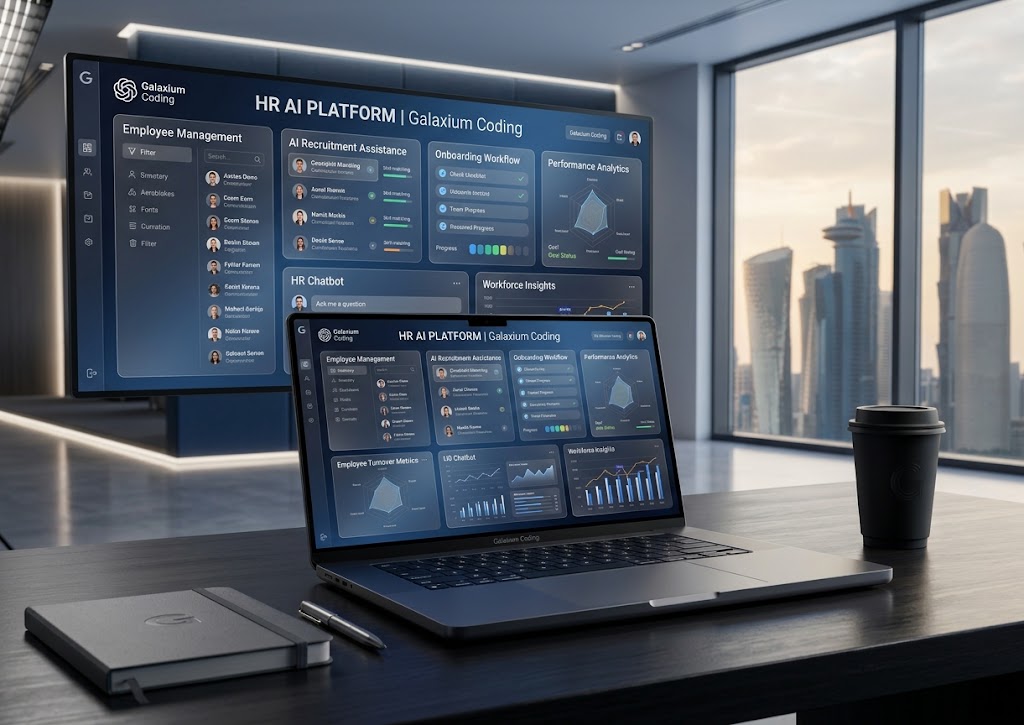
AI is transforming human resources by connecting employee management, automation, analytics and intelligent HR workflows.
How AI Is Transforming Human Resources: Recruitment, Employee Management, Performance & the Future of HR
Human resources is changing rapidly.
For years, HR teams have relied on spreadsheets, emails, manual approvals, disconnected applications and repetitive administrative processes to manage employees. These approaches can work for small teams, but become increasingly difficult as organizations grow.
Artificial intelligence is creating another option.
Modern AI can help HR teams analyze information, automate repetitive tasks, support recruitment, answer employee questions, summarize documents, identify workforce trends and provide managers with more useful insights.
However, AI in HR is not simply about replacing manual work with a chatbot.
The real opportunity is to create HR processes where employees, HR professionals, managers, business software and AI work together.
This is particularly relevant for businesses in Qatar and other growing markets where organizations are investing in digital transformation, automation and connected business systems. Qatar's National AI Strategy identifies employment, business, data access, education and ethics among its AI priorities.
In this guide, we explore how AI is transforming human resources, where it provides the most value, what risks businesses need to consider and how companies can introduce AI into HR responsibly.
What Is AI in Human Resources?
AI in human resources refers to the use of artificial intelligence technologies to support HR activities such as recruitment, employee support, workforce analysis, performance management, learning, document processing and administrative workflows.
An AI-enabled HR platform might combine:
Employee data
HR workflows
Recruitment information
Attendance data
Performance information
Employee documents
Policies
Business rules
AI models
Analytics
Automation
Instead of HR employees manually searching through different systems, AI can help retrieve, summarize or analyze information based on authorized access.
For example, an HR manager could ask:
Which employees have pending performance reviews?
Or:
Summarize the main training requirements identified during recent performance reviews.
Or:
Which onboarding tasks are still incomplete for new employees?
The exact capabilities depend on the system, integrations, data quality, permissions and AI technology being used.
AI should therefore be viewed as a capability within an HR technology ecosystem rather than a replacement for the entire HR department.
Why Is AI Becoming Important for HR?
HR teams manage large amounts of information and many repetitive workflows.
Common HR activities include:
Recruitment
Candidate screening
Interview scheduling
Employee onboarding
Attendance
Leave management
Employee records
Document management
Performance reviews
Training
Employee requests
Policy communication
Workforce reporting
Management dashboards
Some of these activities involve predictable workflows that can be automated. Others require human judgment and should continue to involve HR professionals and managers.
AI becomes valuable when it helps HR teams spend less time searching, sorting, summarizing and manually processing information and more time on activities that require communication, judgment, leadership and employee support.
Businesses can also combine AI with custom software development when standard HR software does not match their specific organizational workflows.

How AI Is Transforming Human Resources
AI can affect almost every stage of the employee lifecycle.
The following areas are among the most practical applications.
1. AI-Powered Recruitment
Recruitment is one of the areas where AI can provide significant assistance.
HR teams may receive hundreds or thousands of applications for a single position. Reviewing every application manually can take considerable time.
AI-powered recruitment systems can help organize this information by:
Extracting information from CVs
Identifying relevant skills
Matching candidates against predefined requirements
Categorizing applications
Highlighting missing information
Summarizing candidate profiles
Supporting interview scheduling
Generating recruitment reports
For example, a company hiring software developers might define requirements such as:
Programming experience
Relevant frameworks
Database knowledge
Cloud experience
Years of experience
Education requirements
Industry experience
An AI system could help HR organize candidates according to these predefined criteria.
However, AI-generated recommendations should not automatically become hiring decisions.
The International Labour Organization has highlighted the complexity of using AI in recruitment and workplace management, including the risk that technology can automate flawed processes rather than solve them.
Human review remains important, particularly when decisions affect employment opportunities.
AI Recruitment Workflow
A practical workflow could look like:
Job requirement → Applications → AI-assisted CV analysis → Candidate shortlist → Human review → Interview → Assessment → Hiring decision
The objective is not to let AI make every decision.
The objective is to reduce unnecessary administrative work while keeping meaningful human oversight.
2. Smarter Employee Onboarding
Employee onboarding often involves many repetitive tasks.
A new employee may need:
An employee profile
Documents
Company policies
IT access
Training assignments
Department information
Manager approvals
Equipment
Orientation sessions
Payroll setup
AI can assist by coordinating information and generating relevant instructions.
For example:
New employee added
↓
HR system creates employee profile
↓
AI identifies required onboarding tasks
↓
Employee receives relevant information
↓
Manager receives pending actions
↓
IT receives access requirements
↓
Training tasks are assigned
↓
HR dashboard tracks progress
This type of workflow can be combined with traditional automation.
Not every step needs AI.
In fact, simple rules-based automation may be better for predictable processes, while AI can be used for tasks involving document understanding, natural-language interaction or recommendations.
3. AI Employee Assistants
One of the most visible applications of AI in HR is the employee assistant.
Instead of asking HR the same questions repeatedly, employees can interact with an AI assistant connected to approved company information.
Employees might ask:
How many annual leave days do I have?
How do I request leave?
What is the remote-work policy?
Where can I find the employee handbook?
How do I submit an HR request?
What documents are required for a particular process?
When is my next performance review?
The AI assistant can provide answers based on approved HR information and, where properly integrated, may also retrieve information from employee systems.
For sensitive actions, the system should authenticate the employee and enforce permissions.
For example:
Employee asks about leave balance
↓
System verifies identity
↓
AI retrieves authorized leave information
↓
AI provides answer
If the employee wants to submit a leave request:
Employee requests leave
↓
Workflow checks relevant rules
↓
Manager receives approval request
↓
HR record updates after approval
This combination of AI and workflow automation can create a more convenient employee experience.
4. AI for Performance Management
Traditional performance management can become a once-a-year exercise.
Modern HR platforms can make performance management more continuous.
AI can help organize:
Employee goals
KPIs
Performance reviews
Feedback
Development plans
Training requirements
Manager observations
Progress information
For example, an AI-enabled performance platform could help a manager summarize an employee's progress across several goals before a review.
It could also help identify areas where additional training may be useful.
However, performance evaluation is a sensitive area.
AI should support managers rather than automatically determine an employee's value or career outcome.
Performance decisions should consider context that may not be visible in structured data.
5. Workforce Analytics
HR departments have access to large amounts of workforce information.
This can include:
Headcount
Departments
Attendance
Leave
Turnover
Recruitment
Performance
Training
Employee engagement
Workforce costs
AI and analytics can help organizations identify patterns within this information.
For example, management might want to understand:
Which departments have the highest turnover?
Which roles take longest to recruit?
Which teams have increasing absenteeism?
Which training programs are most frequently required?
Where are recruitment bottlenecks occurring?
Which employee processes create the most administrative workload?
The goal is not simply to create more dashboards.
The goal is to turn HR information into useful business insight.
6. AI for Employee Training and Development
AI can also support employee development.
A traditional training program may provide the same learning material to every employee in a particular role.
AI can potentially help personalize recommendations based on:
Role
Skills
Goals
Performance information
Previous training
Career interests
Business requirements
For example, if an employee's role requires stronger data-analysis capabilities, an HR system could recommend relevant training.
A manager could also use workforce analytics to identify common skill gaps within a department.
This creates a potential cycle:
Performance information → Skill gap → Training recommendation → Learning → New assessment
AI does not need to replace human trainers.
Instead, it can help organizations identify where training resources may have the greatest value.
7. AI-Powered HR Document Processing
HR departments manage a large amount of documentation.
Examples include:
Employment documents
CVs
Policies
Training records
Certificates
Forms
Employee requests
Internal communications
AI-powered document processing can help extract information, classify documents and summarize long content.
For example, instead of manually reviewing every uploaded document, an HR system could identify the document type and route it to the appropriate workflow.
This can be particularly useful in organizations with large employee populations.
However, sensitive employee documents require strong access controls, appropriate retention policies and careful data governance.
8. AI for HR Reporting and Executive Insights
Senior management often wants answers rather than raw HR data.
Instead of opening several reports, an authorized executive might ask:
How has employee turnover changed over the last quarter?
Or:
Which departments have the highest recruitment workload?
Or:
What are the main workforce issues identified in recent reports?
An AI layer can potentially turn structured HR data into natural-language summaries.
The system might combine:
HR database + analytics + dashboards + AI assistant
This can make workforce information easier to understand.
The quality of these insights still depends on the quality, completeness and governance of the underlying data.
AI vs Traditional HR Automation
AI and automation are related, but they are not the same.
Traditional automation works especially well when the process follows clear rules.
For example:
Employee submits leave request → Check balance → Send approval request → Update record
AI becomes more useful when the task involves unstructured information, language or pattern analysis.
For example:
Read employee feedback → identify common themes → summarize concerns → present insights
A modern HR system may therefore use both.
Traditional Automation | AI |
|---|---|
Rule-based workflows | Pattern and language-based processing |
Predictable processes | More complex information |
Approval workflows | Document and text analysis |
Notifications | Natural-language interaction |
Data updates | Summarization |
Scheduled tasks | Recommendations |
Fixed rules | Context-dependent assistance |
The best HR technology strategy is often not "AI everywhere."
It is the right technology for the right process.
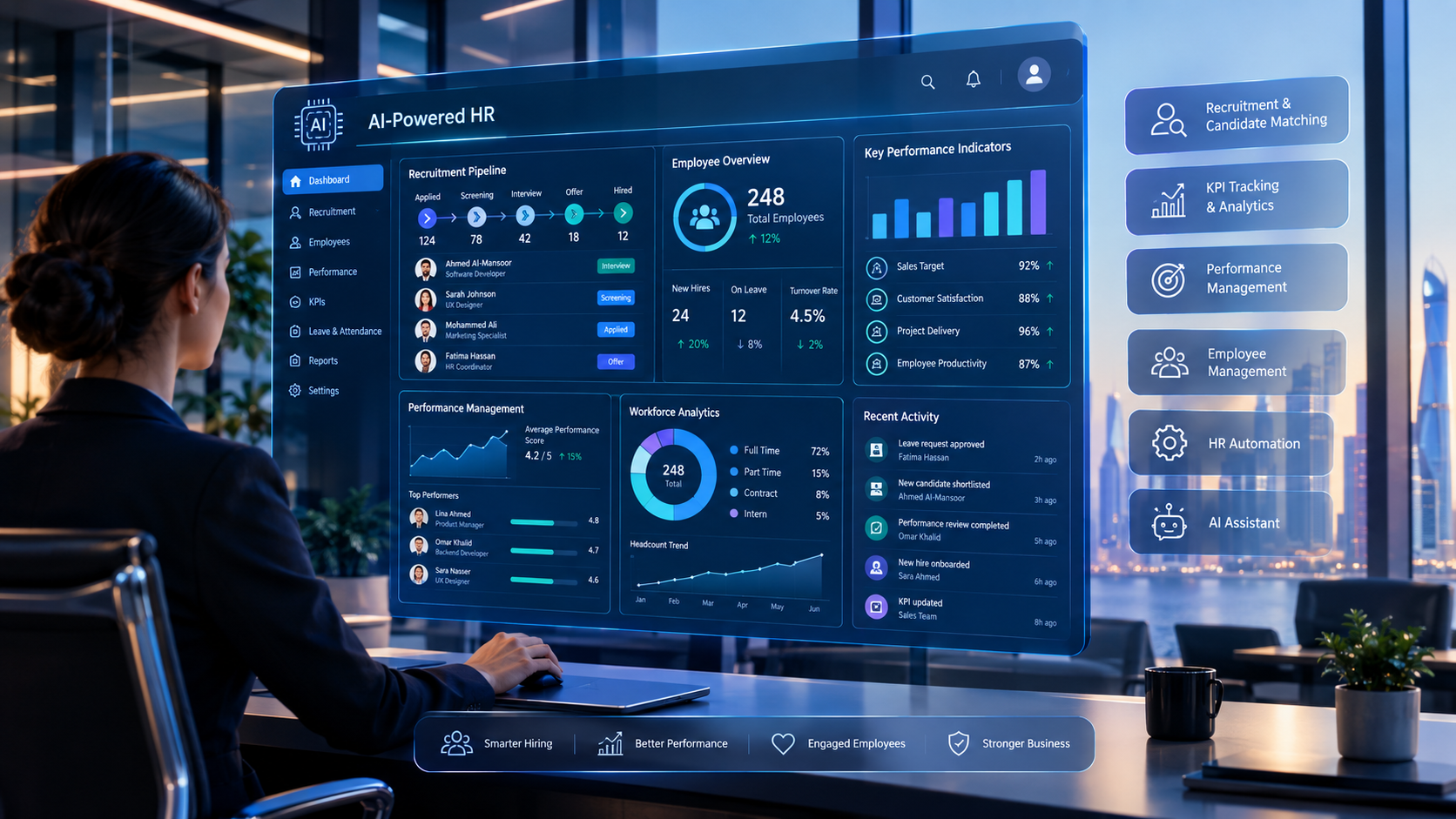
Benefits of AI in Human Resources
When implemented appropriately, AI can provide several potential benefits.
Faster Administrative Work
AI and automation can reduce repetitive manual processing.
Better Employee Experience
Employees can access information and support more quickly.
More Consistent Processes
Standardized workflows can reduce unnecessary variation.
Better Workforce Visibility
AI-supported analytics can help managers understand workforce patterns.
Faster Recruitment Operations
Recruitment teams can organize large applicant volumes more efficiently.
More Personalized Development
AI can help connect employee goals, skills and training recommendations.
Improved Decision Support
Managers can receive summarized information instead of manually combining multiple reports.
The value depends heavily on implementation quality.
AI does not automatically improve a process simply because AI has been added to it.
What Are the Risks of AI in HR?
AI in HR requires more care than many other business applications because HR systems contain sensitive employee information and can influence employment-related decisions.
Important risks include:
1. Bias
If an AI system learns from biased data or uses poorly designed criteria, its recommendations may reproduce or amplify those problems.
2. Privacy
HR systems can contain highly sensitive information.
Organizations need to carefully control what information AI systems can access and how that information is processed.
3. Incorrect AI Outputs
AI systems can generate incorrect or misleading information.
An HR decision should not automatically rely on an AI-generated answer without appropriate validation.
4. Lack of Transparency
Employees and managers may not understand how a recommendation was generated.
Important HR processes should have clear governance and accountability.
5. Over-Automation
Not every HR decision should be automated.
Hiring, disciplinary decisions, promotions and sensitive employee matters can require human judgment and context.
6. Security
AI systems connected to HR databases create additional security considerations.
Organizations should consider authentication, authorization, encryption, audit logs, secure APIs and monitoring.
The NIST AI Risk Management Framework provides a voluntary framework for organizations seeking to incorporate trustworthiness considerations into the design, development, use and evaluation of AI systems.
How Businesses Can Implement AI in HR
Organizations should avoid starting with the question:
"Which AI tool should we buy?"
A better starting point is:
"Which HR problem are we trying to solve?"
Step 1: Identify Repetitive Processes
Document the HR workflows that consume significant administrative time.
Examples:
Employee requests
Onboarding
Document processing
Recruitment administration
Reporting
Policy questions
Step 2: Separate Automation From AI
Determine whether each process requires:
Rules-based automation
AI
Analytics
Human decision-making
A combination of technologies
Step 3: Review Data
AI depends on usable information.
Organizations should examine:
Data quality
Data structure
Duplicate records
Missing information
Access permissions
Data sources
Step 4: Define Permissions
Not every employee, manager or AI assistant should have access to the same HR information.
Role-based access should be designed before connecting AI to sensitive systems.
Step 5: Start With a Focused Use Case
Instead of implementing AI across every HR function at once, start with a measurable problem.
For example:
HR employee assistant
Recruitment document processing
Onboarding automation
HR reporting
Employee document search
Step 6: Measure Results
Define useful metrics before deployment.
Possible measurements include:
Processing time
HR workload
Employee response time
Recruitment administration time
Employee satisfaction
Workflow completion
Error rates
Step 7: Add Human Oversight
AI outputs should be reviewed appropriately, especially when they influence important employee decisions.
AI in HR for Businesses in Qatar
Qatar is developing a broader national AI ecosystem.
The country's National AI Strategy includes six major pillars covering education, data access, employment, business, research and ethics. Qatar's International Media Office also describes AI as an important part of the country's national transformation and digital ecosystem.
For businesses operating in Qatar, this creates opportunities to use AI across HR and wider business operations.
Potential applications include:
AI employee assistants
Recruitment support
HR document processing
Employee onboarding
Performance analytics
Workforce dashboards
Business automation
HR and ERP integration
AI-powered reporting
Organizations should still evaluate their specific industry, workforce, data environment, security requirements and internal processes before implementing AI.
A Qatar-based organization may also need to consider Arabic and English user experiences where appropriate, especially when employee communication involves multilingual teams.
The important point is that Qatar-specific AI adoption should be connected to real business needs rather than treated as a technology trend.
AI and HR Software: Why Integration Matters
AI becomes significantly more useful when it can work with the systems employees already use.
Consider a business with separate systems for:
HR
↓
Attendance
↓
Payroll
↓
Performance
↓
Recruitment
↓
Employee Portal
↓
Management Reporting
If these systems cannot communicate, AI may have limited visibility.
A connected HR platform can provide a stronger foundation.
For businesses that need browser-based employee or management systems, web application development can be used to build interfaces around specific workflows.
For organizations requiring broader business connectivity, HR can also become part of a wider business management platform connecting CRM, ERP, finance, operations and analytics.
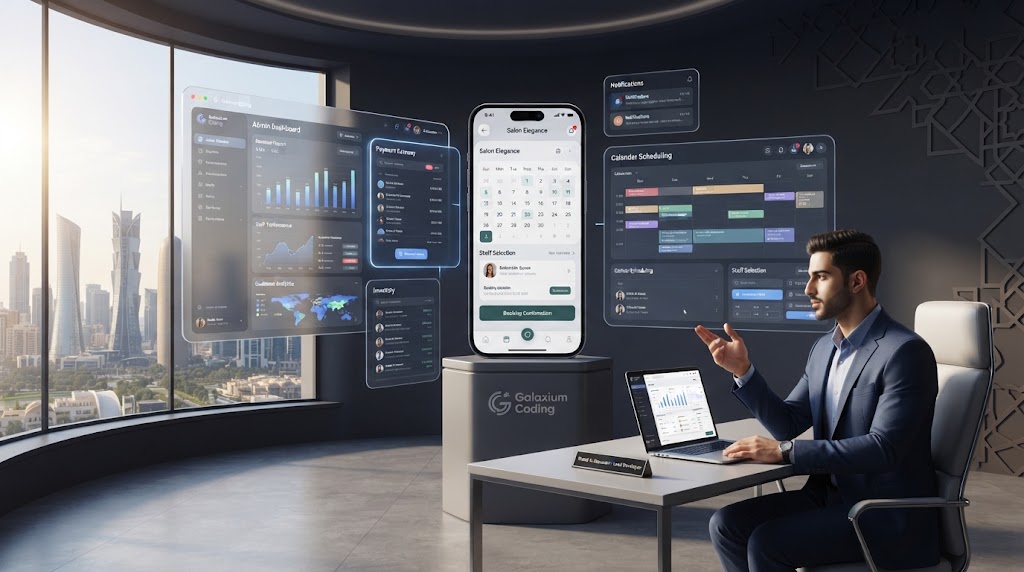
AI-Powered HR vs Traditional HR Software
Traditional HR software remains valuable.
A conventional HR system can already manage:
Employees
Attendance
Leave
Payroll
Documents
Approvals
Reporting
AI adds another layer.
It can potentially help employees and managers interact with the information more naturally.
For example:
Traditional system:
Open HR module → Search employee → Open profile → Select performance → Review information.
AI-enabled system:
"Show me the performance summary for the sales team."
The difference is not necessarily the underlying data.
The difference is how people interact with it.
Common Mistakes Businesses Should Avoid
Adding AI Without a Business Case
AI should solve a genuine problem.
Automating a Poor Process
Automating a broken process can simply make the problem happen faster.
Giving AI Too Much Access
AI systems should only access the information necessary for their intended purpose.
Removing Human Oversight
Important employment decisions should not automatically become AI decisions.
Ignoring Employees
Employees should be considered when designing HR technology.
Treating AI as a One-Time Project
AI systems need monitoring, evaluation, maintenance and improvement.
Ignoring Security
HR information is sensitive. Security should be part of the architecture from the beginning.
What Will the Future of AI in HR Look Like?
The future of HR is unlikely to be simply "AI replacing HR professionals."
A more realistic model is:
HR professionals + AI + automation + business data
AI may increasingly handle information-heavy and repetitive activities while HR professionals focus on:
Employee relationships
Leadership
Conflict resolution
Organizational culture
Strategic workforce planning
Complex decisions
Communication
Employee development
The HR professional of the future may therefore spend less time searching for information and more time using information to make better decisions.
AI could also become increasingly embedded in enterprise software.
Instead of opening separate AI applications, employees may interact with AI directly inside HR, ERP, CRM and business management systems.
How Galaxium Coding Can Support AI-Powered HR Systems
Businesses that want to move beyond basic HR software may need technology designed around their existing processes.
Galaxium Coding provides technology services covering areas such as custom software, web applications, mobile applications, cloud solutions and business automation.
For an organization considering an AI-powered HR platform, the technology architecture could potentially include:
Employee management
Recruitment
Attendance
Leave
Employee self-service
Performance management
HR workflows
Document management
AI assistant
Analytics
Management dashboards
API integrations
Cloud infrastructure
Security controls
The appropriate architecture depends on the organization's requirements.
Businesses can explore Galaxium Coding's projects and portfolio to understand the type of technology work the company provides.
The important step is to begin with the HR problem, define the workflow and then select the appropriate technology.
Final Thoughts
AI is transforming human resources by changing how organizations recruit, onboard, support, develop and manage employees.
The strongest opportunities are not necessarily about replacing HR professionals.
They are about helping HR teams work with better information and less repetitive administration.
A practical AI-powered HR strategy can look like:
Identify the problem
↓
Map the HR workflow
↓
Improve the process
↓
Automate predictable tasks
↓
Add AI where it provides genuine value
↓
Connect HR data
↓
Protect sensitive information
↓
Keep humans involved in important decisions
↓
Measure the results
For businesses in Qatar, AI can become part of a broader digital transformation strategy that connects HR with business software, automation, analytics and other enterprise systems.
The goal should not be to use the most AI.
The goal should be to build an HR environment that is more efficient, accessible, secure and useful for both employees and management.
If your organization is evaluating an AI-powered HR platform or wants to automate an existing HR workflow, you can contact Galaxium Coding to discuss the business requirements and explore an appropriate technology approach.
Frequently Asked Questions
What is AI in human resources?
AI in human resources refers to the use of artificial intelligence to support HR activities such as recruitment, employee assistance, document processing, workforce analytics, performance management, training and HR reporting.
How is AI changing recruitment?
AI can help organize applications, extract information from CVs, identify candidates against predefined criteria, summarize candidate information and support recruitment workflows. Human review remains important for employment-related decisions.
Can AI replace HR professionals?
AI can automate or assist with some HR tasks, but HR professionals remain important for communication, employee relationships, judgment, leadership, organizational culture and complex workforce decisions.
How can AI help employees?
AI can provide employees with faster access to approved HR information, help answer policy questions, support HR requests and provide assistance through employee portals or internal AI assistants.
Is AI safe for HR data?
AI can be used with HR data, but organizations need appropriate security, permissions, data governance, monitoring and human oversight. The level of risk depends on what data the AI system can access and what decisions it supports.
Can small businesses use AI in HR?
Yes. Small businesses do not necessarily need a large AI platform. They can start with focused use cases such as employee FAQs, onboarding, document processing, recruitment administration or HR reporting.
What is the difference between HR automation and AI?
Automation generally follows predefined rules and workflows. AI can process language, analyze unstructured information, summarize content and provide more flexible assistance. Many modern HR systems can use both technologies together.
How can businesses in Qatar use AI for HR?
Businesses in Qatar can use AI for recruitment support, employee assistance, onboarding, document processing, workforce analytics, performance support and HR automation. The exact use case should be selected according to the organization's workforce, processes, data and security requirements.
Should AI make hiring decisions?
AI can support recruitment processes, but organizations should be cautious about using AI as the sole decision-maker for employment decisions. Human oversight, appropriate criteria and governance remain important.