Crypto App Development Cost in 2026: Pricing, Features & Guide
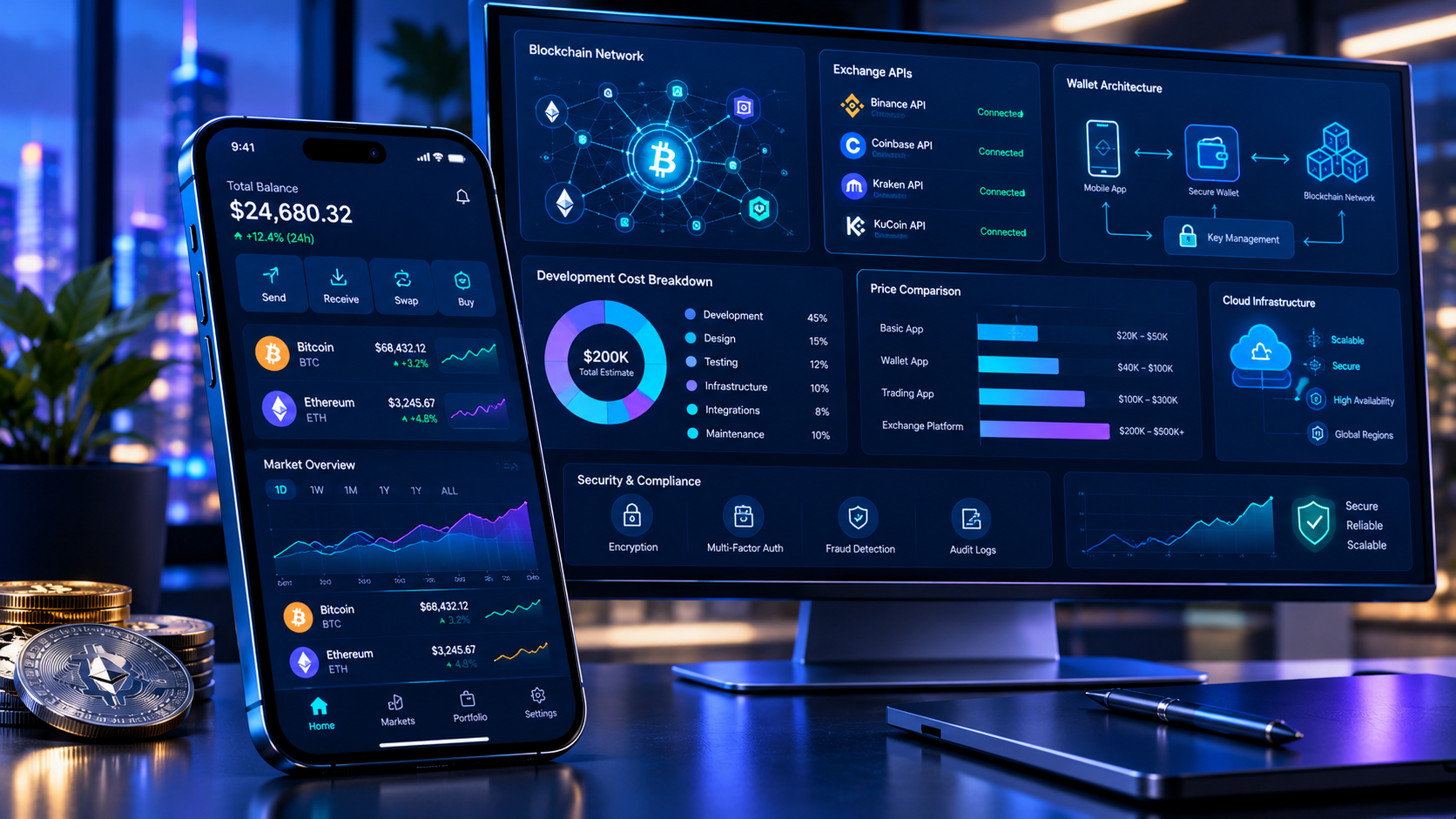
Crypto app development in 2026: understand pricing, blockchain integrations, wallet security, and essential application features.
Crypto App Development Cost in 2026: Pricing, Features & Guide
Crypto app development in 2026 involves much more than creating a mobile interface for buying, selling, or tracking cryptocurrency. A successful application may require blockchain integration, secure wallet functionality, real-time market data, transaction monitoring, backend infrastructure, and carefully designed security controls.
For businesses planning to enter the cryptocurrency market, understanding the cost of development is an important first step. A simple crypto price-tracking application has very different requirements from a trading platform, a non-custodial wallet, or an application that facilitates cryptocurrency exchanges.
Crypto app development costs can range from approximately $20,000 for a relatively simple application to $500,000 or more for a sophisticated trading or exchange platform. These are indicative budgeting estimates, not verified market averages or fixed quotations. The final price depends on the application's functionality, security requirements, blockchain networks, external integrations, operating markets, and regulatory obligations.
This guide explains crypto app development pricing, essential features, technology choices, security requirements, development stages, and business considerations. It also explores how companies planning digital-asset applications in Qatar can evaluate their technical and regulatory requirements before investing in development.
How Much Does Crypto App Development Cost in 2026?
The cost of developing a cryptocurrency application depends primarily on what users need to do within the platform.
A portfolio tracker may retrieve public blockchain information and market prices. A wallet may need to generate and protect cryptographic keys. A trading platform may require order management, exchange integrations, liquidity arrangements, and advanced monitoring.
The following table provides broad estimates for initial project planning.
Type of crypto application | Estimated development cost (USD) | Indicative timeline |
|---|---|---|
Cryptocurrency price tracker | $20,000–$45,000 | 2–4 months |
Crypto portfolio management app | $25,000–$60,000 | 3–5 months |
Non-custodial crypto wallet | $40,000–$100,000 | 3–6 months |
Crypto payment application | $45,000–$120,000 | 4–7 months |
Crypto exchange or trading application | $100,000–$300,000+ | 6–12 months |
Advanced multi-network trading platform | $200,000–$500,000+ | 9–18 months |
These ranges assume professional design, application development, backend engineering, integration work, testing, and initial deployment. They do not automatically include licensing, independent security audits, exchange liquidity, market-making arrangements, or every third-party subscription.
A project that manages customer funds, executes trades, or supports complex blockchain transactions may exceed the upper ranges shown.
What affects crypto app development pricing?
Several factors influence the total budget:
Application type: A price tracker is generally simpler than an exchange or custodial wallet.
Blockchain networks: Supporting additional networks can require separate integrations, transaction logic, testing, and maintenance.
Wallet architecture: Custodial, non-custodial, and multi-signature wallets have different security and operational requirements.
Trading functionality: Order books, execution logic, liquidity providers, and exchange APIs increase complexity.
Security testing: Key management, transaction validation, threat modelling, and independent audits may require specialist expertise.
Third-party services: Market data, identity verification, blockchain analytics, custody, and payment services may introduce setup or usage fees.
Platform requirements: Android, iOS, web, and administrative applications increase the overall scope.
Compliance: Requirements depend on the services provided, the operating jurisdictions, and the legal structure of the business.
For companies planning a custom digital product, Galaxium Coding's custom software development services and mobile application development services can be relevant starting points for defining the application's technical requirements.
What Is Crypto App Development?
Crypto app development is the process of designing, building, testing, and maintaining applications that interact with cryptocurrencies, blockchain networks, digital assets, or related financial services.
Depending on the business model, a crypto application may allow users to:
Monitor cryptocurrency prices and market movements.
Track digital-asset portfolios.
Send and receive supported cryptocurrencies.
Manage wallet addresses and transaction histories.
Connect to decentralized applications.
Access trading interfaces.
Review blockchain transactions.
Make supported crypto-related payments.
Interact with tokenized digital assets.
Not every crypto application needs direct blockchain transaction functionality. An application that displays publicly available market prices can have a much simpler architecture than one that signs transactions or holds digital assets on behalf of customers.
A typical crypto application may contain:
A mobile or web user interface.
A backend application and database.
Blockchain node or API integrations.
Wallet and cryptographic components, where applicable.
Market-data or exchange integrations, where applicable.
Authentication and access-control systems.
Monitoring, logging, and security controls.
An administrative interface for operational tasks.
The most important early decision is to define the product's role. Does the app provide information, manage a user's own wallet, facilitate trading, or provide a service involving customer assets? The answer influences architecture, costs, and regulatory considerations.
Types of Crypto Apps Businesses Can Develop
Choosing the right application category helps establish a realistic development budget and avoids investing in unnecessary features.
1. Cryptocurrency price-tracking apps
A cryptocurrency price tracker displays market information for selected digital assets.
Typical features include:
Live or periodically refreshed prices.
Price-change indicators.
Market-capitalization information.
Watchlists and favourites.
Historical price charts.
Price alerts.
Search and filtering.
Most price-tracking applications use market-data APIs rather than directly processing blockchain transactions.
For example, a startup could launch an application that tracks Bitcoin, Ether, and other supported assets, allowing users to create watchlists and receive price alerts. The first version might not need user wallets, trading functionality, or custody infrastructure.
The main development considerations are data-provider reliability, API usage limits, chart performance, and clear explanations of data freshness.
Best suited for: Market-information businesses, crypto education platforms, and portfolio-monitoring products.
2. Crypto wallet applications
A cryptocurrency wallet helps users manage the cryptographic keys or credentials required to authorize blockchain transactions.
Wallets are commonly divided into two categories.
Non-custodial wallets: Users control their private keys or recovery credentials. The application may facilitate key generation, transaction construction, and signing, depending on its architecture.
Custodial wallets: A service provider manages or safeguards the keys on behalf of users. This introduces additional operational responsibilities and may create significant security and regulatory obligations.
Typical wallet features include:
Wallet creation or account connection.
Supported network and asset displays.
Receive addresses and QR codes.
Transaction construction and signing.
Transaction history.
Network-fee estimates.
Backup and recovery workflows.
Token and network selection.
Optional multi-signature support.
Wallet security must be considered from the beginning. Recovery processes, signing permissions, transaction confirmation, and key storage are fundamental components rather than optional enhancements.
Best suited for: Web3 products, digital-asset management tools, and businesses with a clearly defined wallet use case.
3. Crypto exchange applications
Crypto exchange applications enable users to access supported digital-asset trading services.
Depending on the business model, the app may connect to an existing exchange or serve as the interface to a more extensive trading platform.
Potential features include:
User registration and verification.
Market and limit order interfaces.
Trading charts.
Order status and transaction history.
Market-data feeds.
Account and balance displays.
Notifications.
Risk controls.
Administrative monitoring.
A production exchange may also require order management, custody or wallet integrations, liquidity arrangements, reconciliation, dispute handling, surveillance, and operational controls.
Connecting a user interface to an external exchange API is considerably different from building and operating an exchange infrastructure.
Best suited for: Businesses with an appropriate operating model, access to necessary providers, and a clear understanding of applicable authorization requirements.
4. Crypto portfolio management apps
Portfolio applications help users monitor digital assets held across supported wallets or exchanges.
Common features include:
Portfolio valuation.
Asset allocation charts.
Historical performance.
Profit-and-loss calculations.
Transaction imports.
Multiple-wallet support.
Price alerts.
Exportable reports.
The main challenge is ensuring that the portfolio accurately represents asset balances, transaction history, fees, and exchange rates across different networks and providers.
A portfolio tracker can often begin with read-only integrations, reducing the need to implement transaction-signing functionality.
Best suited for: Investors, analytics providers, and users who want a consolidated view of their digital assets.
5. Crypto payment applications
Crypto payment applications support specific payment workflows involving digital assets.
Possible features include:
Payment requests.
QR-code generation.
Address validation.
Transaction status monitoring.
Payment confirmation.
Merchant dashboards.
Receipts and transaction records.
Optional fiat conversion through supported providers.
Blockchain transactions may remain pending until sufficient network confirmations have occurred. The app should communicate these states clearly and avoid treating an unconfirmed transaction as a completed payment.
Businesses should also consider price volatility, transaction fees, refunds, reconciliation, and the availability of supported payment providers.
Best suited for: Merchants and payment-related businesses operating within an appropriate legal and commercial framework.
6. Decentralized application interfaces
Decentralized application interfaces allow users to interact with blockchain-based protocols and smart contracts.
Possible functionality includes:
Wallet connection.
Token and network selection.
Smart-contract interaction.
Transaction previews.
Gas-fee estimates.
Contract-event displays.
Signature requests.
Transaction status tracking.
The application must clearly explain what the user is authorizing. A misleading signature request or an incorrectly constructed transaction can create serious financial risks.
Smart contracts should receive appropriate testing and, where warranted, independent audits before being used for high-value or sensitive operations.
Best suited for: Web3 businesses, blockchain platforms, and applications that require direct interaction with decentralized protocols.
Essential Features That Affect Crypto App Development Cost
The feature set determines how much engineering, integration, and testing a project requires.
1. Registration and secure authentication
Applications that support user accounts may require email or phone verification, multi-factor authentication, secure sessions, account recovery, and device-management controls.
The design should reflect the application's risks. A read-only price tracker does not need the same authentication and transaction-authorization model as a service that enables asset withdrawals.
2. Wallet integration
Wallet integration may include generating or connecting wallets, displaying addresses, constructing transactions, and handling signatures.
The implementation depends on whether the wallet is custodial, non-custodial, or provided by an external service.
Private keys and recovery credentials must not be exposed through ordinary application logs, insecure storage, or unprotected API requests.
3. Blockchain network support
Supporting a blockchain network involves more than displaying its name.
Depending on the required functionality, the development team may need to implement:
Address validation.
Transaction formatting.
Network-specific fee handling.
Blockchain API integration.
Confirmation monitoring.
Error and retry handling.
Network selection.
Token contract compatibility.
Adding a second or third network may increase both development and ongoing testing costs.
4. Real-time market data
Trading and portfolio applications may require current prices, trading pairs, market depth, historical data, and charting.
The application must handle stale data, API outages, rate limits, and inconsistent responses from external providers.
Market-data subscriptions may also have commercial restrictions that affect the total cost of operating the application.
5. Trading and order management
A trading interface may support market orders, limit orders, order cancellation, order status, and execution history.
The complexity depends on whether orders are processed by an external exchange or by infrastructure operated by the business.
Order handling needs clear state transitions and reliable error management. The interface should not report a successful trade until the relevant provider or trading system confirms the outcome.
6. Notifications and alerts
Notifications can inform users about price changes, deposits, withdrawals, account activity, and transaction confirmations.
Alerts should be configurable and should avoid exposing unnecessary financial or account information on a locked device.
For high-risk actions, notifications may supplement rather than replace the application's formal authorization and confirmation process.
7. Administrative dashboard
An administrative interface may support account management, customer support, transaction review, service monitoring, and reporting.
For sensitive operations, use role-based access controls, audit logs, and appropriate approval workflows.
An administrator's ability to view information should be separated from the ability to change balances, initiate transactions, or modify security settings.
8. Blockchain analytics
Blockchain analytics integrations can help an application display transaction details, monitor activity, or support risk-related workflows.
These services vary in coverage, data quality, response times, and commercial terms. Their outputs should be interpreted within the intended use case rather than treated as infallible proof of a user's identity or intent.
9. Multi-language and multi-currency support
International products may need localized interfaces, time-zone handling, currency conversion, and region-specific disclosures.
Showing a fiat equivalent for a cryptocurrency balance requires a defined price source and timestamp. It should not imply that the displayed amount can necessarily be converted into cash at that exact rate.
Crypto App Development Cost Breakdown by Project Stage
A development estimate becomes more useful when the budget is divided into specific stages.
The following percentages are illustrative planning ranges. They should be adjusted for the product's complexity, and overlapping categories should not be counted twice.
Project stage | Indicative share of build budget | Main activities |
|---|---|---|
Discovery and requirements | 5–10% | Scope, user journeys, architecture planning |
UI/UX design | 10–15% | Wireframes, prototypes, interface design |
Application and backend development | 40–55% | Mobile apps, APIs, database, integrations |
Testing and security validation | 15–20% | Functional, integration, and security testing |
Deployment and launch preparation | 5–10% | Release configuration, monitoring, deployment |
Project management and contingency | Scope-dependent | Coordination, risk allowance, change management |
Stage 1: Discovery and technical planning
The team identifies the application's purpose, target audience, supported assets, required networks, user journeys, and third-party dependencies.
For crypto products, this stage should also determine whether the app needs direct blockchain interaction, custody, trading, payments, or read-only information.
Deliverables may include:
Requirements documentation.
Feature prioritization.
Technical architecture.
Integration assessment.
Preliminary cost estimate.
Security and risk considerations.
Clear requirements help reduce expensive changes after development begins.
Stage 2: UI/UX design
Designers create user flows, wireframes, and high-fidelity interfaces for the application's main screens.
Crypto interfaces need to make addresses, fees, networks, balances, and transaction states easy to understand. Confirmation screens should give users enough information to verify sensitive actions before approving them.
Prototyping also helps identify confusing workflows before they become expensive to implement.
Stage 3: Application and backend development
Developers implement the frontend, backend services, databases, authentication, and external integrations.
A read-only application may need relatively straightforward API integration. A wallet or trading platform may require substantially more complex transaction logic, signing workflows, monitoring, and error handling.
Businesses that need a connected administrative interface may also benefit from custom web application development.
Stage 4: Testing and security validation
Testing should cover ordinary user journeys and failure scenarios.
Examples include:
Interrupted network connections.
Delayed blockchain confirmations.
Incorrect wallet addresses.
Duplicate API requests.
Expired sessions.
Failed transactions.
Incorrect network selection.
External API outages.
Unauthorized access attempts.
Security testing should examine the application, backend, integrations, and key-management approach. Smart contracts and high-value transaction workflows may require specialist review beyond standard mobile application testing.
Stage 5: Deployment and launch
The team prepares the production environment, configures monitoring, validates release settings, and completes applicable app-store submission steps.
Before launch, the business should establish support procedures, incident response, backup arrangements, and a process for handling security reports.
Deployment does not automatically mean that a crypto product is authorized to provide regulated services. Any required legal approvals and commercial arrangements must be addressed separately.
Stage 6: Maintenance and improvement
Crypto applications require ongoing maintenance because blockchain networks, external APIs, mobile operating systems, and security threats evolve.
Post-launch work may include dependency updates, integration changes, incident response, performance improvements, new network support, and security reviews.
A sustainable budget should account for these recurring responsibilities from the beginning.
Which Technology Is Used for Crypto App Development?
The technology stack depends on the application category, target platforms, performance requirements, and available integrations.
Technology layer | Possible options | Typical purpose |
|---|---|---|
Mobile frontend | Flutter, React Native, Swift, Kotlin | iOS and Android interfaces |
Web frontend | React and other modern web frameworks | Trading dashboards and browser applications |
Backend | Node.js, Java, Python, or other suitable technologies | APIs, business logic, and integration services |
Database | PostgreSQL and other appropriate databases | Accounts, preferences, and application records |
Blockchain access | Node providers, blockchain APIs, direct node infrastructure | Reading blockchain data and submitting transactions |
Market data | Third-party market-data APIs | Prices, charts, and supported market information |
Key management | Platform secure storage, specialist custody or signing services | Protecting credentials and authorizing transactions |
Cloud infrastructure | Suitable cloud hosting and monitoring services | Deployment, scaling, backups, and observability |
These are examples rather than a universal recommendation. The right technology should be selected after evaluating the product's security model, team capabilities, performance requirements, and integration constraints.
Native versus cross-platform development
Native development can provide greater control over platform-specific capabilities. Cross-platform frameworks can allow teams to share substantial portions of the application code.
Neither approach automatically makes an application more secure. Security depends on architecture, implementation quality, platform integration, and testing.
A crypto wallet may have specific requirements for secure key storage and transaction signing, so those requirements should be evaluated before choosing a framework.
For businesses that require a tailored technical architecture, Galaxium Coding's software development services can be a starting point for discussing the required functionality and system integrations.
Crypto App Security: What Businesses Must Consider
Security is one of the most important parts of crypto app development because mistakes involving private keys, transaction authorization, or smart contracts can lead to irreversible financial losses.
Security measures should be proportionate to the application's purpose and risk profile.
1. Private-key protection
Private keys authorize transactions on many blockchain networks. Anyone who obtains the relevant key may be able to control the associated assets.
A wallet design should clearly establish who controls the keys, where signing occurs, and how backup and recovery work.
Depending on the product, suitable approaches may include device-backed secure storage, hardware wallets, multi-signature arrangements, or specialist custody infrastructure.
No single approach is suitable for every application.
2. Authentication and transaction authorization
Authentication verifies access to an account, while transaction authorization determines whether a particular operation may proceed.
A user being logged in should not automatically authorize every sensitive action.
The application should clearly present transaction details, including the destination, asset, amount, network, and applicable fee where relevant. High-risk operations may require additional verification.
3. Secure API communication
Applications should use secure communication protocols and validate the authenticity of responses from external services.
Backend systems should enforce authorization and validate sensitive operations rather than relying only on checks performed in the mobile interface.
Credentials, API secrets, and signing keys should not be embedded in public client-side code.
4. Smart-contract security
Smart contracts may control token transfers, decentralized exchanges, staking mechanisms, or other on-chain operations.
Potential risks include flawed access controls, arithmetic errors, reentrancy vulnerabilities, incorrect assumptions about external data, and unsafe upgrade mechanisms.
Testing and independent security reviews are important for contracts that manage valuable assets. An audit can reduce risk but cannot guarantee that a contract is free from vulnerabilities.
5. Fraud and suspicious-activity monitoring
Depending on the business model, the platform may need controls to detect suspicious account access, unusual withdrawals, abusive API activity, or potentially risky transactions.
The appropriate monitoring tools depend on the product and its legal obligations.
Alerts should have clear response procedures so that the business knows how to investigate and escalate a potential incident.
6. Security testing standards
The OWASP Mobile Application Security Verification Standard (MASVS) provides a structured reference for mobile application security controls covering areas such as secure storage, cryptography, authentication, network communication, platform interaction, code quality, resilience, and privacy.
Using an established security framework helps teams define testing requirements and evaluate the application's protection measures.
7. Backup and incident response
Businesses should establish procedures for responding to compromised accounts, exposed credentials, vulnerable dependencies, and infrastructure failures.
A wallet or trading application also needs a carefully designed recovery process. Recovery procedures must not create an easy way for attackers to take control of accounts.
Security planning should continue after launch, supported by monitoring, patch management, and periodic reviews.
Crypto App Development for Businesses in Qatar
Businesses considering crypto-related products in Qatar should evaluate the intended service model before committing to a development budget.
A portfolio tracker that displays publicly available market data may have different requirements from a platform that facilitates asset transfers, custody, trading, or tokenization.
Understand the applicable regulatory framework
The Qatar Financial Centre's digital assets framework describes a framework for eligible digital-asset activities, including tokenization and related services. Its applicability depends on the entity, activity, and relevant rules.
Businesses should not assume that every cryptocurrency, token, exchange, or wallet activity is permitted simply because a digital-asset framework exists.
Before development, determine:
What service the application will provide.
Whether the business will hold or control customer assets.
Whether the application will facilitate trading or payments.
Which legal entity will operate the service.
Whether authorization, registration, or a licensed partner is required.
Which customer verification and monitoring obligations apply.
How customer assets and sensitive information will be protected.
Which jurisdictions the business intends to serve.
Obtain current legal and regulatory advice for the specific business model. Software development does not itself provide a financial-services licence or regulatory approval.
Consider the local user experience
Depending on the target audience, businesses may need Arabic and English interfaces, accessible transaction explanations, appropriate local support, and clear disclosures.
If the application displays fiat equivalents, exchange rates and timestamps should be communicated accurately. Businesses should also confirm that their intended payment or banking partners support the required services.
Plan operational responsibilities
A crypto product may need more than application development. Depending on its business model, it may also require customer support, transaction monitoring, incident management, provider agreements, and ongoing security reviews.
These responsibilities can affect both the initial budget and long-term operating costs.
For businesses exploring a digital product in Qatar, Galaxium Coding offers software and application development services that may be relevant to the technical planning stage. The scope should be defined around the actual product requirements and applicable rules.
How to Choose a Crypto App Development Company
Selecting a development partner requires evaluating technical competence, security practices, project scope, and ongoing support.
1. Assess blockchain and application architecture experience
Ask how the team would approach the application's specific requirements.
Relevant topics may include wallet integration, blockchain APIs, smart-contract interactions, transaction monitoring, backend architecture, and integration testing.
Do not assume that experience building ordinary mobile apps automatically demonstrates expertise in secure cryptocurrency systems.
2. Request an itemized development estimate
A useful proposal should separate major costs and clearly state what is included.
Ask for details covering:
Mobile and web applications.
Backend and database development.
Blockchain integrations.
Wallet or exchange connectivity.
UI/UX design.
Testing and security validation.
Deployment.
Documentation.
Maintenance and support.
Also ask which expenses are excluded, including third-party subscriptions, specialist audits, legal advice, licensing, and transaction-related provider fees.
3. Evaluate security processes
Discuss secure development practices, code reviews, access controls, dependency management, testing, incident response, and the handling of cryptographic secrets.
If smart contracts are involved, clarify who is responsible for their review and whether independent audit costs are included.
4. Clarify ownership and access
The contract should define ownership of the codebase, designs, documentation, and relevant project assets.
It should also clarify access to source repositories, deployment accounts, API accounts, and operational documentation.
For sensitive systems, establish who controls production credentials and who can authorize changes to critical infrastructure.
5. Review maintenance and support
Blockchain integrations and external services can change after launch.
Ask how the provider handles defects, security updates, provider API changes, incident escalation, and compatibility updates. Confirm the duration of any warranty and the ongoing support arrangements.
Businesses can review Galaxium Coding's project portfolio and contact the team to discuss a proposed application's scope and technical requirements.
Common Mistakes to Avoid in Crypto App Development
Building too many features before validating the idea
An initial product does not always need trading, staking, multiple blockchain networks, portfolio analytics, and wallet functionality simultaneously.
Begin with the core user problem and expand when there is a clear reason to do so.
Treating a wallet as an ordinary account system
A crypto wallet may involve cryptographic keys, transaction signing, recovery mechanisms, and blockchain-specific behavior. These concerns require an appropriate architecture and security review.
Underestimating third-party dependencies
Market-data providers, blockchain APIs, custody services, and exchange integrations can have usage limits, commercial restrictions, and ongoing fees.
Confirm availability and pricing before relying on a provider.
Ignoring transaction failure scenarios
Blockchain transactions can be delayed, rejected, or submitted with incorrect parameters. The application needs clear status handling, safe retry behavior, and accurate records.
Delaying security reviews
Security cannot be fully added at the end of development. Decisions about key management, signing, authentication, and transaction flows influence the entire architecture.
Assuming a technical launch means regulatory approval
A completed application does not automatically authorize the business to provide regulated digital-asset services. Confirm applicable obligations before launching or offering services to customers.
Forgetting post-launch expenses
Hosting, monitoring, security updates, API subscriptions, support, and specialist reviews may continue throughout the application's life.
Include these costs in the business plan rather than treating the initial development quote as the total cost of ownership.
How to Reduce Crypto App Development Costs Without Compromising Security
Businesses can control their development budgets through careful planning and prioritization.
Start with a focused MVP. Build the minimum feature set required to test the main use case.
Choose a clear product category. Decide whether the app is a tracker, portfolio tool, wallet, payment interface, or trading platform.
Limit initial blockchain support. Start with the networks required by the target users rather than integrating every available chain.
Use established providers where appropriate. A reputable API or specialist service may be more practical than building every component independently.
Validate workflows through prototypes. Identify usability problems before investing in complete implementation.
Automate suitable tests. Automated testing can reduce regression risk as the application evolves.
Define security requirements early. Early architecture decisions can prevent expensive redesigns later.
Separate initial and recurring costs. Distinguish development expenses from subscriptions, support, infrastructure, and specialist services.
Avoid unnecessary customization. Build custom components where they provide real value, not merely because they are possible.
Cost reduction should come from controlling complexity, not removing essential safeguards around private keys, transactions, user accounts, or sensitive information.
Future Trends in Crypto App Development
Crypto app development continues to evolve as blockchain infrastructure, digital-asset services, and user expectations change.
Improved wallet experiences
Wallet interfaces increasingly need to make network selection, transaction fees, asset balances, and signing requests easier to understand. Better user experience can reduce mistakes, but it must be supported by reliable transaction validation.
Multi-chain applications
Applications may support multiple blockchain networks to reach users and assets across different ecosystems.
Multi-chain functionality also introduces additional integration, testing, fee-handling, and maintenance requirements. Businesses should add networks according to user needs and security considerations.
Tokenization of real-world assets
Tokenization represents certain rights or interests in assets using digital tokens. Depending on the asset and legal structure, tokenization may involve complex ownership, transfer, custody, and compliance requirements.
Businesses should distinguish the technical creation of a token from the legal rights and regulated activities associated with it.
Better transaction monitoring
Applications may integrate analytics and monitoring tools to improve visibility into transaction states and potentially suspicious activity.
Such tools need clear operating procedures and careful interpretation. Automated risk indicators should not be treated as perfect or conclusive.
More accessible blockchain interfaces
Wallet connections, clearer signing prompts, and better transaction explanations can make blockchain applications easier to use.
Product teams should prioritize clarity and safe defaults rather than hiding important transaction details in the name of convenience.
AI-assisted crypto analytics
AI may help summarize market information, organize portfolio data, or explain blockchain activity. However, AI-generated information can be inaccurate and should not be presented as guaranteed investment advice or a reliable prediction of future prices.
Applications should clearly distinguish factual transaction data from generated analysis and disclose relevant limitations.
Final Thoughts
Crypto app development cost in 2026 depends on the application's purpose, blockchain integrations, security architecture, feature set, operating markets, and long-term support requirements.
A cryptocurrency price tracker may be achievable with a relatively focused budget. A wallet, payment application, or trading platform generally requires more complex engineering and risk management, especially when it handles assets or authorizes transactions.
The best starting point is to define the product clearly, identify the required blockchain networks and integrations, assess security and regulatory considerations, and request an itemized development estimate.
For businesses planning a crypto-related application in Qatar or another market, a focused MVP can help validate the product before larger investments are made. Security, transparent user experiences, reliable transaction handling, and compliance planning should remain priorities throughout the development lifecycle.
If you are evaluating a digital product, contact Galaxium Coding to discuss your application requirements, technical scope, and development approach.
Frequently Asked Questions (FAQs)
1. How much does crypto app development cost in 2026?
A relatively simple crypto price tracker may cost approximately $20,000–$45,000, while a non-custodial wallet may cost $40,000–$100,000. Advanced trading or exchange platforms can cost $100,000–$500,000 or more. These are indicative planning estimates rather than guaranteed quotations.
2. How long does it take to develop a crypto app?
A basic crypto tracking app may take around 2–4 months. A wallet or payment application may take 3–7 months, while a complex trading platform may require 6–18 months or longer. Integrations, security testing, and regulatory requirements can affect the schedule.
3. What features should a crypto app include?
Features depend on the application type. Common options include authentication, price tracking, portfolio views, transaction history, notifications, and an administrative dashboard. Wallet and trading products may additionally require blockchain integration, secure signing, network-fee handling, and transaction monitoring.
4. What is the difference between a custodial and non-custodial crypto wallet?
A custodial wallet involves a service provider safeguarding or controlling users' private keys. A non-custodial wallet is designed so users retain control of their keys or signing credentials. The approaches differ in architecture, recovery, operational responsibility, and potential regulatory obligations.
5. Is blockchain required for every crypto app?
No. A price tracker or portfolio dashboard may use market-data APIs and read-only integrations without submitting blockchain transactions. A wallet, payment application, or decentralized application interface may need direct blockchain interaction or a suitable blockchain service provider.
6. Which technologies are used for crypto app development?
Possible technologies include Flutter or React Native for cross-platform mobile interfaces, Swift or Kotlin for native apps, backend frameworks such as Node.js or Java, suitable databases, blockchain APIs, and specialized key-management services. The appropriate stack depends on the product and security requirements.
7. How can I make a crypto app secure?
Security measures may include secure key management, strong authentication, transaction confirmation, backend authorization, encrypted communication, dependency management, security testing, and incident-response procedures. Smart contracts and high-value workflows may require independent specialist review.
8. Can a startup develop a crypto app with a limited budget?
Yes, if the initial scope is appropriately limited. A price tracker or read-only portfolio application may be a more manageable starting point than a full exchange or custodial wallet. The budget should still account for data quality, secure development, maintenance, and any applicable legal requirements.
9. What should businesses consider when developing a crypto app in Qatar?
Businesses should determine the exact services the application will provide and assess the applicable Qatar regulatory framework, including whether authorization or a licensed partner is required. Digital-asset rules depend on the activity, entity, and relevant jurisdiction. Obtain current professional advice before offering regulated services.
10. Does crypto app development include blockchain security audits?
Not necessarily. A standard development quote may include ordinary application testing but exclude independent smart-contract audits, specialist penetration testing, or external security assessments. Confirm the testing scope and deliverables in the contract.
11. Can a crypto app support multiple blockchain networks?
Yes, provided the application is designed and tested for the required networks. Each additional network may introduce different transaction formats, fee mechanisms, address rules, and integration requirements, increasing development and maintenance costs.
12. How do I get an accurate crypto app development quote?
Prepare a feature list, target platforms, intended operating markets, required blockchain networks, integration requirements, and details about whether the application will hold assets or facilitate trading. Ask development companies for an itemized estimate with assumptions, exclusions, security deliverables, and ongoing costs.