Finance App Development Cost in 2026: Features, Pricing & Process
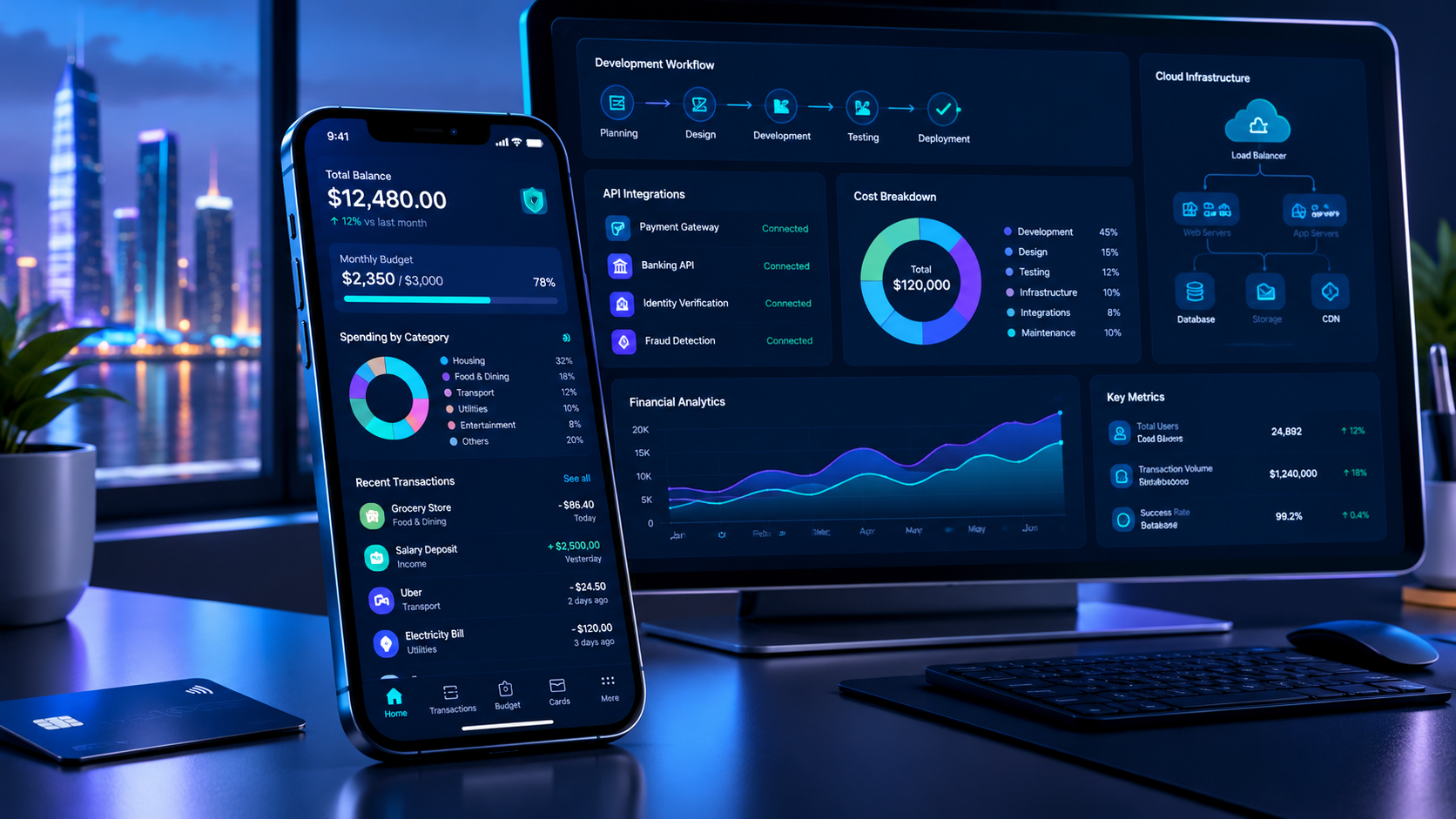
Finance app development in 2026: explore essential features, cost factors, secure integrations, and the process of building a financial application.
Finance App Development Cost in 2026: Features, Pricing & Process
Finance app development cost in 2026 depends on the type of financial product you want to build, the features it needs, the integrations it requires, and the security and compliance measures involved. A personal budgeting app is generally less complex than a digital wallet, lending platform, investment application, or digital banking solution.
For businesses planning a financial application, understanding these differences before development begins can help prevent unexpected expenses, reduce unnecessary features, and establish a realistic launch budget.
This guide explains finance app development pricing, essential features, technology choices, development timelines, security considerations, and the process of selecting a development partner. It also explores important considerations for companies targeting Qatar's financial technology market.
How Much Does Finance App Development Cost in 2026?
Finance app development can range from tens of thousands of US dollars for a focused minimum viable product (MVP) to several hundred thousand dollars or more for a complex financial platform.
The following figures are indicative planning estimates, not fixed quotations. They assume professional product design, mobile development, backend services, testing, and initial deployment. Actual costs depend on the development team's location, scope, integrations, and regulatory requirements.
Finance app type | Estimated development cost (USD) | Indicative timeline |
|---|---|---|
Basic budgeting and expense-tracking app | $15,000–$40,000 | 2–4 months |
Personal finance management app | $25,000–$60,000 | 3–5 months |
Payment-enabled finance app | $35,000–$90,000 | 3–6 months |
Digital wallet with transaction management | $60,000–$150,000+ | 4–8 months |
Lending or investment application | $70,000–$200,000+ | 5–10 months |
Advanced digital banking or fintech platform | $150,000–$500,000+ | 8–18 months |
These ranges are broad estimates for initial planning. They are not a guarantee that a specific application can be delivered at the stated price or within the stated timeframe. Regulated products involving money movement, complex banking integrations, advanced fraud controls, or multiple jurisdictions can require substantially larger budgets.
What determines the final price?
The main cost drivers include:
Feature complexity: Budget tracking is simpler than real-time transfers, automated lending decisions, or investment execution.
Backend development: Financial records, transaction processing, reporting, and account management require dependable server-side logic.
Third-party integrations: Payment gateways, identity verification providers, banking APIs, and market-data services may require implementation and ongoing fees.
Security: Authentication, encryption, access controls, security testing, and fraud prevention add engineering work.
Compliance: Requirements depend on the services offered, the operating country, and whether the product handles regulated financial activities.
Platform choice: Developing for Android, iOS, and the web can increase the scope of design, development, and testing.
Maintenance: Cloud infrastructure, software updates, monitoring, and customer support continue after launch.
For businesses seeking a tailored solution, Galaxium Coding's mobile application development services and custom software development services provide relevant starting points for evaluating application requirements.
What Is Finance App Development?
Finance app development is the process of designing, building, testing, and maintaining software that helps users manage financial information or perform financial activities.
Depending on the product, a finance application might allow users to record expenses, create budgets, monitor accounts, send payments, manage loans, review investments, or access banking services.
A typical finance application combines several technical components:
A mobile or web interface.
A backend application that processes requests and business rules.
A database for user profiles, financial records, and application data.
Secure authentication and authorization.
External APIs for supported financial services.
An administrative dashboard for operational management.
Monitoring, reporting, and security controls.
The exact architecture depends on what the app does. A budgeting tool that stores manually entered expenses has different requirements from an application that initiates transfers or maintains customer balances.
This distinction is important because financial functionality, operational risk, and compliance obligations often influence development cost more than the number of screens.
Types of Finance Apps and Their Development Costs
Choosing the right application category is one of the first steps in estimating your budget.
1. Personal finance and budgeting apps
Personal finance apps help users understand their spending, manage budgets, and monitor financial goals.
Common features include:
Income and expense tracking.
Spending categories.
Monthly budget planning.
Savings goals.
Financial reports and charts.
Bill reminders.
Optional account synchronization.
A basic version can begin with manual expense entry and simple reports. Automated bank synchronization, advanced categorization, shared household budgets, and personalized recommendations increase complexity.
Best for: Startups, personal finance brands, and businesses developing money-management tools.
2. Digital wallet and payment apps
Digital wallets allow users to access supported payment services through a mobile interface. Depending on the business model, they may support transfers, payment initiation, transaction histories, or stored-value functionality.
Potential features include:
User registration and identity verification.
Payment initiation through an approved provider.
Transaction history and receipts.
Payment status notifications.
Refund and dispute workflows.
Fraud monitoring.
Administrative transaction controls.
A wallet that displays payment records is not equivalent to one that holds funds or transfers money between users. The latter may require a more complex ledger, reconciliation, settlement arrangements, and additional regulatory approvals.
Best for: Businesses with an appropriate payment-service model and access to the necessary licensed providers.
3. Digital banking applications
Digital banking apps provide interfaces for banking services, often through a licensed financial institution or approved banking partner.
Features may include account balances, statements, beneficiary management, transfers, card controls, and customer support.
Costs rise when the application requires core banking integration, real-time transaction processing, multi-factor authentication, detailed audit trails, and extensive operational controls.
Best for: Banks, financial institutions, and fintech businesses working with appropriate regulated partners.
4. Lending and loan management apps
Lending apps help users apply for loans, submit documents, track applications, and manage repayments.
Common features include:
Digital application forms.
Identity verification.
Document uploads.
Application status tracking.
Repayment schedules.
Notifications and reminders.
Staff review dashboards.
Credit assessment integrations, where permitted.
Automated credit decisions, collections workflows, complex repayment rules, and regulatory reporting can significantly increase development effort.
Best for: Financial institutions, authorized lenders, and businesses building loan-management software.
5. Investment and wealth management apps
Investment apps provide access to portfolio information, financial research, investment accounts, or trading services, depending on their permissions and integrations.
Possible features include portfolio dashboards, market data, watchlists, transaction records, performance reporting, and risk disclosures.
Live trading, broker integrations, suitability assessments, and investment-related compliance can make these applications more demanding than informational portfolio trackers.
Best for: Investment firms, wealth managers, and appropriately authorized financial service providers.
Essential Features That Influence Finance App Development Pricing
A successful finance app needs more than a visually appealing dashboard. Its features should support the intended financial workflow while protecting users and their data.
1. Secure registration and login
Registration establishes a user's account and access permissions.
Depending on the product, it may include email or phone verification, multi-factor authentication, biometric authentication, secure session management, and account recovery.
Financial applications should avoid storing sensitive authentication secrets in insecure locations. The appropriate authentication model depends on the risks associated with the app.
2. Financial dashboard
The dashboard provides a clear overview of the information most relevant to users.
It may display balances, income, expenses, budgets, savings goals, payment status, or portfolio performance. The displayed data should be consistent with the underlying financial records and should clearly identify pending or completed transactions.
3. Transaction history and financial reporting
Users may need searchable transaction histories, date filters, category breakdowns, downloadable statements, and monthly reports.
For payment applications, the interface should distinguish between pending, failed, reversed, and completed transactions when those states apply.
4. Payment gateway and banking integrations
Integrations allow an application to communicate with approved external services.
The work may include API authentication, data mapping, error handling, webhooks, reconciliation, retry logic, and monitoring. Integration costs depend on the provider's documentation, available test environments, commercial terms, and certification requirements.
5. Notifications and alerts
Notifications can inform users about successful payments, failed transactions, budget limits, unusual activity, and account changes.
Sensitive information should not be unnecessarily exposed in lock-screen notifications or email messages.
6. Administrative dashboard
An administrative dashboard helps authorized staff manage operational tasks, review application activity, respond to support requests, and monitor system performance.
For financial applications, permissions should be carefully controlled. Administrative actions involving accounts or transactions should be logged, and sensitive operations may require additional approval.
7. Analytics and financial insights
Charts and reports can help users understand spending patterns, monitor savings goals, or review financial activity.
Advanced categorization or recommendations may use machine learning, but such features require appropriate data handling, testing, and explanations of their limitations.
8. Multi-currency and localization support
An application serving international customers may need multiple currencies, regional number formats, localized content, and appropriate time-zone handling.
Currency conversion must use a defined exchange-rate source and explain applicable fees or rate differences. Displaying two currencies does not, by itself, provide a complete multi-currency financial system.
9. Customer support and dispute management
Users need a clear way to report incorrect transactions, failed payments, account-access problems, and suspicious activity.
Support workflows may include ticket management, evidence uploads, status updates, escalation, and links to relevant transaction records.
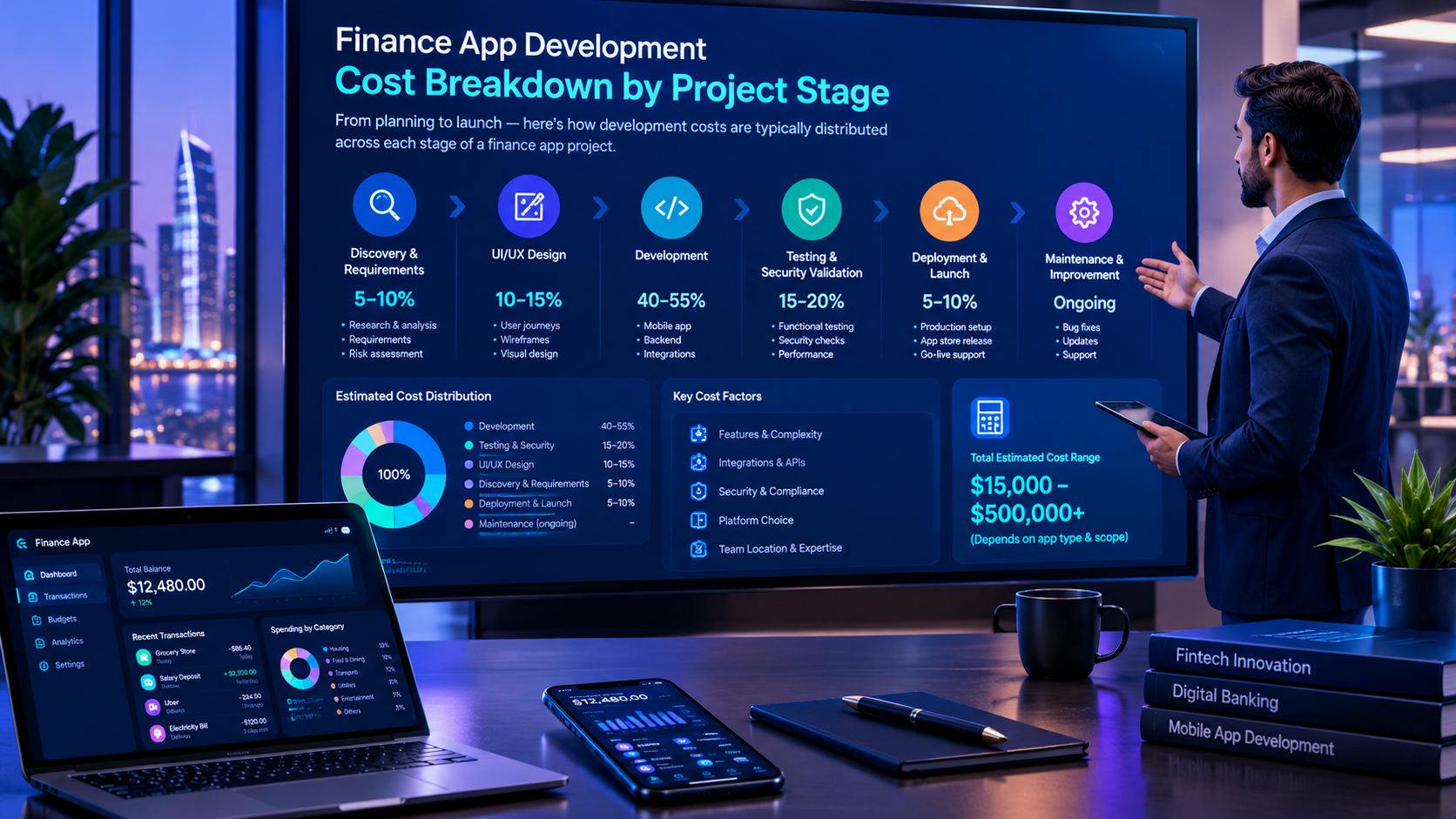
Finance App Development Cost Breakdown by Project Stage
A useful estimate separates the project into stages instead of treating development as a single expense.
Development stage | Indicative share of build budget | Main deliverables |
|---|---|---|
Discovery and requirements | 5–10% | Requirements, scope, risk assessment |
UI/UX design | 10–15% | User journeys, wireframes, interface designs |
Architecture and development | 40–55% | Mobile app, backend, database, integrations |
Testing and security validation | 15–20% | Functional tests, integration tests, security checks |
Deployment and launch | 5–10% | Production configuration, release preparation |
Project coordination and contingency | Scope-dependent | Delivery management and risk allowance |
These percentages are planning guidelines rather than universal industry averages. Some projects include project management and quality assurance within each stage, so the categories should not be added twice.
Stage 1: Discovery and requirements
The development team defines the target users, core financial workflows, integrations, business model, and expected outcomes.
For a financial product, discovery should also identify whether the proposed services involve regulated activity and which external providers or approvals may be required.
A clear requirements document reduces ambiguity and helps make later estimates more reliable.
Stage 2: UI/UX design
Designers create user journeys, wireframes, and interface designs for account management, dashboards, payments, reports, and other core features.
Financial interfaces should make balances, fees, transaction status, and confirmation steps easy to understand. Usability testing is particularly valuable before implementing money-moving workflows.
Stage 3: Backend and mobile development
Developers implement the interface, backend logic, database structure, APIs, and integrations.
The backend must enforce permissions and validate important operations rather than relying only on the mobile interface. Financial records also need appropriate consistency, error handling, and traceability.
Businesses that require connected web dashboards or internal systems may also explore custom web application development.
Stage 4: Testing and security validation
Testing should cover ordinary user journeys as well as failure scenarios.
Examples include duplicate payment requests, interrupted network connections, expired sessions, incorrect permissions, failed verification, and delayed provider responses.
Security reviews should address authentication, data storage, API access, dependency vulnerabilities, logging, and the handling of sensitive information.
Stage 5: Deployment and launch
The team prepares production infrastructure, configures monitoring, completes release checks, and submits mobile applications to the relevant stores when applicable.
Launch readiness also includes support procedures, backup and recovery planning, incident response, and a process for addressing critical defects.
Stage 6: Maintenance and improvement
After launch, the product may require bug fixes, compatibility updates, security patches, infrastructure adjustments, and changes to external integrations.
A realistic budget accounts for these recurring responsibilities instead of allocating the entire budget to the initial build.
What Affects Finance App Development Cost the Most?
Platform selection
Developing an Android application, an iOS application, or both affects the budget. A cross-platform framework may allow teams to share substantial code, but platform-specific testing, integrations, and functionality still require effort.
A web-based administrative portal may be needed in addition to the mobile application.
Custom development versus ready-made solutions
Ready-made components and established financial-service providers can reduce implementation time. However, subscription fees, transaction charges, limitations, and vendor dependency must be considered.
Custom development offers greater control over workflows and architecture but usually requires more initial engineering.
Third-party API integrations
Every integration has its own technical and commercial requirements. Costs may include setup, usage charges, identity checks, transaction fees, provider certification, and ongoing support.
Confirm these terms before selecting a provider.
Compliance and security requirements
A financial dashboard that does not move money may have a different compliance profile from a regulated payment or lending product.
Security requirements should be identified during discovery rather than added after development. Regulated operations may also require external audits, specialist reviews, documented controls, and continuing compliance work.
Scalability and reliability
An application expecting a small initial user base may need a different infrastructure budget from one designed for high transaction volumes.
Architecture should reflect realistic usage forecasts, expected availability, data-retention needs, and recovery objectives. Expensive infrastructure is not automatically necessary for every MVP.
Finance App Development for Businesses in Qatar
Companies targeting Qatar should evaluate local market needs alongside the technical scope of their applications.
Qatar-specific financial considerations
The Qatar Central Bank's FinTech Supervision Department oversees relevant licensed fintech companies and the regulatory requirements applicable to their activities.
The Qatar Central Bank's Payment Services Regulation describes regulated payment services and related licensing requirements. Businesses should obtain current, qualified regulatory advice to determine which requirements apply to their specific model.
Before developing a finance app for Qatar, consider:
Whether the proposed service requires authorization or a licensed partner.
Which payment methods and financial integrations are available for the intended market.
Applicable identity verification and anti-money-laundering obligations.
Privacy, data-handling, recordkeeping, and security requirements.
Arabic and English language support, if appropriate for the target audience.
Qatari riyal support and any additional currencies required by the business model.
Customer support, transaction disputes, and operational reporting.
A development company can help implement technical controls and integrations, but software development alone does not grant permission to provide regulated financial services.
For businesses evaluating a local technology partner, Galaxium Coding provides software and application development solutions relevant to digital product planning. The appropriate scope should be established around the business's actual requirements.
Security and Privacy Requirements for Finance Apps
Security is a core product requirement because finance apps may handle identity information, account details, transaction histories, and other sensitive data.
Authentication and access control
Use an authentication design appropriate to the risk of the service. This may include multi-factor authentication, biometric login, secure session expiration, account recovery safeguards, and controls against repeated login attempts.
Apply least-privilege access so users, employees, and services can access only the resources they need.
Encryption and secure communication
Use secure communication protocols and appropriate encryption for sensitive data in transit and at rest. Protect cryptographic keys and credentials, and avoid embedding secrets in mobile application code.
API and transaction security
The backend should verify authorization for sensitive operations. Validate transaction details on the server, use appropriate protections against duplicate requests, and record significant events for investigation.
Where money movement is involved, the system should be designed to handle retries, reversals, failed transactions, and reconciliation correctly.
Privacy and data minimization
Collect only the information needed for defined purposes. Explain data collection clearly and provide suitable privacy disclosures.
Apple's App Store privacy details guidance explains how developers disclose app data collection and use, including data handled by integrated third-party services.
Google's Android privacy and security guidance covers privacy, authentication, encryption, and application security practices.
Monitoring and incident response
Monitoring should help identify unusual activity, service failures, suspicious access, and integration problems. Define how the team will investigate incidents, communicate with affected users where required, and restore service.
Security testing should continue after launch because dependencies, threats, and application functionality change over time.
How to Choose the Right Finance App Development Company
Selecting a development partner involves more than comparing the lowest quote.
1. Review relevant technical experience
Ask how the team approaches secure authentication, financial APIs, transaction records, testing, and backend architecture. Request relevant, verifiable examples without assuming that experience in ordinary mobile apps automatically translates to regulated fintech expertise.
2. Request a detailed scope and estimate
The proposal should explain the features included, platforms supported, integrations required, assumptions, exclusions, milestones, and payment terms.
Ask which costs are one-time development expenses and which recur after launch.
3. Evaluate security practices
Discuss code review, dependency management, access controls, encryption, security testing, backup procedures, and incident response.
If the product is regulated, determine who is responsible for compliance advice, evidence, independent audits, and any required approvals.
4. Clarify ownership and support
Confirm ownership of the source code, design assets, documentation, and relevant accounts. Define warranty terms, maintenance responsibilities, service expectations, and the process for transferring the application if the relationship ends.
5. Check communication and delivery methods
Look for a clear delivery process, regular progress reviews, documented decisions, and a way to manage changes without losing control of the budget.
You can review Galaxium Coding's projects and portfolio to understand its publicly presented work and contact the team to discuss your requirements.
Common Mistakes to Avoid When Budgeting for Finance App Development
Starting without defining the financial workflow: A vague concept leads to unclear requirements. Decide whether the app tracks information, connects accounts, initiates payments, manages loans, or provides investment services.
Underestimating integrations: External services may require commercial agreements, test environments, certification, and ongoing usage fees.
Treating security as a final-stage task: Security decisions influence architecture, data models, access controls, and testing. Plan them from the beginning.
Building every feature in the first release: An MVP should focus on a clearly defined core problem. Unnecessary features delay launch and make testing more difficult.
Ignoring ongoing costs: Maintenance, hosting, provider fees, monitoring, support, and compliance work may continue throughout the product's lifetime.
Assuming development includes regulatory authorization: A software contract does not replace any licensing, approvals, or professional regulatory advice required for the proposed financial activity.
Choosing a provider based on price alone: A lower quote may exclude critical workflows, security testing, documentation, or post-launch support. Compare equivalent scopes before deciding.
How to Reduce Finance App Development Costs Without Compromising Quality
Businesses can manage development costs by making deliberate scope and architecture decisions.
Define a focused MVP. Launch with the essential workflow and defer optional functionality until user needs are better understood.
Prioritize features by business value. Separate must-have functions from enhancements that can be introduced later.
Use established providers where appropriate. Payment, identity verification, and other specialist services may be more practical than building every component from scratch.
Choose the right platform strategy. Evaluate cross-platform development against the application's performance, integration, and user-experience requirements.
Validate the design early. Test wireframes and prototypes before committing to extensive development.
Automate suitable tests. Automated regression testing can help detect problems as the application evolves.
Plan compliance and security early. Early decisions can reduce expensive architectural changes later.
Budget for maintenance. A planned support budget helps avoid deferred updates and emergency work.
Cost reduction should focus on removing unnecessary complexity, not eliminating essential protections for financial data or transactions.
Future Trends in Finance App Development
Finance applications continue to evolve as businesses seek more convenient, personalized, and connected digital services.
AI-assisted financial insights
AI may support expense categorization, spending summaries, customer-service assistance, and anomaly detection. These functions need appropriate safeguards, privacy controls, and evaluation to avoid misleading recommendations.
Open and connected financial services
Where permitted and supported by suitable providers, APIs can enable account information, payments, and other financial workflows to connect with external systems. Availability and access depend on the relevant market, providers, and regulatory arrangements.
More convenient authentication
Passkeys and device-based biometric authentication can help improve the sign-in experience when implemented with appropriate security controls and recovery options.
Real-time transaction visibility
Users increasingly expect clear transaction statuses and timely notifications. Delivering that experience requires reliable provider integrations, accurate status handling, and monitoring.
Personalized user experiences
Applications may tailor dashboards, reminders, and insights to user preferences. Personalization should remain transparent and respect privacy choices.
Businesses should adopt new technology when it solves a real user problem rather than adding features simply because they are trending.
Final Thoughts
Finance app development cost in 2026 depends on the product's purpose, feature set, integrations, security requirements, regulatory scope, and long-term operating needs. A budgeting app can be relatively straightforward, while a payment, lending, investment, or banking platform may require significantly more engineering and oversight.
The most practical approach is to define the core financial workflow, identify applicable regulatory requirements, select appropriate providers, and request a transparent estimate before development begins.
For businesses planning a finance app in Qatar or another market, a well-scoped MVP can provide a structured starting point. Security, reliable transaction handling, and maintainability should remain priorities throughout the project.
If you are planning a financial application, contact Galaxium Coding to discuss your requirements, evaluate the technical scope, and explore an appropriate development approach.
Frequently Asked Questions (FAQs)
1. How much does finance app development cost in 2026?
A basic finance app may cost approximately $15,000–$40,000, while more advanced fintech applications can cost $60,000–$200,000 or considerably more. The actual price depends on functionality, integrations, platforms, security, and compliance requirements.
2. How long does it take to develop a finance app?
A focused MVP may take around 2–4 months. More complex payment, lending, investment, or banking products may require 5–18 months or longer. Timelines depend on scope, provider integration, testing, and required approvals.
3. What features should a finance app include?
Common features include secure login, a financial dashboard, transaction history, reports, notifications, customer support, and an administrative interface. Payment or banking products may also require identity verification, transaction controls, reconciliation, and additional security features.
4. Is finance app development more expensive than ordinary app development?
It can be. Financial products may require stronger access controls, careful transaction processing, audit trails, specialist integrations, security testing, and regulatory work that an ordinary informational app may not need.
5. Can I build a finance app with a limited budget?
Yes, if the initial product has a narrow and clearly defined scope. A budgeting tool or financial-information app may be a more realistic starting point than a platform that stores funds, transfers money, or provides regulated lending or investment services.
6. What technology is used for finance app development?
Depending on the project, teams may use native Android or iOS technologies, cross-platform frameworks such as Flutter or React Native, backend technologies such as Node.js or Java, secure databases, cloud infrastructure, and financial APIs. The appropriate stack depends on product requirements and team expertise.
7. Do finance apps need bank or payment API integrations?
Not always. An expense tracker with manual data entry may not need banking integrations. An app that synchronizes bank information or processes payments will generally need suitable external services and authorization to use them.
8. What security features are important in a finance app?
Important measures may include multi-factor authentication, secure session management, encryption, server-side authorization, API protection, transaction monitoring, audit logs, security testing, and a documented incident-response process.
9. What should businesses consider when developing a finance app in Qatar?
Businesses should identify whether their proposed services fall under applicable Qatar Central Bank or other regulatory requirements, determine whether authorization or a licensed partner is needed, and plan appropriate data protection, identity verification, payment integrations, and security controls.
10. How can I get an accurate finance app development quote?
Prepare a feature list, target-platform requirements, user workflows, expected integrations, and information about the intended operating market. Ask development companies to provide an itemized estimate with clear assumptions, exclusions, milestones, recurring expenses, and maintenance terms.