Business Applications of Digital Twin Technology in Qatar

Digital twin technology connects physical infrastructure with virtual models and real-time operational data to support smarter business decisions.
Business Applications of Digital Twin Technology in Qatar
Digital transformation is changing how businesses plan projects, manage infrastructure, monitor equipment, and make operational decisions. As organizations adopt connected technologies, digital twin technology is becoming an important tool for understanding real-world assets through digital environments.
In Qatar, where infrastructure development, smart city initiatives, construction, transportation, energy, and logistics are important parts of economic development, digital twins offer opportunities to improve how physical assets and business processes are managed.
From monitoring building performance to analyzing transportation networks, digital twin technology allows organizations to create digital representations of real-world systems and connect them with operational data. Instead of depending entirely on manual inspections and historical reports, businesses can use connected information to understand current conditions, identify potential problems, and evaluate possible improvements.
Qatar's digital transformation initiatives also provide relevant opportunities for these technologies. The Ministry of Communications and Information Technology's TASMU Smart Qatar program focuses on technology-driven development across transportation, logistics, healthcare, environment, and sports.
For businesses, the opportunity extends beyond visualization. Digital twins can support predictive maintenance, resource optimization, project coordination, facility management, and better decision-making.
This guide explores the major business applications of digital twin technology in Qatar, the industries that can benefit, the technologies involved, and how organizations can approach implementation.
What Is Digital Twin Technology?
A digital twin is a virtual representation of a physical object, asset, environment, or process that uses connected data to reflect relevant conditions of its real-world counterpart.
It can represent something relatively small, such as a machine, or something much larger, such as a building, industrial facility, transportation network, or urban environment.
Unlike a traditional 3D model, a digital twin can receive operational information from sensors, software platforms, and connected systems. Depending on its design, it can also support simulations and predictions that help businesses evaluate different scenarios.
For example, a property management company could create a digital twin of a commercial building. The model could combine information about:
Temperature and humidity
Electricity consumption
Air-conditioning performance
Equipment operating conditions
Occupancy patterns
Maintenance history
Building layout and infrastructure
This information helps facility managers understand how the building is performing and identify areas that require attention.
According to the Digital Twin Consortium, digital twins are integrated, data-driven representations of real-world entities and processes that are synchronized at a defined frequency and level of detail.
Digital Twin vs Traditional 3D Model
Although digital twins and 3D models may look similar, they serve different purposes.
Feature | Traditional 3D Model | Digital Twin |
|---|---|---|
Representation | Visual model | Data-connected virtual representation |
Live information | Usually unavailable | Can receive real-time or periodic data |
Monitoring | Limited | Supports operational monitoring |
Simulation | Design-focused | Can simulate operational scenarios |
Predictive analysis | Not normally included | Can support predictive insights |
Maintenance | Requires separate records | Can integrate maintenance information |
Business decisions | Mainly design and visualization | Operational and strategic decisions |
A traditional 3D model can provide an accurate visual representation of a building or machine. A digital twin adds connected information that helps organizations understand how the physical asset behaves over time.
Why Digital Twin Technology Matters for Businesses in Qatar
Qatar's business environment includes complex infrastructure, large construction developments, commercial properties, logistics facilities, energy operations, and technology-driven public services.
Managing these environments requires accurate information, efficient coordination, and reliable operational systems.
Digital twin technology can help organizations connect information from different departments and physical assets.
Supporting Qatar's Digital Transformation
Qatar's TASMU Smart Qatar initiative promotes the use of digital solutions across several priority sectors. These include transportation, logistics, healthcare, environment, and sports.
The initiative demonstrates the importance of connected systems, information sharing, and technology-driven service development.
Businesses can explore the TASMU Smart Qatar initiative to understand the country's wider direction toward digital transformation.
Digital twin technology can complement these objectives by connecting physical environments with data platforms, monitoring systems, and analytical applications.
Improving Infrastructure Management
Large infrastructure projects involve numerous physical assets, including roads, bridges, buildings, drainage networks, utilities, and transportation systems.
Managing these assets requires accurate information throughout their lifecycle.
Digital twins can help organizations:
Monitor asset conditions.
Maintain digital records of infrastructure.
Identify maintenance requirements.
Understand operational performance.
Improve coordination between technical teams.
Evaluate infrastructure changes before implementation.
Making Business Operations More Predictable
Businesses often respond to problems after they occur. Equipment failures, unexpected maintenance, inefficient energy consumption, and operational delays can affect productivity.
A connected digital twin can help organizations identify unusual patterns and evaluate potential risks earlier.
For example, an industrial company could monitor equipment temperature, vibration, and operating hours. If the collected information indicates unusual performance, maintenance teams can investigate before the equipment experiences a major failure.
This does not eliminate operational risks, but it can improve visibility and support more informed decisions.
Major Business Applications of Digital Twin Technology in Qatar
Digital twins have applications across several industries. Their value depends on the physical assets being monitored, the quality of connected data, and the business objectives of the organization.
The following applications are particularly relevant to Qatar's economic and infrastructure environment.
1. Digital Twins in Construction and Infrastructure
Digital Twins in Construction: Build Client Trust & Confidence | AECORD
Construction is one of the most relevant areas for digital twin adoption in Qatar because projects often involve complex buildings, infrastructure networks, and multiple contractors.
Digital twin technology can connect building information models with operational information collected during construction and after project completion.
How Construction Companies Can Use Digital Twins
Construction companies can use digital twins to:
Visualize buildings and infrastructure in three dimensions.
Monitor construction progress.
Compare planned and actual project conditions.
Identify coordination problems.
Maintain equipment and asset records.
Support facility management after handover.
For example, imagine a commercial construction project in Doha involving multiple contractors, electrical systems, plumbing, air conditioning, and structural components.
A digital twin can bring relevant project information together in one digital environment. Project managers can review building components, inspect progress information, and identify potential coordination issues.
BIM and GIS Integration in Qatar
Building Information Modeling (BIM) and Geographic Information Systems (GIS) are important technologies for infrastructure-related digital twins.
BIM provides detailed information about buildings and engineering components, while GIS connects infrastructure information with geographical locations.
In June 2026, Qatar's Public Works Authority (Ashghal) highlighted the integration of BIM and GIS in advancing the development of Qatar's National Digital Twin.
The discussion covered infrastructure planning, project delivery, asset management, urban planning, and the use of accurate data to support future decisions.
QNA
Businesses involved in construction and engineering can benefit from understanding how these technologies work together.
2. Digital Twin Technology in Real Estate and Property Management
Real estate companies manage buildings that require continuous monitoring, maintenance, and operational planning.
Commercial towers, hotels, shopping centers, residential developments, and office buildings can contain complicated electrical, mechanical, security, and environmental systems.
A digital twin can provide a centralized digital view of these assets.
Practical Applications in Property Management
Property management companies can use digital twins for:
Building performance monitoring: Track energy consumption, equipment performance, temperature, and environmental conditions.
Maintenance planning: Connect equipment records with maintenance schedules and operating information.
Space utilization: Analyze occupancy patterns to understand how different areas of a property are being used.
Facility management: Give maintenance teams access to digital building information when investigating operational problems.
Renovation planning: Evaluate proposed building modifications using the digital representation before carrying out physical work.
Example: A Commercial Tower in Doha
Consider a commercial tower with multiple office floors, centralized air conditioning, elevators, lighting systems, and security infrastructure.
Without connected monitoring, facility managers may need to collect information from several independent systems.
A digital twin could combine relevant building information into one interface.
Managers could review energy consumption, identify unusual equipment performance, and coordinate maintenance activities more efficiently.
This is particularly useful for property owners managing multiple commercial buildings.
3. Digital Twins for Energy and Utility Management
Power Plant Digital Twin — Asset Performance Management & AI Simulation
Energy and utility management is another important application area.
Large industrial facilities and commercial properties depend on equipment that requires continuous monitoring. Unplanned downtime, equipment inefficiency, and maintenance problems can affect operational performance.
Digital twin technology can provide a connected representation of selected equipment and systems.
Key Energy Applications
Businesses can use digital twins to:
Monitor equipment operating conditions.
Analyze energy consumption.
Identify abnormal performance patterns.
Evaluate equipment efficiency.
Support predictive maintenance.
Simulate different operating conditions.
Predictive Maintenance for Industrial Equipment
Traditional maintenance often follows fixed schedules or responds to equipment failures.
Predictive maintenance uses operational data to estimate when equipment may require attention.
A digital twin can combine sensor readings, maintenance history, and engineering models to help maintenance teams investigate possible equipment problems.
For example, a facility could monitor pumps, motors, cooling equipment, or industrial machinery.
If vibration or temperature readings begin to move outside expected patterns, the system can flag the equipment for inspection.
The result is better maintenance visibility and potentially fewer unexpected interruptions.
4. Digital Twins in Logistics and Supply Chain Management
Qatar's logistics sector depends on the coordination of warehouses, transportation networks, distribution facilities, and supply chain operations.
Digital twins can help businesses understand how these systems perform and identify opportunities to improve efficiency.
Warehouse Digital Twins
A warehouse digital twin can represent:
Storage areas and inventory locations.
Material movement.
Equipment utilization.
Warehouse traffic.
Loading and unloading operations.
Order processing workflows.
Managers can use this information to evaluate warehouse layouts and identify operational bottlenecks.
For example, a distribution company could simulate different warehouse layouts before physically moving shelves or changing equipment locations.
Transportation and Fleet Operations
Digital twins can also support transportation planning by combining vehicle information, geographical data, traffic conditions, and operational schedules.
Potential applications include:
Fleet performance monitoring.
Route planning analysis.
Vehicle maintenance planning.
Distribution center coordination.
Delivery process optimization.
These capabilities can be useful for logistics businesses that need better visibility across several operational locations.
5. Digital Twins for Smart Cities and Urban Planning
Qatar Transforms National Mapping with ArcGIS and Aerial Tech
Smart cities rely on connected infrastructure, digital services, and information systems that help manage urban environments.
Digital twins can provide a virtual representation of selected city systems, allowing planners and operators to understand how different infrastructure components interact.
Smart City Applications
Possible applications include:
Traffic flow analysis.
Road and infrastructure monitoring.
Environmental data visualization.
Utility network management.
Public infrastructure planning.
Urban development simulations.
For example, a city planning team could use a digital representation of selected roads and surrounding infrastructure to evaluate the possible impact of a proposed development.
It could examine traffic movement, road access, nearby infrastructure, and potential operational challenges.
Qatar's TASMU platform also describes digital twin applications for traffic management and air-quality monitoring, using connected information to support real-time insights and forecasting.
Supporting Better Urban Decisions
Urban planning decisions can affect transportation, infrastructure, utilities, and public services.
Digital twins can help planners evaluate different scenarios before implementing physical changes.
However, the usefulness of these models depends on the availability, accuracy, and timely updating of the underlying data.
6. Digital Twins in Healthcare Facilities
Healthcare facilities depend on reliable infrastructure, including medical equipment, electrical systems, air conditioning, backup power, and facility management operations.
Digital twins can help healthcare organizations monitor these physical environments.
Healthcare Facility Applications
Hospitals and medical centers may use digital twins for:
Monitoring building systems.
Tracking medical equipment maintenance.
Managing facility resources.
Evaluating space utilization.
Monitoring environmental conditions.
Planning infrastructure upgrades.
For example, a hospital could use a digital twin of its building infrastructure to monitor air-conditioning systems, backup generators, and equipment operating conditions.
This can help facility managers identify potential infrastructure problems and coordinate maintenance.
Digital twins should not automatically be treated as clinical decision-making systems. Any application involving patient data or medical decisions requires additional validation, privacy safeguards, and appropriate healthcare governance.
7. Digital Twins in Manufacturing and Industrial Operations
The Future of Smart Manufacturing Digital Twins: Driving Industry 4.0
Manufacturing businesses use machines, production lines, equipment, and industrial processes that generate operational information.
A digital twin can connect this information with a virtual representation of the production environment.
Industrial Use Cases
Production equipment monitoring.
Machine performance analysis.
Production workflow simulation.
Maintenance planning.
Quality process monitoring.
Factory layout optimization.
Example: Production Line Monitoring
Imagine a manufacturing facility with multiple production machines operating continuously.
A digital twin could combine information from sensors, equipment controllers, and production management software.
Managers could review machine performance, production output, and operating conditions through a centralized dashboard.
They could also simulate proposed changes to the production process before applying them to the physical facility.
This can support better planning and reduce the uncertainty involved in operational changes.
8. Digital Twins for Sports Facilities and Stadium Management
How AI and Connected Ball Technology Are Reshaping the 2026 FIFA World Cup | MeshWorld
Sports facilities require coordination between infrastructure, event operations, security, maintenance, lighting, and visitor services.
Digital twins can help facility operators understand how different systems interact.
Potential applications include:
Stadium facility monitoring.
Energy consumption analysis.
Equipment maintenance.
Crowd movement simulation.
Event preparation.
Space and resource planning.
For example, stadium operators could simulate expected visitor movement through entrances, corridors, and designated areas to evaluate operational arrangements before a major event.
These models can support planning, but real-world safety procedures and emergency management must remain governed by qualified professionals and applicable regulations.
Technologies Used in Digital Twin Development
Digital twin systems combine several technologies to connect physical assets with digital environments.
A successful implementation requires more than creating a 3D model. Businesses need a reliable data architecture, integration capabilities, monitoring tools, and suitable software infrastructure.
1. Internet of Things (IoT)
IoT devices and sensors collect information from physical environments.
Depending on the application, sensors can monitor:
Temperature and humidity.
Equipment vibration.
Energy consumption.
Pressure and flow.
Equipment operating conditions.
Environmental conditions.
The collected data can be transmitted to a digital platform for monitoring and analysis.
2. Artificial Intelligence and Machine Learning
AI and machine learning can help digital twin systems analyze large amounts of operational information.
Possible applications include:
Predictive maintenance.
Anomaly detection.
Performance forecasting.
Pattern recognition.
Operational optimization.
For example, a machine-learning model could analyze equipment performance history and identify patterns associated with potential mechanical problems.
3. Building Information Modeling (BIM)
BIM provides detailed digital information about buildings and infrastructure.
It can include structural components, electrical systems, plumbing, mechanical equipment, materials, and building layouts.
When integrated with operational data, BIM can contribute to a digital twin that supports both construction and facility management.
4. Geographic Information Systems (GIS)
GIS connects information with geographical locations.
It is especially useful for digital twins involving:
Roads and transportation networks.
Utilities and infrastructure.
Urban planning.
Geographical asset management.
Environmental monitoring.
Combining BIM and GIS allows organizations to understand both individual infrastructure components and their geographical relationships.
5. Cloud Computing
Cloud infrastructure can support the storage, processing, and accessibility requirements of digital twin applications.
Businesses can use cloud platforms to:
Store sensor information.
Process incoming data.
Host digital twin applications.
Support remote monitoring.
Integrate multiple operational systems.
Scale computing resources as requirements change.
Organizations planning these systems can explore cloud and DevOps solutions to understand the infrastructure considerations involved in building scalable digital platforms.
6. Data Analytics and Visualization
Digital twins generate information that needs to be understandable to business users.
Analytics dashboards can present:
Equipment performance.
Energy consumption.
Operational alerts.
Maintenance records.
Asset conditions.
Historical performance trends.
A well-designed interface helps managers and technical teams interpret information without needing to examine raw sensor data.
How Digital Twin Systems Work
A digital twin operates through a continuous or periodic connection between a physical asset and its digital representation.
The exact architecture depends on the business application, but most systems follow a similar process.
What Is a Digital Twin? Benefits, Real-World Examples, and Applications
Step 1: Identify the Physical Asset
The first step is selecting the object, process, building, or infrastructure system that needs a digital representation.
For example, a company might select a commercial building, manufacturing machine, warehouse, or energy system.
Step 2: Create the Digital Representation
Developers and engineers create the virtual model using suitable design, engineering, or software tools.
The model should represent the important physical characteristics of the selected asset.
Step 3: Connect Sensors and Data Sources
The system connects relevant information sources, such as:
IoT sensors.
Equipment controllers.
Existing business software.
Maintenance systems.
Building management platforms.
Geographical information systems.
Not every digital twin requires physical sensors. Some systems can use scheduled data imports, operational records, or other information sources.
Step 4: Process and Synchronize Information
The collected information is transferred to the digital platform.
Data processing helps organize the information, check its quality, and update the virtual representation.
The update frequency depends on the business requirement. Some applications need near-real-time information, while others can operate with periodic updates.
Step 5: Analyze and Simulate Performance
The digital twin can display current conditions and, where suitable models are available, simulate different scenarios.
For example, a facility manager could evaluate how changing equipment operating schedules might affect energy consumption.
Step 6: Support Operational Decisions
Managers and technical teams use the information to plan maintenance, investigate problems, evaluate improvements, and coordinate operations.
A digital twin becomes more valuable when its insights connect with actual business processes and decision-making responsibilities.
Key Benefits of Digital Twin Technology for Qatar Businesses
Digital twin technology can provide several business advantages when implemented around clear operational objectives.
Business benefit | How it helps |
|---|---|
Better asset visibility | Provides a centralized view of selected physical assets |
Predictive maintenance | Helps identify unusual equipment performance |
Improved planning | Supports testing and evaluation of different scenarios |
Operational efficiency | Highlights potential process and resource inefficiencies |
Reduced downtime risk | Helps maintenance teams investigate problems earlier |
Better coordination | Connects information across technical teams |
Resource optimization | Supports analysis of energy, space, and equipment usage |
Lifecycle management | Helps maintain digital records throughout an asset's life |
Improved Decision-Making
Digital twins can bring information from different sources into one environment.
Instead of reviewing separate reports, managers can access a more connected view of operational conditions.
Better Maintenance Planning
Maintenance teams can use operational information and historical records to identify equipment that may require inspection.
This can help organizations move beyond maintenance approaches based entirely on fixed schedules or emergency repairs.
Greater Operational Visibility
Businesses with multiple facilities or complex infrastructure can benefit from centralized monitoring.
Managers can understand asset conditions and compare operational performance across different locations.
More Effective Project Planning
Digital simulations can help organizations evaluate proposed changes before committing resources to physical implementation.
This can be particularly valuable for construction, industrial facilities, and infrastructure projects.
Challenges of Implementing Digital Twin Technology in Qatar
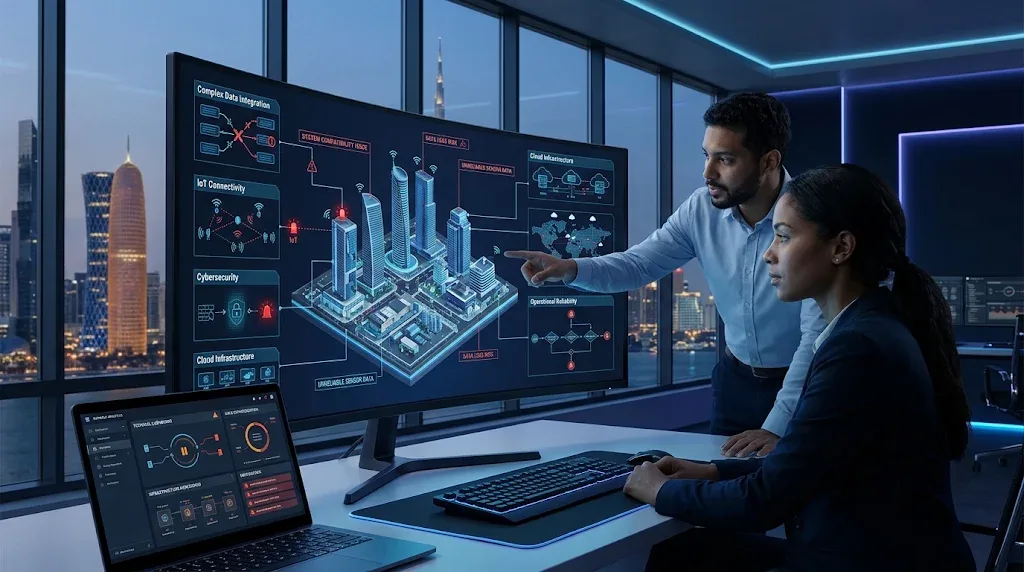
Although digital twins offer significant opportunities, implementing them requires careful planning.
Businesses should understand the technical, operational, and financial challenges before starting a project.
1. High Initial Development Requirements
Creating a digital twin can involve 3D modeling, sensors, software development, cloud infrastructure, data integration, and testing.
The cost depends on the complexity of the physical asset and the level of functionality required.
A small equipment-monitoring application will have very different requirements from a digital twin covering a large industrial facility.
2. Data Quality and Accuracy
Digital twin systems depend on the quality of their input information.
Incorrect sensor readings, outdated asset records, incomplete models, or inconsistent data formats can reduce the reliability of the digital representation.
Businesses should establish data validation processes before relying on the system for important operational decisions.
3. Integration With Existing Systems
Many organizations already use different applications for maintenance, finance, inventory, building management, and operational reporting.
A digital twin may need to connect with these platforms.
Poor integration can create information gaps and make it difficult to maintain an accurate digital environment.
4. Cybersecurity and Data Privacy
Digital twins can contain sensitive information about buildings, industrial equipment, infrastructure, and business operations.
Unauthorized access or compromised connected devices may create operational and security risks.
Businesses should consider:
Strong authentication.
Role-based access controls.
Encryption.
Secure API connections.
Network segmentation.
Regular software updates.
Security monitoring.
Backup and recovery procedures.
Where personal or sensitive information is involved, organizations should also consider applicable Qatar data protection requirements.
5. Skills and Technical Expertise
Digital twin development often requires collaboration between software developers, data engineers, IoT specialists, BIM professionals, and industry experts.
Businesses need to ensure that the implementation team understands both the technology and the physical processes being represented.
How Businesses in Qatar Can Implement Digital Twin Solutions
A successful digital twin project should begin with a specific business problem rather than an ambitious technology objective.
Organizations should first identify where improved visibility, monitoring, or simulation could provide measurable value.
Step 1: Define the Business Objective
Determine what the organization wants to improve.
Examples include:
Reducing equipment downtime.
Improving building energy management.
Monitoring infrastructure conditions.
Optimizing warehouse operations.
Improving construction coordination.
The objective should be specific enough to evaluate whether the project has delivered value.
Step 2: Select the Right Asset or Process
Start with a clearly defined asset or operational process.
For example, a property management company could begin with one commercial building rather than attempting to create digital twins for every property at once.
A focused starting point makes testing and evaluation easier.
Step 3: Identify Required Data Sources
Determine which information is needed to create a useful digital representation.
This may include:
Existing 3D models.
BIM information.
GIS information.
Sensor readings.
Equipment specifications.
Maintenance records.
Operational databases.
Step 4: Choose the Technology Architecture
Select the software, infrastructure, integration methods, and data management tools required for the project.
The architecture should support the expected data volume, update frequency, security requirements, and future expansion.
Step 5: Develop the Digital Twin Application
The development team builds the digital environment, integrates data sources, and creates the required dashboards and monitoring features.
Businesses may require custom software development when their digital twin needs to connect with specialized workflows or existing business systems.
Step 6: Test the System
Testing should confirm that:
Data is collected correctly.
The virtual model represents the selected asset accurately.
Updates occur at the required frequency.
Dashboards display information correctly.
Integrations work reliably.
Access controls protect sensitive information.
Alerts and analytical functions behave as expected.
Step 7: Deploy and Monitor Performance
After testing, the system can be deployed for operational use.
Organizations should monitor system reliability, data quality, user adoption, and business performance.
Step 8: Expand Based on Results
Once the initial implementation demonstrates value, businesses can consider extending the system to additional assets, locations, or processes.
This gradual approach helps organizations manage complexity and investment risk.
Essential Features of a Business Digital Twin Platform
A digital twin platform should be designed around its intended users and operational requirements.
The following features can be useful for business applications.
Feature | Purpose |
|---|---|
3D visualization | Displays the digital representation of an asset |
IoT integration | Connects physical sensors and devices |
Live or scheduled updates | Synchronizes information from real-world systems |
Data analytics | Identifies trends and unusual patterns |
Predictive monitoring | Supports potential maintenance forecasting |
Alerts and notifications | Highlights important operational events |
Historical records | Stores information for performance analysis |
API integration | Connects the platform with external software |
User management | Controls access to sensitive information |
Reporting dashboard | Presents useful business insights |
Why API Integration Matters
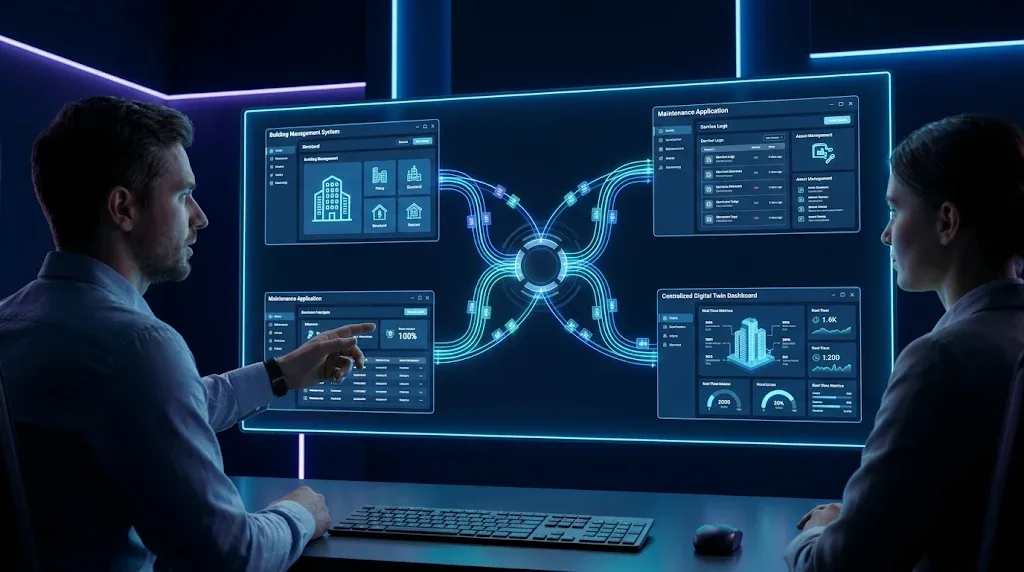
A digital twin may need information from several independent systems.
For example, a building management platform may provide equipment data, while a maintenance application stores service records.
APIs allow these applications to exchange information through defined interfaces.
Businesses can explore web application development services when planning customized dashboards and management interfaces for connected operational systems.
How Much Does Digital Twin Development Cost in Qatar?
The cost of developing a digital twin depends on the scope, complexity, and technical requirements of the project.
There is no single standard price that applies to every business.
A digital twin for one industrial machine may require a relatively focused solution, while a large infrastructure or smart-city application can involve extensive modeling, data integration, and engineering work.
Factors That Affect Development Cost
1. Complexity of the physical asset
A simple machine requires less modeling and data integration than a large commercial building or industrial facility.
2. 3D modeling requirements
Existing BIM or engineering models may reduce some initial work. Creating new models can add development time and cost.
3. IoT hardware and sensors
The number, type, installation requirements, and connectivity of sensors influence the total investment.
4. Software development
Custom dashboards, simulation tools, analytics, user management, and business workflows affect development requirements.
5. Data integration
Connecting multiple systems may require additional API development, data transformation, and testing.
6. Cloud infrastructure
Storage, processing, network usage, and hosting requirements influence ongoing operational expenses.
7. Maintenance and support
Digital twin systems require continued monitoring, software updates, security maintenance, and data quality management.
Estimated Project Complexity
Project type | Typical complexity |
|---|---|
Single-machine digital twin | Low to medium |
Commercial building digital twin | Medium to high |
Warehouse digital twin | Medium to high |
Industrial facility digital twin | High |
Large infrastructure digital twin | Very high |
City-scale digital twin | Very high |
These are relative complexity categories, not quoted Qatar market prices. A reliable cost estimate requires a technical assessment and a defined project scope.
Digital Twin Technology vs IoT: What Is the Difference?
Digital twins and IoT are closely related, but they are not interchangeable.
IoT focuses on connecting physical devices and collecting information from them.
Digital twin technology uses physical and operational information to maintain a digital representation of an asset or process.
Area | IoT | Digital Twin |
|---|---|---|
Main purpose | Device connectivity and data collection | Digital representation and analysis |
Sensors | Commonly used | Often used |
Visualization | Can provide device dashboards | Can provide virtual asset models |
Simulation | Not a core requirement | Can support simulations |
Predictive analysis | Possible with additional analytics | Can integrate predictive models |
Business application | Monitoring connected devices | Understanding and improving physical systems |
An IoT system can provide the data required by a digital twin. However, an organization can also create a digital twin using other data sources.
Future of Digital Twin Technology in Qatar
The future of digital twin technology in Qatar is connected to wider developments in smart infrastructure, industrial digitalization, data integration, and intelligent business systems.
As organizations continue to modernize their operations, the demand for connected information and better asset management may create further opportunities for digital twin applications.
Integration With Artificial Intelligence
AI can help digital twin platforms analyze operational information, recognize unusual patterns, and support predictive insights.
Future systems may combine digital models with more advanced analytical capabilities to help businesses evaluate operational scenarios.
Growth of Smart Infrastructure
Smart infrastructure requires information from buildings, transportation networks, utilities, and connected devices.
Digital twins can provide a framework for bringing relevant information together.
More Connected Industrial Operations
Manufacturing and industrial organizations may increasingly connect digital twins with production systems, equipment monitoring, and maintenance applications.
Improved Sustainability Monitoring
Digital twins can help organizations examine energy consumption, equipment performance, and resource utilization.
This can support more informed sustainability planning when the underlying data is accurate and appropriate.
Integration Across Business Systems
Digital twins may become more useful when connected with ERP, CRM, maintenance management, and operational software.
This allows businesses to connect physical asset information with broader business processes.
Qatar's emphasis on digital technology and sustainable development provides a relevant environment for these developments, although the adoption and maturity of individual applications will vary by sector.
How to Choose the Right Digital Twin Development Company in Qatar
Selecting a technology partner is an important decision because digital twin systems require coordination between software, data, infrastructure, and business operations.
Before selecting a development company, businesses should evaluate the following areas.
Technical Experience
Look for a team that understands relevant technologies such as:
Custom software development.
Cloud architecture.
API integration.
IoT connectivity.
Data analytics.
Web application development.
Secure database management.
Understanding of Business Requirements
A development partner should understand the physical environment and operational objectives before recommending a technical solution.
Integration Capabilities
Ask how the development team will connect the digital twin with existing software, databases, sensors, and business applications.
Security Practices
Discuss authentication, encryption, access permissions, data protection, and system maintenance.
Scalability
The platform should be designed to accommodate future expansion without requiring an unnecessary rebuild.
Ongoing Support
Digital twin applications require maintenance and monitoring after deployment. Confirm what support and update arrangements are available.
Businesses exploring technology development options can review Galaxium Coding's software development services and project portfolio to understand its wider software development capabilities.
How Galaxium Coding Can Support Digital Business Solutions
Digital twin projects often require custom software, data integration, cloud infrastructure, and business-focused applications.
Galaxium Coding works across software development, web applications, mobile applications, AI solutions, and cloud technologies.
These capabilities can be relevant when businesses need customized digital platforms to connect operational information, create management dashboards, and support connected workflows.
Depending on project requirements, a digital business solution may involve:
Custom web-based monitoring dashboards.
Secure database architecture.
API integrations.
Cloud-hosted applications.
Business analytics interfaces.
Mobile access to operational information.
Automated alerts and reporting.
A digital twin project may also require specialist BIM, GIS, IoT hardware, or industrial engineering partners. The exact delivery team should be selected according to the project's technical scope.
To discuss a software project or explore a customized digital solution, businesses can contact Galaxium Coding.
Conclusion
Digital twin technology is creating new opportunities for businesses to understand and manage physical assets through connected digital environments.
In Qatar, its applications are relevant to construction, real estate, energy, logistics, healthcare facilities, manufacturing, sports infrastructure, and smart city development.
By connecting physical assets with reliable data, digital twin platforms can support better monitoring, maintenance planning, operational visibility, and informed decision-making.
However, successful implementation requires clear business objectives, accurate data, appropriate software architecture, secure integrations, and ongoing technical support.
For organizations considering digital transformation, starting with one well-defined business problem can be a practical way to evaluate the value of digital twin technology before expanding into larger applications.
As Qatar continues developing its digital economy, businesses that understand how connected technologies support real operational needs will be better prepared to evaluate emerging opportunities.
Frequently Asked Questions (FAQs)
1. What is digital twin technology?
Digital twin technology creates a virtual representation of a physical asset, process, or environment. It can use connected data to reflect real-world conditions and support monitoring, analysis, and simulation.
2. How is digital twin technology used in Qatar?
Potential applications in Qatar include construction, infrastructure management, smart cities, real estate, energy, logistics, manufacturing, healthcare facilities, and sports venue operations.
3. What are the main benefits of digital twins for businesses?
Digital twins can improve asset visibility, support predictive maintenance, help optimize resources, improve planning, and provide better information for operational decisions.
4. What is the difference between BIM and a digital twin?
BIM provides structured digital information about buildings and infrastructure, mainly supporting design, construction, and asset information management. A digital twin can connect such models with operational data to represent how an asset performs over time.
5. Does digital twin technology require IoT sensors?
Not always. IoT sensors are common sources of real-world data, but digital twins can also use information from existing software, engineering records, databases, and scheduled data updates.
6. Can small businesses use digital twin technology?
Yes. Small businesses can start with focused applications, such as monitoring a machine, managing a facility, or analyzing a warehouse process. The solution should match the organization's budget and operational needs.
7. How much does a digital twin project cost in Qatar?
The cost depends on asset complexity, modeling requirements, sensors, software development, integrations, cloud infrastructure, and ongoing support. A technical assessment is necessary to prepare a reliable quotation.
8. What technologies are used to develop digital twins?
Common technologies include IoT, BIM, GIS, cloud computing, AI, machine learning, data analytics, 3D visualization, APIs, and database systems.
9. Are digital twins and smart cities related?
Yes. Digital twins can support smart city applications by connecting information about infrastructure, transportation, utilities, and environmental conditions in a virtual environment.
10. How can a business start a digital twin project?
A business should identify an operational problem, select a suitable asset, review available data, choose an appropriate technical architecture, develop a focused solution, and evaluate its performance before expanding.
11. Is digital twin technology secure?
It can be designed with security controls such as encryption, authentication, role-based access, network protection, and continuous monitoring. Security depends on the architecture, implementation, and ongoing maintenance.
12. What is the future of digital twin technology in Qatar?
Potential growth areas include smart infrastructure, connected industrial operations, real estate management, logistics, energy optimization, and AI-supported operational analysis.
Call to Action
Ready to Build Smarter Digital Business Solutions?
Digital transformation starts with understanding your business requirements and choosing the right technology.
Whether you need custom software, connected business applications, cloud solutions, or intelligent digital platforms, Galaxium Coding can help you explore the right development approach.
Contact Galaxium Coding to discuss your next technology project.