Best Dating App Developers in 2026:How to choose
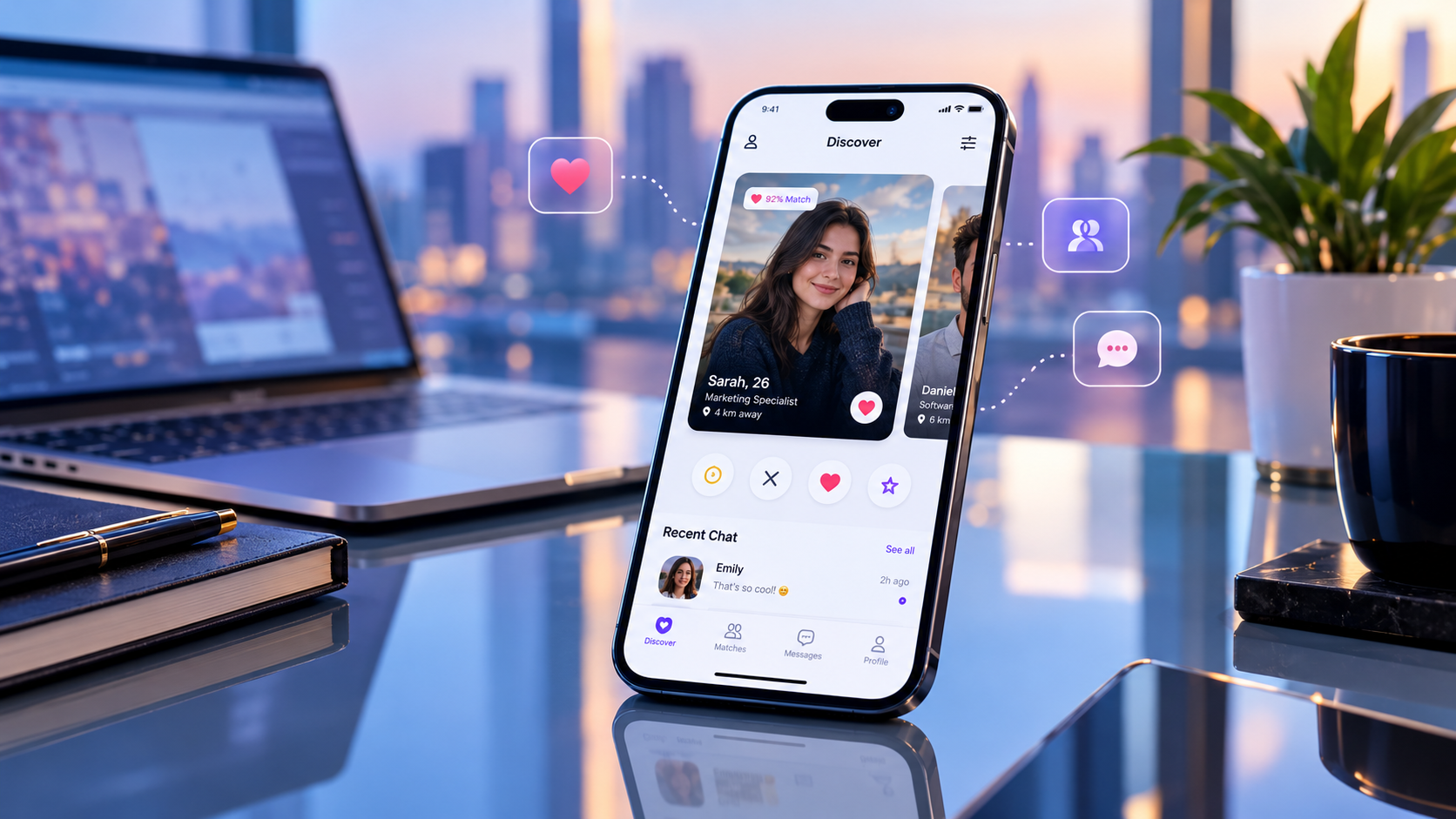
Explore leading dating app developers in 2026, compare development costs, and learn how to choose the right partner for a secure, scalable matchmaking application.
Best Dating App Developers in 2026: Top Companies, Costs, and How to Choose
Building a dating app in 2026 involves much more than creating profile cards and adding a swipe feature. A successful platform needs reliable matching algorithms, real-time messaging, profile verification, privacy controls, moderation tools, subscription management, and a user experience that encourages people to return.
Choosing the right dating app developers is one of the most important decisions for a startup, entrepreneur, or established business planning to enter the online dating market. The development partner you select can influence your launch timeline, development budget, platform performance, security, and ability to scale.
The challenge is that many software companies offer mobile application development, but not every team has the experience required to build a safe, scalable dating platform. You need a developer who understands both the technical requirements and the business challenges of launching a matchmaking product.
This guide explores dating app development companies to investigate in 2026, estimated development costs, essential features, technology options, security considerations, and the questions you should ask before signing a contract.
Whether you are planning a Tinder-style application, a niche matchmaking platform, or a dating service for a specific community, this guide will help you make a more informed decision.
What Is Dating App Development?
Dating app development is the process of designing, building, testing, launching, and maintaining a mobile or web application that helps people discover compatible individuals and communicate with potential matches.
A dating platform typically combines several technologies, including mobile application development, backend services, databases, location-based discovery, messaging systems, recommendation algorithms, and payment integrations.
Depending on the business model, it may also include identity verification, video calls, artificial intelligence, premium subscriptions, profile boosts, and administrative moderation tools.
For example, a startup might launch a niche dating app for professionals in one city. The first version could include user registration, detailed profiles, preference-based discovery, mutual matching, messaging, and reporting tools. Additional capabilities could be introduced after the company validates demand.
Businesses considering a custom product can explore Galaxium Coding's software development services to understand how tailored software can support specific product requirements.
Why Choosing the Right Dating App Developers Matters
Dating applications have requirements that differ from many standard business applications. They must support personal interactions, sensitive user information, location-related functionality, and potentially large volumes of real-time communication.
A development company should understand these requirements before proposing an architecture or budget.
1. A Better User Experience
Users expect registration, profile creation, browsing, matching, and messaging to feel intuitive. Complicated onboarding or slow responses can discourage people from completing their profiles or returning to the app.
Experienced developers can help simplify these journeys while maintaining the controls necessary for a safe platform.
2. Reliable Matching and Discovery
Matching is central to the product. Developers must translate business rules into useful discovery and recommendation systems.
A basic platform might use age ranges, location radius, interests, and relationship preferences. A more advanced product could introduce compatibility scores and recommendations informed by user feedback.
3. Privacy and User Safety
Dating applications may process personal photographs, messages, location information, preferences, and verification records. Poor security or inadequate moderation can expose users to fraud, harassment, impersonation, or privacy violations.
A capable development partner should plan for access controls, secure data handling, reporting, blocking, abuse prevention, and incident response.
4. Scalability
An application that works with a small testing group may encounter performance problems as registrations, messages, photographs, and concurrent sessions increase.
A well-designed backend makes it easier to scale infrastructure, improve database performance, and introduce additional features without rebuilding the entire product.
5. Long-Term Product Support
Launching an app is only the beginning. Mobile operating systems change, users report bugs, third-party services update their APIs, and new security issues emerge.
Before choosing a developer, confirm how post-launch maintenance, updates, monitoring, and technical support will work.
Best Dating App Developers in 2026: Companies to Consider
There is no single best dating app development company for every project. Some businesses need a specialist in social discovery, while others need a general mobile application development partner capable of building a custom matchmaking product.
The following companies are candidates to investigate, not a definitive performance ranking. Their inclusion does not constitute an endorsement, and their current dating-specific portfolios, availability, pricing, and client references should be independently verified.
1. RaftLabs
RaftLabs is worth investigating for businesses planning niche dating and community-based matching products. Its published material discusses dating platforms for specific communities, including professional and interest-based audiences.
Potential fit: Startups that want to differentiate through a defined audience, tailored matching rules, or community-specific functionality.
What to verify before hiring:
Relevant live products and references.
Experience implementing verification and moderation.
Ownership of source code and deployment infrastructure.
Scope, pricing, and support arrangements for your project.
Website: RaftLabs
2. Appinventiv
Appinventiv is a mobile application development provider to consider when comparing agencies for larger or more feature-rich digital products.
Potential fit: Businesses evaluating a broader development engagement that may include iOS, Android, backend systems, integrations, and ongoing product development.
Ask whether the proposed team has shipped dating or social-discovery applications rather than relying exclusively on general mobile development experience.
Website: Appinventiv
3. JPLoft
JPLoft is another company to investigate when comparing custom application development and dating-app-related offerings.
Potential fit: Founders who want to compare an MVP-focused engagement with a more comprehensive application build.
Request a detailed breakdown of the proposed features, including messaging, subscription payments, profile verification, admin controls, and post-launch maintenance. Confirm that any published starting price applies to a scope comparable to yours.
Website: JPLoft
4. Code Brew Labs
Code Brew Labs is a candidate for businesses exploring custom mobile platforms and consumer-facing digital products.
Potential fit: Companies comparing agencies for a product that may require custom user journeys, third-party integrations, monetization, and ongoing enhancements.
During evaluation, ask for examples of production applications with similar technical requirements and confirm which capabilities are included in the initial proposal.
Website: Code Brew Labs
5. DevCom
DevCom is another software development provider to include in a broader agency comparison.
Potential fit: Businesses that want to assess a software engineering partner for a custom product and evaluate its ability to handle backend development, integrations, quality assurance, and maintenance.
Verify the team's specific experience with real-time communication, location-based discovery, user-generated content, and dating-related safety workflows.
Website: DevCom
6. RichestSoft
RichestSoft is worth researching if you are comparing prebuilt or white-label dating platforms against custom development.
Potential fit: Entrepreneurs who want to evaluate a potentially faster route to launching a branded application.
Before selecting a white-label solution, establish who owns the code, whether you can export user data, which features are configurable, and whether the platform permits future migration to custom infrastructure.
Website: RichestSoft
7. Suffescom Solutions
Suffescom Solutions is another provider to investigate when comparing agencies offering consumer mobile applications and related digital services.
Potential fit: Businesses that want to compare a packaged development proposal with a custom-built solution.
Ask for a demonstrable portfolio, a clear feature-by-feature estimate, and details of the team responsible for your project.
Website: Suffescom Solutions
8. Galaxium Coding
Galaxium Coding is a Qatar-based technology company offering software development and mobile application services. It is a relevant option to evaluate if you want to build a custom dating application around a particular business model, target audience, or regional market.
Rather than assuming that every dating-specific feature is already available, discuss your requirements with the team and establish the proposed scope, delivery milestones, technical architecture, and responsibilities.
Potential fit: Businesses that want to explore custom mobile applications, tailored backend functionality, integrations, and scalable digital products, including products aimed at the Qatar market.
Areas to discuss include:
iOS and Android application requirements.
Custom registration, profiles, discovery, and matching workflows.
Backend development and database architecture.
Messaging, notifications, and third-party service integrations.
Subscription management and administrative dashboards.
Privacy, moderation, testing, deployment, and ongoing maintenance.
You can review Galaxium Coding's mobile application development services and software development portfolio before discussing a project.
Important: Confirm dating-app-specific capabilities, relevant delivery experience, and commercial terms directly with the company. Do not assume that a general mobile development portfolio proves experience delivering a production dating platform.
How to Compare These Companies
Use the following comparison as an initial screening guide rather than a ranking of quality.
Company | What to investigate | Best evaluation question |
|---|---|---|
RaftLabs | Niche dating and community matching | Can you demonstrate a comparable live product? |
Appinventiv | Larger mobile development engagements | Who will lead architecture, delivery, and quality assurance? |
JPLoft | Custom builds and MVP options | What exactly is included in the quoted price? |
Code Brew Labs | Consumer applications and integrations | Which comparable features have been delivered? |
DevCom | Engineering and ongoing product support | How will real-time features and future scaling be handled? |
RichestSoft | White-label versus custom platforms | Can the product be migrated or independently hosted? |
Suffescom Solutions | Custom application proposals | Can you provide references and a transparent milestone plan? |
Galaxium Coding | Custom software and mobile development in Qatar | What dating-specific scope and delivery approach can you support? |
Before making a final selection, obtain proposals from at least three suitable providers. Compare the same requirements, delivery assumptions, ownership terms, and maintenance commitments rather than comparing headline prices alone.
How Much Does Dating App Development Cost in 2026?
Dating app development costs depend on the feature set, design complexity, number of platforms, backend architecture, security requirements, development team's location, and expected user volume.
Published vendor estimates vary considerably. A lean MVP may cost tens of thousands of dollars, while a sophisticated platform with advanced matching, video communication, and extensive moderation can cost several hundred thousand dollars or more.
The following ranges are planning estimates in USD, not fixed quotations or guaranteed market averages.
Development level | Indicative budget | Typical scope |
|---|---|---|
Basic MVP | $15,000–$50,000 | Registration, profiles, basic matching, and core discovery |
Custom launch-ready application | $50,000–$150,000 | More complete messaging, notifications, payments, administration, and safety features |
Advanced dating platform | $150,000–$300,000+ | Advanced recommendations, verification, video, and more sophisticated moderation |
Large-scale or multi-market platform | $300,000–$500,000+ | Complex infrastructure, multiple markets, advanced analytics, and expanded operational controls |
These ranges overlap because companies define an MVP differently. A quote near the bottom of a range may exclude important backend functionality, verification, moderation, testing, or production support.
For additional context, compare published 2026 dating app development cost estimates with other providers' estimates before setting a budget.
1. Basic Dating App MVP: $15,000–$50,000
A minimum viable product (MVP) is designed to test the core business idea with a limited but functional set of features.
It may include:
User registration and authentication.
Profile creation and photographs.
Basic preferences and profile discovery.
Simple matching logic.
Basic messaging, if included in scope.
Push notifications.
A basic administrative interface.
Essential reporting and blocking controls.
Testing and initial deployment.
The exact scope matters. A very lean prototype may omit production-grade messaging, verification, or sophisticated moderation. Those omissions should be identified explicitly rather than hidden inside a low quote.
Suitable for: Startups testing a specific audience, geography, or matchmaking concept before investing in a larger product.
2. Custom Dating App: $50,000–$150,000
A more complete application may include:
Polished onboarding and profile experiences.
Advanced search filters.
Mutual matching and preference management.
Reliable real-time messaging.
Subscription payments and premium features.
Profile verification integrations.
Reporting, blocking, and moderation workflows.
An administrative dashboard.
Analytics and crash monitoring.
More comprehensive security and quality assurance.
Suitable for: Businesses preparing for a broader commercial launch that need a stronger feature set and operational controls.
3. Advanced Dating Platform: $150,000–$300,000+
An advanced product may introduce:
More sophisticated recommendation algorithms.
Video and audio calls.
Enhanced identity verification.
Automated moderation assistance.
Fraud detection and suspicious-behaviour alerts.
Events or community features.
Multiple subscription tiers and promotional purchases.
High-availability infrastructure.
Advanced analytics and experimentation.
Suitable for: Funded startups or established businesses with a validated concept and a clear plan for user acquisition and operational support.
4. Enterprise or Multi-Market Platform: $300,000+
A large platform may require multiple regional deployments, more demanding availability targets, extensive integration requirements, multilingual experiences, complex moderation operations, and advanced data governance.
Costs can rise further when a business needs native iOS and Android applications, a web application, sophisticated recommendation infrastructure, or substantial compliance work across different jurisdictions.
Suitable for: Organizations with established demand, appropriate funding, and a justified need for complex infrastructure.
What Is the Best Budget for a New Dating App?
For many early-stage businesses, a carefully scoped MVP is a more sensible starting point than attempting to reproduce every feature of an established dating platform.
Start with the smallest product that can test three questions:
Can you attract the intended users?
Can the app create meaningful, repeat interactions?
Will users trust the platform enough to return and potentially pay?
The initial budget should also leave room for marketing, moderation, hosting, verification services, and improvements after launch.
A dating app can be technically successful and still struggle commercially if there are too few relevant users in each location or community.
What Factors Affect Dating App Development Costs?
1. Platform Selection
Building for iOS, Android, or both affects design, development, testing, and maintenance.
A cross-platform framework may allow a team to share substantial application code between iOS and Android. Separate native applications may be justified when the product requires platform-specific behaviour or a high degree of customization.
However, cross-platform development does not eliminate the need for platform-specific testing, store compliance, and integrations.
2. UI/UX Design
Dating apps depend heavily on first impressions and simple interactions.
The budget may cover:
User research.
User journeys and wireframes.
Interactive prototypes.
Profile and discovery interfaces.
Accessibility.
Design systems.
Usability testing.
Investing in a clear onboarding process and an understandable safety experience can be more valuable than adding decorative features.
3. Matching Algorithm Complexity
A rule-based matching system may use location, age range, interests, and preferences.
More sophisticated systems can incorporate compatibility scoring, ranking models, user feedback, and recommendations based on observed behaviour. These require additional engineering, testing, data quality controls, and ongoing evaluation.
AI should be introduced when it addresses a defined user problem, not simply because it is fashionable.
4. Real-Time Messaging and Video
Text messaging requires reliable delivery, notifications, conversation storage, and appropriate access controls.
Video calling adds additional considerations, including media infrastructure, connectivity, permissions, network quality, and potentially third-party usage charges.
A team should explain whether these features will use managed services or custom infrastructure and how their ongoing costs will be calculated.
5. Verification and Moderation
Identity checks, selfie verification, image screening, abuse reports, and moderator tools can significantly affect both development and operating budgets.
Third-party verification and moderation providers may charge based on usage, making costs dependent on the number of users and checks performed.
6. Backend and Infrastructure
Backend systems manage profiles, matching, messaging, notifications, payments, and administrative functions.
Infrastructure costs depend on traffic, storage, media delivery, database workloads, monitoring, redundancy, and regional deployment requirements.
The lowest initial development quote is not necessarily the lowest total cost of ownership.
7. Security and Privacy
Security requirements affect architecture, testing, data retention, permissions, encryption, logging, and incident response.
For dating apps, these controls should be planned from the beginning. Retrofitting them after a product gains users can be expensive and disruptive.
Essential Features Every Dating App Should Consider
A dating platform should begin with features that make discovery useful, communication reliable, and user interactions safer.
1. User Registration and Authentication
Registration may support email, phone verification, or approved third-party sign-in methods.
The onboarding process should explain the information users need to provide, avoid unnecessary data collection, and protect accounts against automated abuse.
2. User Profiles
A profile may include:
Display name and photographs.
Biography and interests.
Age or other permitted profile attributes.
Location preferences.
Relationship intentions.
Compatibility preferences.
Verification status, where applicable.
Only collect and display information that is necessary for the product. Sensitive attributes should receive particular care.
3. Matching and Discovery
The app should let users discover relevant profiles according to clear preferences and product rules.
Possible functionality includes swiping, browsing, filters, mutual likes, and recommendations.
The system should also account for blocked users, eligibility rules, and profile visibility preferences.
4. Real-Time Chat
Messaging may include text, photographs, read states, and notifications, depending on the product.
Consider controls that let users block contacts, report harmful messages, manage notifications, and end conversations safely.
5. Location-Based Discovery
Location features can help users discover nearby matches, but precise location data can create significant privacy risks.
Prefer coarse location or approximate-distance functionality where practical. Avoid revealing exact coordinates or allowing users to infer another person's movements.
6. Profile Verification
Verification may use phone checks, selfies, identity documents, or third-party services.
Verification methods should be selected carefully, with clear explanations of what is verified and what is not. A verified photograph or identity document does not guarantee that every interaction is safe.
7. Push Notifications
Notifications can inform users about matches, messages, and account activity.
Users should be able to manage notification preferences. Sensitive message content should not be unnecessarily exposed on lock screens.
8. Subscription and Monetization
Common options include:
Premium subscriptions.
Profile boosts.
Additional discovery features.
Paid visibility options.
Optional virtual gifts, where appropriate.
Payment implementation must account for applicable app-store policies, taxes, refunds, and payment-provider requirements.
9. Reporting and Blocking
These are core safety features rather than optional enhancements.
Users should be able to report abusive behaviour, block accounts, and receive understandable confirmation that their actions have been registered. Moderators need suitable tools to investigate reports and enforce policies.
10. Admin Dashboard
An administrative dashboard can help authorized staff manage reports, review suspicious activity, handle support requests, moderate profiles, and monitor platform health.
Access should be restricted according to job responsibilities, and administrative actions should be logged appropriately.
Best Technologies for Dating App Development
The right technology stack depends on the product's requirements, team expertise, expected traffic, and long-term maintenance plan.
Technology area | Options to evaluate | Main consideration |
|---|---|---|
iOS development | Swift and SwiftUI | Native Apple platform integration |
Android development | Kotlin and Jetpack Compose | Native Android experience |
Cross-platform mobile | Flutter or React Native | Shared code and delivery efficiency |
Backend | Node.js, Python, Java, or other suitable frameworks | Real-time workloads, maintainability, and team expertise |
Database | PostgreSQL or another suitable database | Relationships, consistency, querying, and data integrity |
Real-time messaging | WebSockets or managed messaging services | Delivery reliability, concurrency, and operating cost |
Media storage | Managed object storage and content delivery | Secure uploads, access controls, and performance |
Notifications | Apple and Android push notification services | Reliable delivery and privacy |
Cloud infrastructure | AWS, Azure, Google Cloud, or other suitable providers | Security, availability, cost, and operational capability |
Analytics | Privacy-conscious product analytics | Measuring engagement without excessive data collection |
There is no universally best stack. For example, a startup with a small engineering team may prefer a managed messaging service to reduce operational complexity. A company with specialized infrastructure requirements may need a different approach.
For businesses evaluating custom architectures and connected systems, Galaxium Coding's software development services provide a starting point for discussing tailored technical requirements.
How to Choose the Best Dating App Development Company
Selecting a development partner requires more than comparing websites, advertised prices, or sales presentations.
Use the following process to evaluate providers consistently.
Step 1: Define Your Dating App Concept
Before requesting quotations, document the target audience and the problem your product will solve.
For example, your concept might be:
A dating app for professionals.
A community-based matchmaking platform.
A location-focused dating service.
A platform for shared hobbies or interests.
A matchmaking service with enhanced identity checks.
A clear audience helps the development team design relevant features instead of building a generic collection of functions.
Step 2: Review Relevant Portfolio Projects
Ask each company to demonstrate live applications or projects with comparable functionality.
Look for evidence of experience with profiles, discovery, real-time messaging, subscriptions, verification, user-generated content, and administrative moderation.
Confirm the company's actual role in each project. A design prototype, a white-label customization, and a production application are different levels of experience.
Step 3: Assess Technical Expertise
Ask how the team intends to handle:
Application architecture.
Matching and recommendation logic.
Real-time messaging.
Account security.
Privacy controls.
Database performance.
Cloud infrastructure.
Testing and deployment.
The provider should explain its recommendations in language you can understand and connect each technical decision to a business requirement.
Step 4: Compare Detailed Proposals
Give every shortlisted company the same initial requirements document.
Ask each to separate the cost of design, mobile development, backend development, integrations, testing, deployment, and maintenance.
A useful proposal also identifies assumptions, exclusions, dependencies, milestones, and change-request rates.
Step 5: Check Communication and Project Management
Find out who will manage the project and who will make technical decisions.
Agree on communication frequency, progress demonstrations, issue escalation, acceptance criteria, and access to project management tools.
Regular working software demonstrations are more useful than relying solely on percentage-complete reports.
Step 6: Confirm Ownership and Contract Terms
The contract should specify ownership of source code, design assets, databases, deployment configurations, and project documentation.
Where possible, production infrastructure and developer accounts should be controlled by your business. Any third-party licensing restrictions should be disclosed.
Clarify payment milestones, warranties, maintenance, termination provisions, confidentiality, and transition assistance.
Step 7: Evaluate Post-Launch Support
Ask what happens after launch.
Confirm response times, bug-fix responsibilities, security updates, operating-system compatibility work, monitoring, and the hourly or monthly cost of ongoing support.
Choose a company that can support the product's realistic long-term needs.
Custom Dating App Development vs White-Label Solutions
One of the first decisions is whether to build a custom platform or adapt an existing solution.
Factor | Custom development | White-label platform |
|---|---|---|
Initial cost | Generally higher | Can be lower |
Launch speed | Usually longer | Often faster |
Feature flexibility | High, subject to budget | Depends on vendor capabilities |
Matching logic | Can be designed around your concept | May be limited to supported options |
Code ownership | Negotiated in the contract | Often restricted or license-dependent |
Integrations | Can be tailored | Depends on available APIs |
Long-term changes | Greater control with suitable architecture | May require vendor changes |
Vendor dependence | Depends on hosting and architecture | Can be substantial |
When Custom Development Makes Sense
Choose custom development when your product requires distinctive matching logic, specialized workflows, deeper integrations, or long-term control over the technical roadmap.
It can also be appropriate when privacy, scalability, and differentiation are important business requirements.
When White-Label Development Makes Sense
A white-label platform may suit a business that wants to test demand quickly with a limited budget and can operate within an existing feature set.
However, investigate recurring licensing fees, user-data access, customization limits, export capabilities, and migration rights before committing.
The correct choice depends on whether speed and initial cost outweigh the limitations of the platform for your particular business.
Dating App Security, Privacy, and User Safety
Security and safety should be treated as fundamental product requirements.
Dating apps can involve highly personal information and interactions with people users have never met. A security incident or poorly handled abuse report can damage trust and create legal or operational consequences.
Protect Accounts and Personal Information
Consider strong authentication, secure session handling, access controls, encryption in transit, and appropriate encryption at rest.
Restrict internal access to personal information and provide stronger controls for administrative accounts.
Minimize Location Exposure
Do not expose exact coordinates or unnecessary movement history to other users.
Assess whether approximate distance, coarse geographic areas, or user-controlled location settings can satisfy the discovery requirement.
Create Effective Moderation Workflows
Provide reporting and blocking mechanisms, clear community standards, and a documented process for reviewing serious reports.
Depending on the product's risks, moderation may combine automated screening with human review. Automated systems should not be treated as infallible.
Reduce Fraud and Impersonation
Consider rate limits, suspicious-login detection, duplicate-account signals, verification options, and appropriate safeguards against automated registrations.
Avoid promising that verification can eliminate scams. Explain the limitations of the checks used.
Establish Privacy and Retention Policies
Document what data is collected, why it is needed, who can access it, how long it is retained, and how users can exercise applicable rights.
Deletion workflows should cover relevant profile data, media, and associated records, subject to legitimate legal and operational retention requirements.
Review Relevant Laws and Platform Policies
The applicable requirements depend on where the service operates, the locations of its users, and the information it processes.
Businesses serving users in Qatar should obtain appropriate advice about applicable privacy and data-protection obligations. Products serving other jurisdictions may also need to address their local privacy, consumer-protection, age-related, and online-safety rules.
Review the official Apple App Review Guidelines and Google Play policy documentation before finalizing product features and store-submission plans.
How Long Does It Take to Develop a Dating App?
Development time depends on the scope, team size, integrations, design readiness, testing requirements, and complexity of the matching and safety systems.
The following are illustrative planning estimates rather than delivery guarantees.
Stage | Indicative duration |
|---|---|
Discovery and requirements | 2–4 weeks |
UX/UI design and prototyping | 2–6 weeks |
Basic MVP development | 8–16 weeks |
More complete custom application | 4–7 months |
Advanced multi-platform platform | 6–12 months or longer |
App-store review and launch preparation | Additional time may be required |
Some stages can overlap, so these durations should not simply be added together.
What Can Delay a Dating App Project?
Common causes include:
Frequently changing requirements.
Unclear target users or matching rules.
Complex third-party integrations.
Unresolved design decisions.
Slow feedback or approval cycles.
Unexpected performance or security issues.
App-store review concerns.
Incomplete moderation and privacy workflows.
A written scope, clear acceptance criteria, and staged demonstrations help reduce avoidable delays.
Common Mistakes to Avoid When Hiring Dating App Developers
Choosing the Cheapest Quote
A low quote may exclude critical safety features, testing, maintenance, or production infrastructure.
Compare the actual deliverables rather than assuming two proposals provide the same product.
Copying Established Apps Too Closely
A familiar interface can help users understand your product, but copying another company's branding, protected assets, or distinctive implementation can create legal and commercial problems.
Build around your own audience, positioning, and user needs.
Treating AI Matching as a Guarantee
AI may help rank profiles or personalize discovery, but it cannot guarantee compatibility or successful relationships.
Start with measurable matching rules, gather appropriate feedback, and introduce more complex models only when there is a clear benefit.
Ignoring Trust and Safety
Reporting, blocking, account protection, and moderation should be planned before launch. Adding them only after problems occur can expose users and the business to avoidable risks.
Forgetting Operating Costs
Development is only one part of the budget. Hosting, storage, verification, messaging, moderation, support, marketing, and app-store-related charges may continue for as long as the product operates.
Failing to Secure Ownership
Never assume you automatically own the source code, infrastructure, or third-party accounts simply because you paid for development.
Make ownership and access rights explicit in the contract.
Future Trends in Dating App Development for 2026
The most useful trends are those that solve real user problems rather than merely adding complexity.
AI-Assisted Recommendations
Recommendation systems may help users discover profiles that align more closely with their stated preferences and behaviour.
Developers should evaluate fairness, explainability, privacy, and the risk of reinforcing unwanted patterns.
Stronger Profile Authenticity
Selfie checks, identity verification, and other authenticity signals may help platforms reduce impersonation. These measures need transparent explanations and proportionate data handling.
Better Privacy Controls
Users may benefit from more control over visibility, location sharing, profile discovery, and the information revealed during interactions.
Privacy should influence the design of features rather than being treated as an isolated settings page.
Video and Interactive Experiences
Video introductions, calls, and virtual events can support new ways of interacting. They also increase infrastructure, moderation, accessibility, and operational requirements.
Niche and Community-Based Products
Some businesses may differentiate through a well-defined audience, shared interests, or community-specific matching criteria.
For these products, understanding the intended users and building a safe, relevant community may be more important than launching the largest possible feature set.
Frequently Asked Questions
1. Who are the best dating app developers in 2026?
The best developer depends on your budget, product requirements, location, and desired level of customization. Companies such as RaftLabs, Appinventiv, JPLoft, Code Brew Labs, DevCom, RichestSoft, and Suffescom Solutions can be included in an initial comparison. Galaxium Coding is also worth evaluating for custom mobile and software development needs, particularly for businesses considering the Qatar market. Verify relevant portfolios, references, and commercial terms before choosing.
2. How much does it cost to develop a dating app in 2026?
A basic MVP may cost approximately $15,000–$50,000, a more complete custom application $50,000–$150,000, and an advanced platform $150,000–$300,000 or more. These are indicative estimates. Actual pricing depends on the feature set, platform choices, team rates, security requirements, and ongoing service needs.
3. How long does it take to build a dating app?
A basic MVP may take approximately three to four months, while a more sophisticated product can require four to seven months or longer. Large multi-market platforms may take a year or more. The schedule depends on requirements, team capacity, integrations, and testing.
4. Should I build a custom dating app or use a white-label solution?
A white-label solution can be suitable for testing a simple concept quickly. Custom development is generally more appropriate when you need distinctive matching logic, deeper integrations, greater flexibility, or stronger control over the technical roadmap. Compare ownership, migration, and recurring costs before deciding.
5. What features are essential for a dating app MVP?
A practical MVP typically needs account registration, user profiles, discovery, matching, messaging, basic notifications, reporting, blocking, and administrative controls. The precise scope should reflect your audience and safety risks. Payment features and advanced verification can be phased according to the business model and launch requirements.
6. Which technology is best for dating app development?
Swift and Kotlin are options for native development, while Flutter and React Native support cross-platform approaches. Backend technologies and databases should be selected according to the expected workload, security needs, integrations, and the team's expertise. No single stack is best for every application.
7. How can a dating app make money?
Common models include premium subscriptions, profile boosts, paid discovery features, and other optional purchases. The business plan should account for payment processing, applicable app-store rules, customer acquisition, refunds, and the ongoing cost of safety and moderation.
8. How do dating apps protect user information?
Appropriate safeguards may include encryption, access controls, secure authentication, limited data collection, careful location handling, account protection, and documented retention policies. Verification and moderation can reduce certain risks but cannot guarantee that every account or interaction is safe.
9. Can AI be used in a dating application?
Yes. AI may support recommendations, spam detection, moderation assistance, and personalized discovery. These features should be tested carefully, respect user privacy, and provide appropriate safeguards against inaccurate or unfair outcomes.
10. What should I ask before hiring a dating app development company?
Ask about comparable production projects, team composition, technology choices, security, moderation, source-code ownership, milestone payments, testing, maintenance, and support. Request a written proposal that clearly separates included features from exclusions and recurring costs.
Final Thoughts
Choosing the best dating app developers in 2026 means finding a partner who understands your audience, business model, technical requirements, and responsibilities toward users.
Compare companies on demonstrated experience, transparent proposals, engineering quality, security practices, ownership terms, and post-launch support—not just price.
Start with a clear product concept and a realistic MVP. Prioritize useful matching, reliable communication, privacy, and user safety before investing in complex features that have not yet been validated.
If you are planning a custom dating application, explore Galaxium Coding's mobile application development services and software development portfolio to assess potential approaches for your project.
To discuss your requirements, expected budget, and development roadmap, contact Galaxium Coding for a project-specific conversation.
The right development partner should help you build a product that is technically reliable, commercially sustainable, and genuinely useful to the people it serves.