Fitness App Development in 2026: Features, Costs, and How to Build One
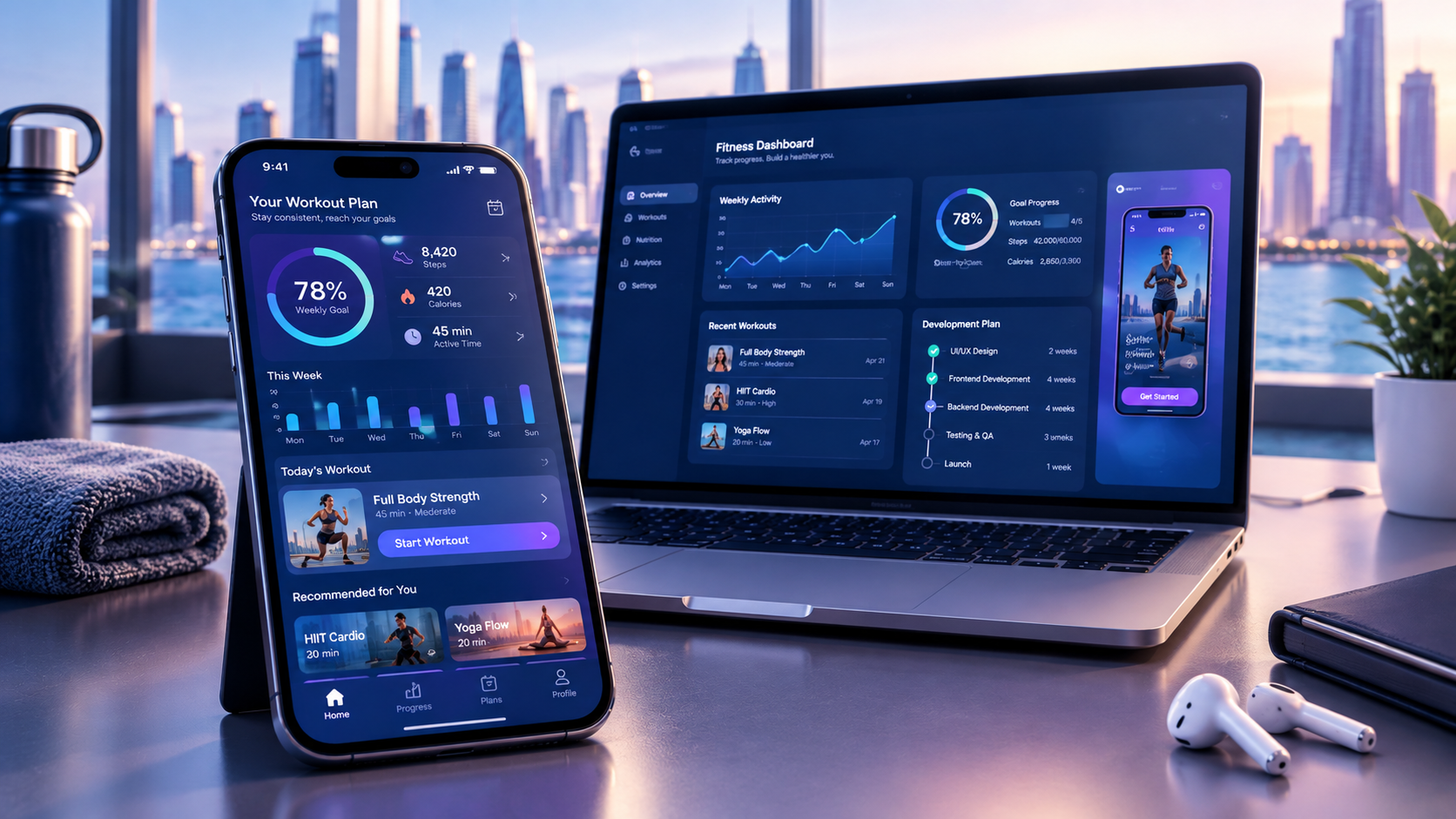
Explore fitness app development in 2026, including essential features, development costs, wearable integrations, and strategies for building a successful fitness application.
Fitness App Development in 2026: Features, Costs, and How to Build One
A fitness app can help people track workouts, follow training plans, monitor physical activity, improve consistency, and manage their fitness goals from a smartphone. For businesses, it can also create opportunities to offer digital coaching, sell subscriptions, deliver workout content, and build long-term customer relationships.
However, developing a successful fitness app in 2026 requires more than a collection of workout videos or a step counter. Users increasingly expect personalized experiences, easy progress tracking, wearable integrations, secure data handling, and features that help them stay motivated.
Whether you are a startup founder, gym owner, personal trainer, fitness brand, or business exploring digital products, understanding the development process is essential before investing in an application.
This guide explains what a fitness app is, which features to prioritize, how much development may cost, which technologies to consider, and how to build a product that supports both user needs and business goals.
What Is a Fitness App?
A fitness app is a mobile or web application designed to help users plan, perform, record, or evaluate physical activity and related wellness routines.
Depending on its purpose, a fitness app may focus on workout planning, gym training, running, cycling, nutrition tracking, personal coaching, class bookings, or connected fitness equipment.
For example, a gym might launch an app that lets members view exercise plans, reserve classes, track progress, and renew memberships. A personal trainer might create an application that delivers customized workout programs and allows clients to submit progress updates.
Businesses can build these experiences using custom mobile application development or a web-based platform, depending on the product's requirements.
The right approach depends on the intended users, the core problem being solved, the business model, and the features needed for the first release.
Types of Fitness Apps Businesses Can Build
Before selecting a development company or estimating a budget, identify which type of fitness app you want to create.
1. Workout and Exercise Apps
Workout apps provide exercise instructions, training plans, workout logs, and progress tracking.
Common users include gym members, beginners, athletes, and people exercising at home.
Potential features include:
Exercise libraries with demonstrations.
Workout plans based on fitness goals.
Sets, repetitions, duration, and rest timers.
Training history.
Progress charts.
Reminders and workout schedules.
A focused workout app can be a practical starting point because it can concentrate on one core user need before introducing more complex functionality.
2. Personal Training Apps
Personal training applications connect coaches with clients through digital training programs and communication tools.
Features may include personalized plans, trainer dashboards, progress updates, appointment scheduling, messaging, and subscription management.
A trainer-focused app may also require an administrative portal for managing clients, creating workout plans, and monitoring engagement.
3. Fitness Tracking Apps
Fitness tracking apps record activities such as walking, running, cycling, and other forms of exercise.
Depending on the product, they may use smartphone sensors, GPS, or connected wearable devices.
Common capabilities include step counts, distance, duration, pace, activity history, and goal tracking.
Developers must carefully consider battery usage, sensor limitations, permissions, and how activity data is synchronized.
4. Nutrition and Diet Tracking Apps
Nutrition-focused applications help users record meals, monitor dietary targets, and review eating patterns.
Possible features include food databases, meal logs, barcode scanning, recipe collections, and nutrient summaries.
Food database licensing, data accuracy, and the quality of nutritional information can significantly influence development and ongoing operating costs.
5. Gym and Fitness Studio Apps
Gyms and studios can use fitness apps to improve member convenience and reduce administrative work.
Typical functionality includes:
Class schedules and reservations.
Membership plans and renewals.
Trainer profiles.
Payment processing.
Attendance records.
Notifications about bookings and schedule changes.
Member support.
For a gym business, integrating the app with existing membership or booking software may be more valuable than developing advanced AI features.
6. On-Demand Workout and Live Fitness Apps
These applications deliver pre-recorded classes, live training sessions, or instructor-led workout programs.
They may include video libraries, live streaming, trainer subscriptions, class calendars, and progress tracking.
Video delivery, content production, streaming infrastructure, and moderation can make this category more expensive than a basic activity tracker.
7. AI-Powered Fitness Apps
AI-powered fitness applications can help personalize workout recommendations, adapt training schedules, summarize activity patterns, or provide coaching assistance.
For example, an app could recommend a suitable workout based on a user's stated goals, available equipment, and completed sessions.
AI-generated guidance must be carefully designed, tested, and limited to its intended purpose. It should not make unsupported medical claims or replace qualified professional advice where that advice is needed.
Why Are Businesses Investing in Fitness Apps?
Fitness applications can create value for both users and businesses when they solve a clear problem.
Greater Convenience for Users
Users can access workout plans, exercise instructions, progress summaries, and schedules without depending entirely on in-person services.
This is particularly useful for people who exercise at home, travel frequently, or need flexible training schedules.
More Personalized Experiences
A well-designed fitness app can adapt content to a user's stated goals, experience level, available equipment, and training preferences.
Personalization does not always require AI. Even straightforward rules and user-selected preferences can make an application more useful.
Stronger Customer Engagement
Workout reminders, achievable goals, progress summaries, and structured challenges can encourage users to return to the app.
These features should remain optional and helpful rather than creating excessive notifications or pressure.
Additional Revenue Opportunities
Businesses can offer subscriptions, premium workout programs, digital coaching, class bookings, or branded services.
A fitness app can also help a gym or trainer maintain a digital relationship with clients between in-person sessions.
Better Operational Efficiency
For gyms and fitness studios, an application can simplify bookings, payment collection, schedule updates, and member communication.
When connected to suitable business systems, it may also reduce repetitive administrative work.
Essential Features of a Fitness App
The best feature set depends on the intended audience. A beginner-focused workout app has different requirements from a running tracker or gym membership platform.
1. User Registration and Profiles
Users should be able to create accounts, manage preferences, and access their personal information.
A profile may include fitness goals, training experience, preferred workout types, available equipment, and schedule preferences.
Collect only information necessary for the app's functionality. Sensitive information should not be requested simply because it might be useful in the future.
2. Workout Plans and Exercise Library
A structured exercise library helps users understand what to do and how to follow a program.
Depending on the product, it can include:
Exercise names and instructions.
Demonstration images or videos.
Sets, repetitions, and rest periods.
Difficulty levels.
Equipment requirements.
Weekly workout schedules.
The content should be reviewed for accuracy and presented in an accessible format.
3. Fitness Tracking and Progress Reports
Progress tracking allows users to review completed workouts and monitor their consistency.
An app might record workout duration, distance, repetitions, completed sessions, or other activity measurements relevant to its purpose.
Charts and summaries should explain what is being measured. Avoid suggesting that a particular measurement proves overall health or fitness.
4. Goal Setting and Reminders
Users may set weekly activity goals, schedule training sessions, or receive reminders.
Useful reminders are timely, configurable, and easy to disable. Users should remain in control of their notification preferences.
5. Wearable Device Integration
Some fitness apps connect with smartwatches and other devices to access activity information.
On Apple platforms, developers can explore Apple Health and HealthKit technologies for permitted health and fitness data access.
For Android, developers should evaluate Android Health Connect and its supported data types and permissions.
Integration requirements vary by device, operating system, data type, and user consent. Test synchronization, missing data, permissions, and conflicting records rather than assuming every wearable behaves identically.
6. Nutrition Tracking
Nutrition functionality can allow users to log meals, record dietary preferences, and review selected nutritional information.
For a workout-focused MVP, nutrition tracking may be unnecessary. Add it when it supports a clearly defined user need and the business has a reliable plan for maintaining the underlying food data.
7. Social Features and Challenges
Some fitness applications include group challenges, progress sharing, leaderboards, or community discussions.
These features can support accountability, but they introduce additional privacy and moderation requirements. Users should control what information they share and with whom.
8. Subscription and Payment Management
A fitness app may offer free access with optional paid features, recurring subscriptions, or one-time purchases.
The application should communicate pricing, renewal terms, trial conditions, and cancellation procedures clearly.
Payment implementation must account for applicable app-store policies and payment-provider requirements.
9. Admin Dashboard
A web-based administrative dashboard helps authorized staff manage application content and business operations.
Depending on the product, it may support:
User and membership management.
Workout and video publishing.
Trainer and class scheduling.
Subscription monitoring.
Support requests.
Usage analytics.
Access permissions.
Administrative functions should use role-based access controls and maintain suitable records of sensitive actions.
10. AI-Assisted Personalization
AI features may recommend workouts, summarize progress, or help users navigate exercise content.
Before implementation, define how recommendations are generated, what information is used, how errors are handled, and when a user should be directed to a qualified professional.
AI functionality should improve a meaningful part of the user journey rather than increase complexity without a clear benefit.
How Much Does It Cost to Develop a Fitness App in 2026?
The cost of fitness app development depends on the product's scope, design, mobile platforms, backend requirements, integrations, content, security, and ongoing maintenance.
The following figures are indicative planning estimates in US dollars, not fixed quotations or guaranteed industry averages.
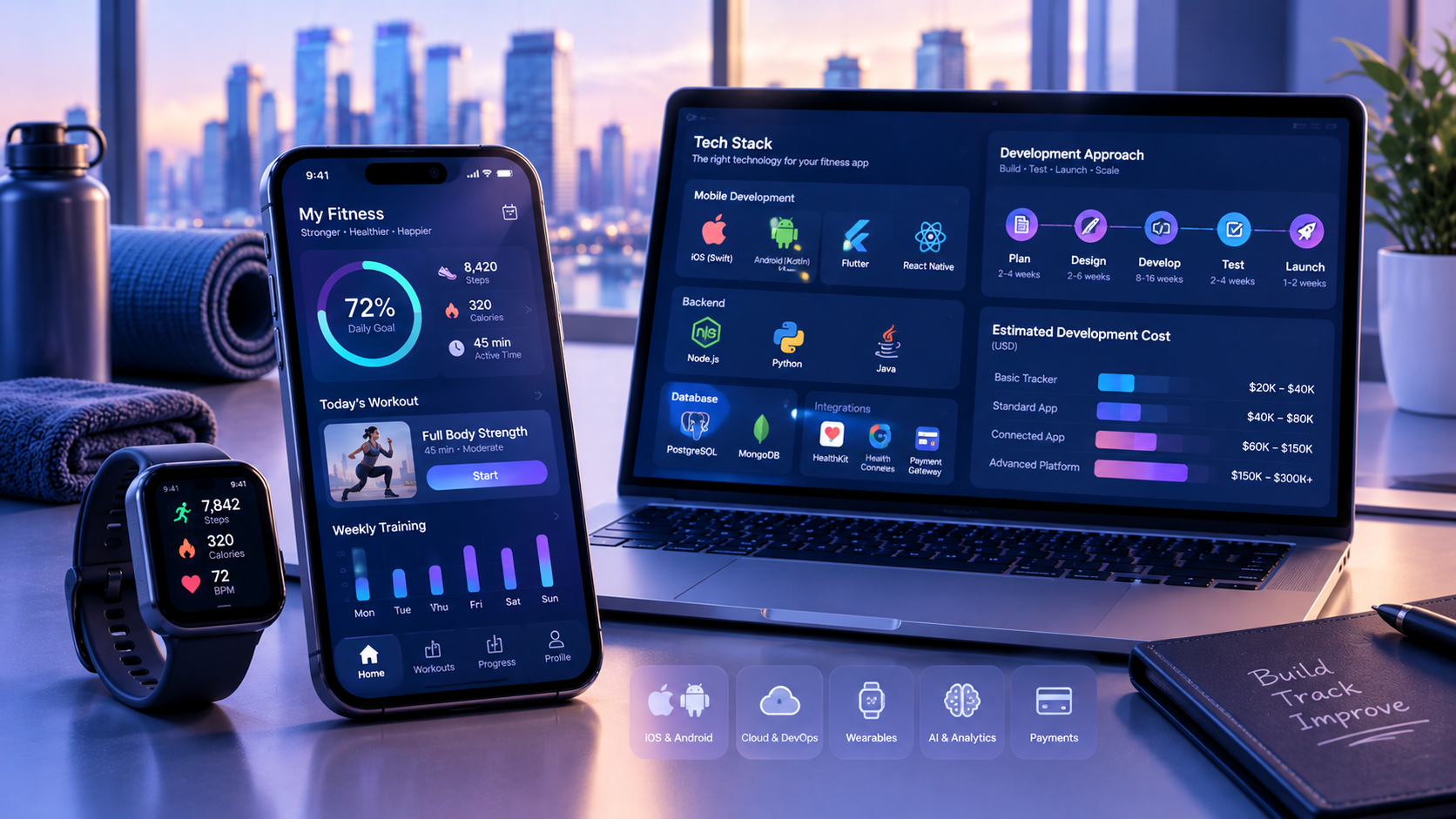
Fitness app type | Estimated development cost | Typical scope |
|---|---|---|
Basic fitness MVP | $20,000–$40,000 | Registration, workout logging, basic tracking, and a simple backend |
Standard fitness app | $40,000–$80,000 | Workout plans, progress reports, notifications, and additional user features |
Connected fitness app | $60,000–$150,000 | Wearable integrations, subscriptions, nutrition features, or more advanced tracking |
Advanced fitness platform | $150,000–$300,000+ | AI-assisted features, video streaming, complex integrations, or large-scale infrastructure |
These ranges overlap because two apps described as “fitness apps” may require very different engineering work. A focused tracker is not equivalent to a platform offering live classes, wearable synchronization, and personalized coaching.
For another perspective, review published fitness app development cost estimates and compare their assumptions with your planned feature set.
Basic Fitness App: $20,000–$40,000
A basic MVP might include account creation, workout logs, a small exercise library, simple progress summaries, and notifications.
This scope is suitable for testing a clearly defined idea before investing in advanced features.
The estimate may change if the project requires both native iOS and Android apps, extensive custom design, or complicated backend functionality.
Standard Fitness App: $40,000–$80,000
A standard application might add structured workout programs, more detailed analytics, subscriptions, a content management dashboard, and improved user personalization.
It may suit a personal training business or fitness brand preparing for a broader commercial launch.
Connected Fitness App: $60,000–$150,000
Connected fitness products may integrate wearable data, health platforms, nutrition services, or other third-party systems.
Integration work requires additional development and testing. Third-party APIs may also introduce usage charges, technical restrictions, and future maintenance requirements.
Advanced Fitness Platform: $150,000–$300,000 or More
An advanced platform may combine live classes, on-demand video, AI-assisted recommendations, complex subscription models, and sophisticated analytics.
Infrastructure and content operations may also become substantial ongoing expenses.
What Factors Influence Fitness App Development Costs?
The main cost drivers include:
Platform selection: iOS, Android, web, or cross-platform development.
Design complexity: Custom interfaces, animations, accessibility, and user testing.
Backend architecture: User accounts, data storage, synchronization, and administration.
Wearable integration: Health platforms, device APIs, and testing across supported devices.
Video features: Content hosting, streaming, bandwidth, and production.
AI capabilities: Model integration, evaluation, monitoring, and data requirements.
Security: Access controls, secure storage, privacy features, and testing.
Maintenance: Bug fixes, operating-system updates, monitoring, and feature improvements.
When requesting a quotation, ask for an itemized estimate that distinguishes one-time development costs from recurring operating expenses.
How to Develop a Fitness App: Step-by-Step Process
A structured development process helps control costs, validate requirements, and reduce unnecessary rework.
Step 1: Research the Target Audience
Define who the app is for and which problem it will solve.
Your target audience might include beginners, gym members, runners, personal training clients, or people who prefer home workouts.
Research competing products, interview prospective users, and identify the limitations of existing solutions.
The goal is to establish a clear reason for users to choose your application.
Step 2: Define the Business Model
Decide how the app will generate revenue, if monetization is part of the plan.
Possible approaches include subscriptions, premium workout programs, personal coaching, gym memberships, and corporate fitness services.
The business model influences the features, payment flow, content strategy, and administrative tools required.
Step 3: Select MVP Features
Choose the smallest feature set that can deliver a useful experience.
For example, a personal trainer might start with:
User registration and profiles.
Assigned workout plans.
Exercise instructions.
Workout completion tracking.
Progress summaries.
A trainer dashboard.
Wearable integrations, social challenges, and AI coaching could be added after the core product has been tested.
Step 4: Design the User Experience
Create wireframes and prototypes before building the full application.
Test whether users can register, find a workout, understand instructions, record their activity, and review their progress without confusion.
Accessible text, clear navigation, readable charts, and straightforward error messages improve usability.
Step 5: Choose the Technology Stack
Select technologies according to the required platforms, team expertise, data needs, and long-term maintenance plan.
Native development may be appropriate for deeply integrated platform experiences. Cross-platform frameworks may reduce duplicated application code.
The architecture should support the product's real requirements rather than assuming that the most complicated technology is automatically the best choice.
Step 6: Develop the Application and Backend
Build the mobile or web interface, backend services, database, administrative tools, and required integrations.
Use staged development so that the team can demonstrate working features and receive feedback throughout the project.
Keep development and production environments appropriately separated, and protect credentials and sensitive data.
Step 7: Test Functionality, Performance, and Security
Testing should cover:
Account creation and login.
Workout logging and progress calculations.
Data synchronization.
Notification behaviour.
Subscription and payment flows.
Accessibility and usability.
Performance on supported devices.
Permissions and privacy controls.
Error handling and recovery.
For wearable-connected apps, also test missing data, revoked permissions, disconnected devices, and synchronization failures.
Step 8: Prepare for Launch
Prepare app-store listings, screenshots, descriptions, privacy disclosures, support information, and the required review materials.
Review the relevant Apple App Review Guidelines and Google Play developer policies before submission.
Do not assume that approval is automatic. Store requirements and review outcomes can affect launch timing.
Step 9: Monitor and Improve
After launch, monitor crashes, usability issues, user feedback, feature adoption, and subscription performance.
Measure whether users complete workouts and return to the app, not just how many people download it.
Use this evidence to prioritize improvements and determine whether additional features justify their cost.
Best Technologies for Fitness App Development
The right technology stack depends on whether your application is a simple tracker, a connected fitness product, or a full coaching platform.
Technology area | Options to consider | Purpose |
|---|---|---|
iOS development | Swift, SwiftUI | Native Apple application experiences |
Android development | Kotlin, Jetpack Compose | Native Android experiences |
Cross-platform development | Flutter, React Native | Shared application code across mobile platforms |
Backend | Node.js, Python, Java, or other suitable frameworks | Business logic, APIs, and user data |
Database | PostgreSQL or another suitable database | User accounts, workout records, and application data |
Health integrations | Apple HealthKit, Android Health Connect | Permission-based health and activity data exchange |
Notifications | Platform push notification services | Workout reminders and account updates |
Cloud infrastructure | AWS, Azure, Google Cloud, or other suitable providers | Hosting, storage, monitoring, and scaling |
Analytics | Privacy-conscious analytics tools | Product usage and engagement measurement |
Video delivery | Suitable managed streaming or content delivery services | On-demand workouts and live sessions |
Technology selection should reflect the team's experience and the app's actual requirements. A basic workout tracker does not necessarily need the same architecture as a live-streaming platform.
Businesses planning a custom product can explore Galaxium Coding's software development services to discuss suitable application architecture and integration requirements.
Fitness App Monetization Strategies
A sustainable business model should align with the value the app provides and the expectations of its target users.
1. Freemium Model
Offer core functionality for free and charge for advanced features, specialized programs, or detailed analytics.
This model can help users experience the product before deciding whether a paid plan offers enough additional value.
2. Subscription Plans
Monthly or annual subscriptions can provide access to premium workout plans, trainer content, personalized programs, or additional tracking features.
Subscription pricing should reflect the value delivered and the cost of creating and maintaining the service.
3. Personal Coaching
A fitness business may offer paid consultations, trainer-led programs, or individual coaching through the application.
This model works best when the product supports a clear workflow for scheduling, communication, payments, and progress updates.
4. Gym Memberships and Class Bookings
Gyms and fitness studios can connect their apps to membership plans, class reservations, and recurring payments.
In this case, the app may primarily support an existing business rather than function as a separate consumer subscription product.
5. Premium Content
Businesses can charge for specialized workout programs, structured courses, or exclusive video libraries.
Content licensing, production, hosting, and regular updates should be included in the financial plan.
6. Corporate Wellness
Some businesses may provide fitness applications as part of employee wellness programs.
This approach may require organization-level accounts, group administration, privacy protections, and reporting that avoids unnecessarily exposing individual employee data.
Fitness App Development Considerations for Businesses in Qatar
Businesses targeting Qatar should plan around their intended audience, operating model, supported languages, payment needs, and applicable privacy obligations.
Arabic and English Language Support
Depending on the target audience, bilingual interfaces may improve accessibility and usability.
Plan for right-to-left layouts, suitable fonts, translated content, and testing of Arabic text throughout the application.
Local Payment Requirements
If the application sells subscriptions, coaching, or gym memberships, assess the payment options appropriate for the intended users.
Payment integration should also account for applicable platform policies, transaction fees, refunds, taxes, and subscription management.
Privacy and Fitness Data
Fitness applications may process activity records, location information, and other personal or sensitive data.
Businesses should assess applicable Qatar data-protection requirements and any other laws relevant to the markets they serve. Request only the permissions needed for core features and clearly explain how collected information is used.
Local Fitness Businesses
Gyms, personal trainers, studios, and fitness brands may need booking systems, membership management, digital workout programs, or client portals.
A tailored application can be designed around these workflows rather than forcing the business to adapt to a generic product.
Businesses evaluating custom development can review Galaxium Coding's mobile application services and discuss their requirements with the team.
Fitness App Security and Privacy Best Practices
Security and privacy should be part of the initial design, not postponed until launch.
Collect Only Necessary Data
Define which information is required for the app to work. Avoid collecting precise location, health records, or other sensitive information without a clear purpose.
Use Permission-Based Access
Explain why each permission is needed and request it at the relevant point in the user journey.
Where possible, allow users to decline optional permissions without losing access to unrelated features.
Protect Stored and Transmitted Information
Use appropriate encryption, secure authentication, access controls, and carefully managed credentials.
Limit administrative access and maintain suitable monitoring for suspicious activity.
Provide Data Controls
Users should be able to understand what information is collected and how it is used. Provide appropriate options for managing permissions, accessing account information, and requesting deletion where applicable.
Review Third-Party Integrations
Wearable services, analytics tools, payment providers, and video platforms may each introduce separate data flows.
Review what information each service receives, how it is protected, and whether its use is consistent with your privacy disclosures and applicable requirements.
Apple's health and fitness developer guidance is a useful starting point for understanding platform-specific privacy expectations.
Common Mistakes to Avoid When Building a Fitness App
Adding Too Many Features at Launch
Trying to build workout tracking, meal planning, AI coaching, live classes, social communities, and wearable integrations at once can increase cost and delay launch.
Start with the features needed to validate your core proposition.
Ignoring User Retention
Downloads alone do not demonstrate that an app is useful.
Monitor activation, workout completion, repeat usage, and cancellations to identify where users lose interest.
Underestimating Content Requirements
Workout videos, exercise instructions, and training programs require creation, review, organization, and updates.
Budget for content operations as well as software development.
Neglecting Wearable Compatibility
Health data integrations can behave differently across devices and operating-system versions.
Test permissions, synchronization, missing records, and error handling before promising broad device support.
Overlooking Ongoing Costs
Hosting, video delivery, third-party APIs, support, content production, and security updates can continue long after launch.
Plan for these recurring expenses before selecting a monetization strategy.
Making Unsupported Health Claims
Do not present a general fitness application as a medical diagnostic tool unless the product has been appropriately designed and assessed for that intended use.
Recommendations should be evidence-informed, clearly explained, and appropriately limited.
How to Choose a Fitness App Development Company
Choosing the right development partner is important because the company will influence the application's quality, architecture, security, and maintainability.
Before signing a contract, evaluate the following:
Relevant portfolio: Ask for examples of comparable mobile applications or fitness-related functionality.
Technical expertise: Confirm experience with mobile development, backend systems, integrations, and testing.
Transparent pricing: Request a detailed proposal that identifies features, exclusions, milestones, and recurring costs.
Security practices: Discuss data protection, access controls, permissions, and incident handling.
Ownership terms: Confirm who owns the source code, design assets, and deployment accounts.
Communication: Agree on demonstrations, feedback cycles, acceptance criteria, and project reporting.
Post-launch support: Clarify maintenance, bug fixes, updates, monitoring, and support costs.
Do not choose a provider based on price alone. Compare proposals against the same requirements and verify any claims about previous work.
Galaxium Coding provides software and mobile application development services that businesses can evaluate when planning a custom fitness product. Review the company's project portfolio and discuss the proposed scope before making a decision.
Future Trends in Fitness App Development
More Personalized Training Experiences
Applications can use user-selected goals, workout history, and relevant activity data to provide more tailored training experiences.
Personalization should remain understandable and give users reasonable control over recommendations.
AI-Assisted Fitness Guidance
AI may help users discover suitable exercises, organize training schedules, or summarize their progress.
The value depends on accuracy, appropriate limitations, privacy, and the ability to recognize situations where automated guidance is unsuitable.
Connected Wearables
Smartwatches and other activity devices can provide useful information when users choose to share it.
Developers should focus on reliable synchronization and meaningful presentation instead of collecting as much data as possible.
Video-Based Coaching
On-demand classes and remote coaching can help businesses deliver services beyond physical locations.
This opportunity also requires investment in content, streaming quality, scheduling, and support.
Greater Focus on Privacy
As fitness apps collect increasingly detailed information, users need understandable privacy choices and appropriate control over their data.
Privacy-conscious design can help establish trust and reduce unnecessary technical and operational risks.
Frequently Asked Questions About Fitness App Development
What is a fitness app?
A fitness app is a mobile or web application that helps users track physical activity, follow workout plans, record exercise sessions, monitor progress, or access digital fitness services. Its features depend on the intended audience and business model.
How much does it cost to develop a fitness app in 2026?
A basic fitness app may cost approximately $20,000–$40,000, while a more advanced product can cost $150,000–$300,000 or more. The final price depends on features, platforms, wearable integrations, backend complexity, and security requirements.
How long does it take to build a fitness app?
A focused fitness app MVP may take approximately three to four months, while a more complex application may require five to eight months or longer. The timeline depends on requirements, integrations, team capacity, testing, and launch preparation.
What features should a fitness app include?
Core features may include registration, user profiles, workout plans, exercise instructions, activity tracking, progress reports, and notifications. Depending on the product, businesses may also need subscriptions, wearable integration, nutrition tracking, video content, and an administrative dashboard.
Can I build a fitness app for both iOS and Android?
Yes. You can build separate native applications or use a cross-platform framework such as Flutter or React Native. The best option depends on budget, platform-specific requirements, integrations, performance expectations, and long-term maintenance.
How do fitness apps make money?
Fitness apps can generate revenue through premium subscriptions, paid workout programs, personal coaching, gym memberships, class bookings, and corporate wellness services. The most suitable model depends on the audience and the value the application delivers.
Is AI necessary for a fitness app?
No. A fitness app can be useful without AI. Basic workout plans, progress tracking, and reminders may be sufficient for an MVP. AI should be introduced when it solves a specific problem and can be implemented responsibly.
How can a fitness app connect with smartwatches?
Depending on the platform and device, developers may integrate Apple HealthKit, Android Health Connect, or specific wearable APIs. Access requires appropriate permissions, and compatibility should be tested for the data types and devices the app supports.
How can I protect user data in a fitness app?
Use appropriate authentication, encryption, access controls, data minimization, clear permission requests, and secure third-party integrations. Establish transparent retention and deletion procedures and review the privacy requirements that apply to your users and business.
Can a fitness app be developed for a gym in Qatar?
Yes. A gym-focused application can include membership management, class bookings, payments, workout plans, trainer profiles, and notifications. Businesses targeting Qatar should also assess Arabic and English support, suitable payment options, and applicable data-protection requirements.
Final Thoughts
A successful fitness app starts with a clear audience and a practical solution to a real problem. The most effective development strategy is not necessarily to build the largest feature set, but to create an experience that users can understand, trust, and use consistently.
Start by defining your business model, selecting essential MVP features, and choosing technology that fits your requirements. Budget for testing, security, content, integrations, and ongoing maintenance as well as initial development.
If you are planning a custom fitness app, explore Galaxium Coding's mobile application development services and software development portfolio.
To discuss your application idea, features, budget, and development roadmap, contact Galaxium Coding for a project-specific discussion.