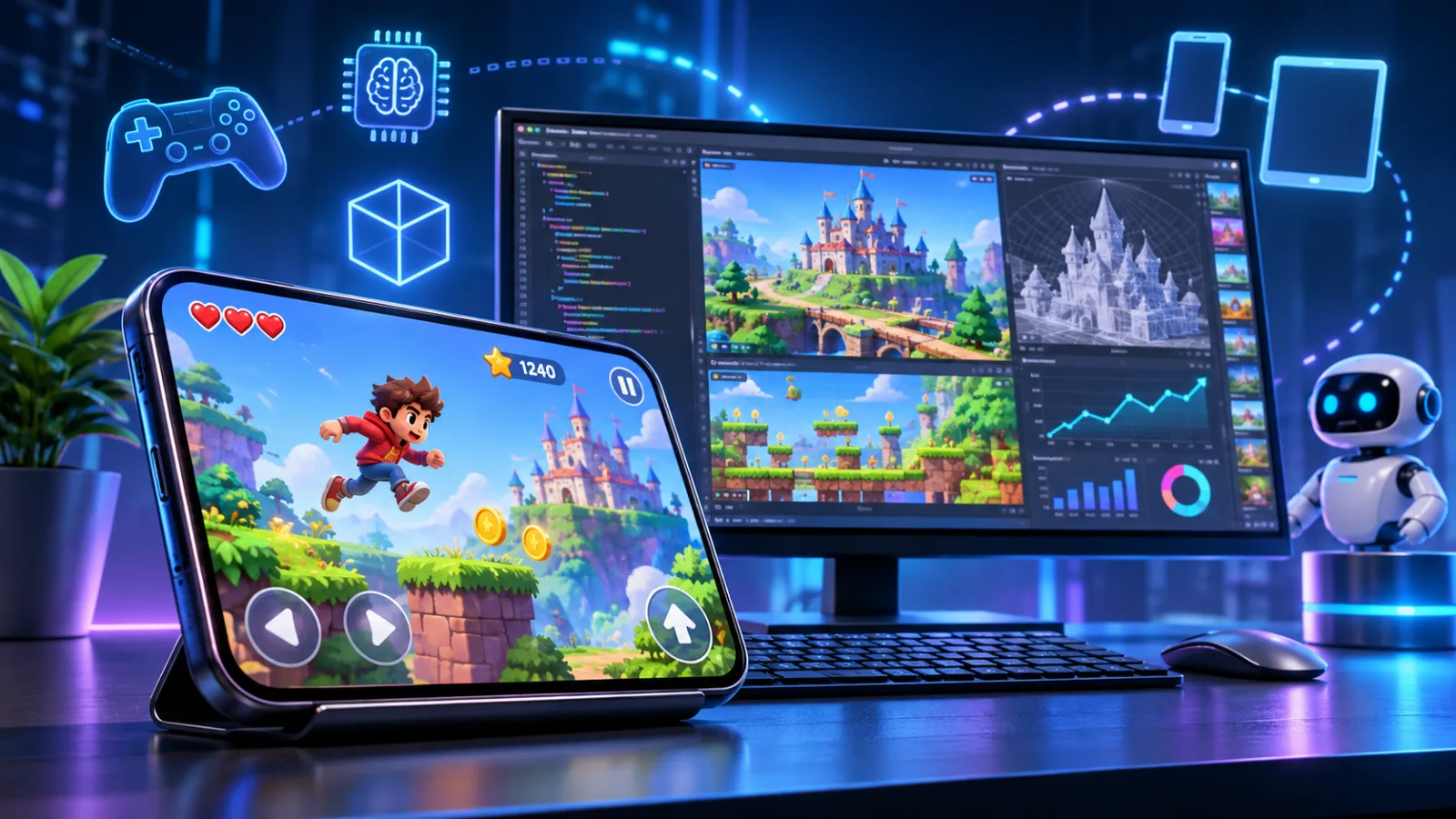
Artificial Intelligence in Video Games how AI is transforming
Discover how artificial intelligence is transforming video games through intelligent NPCs, adaptive gameplay, generative AI, and advanced game development technologies in 2026
Artificial Intelligence in Video Games: How AI Is Transforming Gaming in 2026
Artificial intelligence (AI) is transforming the way video games are designed, developed, and experienced. From intelligent non-player characters (NPCs) and realistic enemy behavior to procedurally generated environments and personalized gameplay, AI is helping developers create more immersive, dynamic, and responsive gaming experiences.
In 2026, artificial intelligence in video games goes beyond traditional programming. Developers are exploring machine learning, generative AI, reinforcement learning, natural language processing, and advanced decision-making systems to make virtual worlds feel more interactive and alive.
Whether you are a game developer, gaming enthusiast, technology entrepreneur, or business exploring interactive digital experiences, understanding how AI is changing the gaming industry reveals exciting opportunities for innovation.
This guide explores how AI works in video games, its major applications, benefits, limitations, emerging technologies, and what the future may hold.
What Is Artificial Intelligence in Video Games?
Artificial intelligence in video games refers to technologies and algorithms that enable game systems to simulate intelligent behavior, respond to player actions, make decisions, and create interactive experiences.
Traditional game AI often relies on predefined rules, decision trees, finite state machines, and navigation algorithms. Modern approaches increasingly incorporate machine learning and generative technologies to support more adaptive and sophisticated behavior.
Unlike AI designed for general-purpose tasks, game AI is usually developed around specific objectives, including:
Making enemies respond intelligently to player actions
Creating realistic NPC behavior and interactions
Generating maps, environments, and missions
Adjusting gameplay difficulty
Improving animation and character movement
Supporting natural language conversations
Personalizing player experiences
The objective is not simply to make games harder. It is to create engaging experiences that feel believable, balanced, and responsive.
Why Is AI Important in the Gaming Industry in 2026?
Modern players expect more than static environments and predictable characters. They want interactive worlds that respond to their decisions and offer meaningful gameplay.
AI helps developers address these expectations while managing the complexity of modern game production.
1. More Immersive Gameplay
AI-powered characters can respond to environmental changes, player behavior, and game events. This creates experiences that feel less scripted and more natural.
2. Smarter NPCs
NPCs can make decisions based on surroundings, objectives, relationships, and player interactions rather than following a limited set of repetitive actions.
3. Faster Game Development
AI-assisted tools can support developers with asset creation, testing, animation, level design, and repetitive production tasks.
4. Personalized Experiences
Game systems can analyze gameplay patterns and adapt challenges, tutorials, recommendations, and content to individual players.
5. Dynamic Virtual Worlds
AI can help create environments where weather, characters, missions, and events evolve according to player choices and game conditions.
How Does AI Work in Video Games?
AI in games combines different technologies depending on the desired gameplay experience. A simple enemy may use a rule-based system, while an advanced simulation could combine machine learning, pathfinding, and behavior modeling.
Rule-Based Systems
Rule-based AI follows predefined instructions and conditions.
For example:
If the player enters a detection zone, the enemy becomes alert.
If the enemy loses sight of the player, it investigates the last known position.
If health falls below a certain threshold, it retreats.
If an objective is completed, the next mission begins.
These systems are predictable, efficient, and useful for many game mechanics.
Pathfinding Algorithms
Pathfinding helps characters navigate virtual environments.
Algorithms such as A* (A-star) allow characters to calculate routes around obstacles and reach destinations efficiently.
Pathfinding is commonly used in strategy games, role-playing games, adventure titles, and simulation environments.
Machine Learning
Machine learning allows systems to identify patterns from data and improve behavior through training.
In gaming, it can support player behavior analysis, gameplay balancing, animation, procedural content generation, and decision-making.
Reinforcement Learning
Reinforcement learning trains an agent to make decisions through interaction with an environment. It receives rewards or penalties based on its actions and learns strategies that maximize cumulative rewards.
This approach can be used to train game-playing agents, optimize enemy strategies, and explore complex gameplay scenarios.
Generative AI
Generative AI can create or assist in producing dialogue, stories, textures, audio, environments, and other content.
When integrated carefully, it can expand the variety of content available in a game while reducing some manual production work.
Major Applications of AI in Video Games
1. Intelligent Non-Player Characters (NPCs)
NPCs are characters controlled by the game rather than directly by players. They include shopkeepers, companions, enemies, civilians, and other interactive characters.
Traditional NPCs often rely on scripted dialogue and predefined behavior. AI can make them more responsive and context-aware.
How AI Improves NPC Behavior
AI-powered NPCs may be designed to:
React to player decisions
Recognize environmental changes
Adjust behavior based on nearby characters
Follow schedules and objectives
Remember selected interactions
Respond to dialogue in a more flexible way
For example, in an open-world role-playing game, a shopkeeper might respond differently depending on the player's reputation, previous interactions, or current quest status.
However, these capabilities depend on the system's design. AI does not automatically make every character realistic or intelligent.
2. AI-Powered Enemy Behavior
Intelligent enemies make combat more challenging and engaging.
Instead of repeatedly using the same attack pattern, enemies can select actions based on distance, player movement, available resources, and tactical conditions.
Examples include:
Taking cover during combat
Coordinating with other enemies
Flanking the player
Retreating when overwhelmed
Changing tactics after repeated encounters
Detecting player movement or noise
In a tactical shooter, AI-controlled opponents might work together to defend an area or attempt to surround a player. In a survival game, enemies could respond to environmental sounds or visible activity.
The challenge for developers is balancing intelligence with fairness. Enemies should create interesting challenges without feeling unpredictable or impossible to defeat.
3. Procedural Content Generation
Procedural content generation (PCG) uses algorithms to create game content rather than requiring developers to design every element manually.
AI-assisted procedural generation can support:
Maps and landscapes
Dungeons and buildings
Missions and quests
Character designs
Textures and environmental assets
Dialogue and narrative variations
For example, a fantasy game could generate different dungeon layouts, enemy placements, and environmental challenges for each playthrough.
Procedural generation can increase replayability, but human oversight remains important. Generated content must be tested for quality, consistency, balance, and playability.
4. Adaptive Difficulty and Dynamic Gameplay
Adaptive difficulty allows a game to respond to a player's performance.
An AI system might evaluate factors such as:
Time taken to complete missions
Accuracy and combat performance
Frequency of failure
Resource management
Exploration behavior
Progression speed
Based on these signals, the game may adjust enemy strength, tutorial guidance, available resources, or challenge levels.
For example, a racing game could introduce more competitive opponents when a player consistently wins, while offering additional assistance if the player struggles.
Adaptive difficulty should be implemented transparently and thoughtfully. Players may prefer consistent challenges rather than invisible changes that make success feel artificial.
5. Natural Language Processing and AI Dialogue
Natural language processing (NLP) enables computers to interpret, process, and generate human language.
In video games, NLP and language models can support more flexible conversations between players and NPCs.
Potential capabilities include:
Context-sensitive dialogue
Voice-based interaction
Dynamic quest explanations
Conversational companions
Multilingual communication
Dialogue variations based on player choices
A player might ask a virtual character about a mission using their own words rather than selecting from a fixed list of dialogue options.
Developers must carefully control dialogue systems to prevent inappropriate responses, maintain narrative consistency, protect player privacy, and manage latency and operating costs.
6. AI in Animation and Character Movement
AI and machine learning can help characters move more naturally.
Applications include:
Motion matching
Procedural animation
Facial expression generation
Character pose prediction
Realistic locomotion
Animation blending
For example, a character navigating uneven terrain may adjust its movement, posture, and foot placement to match the environment.
These techniques can improve visual realism and reduce the need to manually create every possible animation sequence.
7. AI-Assisted Game Testing
Game testing is a complex process involving thousands of gameplay scenarios, combinations of player actions, and potential software defects.
AI-powered testing tools can help developers:
Simulate gameplay
Detect unexpected behavior
Identify bugs and crashes
Test navigation and mission completion
Evaluate performance
Explore unusual gameplay scenarios
AI agents can repeatedly play sections of a game to uncover problems that conventional test scripts might miss.
Nevertheless, human testers remain essential for evaluating enjoyment, usability, storytelling, accessibility, and emotional impact.
8. Personalized Gaming Experiences
AI can analyze gameplay patterns to help tailor the experience to individual players.
Possible personalization includes:
Customized tutorials
Recommended missions
Player-specific challenges
Personalized story elements
Different progression paths
Accessibility adjustments
For instance, an adventure game could provide more exploration guidance to a player who frequently misses objectives while allowing experienced players to navigate independently.
Personalization should respect player preferences and provide appropriate privacy controls.
AI Technologies Used in Video Game Development
Different AI technologies serve different purposes. Developers typically select a combination based on game genre, platform, performance requirements, and project scope.
Technology | Gaming application |
|---|---|
Machine learning | Player behavior analysis and prediction |
Reinforcement learning | Training agents and optimizing strategies |
Generative AI | Dialogue, stories, audio, and content assistance |
Natural language processing | Conversational NPCs and voice interactions |
Computer vision | Visual recognition and perception systems |
A* pathfinding | Character navigation |
Behavior trees | Structured character decision-making |
Neural networks | Pattern recognition and complex predictions |
Traditional Game AI vs. Generative AI
Traditional AI and generative AI are not interchangeable. Both can be valuable, and many games benefit from combining them.
Feature | Traditional Game AI | Generative AI |
|---|---|---|
Primary approach | Rules, logic, algorithms | Trained generative models |
Behavior | Usually predefined | Can generate new outputs |
Dialogue | Scripted responses | Flexible language generation |
Predictability | Generally high | Requires additional controls |
Performance | Often runs locally | May require local or cloud models |
Typical use | Pathfinding, combat, decision trees | Dialogue, content, creative assistance |
Quality control | Easier to validate | Requires stronger monitoring |
A practical game architecture may use traditional AI for core gameplay logic and generative AI for optional dialogue or content variation.
Benefits of Artificial Intelligence in Video Games
Improved Player Engagement
Responsive characters and dynamic challenges can make gameplay more engaging and encourage players to explore different strategies.
Greater Replayability
Procedurally generated content and varied interactions can provide different experiences across multiple playthroughs.
More Efficient Development
AI-assisted workflows can reduce repetitive work in asset creation, testing, prototyping, and content production.
More Realistic Virtual Environments
AI can support believable character movement, environmental responses, and more natural interactions.
Better Accessibility
Intelligent systems can help adapt interfaces, tutorials, difficulty, and gameplay assistance to different player needs.
New Creative Possibilities
AI tools allow developers to explore mechanics, narratives, and interactive experiences that may be difficult to implement using conventional approaches alone.
Real-World Examples of AI in Video Games
AI has influenced games across multiple genres for decades. The following examples illustrate different approaches to intelligent gameplay and content generation.
The Sims
The Sims series uses autonomous character behavior and needs-based decision-making. Characters interact with objects, manage needs, and respond to their surroundings based on game systems.
Middle-earth: Shadow of Mordor
Its Nemesis System allows certain enemies to develop persistent identities, relationships, strengths, and weaknesses based on player encounters. This creates personalized rivalries within the game.
Alien: Isolation
The game's enemy behavior combines multiple AI systems to create an unpredictable and tense experience. The creature responds to player actions and environmental cues while remaining subject to designed limitations.
Minecraft
Minecraft demonstrates how procedural generation creates expansive worlds. Its environments, structures, and gameplay systems combine algorithmic generation with carefully designed mechanics.
These examples show that successful game AI does not always require generative AI. Carefully designed conventional systems can produce memorable experiences.
How Different Gaming Genres Use AI
Action and Shooter Games
AI supports enemy detection, combat decisions, tactical coordination, cover selection, and navigation.
Role-Playing Games (RPGs)
AI can enhance NPC dialogue, quest behavior, character relationships, world simulation, and branching interactions.
Strategy Games
AI helps manage resources, plan military actions, evaluate threats, and compete against players in complex environments.
Racing Games
AI controls opponent driving behavior, racing lines, speed selection, and competitive responses.
Simulation Games
AI supports realistic populations, economic systems, environmental behavior, and complex interactions between virtual agents.
Open-World Games
AI helps manage NPC routines, dynamic events, traffic, environmental reactions, and procedural content.
How Developers Can Integrate AI Into a Video Game
Building an AI-powered game requires more than selecting an AI model. Developers must identify the gameplay problem, determine the right technology, and evaluate how the system affects performance and player experience.
Step 1: Define the Gameplay Objective
Identify exactly what AI should improve.
Examples:
More realistic enemy decisions
Flexible NPC conversations
Personalized difficulty
Procedurally generated environments
Automated gameplay testing
A clear objective helps prevent unnecessary complexity.
Step 2: Choose the Appropriate AI Approach
Not every problem requires machine learning or generative AI.
Use rule-based systems for predictable mechanics, pathfinding for navigation, behavior trees for structured decisions, and machine learning where adaptive behavior provides meaningful value.
Step 3: Select the Game Engine
Popular game development engines include:
Unity: A widely used engine for 2D, 3D, mobile, and cross-platform games.
Unreal Engine: A powerful engine for high-fidelity 3D environments and complex interactive experiences.
Godot: An open-source engine for developing 2D and 3D games.
Engine selection depends on the development team's skills, target platforms, visual requirements, and project architecture.
Step 4: Develop and Train AI Systems
For machine learning applications, developers may need training data, simulation environments, evaluation metrics, and model optimization.
For generative AI, they must also select suitable models, define prompts, establish output constraints, and design content moderation.
Step 5: Integrate AI Into Gameplay
AI systems must interact with game mechanics, player data, physics, animation, and other components without disrupting the gameplay loop.
For cloud-connected AI, developers must also consider API integration, network connectivity, and fallback behavior.
Step 6: Test and Optimize
Testing should evaluate:
Decision quality
Gameplay fairness
Response latency
CPU, GPU, and memory usage
Network requirements
Player experience
Security and privacy
Step 7: Deploy and Maintain
AI-powered games may require continuous monitoring, model updates, performance optimization, bug fixes, and content moderation after launch.
Teams planning complex interactive products can explore custom software development services to support tailored architectures and technical integrations.
Challenges and Limitations of AI in Gaming
Despite its advantages, AI introduces technical, creative, and operational challenges.
Development Complexity
Advanced AI requires specialized expertise, additional testing, and careful integration with existing game systems.
Performance Constraints
Games often need to maintain stable frame rates and responsive interactions. Computationally expensive AI can affect performance, especially on mobile and lower-end hardware.
Unpredictable Outputs
Generative AI can produce inconsistent dialogue, irrelevant responses, or content that conflicts with the game's narrative.
Development and Operating Costs
Training models, cloud inference, infrastructure, data management, and ongoing monitoring can increase development and operational expenses.
Privacy and Security
Player interactions and gameplay data must be handled responsibly. Online AI systems can also introduce risks related to prompt injection, inappropriate content, and misuse.
Creative Control
AI-generated content should support rather than replace creative direction. Developers must preserve narrative quality, originality, and a consistent artistic vision.
AI in Mobile Game Development
Mobile games introduce additional constraints, including limited processing power, battery consumption, memory, and variable network connectivity.
Developers can address these challenges through:
Lightweight AI models
On-device inference
Cloud-based processing for complex tasks
Optimized decision-making algorithms
Efficient caching
Adaptive quality settings
Offline fallback mechanisms
For example, a mobile RPG could use local behavior trees for combat while relying on a cloud-based language model for optional NPC conversations.
Businesses exploring interactive mobile experiences can learn more about mobile application development and cross-platform engineering approaches.
The Role of Cloud Computing in AI-Powered Games
Cloud infrastructure can support gaming applications that require large-scale computing, online multiplayer services, or AI models that exceed local device capabilities.
Cloud technologies may provide:
AI inference services
Multiplayer server infrastructure
Player data synchronization
Real-time analytics
Model deployment and updates
Scalable backend services
Centralized content management
However, cloud AI introduces network latency and ongoing usage costs. Developers should determine which features genuinely require remote processing and which can run directly on a player's device.
For scalable architecture and infrastructure planning, cloud and DevOps solutions can help support deployment, monitoring, and application reliability.
AI in Video Games: Security, Ethics, and Responsible Development
AI-powered gaming systems must be designed with player safety, transparency, and responsible data practices in mind.
Player Privacy
Developers should collect only the data required for specific gameplay functions and communicate clearly about how it is used.
Content Moderation
Generative dialogue must be protected against abusive, inappropriate, or harmful outputs, particularly in games accessible to younger audiences.
Fairness and Transparency
AI-driven matchmaking and adaptive difficulty should avoid unfairly manipulating player experiences or creating unexplained disadvantages.
Intellectual Property
Teams should review licensing, ownership, and usage rights associated with training data and AI-generated assets.
Human Oversight
Important gameplay, narrative, and safety decisions should remain subject to appropriate human review.
How Much Does AI Game Development Cost in 2026?
The cost of implementing AI in a video game depends on its complexity, scope, technology, and infrastructure requirements.
There is no universal price because adding basic enemy logic is very different from developing a custom conversational AI system.
AI implementation | Relative complexity |
|---|---|
Basic rule-based NPCs | Low |
Pathfinding and behavior trees | Low to moderate |
Adaptive difficulty | Moderate |
Machine learning-based gameplay | Moderate to high |
Generative AI dialogue | Moderate to high |
Custom AI training and simulation | High |
Large-scale multiplayer AI infrastructure | High |
Factors That Influence AI Game Development Costs
Game genre and overall scope
Number and complexity of AI characters
Custom model development requirements
Data preparation and training
Game engine and platform
Backend and cloud infrastructure
Testing and optimization
Licensing and third-party API usage
Security, moderation, and maintenance
A practical budget should distinguish initial development costs from recurring expenses such as cloud hosting, API consumption, model monitoring, and updates.
The Future of Artificial Intelligence in Video Games
AI development continues to expand the possibilities of interactive entertainment. Several emerging directions could influence future game design.
More Conversational Characters
NPCs may become capable of more context-aware conversations, personalized responses, and dynamic interactions while maintaining narrative boundaries.
AI-Generated Missions and Stories
Generative systems may assist in creating quests, character backstories, and narrative variations based on player decisions.
Smarter Game Worlds
AI may help coordinate environmental simulations, virtual populations, and evolving game events.
Personalized Game Experiences
Future games could adapt accessibility, learning curves, and progression more intelligently while giving players greater control over their preferences.
AI-Assisted Production Pipelines
Game studios may increasingly integrate AI into design, prototyping, asset workflows, testing, and localization.
Hybrid AI Architecture
A combination of traditional game AI, machine learning, and generative models is likely to remain valuable because each approach offers different strengths.
Choosing the Right AI Game Development Partner
Developing an AI-powered game requires expertise in both game engineering and artificial intelligence.
Before selecting a development partner, consider the following:
Technical expertise: Experience with game engines, AI algorithms, backend systems, and integrations.
Portfolio: Relevant projects demonstrating interactive systems and technical quality.
Scalability: Ability to support performance, infrastructure, and future development.
Testing methodology: Clear processes for evaluating AI behavior and gameplay quality.
Security and privacy: Responsible handling of player data and AI-generated content.
Communication: Transparent project planning, deliverables, and progress reporting.
Post-launch support: Maintenance, updates, optimization, and monitoring.
Explore Galaxium Coding's projects and portfolio to learn more about software engineering capabilities and digital solutions.
Conclusion
Artificial intelligence in video games is transforming interactive entertainment by enabling smarter characters, adaptive gameplay, procedural content generation, improved testing, and more personalized player experiences.
However, successful AI integration depends on selecting the right technology for the right purpose. Traditional algorithms remain essential for predictable mechanics, while machine learning and generative AI can introduce new possibilities when carefully implemented.
As gaming technology evolves in 2026 and beyond, the most effective solutions will combine intelligent automation with thoughtful design, technical performance, security, and creative human oversight.
Businesses and development teams exploring AI-powered interactive products can contact Galaxium Coding to discuss software engineering, AI integration, and development requirements.
Frequently Asked Questions
What is artificial intelligence in video games?
Artificial intelligence in video games enables characters and systems to make decisions, respond to player actions, navigate environments, and generate or adapt gameplay content.
How is AI used in modern video games?
AI is used for NPC behavior, enemy decision-making, pathfinding, procedural content generation, adaptive difficulty, dialogue, animation, and automated testing.
Will generative AI replace traditional game AI?
No. Traditional game AI remains effective for predictable mechanics, navigation, and structured decisions. Generative AI adds capabilities such as flexible dialogue and content creation. Many games can benefit from combining both.
Can AI generate entire video games?
AI can assist with generating code, assets, dialogue, environments, and prototypes. However, creating a complete production-ready game still requires engineering, testing, creative direction, integration, and human oversight.
What game engines support AI development?
Unity, Unreal Engine, and Godot support game development with AI-related systems. Developers can integrate custom algorithms, machine learning models, and external AI services depending on their requirements.
Is AI expensive to implement in video games?
Costs vary considerably. Basic rule-based AI can be relatively inexpensive, while custom machine learning, generative AI, cloud infrastructure, and large-scale simulations require greater investment.
How does AI improve NPC interactions?
AI can enable NPCs to respond to player actions, environmental conditions, dialogue context, and selected past interactions. The degree of intelligence depends on the system's architecture and capabilities.
What is procedural generation in gaming?
Procedural generation uses algorithms to create content such as maps, levels, missions, objects, and environments. AI can enhance these systems by supporting more complex patterns and variations.
Is AI used in mobile games?
Yes. AI supports enemy behavior, matchmaking, recommendations, adaptive difficulty, and procedural content in mobile games. Developers must optimize systems for battery life, processing power, memory, and connectivity.
What is the future of AI in gaming?
The future may include more adaptive NPCs, dynamic storytelling, personalized gameplay, intelligent virtual worlds, and AI-assisted game production. Human oversight and creative direction will continue to be important.