Appnovation Technologies in 2026: Services, Solutions, and Digital Innovation

Exploring enterprise technology, AI solutions, and digital transformation strategies for modern businesses in 2026.
Appnovation Technologies in 2026: Services, Solutions, and Digital Innovation
Businesses in 2026 are increasingly investing in digital transformation to improve customer experiences, modernize operations, and remain competitive in rapidly evolving markets. From enterprise software development and cloud infrastructure to artificial intelligence (AI) and digital product innovation, technology partners play an important role in helping organizations turn business challenges into scalable digital solutions.
Appnovation Technologies is a global digital consultancy and technology services company known for helping organizations develop digital products, modernize technology platforms, and implement innovative enterprise solutions. Its service portfolio spans digital strategy, experience design, technology development, enterprise AI, platform engineering, and managed services.
For organizations researching technology partners, understanding Appnovation Technologies' services, capabilities, and approach to digital innovation can help clarify what modern digital transformation involves and how to evaluate a suitable development partner.
This guide explores Appnovation Technologies in 2026, its core services, enterprise solutions, technology capabilities, industry applications, and the considerations businesses should evaluate when planning digital transformation.
What Is Appnovation Technologies?
Appnovation is a global digital consultancy that helps organizations use technology to improve business performance, develop digital products, and modernize existing systems.
The company has operated since 2007 and combines digital consulting, technology development, experience design, and enterprise technology expertise.
Its work focuses on connecting business strategy with practical digital implementation. Rather than treating technology as an isolated investment, Appnovation emphasizes solutions that support customer experiences, operational efficiency, organizational growth, and measurable business outcomes.
Its areas of expertise include:
Digital strategy and business transformation
Enterprise software and platform development
AI product development and enterprise AI
Digital experience and UX design
Technology integration and modernization
Cloud and platform engineering
Managed services and ongoing technical support
Businesses can explore Appnovation's official website to learn more about its services, approach, and technology capabilities.

Appnovation Technologies' Core Services in 2026
Digital transformation can involve several interconnected disciplines. Appnovation's service portfolio brings together strategic consulting, design, engineering, and operational support.
1. Digital Strategy and Consulting
Digital transformation begins with identifying business objectives and understanding how technology can support them.
Digital strategy consulting helps organizations evaluate their current systems, identify operational challenges, and prioritize investments that can deliver business value.
Typical activities include:
Digital maturity assessments
Business process analysis
Technology roadmap development
Customer journey evaluation
Digital product strategy
Technology investment planning
Innovation and transformation consulting
For example, a retail organization may discover that its customer experience is fragmented across physical stores, mobile applications, and online platforms. A digital strategy can establish a unified roadmap for improving customer interactions and connecting these channels.
A well-defined strategy also reduces the risk of investing in technology that does not address a genuine business requirement.
2. Enterprise AI and AI Product Development
Artificial intelligence is becoming a central component of enterprise digital innovation.
Appnovation offers enterprise AI capabilities and AI product development services that help organizations explore, build, and integrate AI-powered solutions into their business operations.
Potential applications include:
Intelligent customer support
AI-powered business assistants
Document processing and information extraction
Enterprise knowledge management
Business process automation
Predictive analytics
AI-enabled digital products
Enterprise AI requires more than selecting a model. Organizations must also consider data quality, system integration, security, governance, user experience, and ongoing monitoring.
For instance, an organization with thousands of internal documents could develop an AI-powered knowledge assistant that helps employees locate relevant information more efficiently.
Appnovation also presents Evolve, an open-source AI infrastructure platform designed to support AI workload management, governance, orchestration, and model management.
Learn more about its enterprise AI and digital services.
3. Technology and Platform Development
Technology and platform development focuses on building, modernizing, and connecting digital systems that support business operations.
Appnovation's capabilities include:
Enterprise application development
Digital platform engineering
Application modernization
Rapid prototyping
Agile software development
API and system integration
Quality engineering
Continuous development and delivery
These capabilities help organizations develop new digital products while improving the reliability and maintainability of existing platforms.
For example, a company may need a customer portal that integrates with its existing CRM, payment system, and enterprise database. Platform engineering can help establish the architecture and integration approach required to deliver that experience.
Explore Appnovation's technology and platform engineering services for more information.
4. Creative and Experience Design
Digital innovation is not only about technical functionality. User experience has a significant influence on how customers and employees interact with technology.
Experience design focuses on making digital products intuitive, accessible, and aligned with user needs.
Typical services include:
User research
UX strategy
User interface design
Customer journey mapping
Digital experience design
Accessibility considerations
Interactive prototyping
Consider an enterprise application with dozens of features. Without thoughtful UX design, employees may struggle to navigate it, even if its technical architecture is strong.
A user-centered design process helps simplify workflows, reduce friction, and improve the adoption of digital products.
5. Managed Services and Technical Support
Launching a digital product is only one stage of its lifecycle. Businesses also need to maintain, monitor, improve, and secure their technology over time.
Managed services can support activities such as:
Application maintenance
Technical troubleshooting
Infrastructure monitoring
Performance optimization
Security updates
Platform upgrades
Continuous improvement
Ongoing support is especially important for enterprise platforms that support critical business operations.
A structured support model helps organizations address technical issues, maintain system reliability, and adapt applications as requirements change.
6. Corporate Agility and Digital Transformation
Corporate agility refers to an organization's ability to respond to changing market conditions, customer expectations, and technology developments.
Digital transformation initiatives often require more than software implementation. They may also involve changes to business processes, organizational practices, decision-making, and team collaboration.
Agile approaches can help businesses:
Deliver improvements incrementally
Gather feedback from users
Adapt requirements as projects evolve
Reduce uncertainty through iterative development
Align business and technology teams
Improve the speed of decision-making
The objective is to create an environment where digital systems and business processes can evolve together.
Digital Solutions Offered by Appnovation Technologies
Modern businesses often need connected digital ecosystems rather than individual standalone applications.
Appnovation's services address different parts of this ecosystem, from customer-facing products to enterprise infrastructure.
Digital solution | Business purpose |
|---|---|
Enterprise applications | Support complex organizational workflows |
Digital platforms | Deliver scalable products and services |
AI-powered solutions | Improve analysis, automation, and decision-making |
Customer experience platforms | Improve digital interactions |
Content management systems | Manage and distribute digital content |
Cloud infrastructure | Support scalable and resilient applications |
Integrated technology systems | Connect business applications and data |
The appropriate solution depends on the organization's existing technology, business goals, operational requirements, and available resources.
How Appnovation Technologies Supports Digital Transformation
Digital transformation is a structured process that connects business objectives with technology implementation.
Although each organization has different requirements, a typical transformation initiative involves several stages.
Step 1: Understand Business Requirements
The first step is identifying the problems the organization wants to solve.
This includes evaluating existing workflows, understanding user needs, identifying operational bottlenecks, and establishing measurable objectives.
Step 2: Develop a Technology Roadmap
Once requirements are understood, the organization can prioritize digital initiatives.
A roadmap may include application modernization, AI integration, platform development, cloud adoption, or customer experience improvements.
Step 3: Design the Digital Experience
UX and architecture teams define how the solution should function, how users will interact with it, and how it will connect with existing systems.
Prototypes and design reviews can help validate assumptions before substantial development begins.
Step 4: Develop and Integrate the Solution
Development teams implement the required features, APIs, business logic, and integrations.
Agile development practices can allow stakeholders to review progress through iterative releases.
Step 5: Test and Validate
Quality assurance evaluates functionality, performance, usability, compatibility, and security.
Testing helps identify defects before the solution is deployed into production.
Step 6: Deploy and Improve
After deployment, organizations monitor performance, gather feedback, and identify opportunities for improvement.
Digital transformation is an ongoing process rather than a one-time technology upgrade.
Technologies Driving Digital Innovation in 2026
Digital solutions increasingly combine multiple technologies to support complex business requirements.
Artificial Intelligence and Machine Learning
AI can support intelligent automation, predictive analysis, natural language processing, and personalized digital experiences.
Machine learning systems can identify patterns in data and assist with tasks that previously required extensive manual analysis.
Cloud Computing
Cloud infrastructure enables organizations to deploy applications, manage resources, and scale capacity according to demand.
Cloud-based architecture can also support geographically distributed teams and digital services.
APIs and System Integration
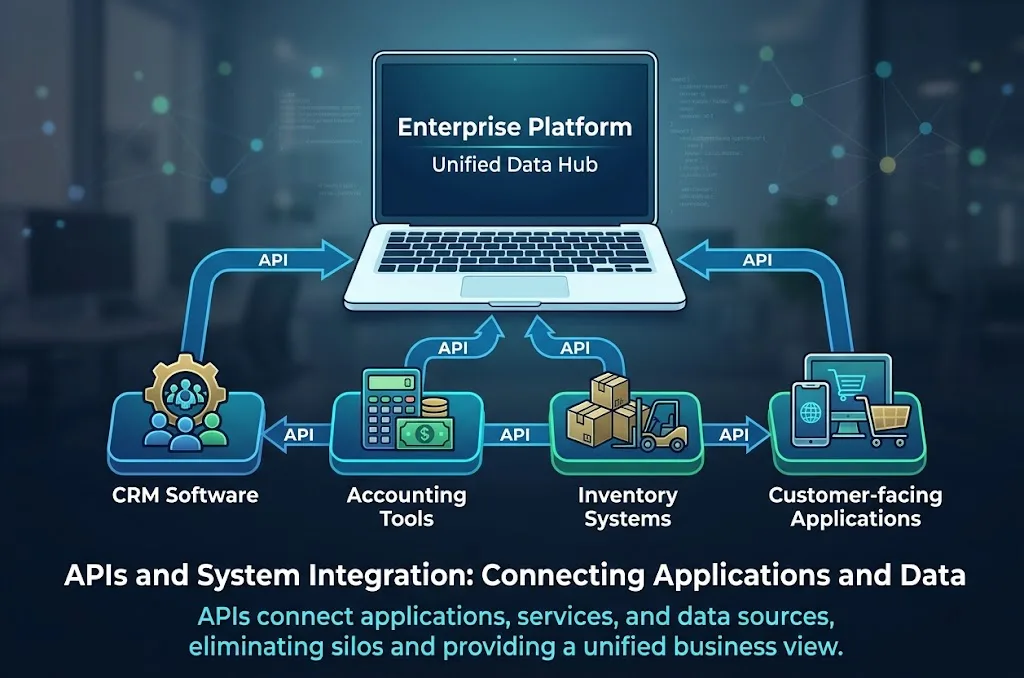
APIs connect applications, services, and data sources.
For example, an enterprise platform may integrate CRM software, accounting tools, inventory systems, and customer-facing applications through APIs.
Data Analytics and Business Intelligence
Data analytics transforms operational information into useful insights.
Businesses can use dashboards, reporting systems, and analytical tools to understand performance, identify trends, and support decision-making.
Agile and DevOps
Agile development supports iterative delivery, while DevOps practices help connect development and operations.
Together, these approaches can improve collaboration, deployment processes, and software delivery consistency.
Industry Applications of Appnovation's Digital Solutions
Different industries have different digital transformation priorities.
Healthcare
Healthcare organizations can use digital platforms to support patient engagement, information management, operational workflows, and secure access to services.
Financial Services
Financial organizations may require secure customer-facing applications, digital onboarding, data analytics, AI-supported operations, and integration with existing financial systems.
Retail and E-Commerce
Retail businesses can improve customer experiences through personalized digital platforms, omnichannel experiences, content management, and intelligent analytics.
Manufacturing
Manufacturers can benefit from digital operational platforms, data integration, process automation, and analytics that help improve visibility across business processes.
Education
Educational institutions may invest in digital learning platforms, student portals, content management, and systems that support administrative operations.
The specific technology architecture and implementation requirements depend on the organization's size, existing infrastructure, and industry needs.
Benefits of Enterprise Digital Innovation
When planned and implemented effectively, digital transformation can create several business benefits.
Improved Operational Efficiency
Automating repetitive workflows and integrating disconnected systems can reduce manual work and improve operational consistency.
Better Customer Experiences
Well-designed digital platforms make it easier for customers to discover services, complete transactions, and access support.
Greater Scalability
Modern architecture can help businesses accommodate increasing users, data volumes, and operational complexity.
Data-Driven Decision-Making
Integrated analytics can provide more comprehensive information about business performance and customer behavior.
Faster Innovation
Agile development and modern engineering practices can help organizations experiment, validate ideas, and deliver improvements more frequently.
Enhanced Digital Competitiveness
Organizations that align technology investments with business objectives can respond more effectively to changing market expectations.
However, these benefits are not automatic. Results depend on implementation quality, adoption, organizational readiness, and ongoing management.
Appnovation Technologies vs. Traditional IT Development
Traditional IT development and modern digital consultancy approaches can differ in how they prioritize strategy, user experience, and ongoing innovation.
Area | Traditional IT approach | Modern digital consultancy approach |
|---|---|---|
Planning | Often project and system focused | Business outcomes and user needs focused |
Development | May follow sequential delivery | Frequently uses iterative or agile delivery |
User experience | Sometimes treated as a separate stage | Integrated into product strategy and development |
Technology | Focus on individual systems | Focus on connected digital ecosystems |
AI adoption | Often introduced as a separate initiative | Can be integrated into broader transformation |
Delivery | Emphasis on project completion | Emphasis on continuous improvement |
Support | Maintenance after implementation | Ongoing optimization and managed services |
Neither approach is universally better. Businesses should select a delivery model based on project complexity, internal capabilities, timelines, and organizational requirements.
How to Choose a Digital Transformation Partner in 2026
Selecting a technology partner requires evaluating more than a company's service list.
1. Evaluate Technical Expertise
Determine whether the provider has experience with the technologies and architectures relevant to your project.
Ask about software engineering practices, system integration, cloud infrastructure, AI implementation, and quality assurance.
2. Understand the Delivery Process
A reliable development process should explain how requirements are documented, progress is reviewed, risks are managed, and changes are handled.
3. Review Relevant Projects
Look for case studies or portfolio examples that demonstrate experience with comparable challenges.
You can explore Galaxium Coding's projects and portfolio to understand its digital development capabilities.
4. Assess Security and Governance
Understand how the provider approaches access control, data protection, application security, testing, and compliance requirements.
For AI projects, ask about data handling, model governance, monitoring, and responsible deployment.
5. Clarify Ownership and Documentation
Discuss intellectual property, source code ownership, technical documentation, hosting arrangements, and third-party dependencies before signing a contract.
6. Evaluate Long-Term Support
Determine whether the provider offers maintenance, technical support, upgrades, performance monitoring, and future development.
7. Compare Total Project Costs
Evaluate the full cost of implementation, including development, licensing, infrastructure, integrations, training, maintenance, and future enhancements.
Digital Innovation Opportunities for Businesses in Qatar
Qatar's business environment creates opportunities for organizations to invest in digital services, enterprise applications, AI, and technology modernization.
Businesses operating in Qatar may consider:
Digitizing customer interactions and service delivery
Developing mobile applications for customers and employees
Automating administrative and operational workflows
Integrating enterprise systems and business data
Modernizing legacy software infrastructure
Developing AI-supported business applications
Improving cloud infrastructure and application scalability
Organizations planning these initiatives should also evaluate relevant regulatory, data protection, security, and industry-specific requirements.
For businesses seeking a technology development partner, Galaxium Coding's software development services can be explored for custom digital solutions aligned with specific business workflows.
Companies can also explore web application development and mobile application development for customer-facing and internal digital products.
The Future of Digital Innovation
Digital innovation in 2026 is increasingly shaped by the convergence of AI, enterprise platforms, cloud infrastructure, and user-centered design.
Several trends are likely to influence future digital strategies.
AI-Enabled Enterprise Workflows
Organizations are exploring AI assistants, intelligent automation, and AI-powered applications to support employees and customers.
The emphasis is shifting toward practical business use cases, governance, and measurable value.
Greater Focus on AI Governance
As AI adoption expands, businesses must consider privacy, transparency, risk management, security, and accountability.
Governance frameworks can help organizations deploy AI responsibly while maintaining appropriate oversight.
Connected Digital Ecosystems
Businesses are moving toward integrated environments in which applications, data, and workflows communicate with each other.
API-led architecture and platform engineering can support this transition.
Continuous Digital Product Improvement
Digital products increasingly evolve through ongoing development, user feedback, analytics, and incremental improvements.
Flexible Technology Infrastructure
Cloud-native and modular architecture can help organizations adapt systems as business needs change.
Frequently Asked Questions
What is Appnovation Technologies?
Appnovation is a global digital consultancy that provides technology development, digital strategy, experience design, enterprise AI, platform engineering, and managed services.
What services does Appnovation offer in 2026?
Its services include enterprise AI, AI product development, technology and platform development, digital strategy, creative and experience design, managed services, and corporate agility.
Does Appnovation provide AI development services?
Yes. Appnovation offers enterprise AI and AI product development capabilities, helping organizations explore and implement AI-powered solutions and digital products.
What industries does Appnovation serve?
Appnovation works with organizations across multiple industries. Its digital solutions can support sectors such as healthcare, financial services, retail, manufacturing, and education, depending on project requirements.
What is digital transformation?
Digital transformation is the process of using technology to improve business processes, customer experiences, operational efficiency, and organizational capabilities.
How much does digital transformation cost in 2026?
There is no universal price. Costs depend on project scope, technical complexity, existing infrastructure, integrations, licensing, security requirements, and ongoing support.
Businesses should request a project-specific assessment rather than rely on a single general estimate.
How long does a digital transformation project take?
Timelines vary considerably. A focused digital product may take several months, while large enterprise modernization initiatives can require phased implementation over a longer period.
How can businesses select a digital technology partner?
Businesses should evaluate technical expertise, relevant experience, project methodology, security practices, communication, ownership terms, pricing transparency, and long-term support.
Final Thoughts
Appnovation Technologies represents a broad digital consultancy approach that combines strategy, software development, AI, experience design, and enterprise technology services.
In 2026, businesses evaluating digital innovation should focus on how technology can solve practical problems, improve user experiences, and support sustainable growth.
The right technology partner should understand business objectives, recommend appropriate technical solutions, and deliver systems that can evolve over time.
Galaxium Coding helps businesses explore and develop digital solutions, including custom software, web applications, mobile platforms, AI integration, and cloud technologies.
If your organization is planning a new digital initiative, contact Galaxium Coding to discuss your requirements and explore potential technology solutions.
Build digital solutions around your business goals—not technology trends alone.