AI-Powered HR Software: Recruitment, KPIs, Performance and Employee Management
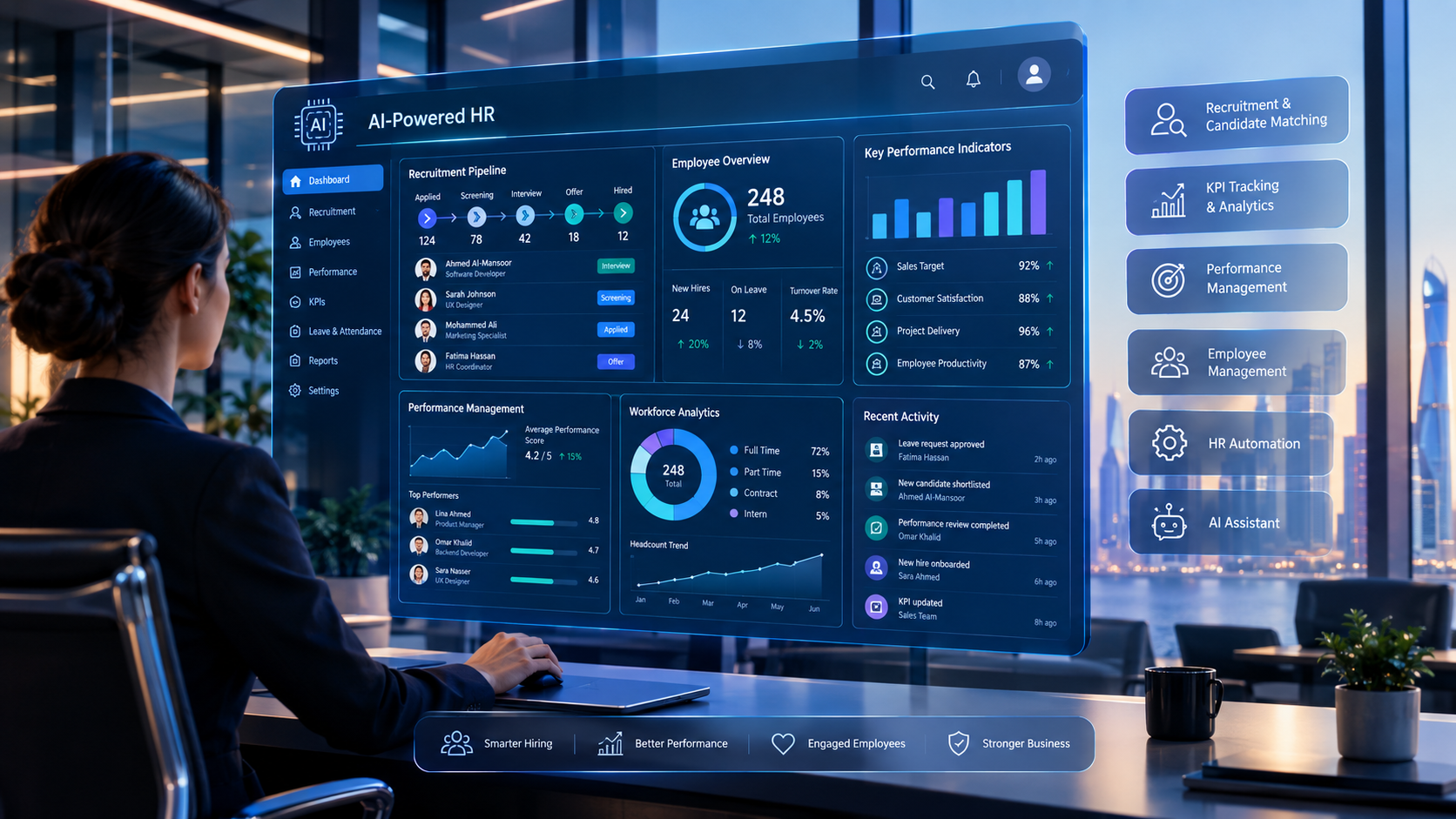
AI-powered HR software connects recruitment, KPI tracking, performance management and employee management through one intelligent platform.
AI-Powered HR Software: Recruitment, KPIs, Performance and Employee Management
Human resources is becoming increasingly data-driven.
Recruitment teams need to process applications efficiently. Managers need better visibility into employee performance. HR departments need to manage employee records, attendance, leave, documents, onboarding, and internal requests. At the same time, business leaders want clearer information about workforce productivity and organizational performance.
Traditional HR processes can make these activities difficult when information is spread across spreadsheets, emails, documents, separate applications, and manual reports.
AI-powered HR software brings these processes together and adds intelligent capabilities such as automated candidate screening, employee insights, KPI monitoring, performance analysis, workflow automation, and HR assistance.
Instead of treating HR software simply as a digital employee database, businesses can use a modern HR platform as a connected workforce management system.
For organizations considering custom software development, AI-powered HR functionality can also be designed around their existing recruitment processes, organizational structure, approval workflows, reporting requirements, and business systems.
This guide explains how AI-powered HR software can support recruitment, KPIs, performance management, employee management, automation, analytics, security, integrations, and implementation.
What Is AI-Powered HR Software?
AI-powered HR software is an HR management platform that combines traditional HR functionality with artificial intelligence, automation, analytics, and intelligent data processing.
Traditional HR software may help organizations store and manage:
Employee profiles
Departments
Job positions
Attendance
Leave
Documents
Payroll information
Recruitment records
Performance information
HR requests
AI-powered HR software can extend these capabilities by helping HR teams analyze information and automate repetitive activities.
For example:
Traditional HR workflow
Job application → HR review → Manual screening → Interview → Selection → Employee onboarding
AI-assisted HR workflow
Job application → Candidate data extraction → Skill matching → Shortlisting support → Human review → Interview → Selection → Automated onboarding
The important distinction is that AI should support HR professionals rather than automatically make every employment decision.
Human oversight remains particularly important for recruitment, performance evaluation, disciplinary processes, compensation, and other decisions that can significantly affect employees.
Why Businesses Are Moving Toward AI-Powered HR Systems
HR teams deal with large amounts of structured and unstructured information.
A single employee may have:
Personal information
Employment records
Contracts
Documents
Attendance data
Leave history
Performance reviews
Goals
Training records
Manager feedback
Payroll information
Internal requests
Recruitment creates another large information flow.
A company hiring for one position may receive dozens or hundreds of applications, each containing different combinations of resumes, skills, experience, education, and other information.
AI and automation can help organize this information.
The objective is not simply to add AI because it is a popular technology.
The better objective is to identify HR processes where intelligent automation can reduce repetitive work, improve information visibility, and help employees and managers access relevant information more easily.
AI-Powered Recruitment
Recruitment is one of the most obvious areas where AI can assist HR teams.
Recruiters often need to review job applications, identify relevant experience, compare candidates against job requirements, schedule interviews, communicate with applicants, and maintain candidate records.
A modern recruitment module can centralize these activities.
AI Resume Screening
AI can help extract structured information from resumes.
For example, a system could identify:
Candidate name
Contact information
Education
Previous positions
Years of experience
Technical skills
Certifications
Languages
Industry experience
The information can then be stored in a searchable candidate profile.
Instead of opening every resume individually to locate basic information, recruiters can work with structured candidate records.
Example
Suppose a company is hiring a software developer.
The job requirements include:
Backend development experience
API development
Database knowledge
Cloud experience
Relevant programming skills
The HR system can extract skills from submitted resumes and help recruiters identify candidates whose profiles contain relevant qualifications.
The recruiter still reviews the candidates and makes the final decision.
Candidate Matching
AI can also assist with candidate-job matching.
A recruitment platform could compare:
Job requirements
↓
Required skills
↓
Experience
↓
Education
↓
Certifications
↓
Candidate profiles
The system may then provide recruiters with a structured view of how candidate profiles correspond to the defined job requirements.
This can reduce repetitive manual comparison.
However, businesses should avoid treating an AI-generated match score as an unquestionable hiring decision.
Recruitment decisions require human judgment and context.
Automated Interview Scheduling
Recruitment involves more than evaluating resumes.
Scheduling interviews can also create unnecessary administrative work.
An HR system can automate parts of the process:
Candidate shortlisted
↓
Interview request
↓
Candidate selects available time
↓
Calendar updated
↓
Recruiter notified
↓
Candidate receives confirmation
This type of workflow can save HR teams from repeatedly exchanging emails to coordinate schedules.
AI-Assisted Job Descriptions
AI can also help recruiters create initial job-description drafts.
For example, HR could provide:
Job title
Department
Required skills
Experience level
Responsibilities
Location
Employment type
The system could generate a structured draft that HR professionals review and edit before publishing.
AI-generated content should still be checked for accuracy, clarity, discriminatory language, unrealistic requirements, and consistency with the actual position.
AI for Employee Management
Recruitment is only one part of HR.
Once someone joins the company, HR teams need to manage the employee throughout the employment lifecycle.
A centralized employee management system can provide a single profile containing relevant information.
An employee record may include:
Employee Information | Examples |
|---|---|
Personal details | Name, contact information |
Employment | Job title, department, joining date |
Documents | Contracts, certificates, identification |
Attendance | Working hours, attendance records |
Leave | Leave requests and balances |
Performance | Goals, reviews, feedback |
Training | Courses and completion |
Compensation | Relevant payroll information |
Requests | HR-related employee requests |
AI can work on top of this structured information to provide summaries, identify patterns, automate workflows, and assist employees and HR teams.
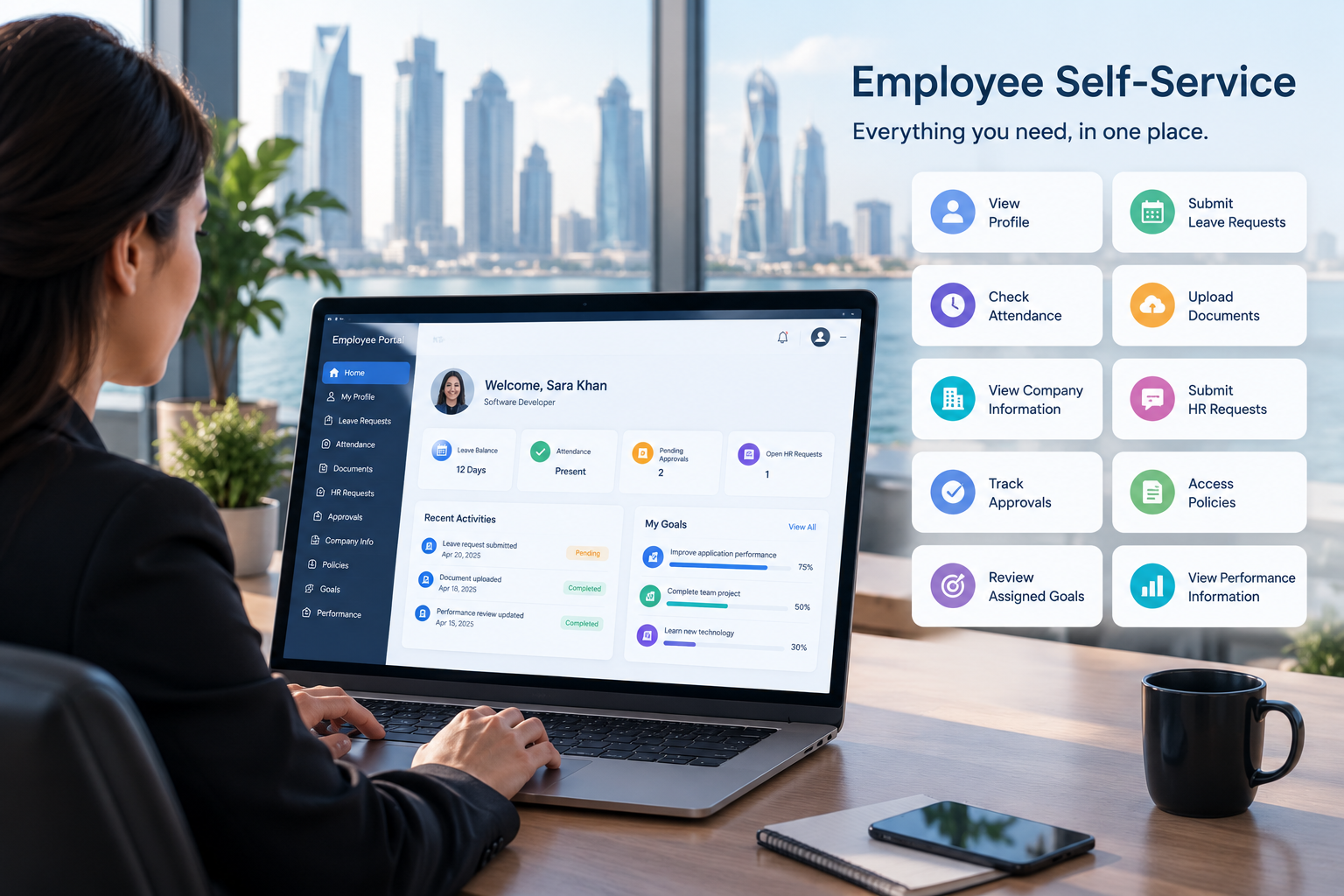
Employee Self-Service
A modern HR platform can provide an employee portal.
Employees may be able to:
View their profile
Submit leave requests
Check attendance
Upload documents
View company information
Submit HR requests
Track approvals
Access policies
Review assigned goals
View performance information
This reduces the need for HR employees to manually answer routine requests.
For example:
Employee submits leave request
↓
System checks available balance
↓
Manager receives approval request
↓
Manager approves
↓
HR record updates
↓
Employee receives notification
This is a simple example of HR workflow automation.
Not every automated HR workflow needs AI. In many cases, straightforward rules-based automation is more predictable and easier to maintain.
AI-Powered Employee Performance Management
Performance management is another major area where AI-powered HR software can provide useful support.
Traditional performance reviews often happen periodically.
For example, an employee may receive a formal review once or twice a year.
This can create a problem: important performance information may be spread across many months of work.
A modern performance management system can create a more continuous process.
Managers can track:
Goals
KPIs
Projects
Tasks
Milestones
Feedback
Training
Reviews
Achievements
AI can then help organize and summarize relevant information.
How AI Can Support Performance Reviews
Suppose a manager needs to prepare an employee performance review.
Instead of manually searching through multiple systems, an HR platform could present:
Employee goals
Goal completion
KPI progress
Project contributions
Manager feedback
Training completed
Recent achievements
Areas requiring attention
AI could summarize this information into a draft review.
The manager then checks the information, adds context, and makes the final assessment.
This creates a human-reviewed AI-assisted performance process rather than an automated judgment.
KPI Management in HR Software
Key Performance Indicators, or KPIs, help organizations measure specific outcomes.
AI-powered HR software can connect employee goals and KPIs with broader organizational objectives.
For example:
Sales Employee
Possible KPIs:
Revenue generated
Qualified leads
Conversion rate
Customer retention
Sales target achievement
Customer Support Employee
Possible KPIs:
Response time
Resolution time
Customer satisfaction
Ticket volume
First-contact resolution
Software Developer
Possible indicators may include:
Project delivery
Assigned task completion
Defect resolution
Code review participation
Sprint objectives
HR Recruiter
Possible indicators may include:
Time to fill
Interview completion
Candidate pipeline activity
Hiring process progress
Recruitment workload
The exact KPIs should depend on the employee's actual role.
A major mistake is creating identical KPIs for every employee simply because the software makes it easy to do so.
AI-Powered KPI Insights
Once KPI information is centralized, AI can help identify patterns.
For example:
Which teams are consistently meeting their targets?
Which goals are falling behind?
Which departments have increasing workloads?
Which employees have incomplete objectives?
Which projects are repeatedly missing deadlines?
These questions can potentially be answered through dashboards and natural-language HR analytics.
The AI should be treated as an analytical assistant rather than the final authority on employee performance.
AI-Powered HR Analytics
HR departments generate large amounts of workforce data.
Without analytics, that information can remain underused.
AI-powered HR analytics can help transform raw HR data into understandable insights.
A management dashboard might show:
Total employees
New hires
Employee turnover
Open positions
Recruitment pipeline
Attendance trends
Leave activity
Training completion
KPI progress
Performance review status
The value comes from connecting the information.
For example:
Recruitment
Open positions → Candidates → Interviews → Offers → New hires
Employee lifecycle
New hire → Onboarding → Training → Performance → Promotion
Performance
Goals → KPIs → Progress → Review → Development
This gives management a broader view of workforce operations.
HR Automation Beyond AI
AI is only one part of modern HR technology.
Many HR processes can be automated without using advanced AI.
Examples include:
Leave approvals
Attendance notifications
Employee onboarding checklists
Document reminders
Contract-expiration alerts
Interview scheduling
Performance-review reminders
Training notifications
HR request routing
Approval workflows
For example:
Employee onboarding
New employee created
↓
Employee profile generated
↓
Document checklist created
↓
HR receives task
↓
Manager receives notification
↓
Training assigned
↓
Onboarding progress tracked
This type of workflow can reduce administrative work while keeping responsibilities clearly defined.
AI Chatbots and HR Assistants
Another possible feature is an AI HR assistant.
Employees could ask questions such as:
How do I request leave?
What documents do I need?
Where can I find the employee policy?
What is the status of my request?
When is my next performance review?
How do I update my personal information?
The assistant could retrieve information from the organization's HR system or knowledge base.
This can provide employees with faster access to routine information.
However, access controls are essential.
An employee should not be able to ask an AI assistant for another employee's salary, personal documents, performance review, or confidential HR information.
AI-Powered HR Software Architecture
A modern HR platform can contain several interconnected layers.
1. HR Application
The user-facing application may include:
HR dashboard
Employee portal
Recruitment portal
Manager dashboard
Performance management
KPI management
Reports
2. Business Logic
The backend manages:
Employee records
Recruitment workflows
Approval rules
Performance processes
KPI calculations
Notifications
Permissions
3. Database
The database stores structured HR information.
4. AI Layer
AI services may support:
Resume extraction
Candidate matching
Text summarization
HR question answering
Document analysis
Workforce insights
Automated content generation
5. Integration Layer
APIs can connect the HR system with:
Payroll
Accounting
Attendance systems
Email
Calendars
Identity systems
ERP
CRM
Communication platforms
6. Security Layer
Security controls can include:
Authentication
Role-based permissions
Encryption
Audit logs
Access controls
Data backups
Monitoring
Businesses requiring connected enterprise systems can also explore web application development for browser-based HR platforms.
Integrating HR Software With ERP and Business Systems
HR does not operate independently from the rest of a business.
Employee information may need to interact with other business processes.
For example:
HR
Employee
↓
Payroll
Salary
↓
Finance
Accounting records
↓
Management
Financial and workforce reporting
An HR platform may also integrate with attendance systems.
Employee
↓
Attendance
↓
HR
↓
Payroll
Similarly, recruitment can connect with employee onboarding.
Candidate
↓
Selected
↓
Employee record created
↓
Documents collected
↓
Onboarding
↓
Training
↓
Performance management
Integration reduces duplicate data entry and can make information flow more consistently between systems.
Businesses that need multiple systems to communicate can consider software integration services as part of a broader digital architecture.
AI-Powered HR Software for Businesses in Qatar
For businesses in Qatar, HR software can be designed around the organization's actual workforce structure and operational requirements.
Different organizations may have different needs based on:
Number of employees
Departments
Locations
Branches
Recruitment volume
Approval structures
Employee roles
Existing software
Payroll systems
Reporting requirements
Language requirements
For example, a growing company may initially require:
Employee management
Leave
Attendance
Recruitment
Documents
As the company grows, it may add:
Performance management
KPI dashboards
Employee self-service
Training
AI assistance
Advanced analytics
ERP integration
Mobile access
This makes scalability an important consideration when selecting or developing HR software.
Galaxium Coding's current technology content also emphasizes connected HR, ERP, automation, reporting, and business-management systems rather than treating each function as an isolated application.
Custom HR Software vs Ready-Made HR Software
Businesses often have to decide whether to purchase an existing HR platform or build a custom system.
Ready-Made HR Software
Ready-made software may provide:
Faster implementation
Established features
Standard HR workflows
Existing support
Predictable subscription models
It can be suitable when the company's processes closely match the available software.
Custom HR Software
Custom HR software can be designed around:
Specific HR workflows
Unique approval processes
Custom KPI structures
Existing ERP systems
Internal employee portals
Industry-specific requirements
Custom reporting
AI functionality
Business-specific integrations
The choice depends on the organization's requirements rather than simply whether one approach is universally better.
Businesses evaluating a custom approach can explore custom software development services.
Security and Privacy in AI HR Software
HR systems contain sensitive business and employee information.
This makes security one of the most important considerations.
An HR platform may contain:
Employee identity information
Employment documents
Compensation information
Performance reviews
Attendance information
Recruitment data
Manager feedback
Internal communications
AI introduces additional considerations because information may be processed by AI services.
Businesses should understand:
What data is being processed
Where data is stored
Which systems can access it
How long information is retained
Which users can view specific records
How AI services handle submitted information
How access is logged
How data is backed up
Role-based access is especially important.
For example:
User | Possible Access |
|---|---|
Employee | Own profile and requests |
Manager | Team information and relevant performance data |
HR Manager | HR records and recruitment |
Finance | Payroll-related information |
Administrator | System configuration |
Senior Management | Approved workforce dashboards |
Access should be based on actual responsibilities.
Responsible Use of AI in HR
AI can improve HR workflows, but organizations should be careful about how it is used.
Employment decisions can affect people's careers and livelihoods.
Businesses should therefore consider:
Human Oversight
Important decisions should not automatically be delegated to an AI system.
Data Quality
Poor or incomplete data can produce misleading outputs.
Transparency
Employees and HR teams should understand where AI is being used when appropriate.
Bias Monitoring
Recruitment and performance systems should be tested for potentially unfair patterns.
Access Control
Sensitive HR information should only be available to authorized users.
Auditability
Important automated actions should be traceable.
The goal should be responsible AI-assisted HR, not uncontrolled automation.
Common Mistakes When Implementing AI HR Software
1. Adding AI Without a Business Problem
AI should solve a real problem.
Adding a chatbot simply because it is technically possible may not create meaningful value.
2. Automating Bad Processes
If an existing workflow is unnecessarily complicated, automating it can simply make the complicated process faster.
Businesses should first simplify the workflow.
3. Treating AI Recommendations as Decisions
AI can provide useful analysis, but managers and HR professionals should retain appropriate responsibility for important employment decisions.
4. Ignoring Data Security
HR data requires strong access controls and security practices.
5. Building Too Much Too Early
A company does not necessarily need every HR feature in the first version.
An initial system might focus on:
Employee management
Recruitment
Leave
Attendance
KPIs
Performance
AI analytics and advanced features can be introduced progressively.
6. Forgetting Employee Experience
HR software is used by employees, managers, recruiters, HR teams, and administrators.
A technically powerful system can still fail if it is difficult to use.
How to Implement AI-Powered HR Software
A structured implementation process can reduce unnecessary complexity.
Step 1: Identify HR Problems
Start by documenting the current process.
Ask:
Where is HR spending the most manual time?
Which information is stored in spreadsheets?
Which approvals are slow?
Where does duplicate data entry occur?
Which reports are difficult to prepare?
Which recruitment activities are repetitive?
Step 2: Define the Core Modules
Select the initial functionality.
For example:
Employee management
Recruitment
Attendance
Leave
Documents
KPIs
Performance
Step 3: Identify AI Use Cases
Then determine where AI can genuinely help.
Possible use cases include:
Resume parsing
Candidate matching
HR assistant
Document summarization
Performance-summary generation
Workforce analytics
Employee query handling
Step 4: Design Roles and Permissions
Define who can access:
Employee information
Recruitment information
Performance records
Payroll-related information
Reports
AI features
Step 5: Plan Integrations
Identify systems that must communicate with the HR platform.
Step 6: Build and Test
Testing should include:
Functional testing
Security testing
User acceptance testing
AI output testing
Integration testing
Performance testing
Step 7: Launch in Phases
Instead of launching everything simultaneously, businesses can introduce modules progressively.
For example:
Phase 1: Employee management
Phase 2: Recruitment
Phase 3: Attendance and leave
Phase 4: KPI and performance management
Phase 5: AI assistant and analytics
Phase 6: Advanced integrations
This approach can make implementation easier to manage.
What Should an AI-Powered HR System Include?
A complete platform may include the following:
Module | Purpose |
|---|---|
Employee Management | Centralized employee records |
Recruitment | Candidate and hiring management |
AI Resume Analysis | Extract and organize candidate information |
Candidate Matching | Assist recruiters with requirement comparison |
Onboarding | Automate new-employee workflows |
Attendance | Track attendance information |
Leave Management | Manage requests and approvals |
KPI Management | Define and monitor objectives |
Performance Management | Track goals, reviews and feedback |
Employee Portal | Give employees self-service access |
HR Assistant | Answer routine HR questions |
Analytics | Workforce insights and reporting |
Notifications | Automated reminders and updates |
Document Management | Centralize HR documents |
Integrations | Connect HR with other systems |
Security | Protect sensitive workforce information |
Not every company needs every feature.
The right architecture depends on the organization's workforce, processes, industry, and growth plans.
How Much Does AI-Powered HR Software Cost?
The cost of an AI-powered HR platform depends heavily on its scope.
Factors can include:
Number of users
Number of modules
Customization
AI features
Integrations
Mobile applications
UI/UX requirements
Security requirements
Hosting architecture
Reporting
Data migration
Support and maintenance
A simple HR management platform and a fully customized enterprise HR ecosystem can have very different development requirements.
For this reason, businesses should define the required workflows and modules before requesting a development estimate.
The Future of AI-Powered HR Software
HR technology is likely to become increasingly connected with broader business systems.
A future workforce platform could look like:
Recruitment
↓
Employee Management
↓
KPIs & Performance
↓
Payroll & Finance
↓
Training
↓
Business Operations
↓
AI Analytics
Instead of HR data existing in isolation, it can become part of a larger business information system.
AI may increasingly help HR teams:
Summarize information
Find relevant records
Identify patterns
Generate reports
Assist employees
Support recruiters
Automate administrative workflows
Provide management insights
However, the most useful HR systems will likely combine AI with clear workflows, reliable data, strong security, and human oversight.
Why Businesses Should Think Beyond Basic HR Software
Basic HR software solves an important problem: centralizing employee information.
But modern organizations often need more.
They may need a platform connecting:
Recruitment
→ Employees
→ Attendance
→ Leave
→ KPIs
→ Performance
→ Training
→ Payroll
→ Analytics
→ AI
This connected approach can provide HR teams and management with a broader view of the employee lifecycle.
For organizations that need a broader digital platform, Galaxium Coding provides technology solutions covering custom software, web applications, mobile applications, business automation, and connected business systems. Its projects and portfolio can also provide context on the type of technology work the company undertakes.
How Galaxium Coding Can Help With AI-Powered HR Software
Galaxium Coding is a Qatar-focused technology company working across custom software and digital business solutions.
For businesses with HR processes that do not fit neatly into a standard platform, a custom approach can provide flexibility around:
Employee management
Recruitment
KPI tracking
Performance management
Employee portals
Workflow automation
AI assistants
HR analytics
Business dashboards
API integrations
Mobile access
The right solution should begin with the organization's actual requirements rather than starting with a predefined list of technologies.
If your business is evaluating a custom HR platform, you can contact Galaxium Coding to discuss the required workflows, modules, integrations, and AI use cases.
Frequently Asked Questions
What is AI-powered HR software?
AI-powered HR software combines traditional HR management functionality with artificial intelligence, automation, analytics, and intelligent data processing. It can support recruitment, employee management, performance tracking, HR assistance, and workforce analytics.
Can AI screen resumes?
AI can help extract information from resumes and compare candidate profiles with predefined job requirements. Human recruiters should remain involved in evaluating candidates and making employment decisions.
Can AI manage employee performance?
AI can assist with performance management by organizing goals, KPIs, feedback, and performance information and generating summaries or insights. Final performance evaluations should remain subject to appropriate human review.
What KPIs can HR software track?
Depending on the organization, HR software can track recruitment, attendance, employee, performance, training, and role-specific KPIs. The exact KPIs should reflect the employee's responsibilities and organizational objectives.
Can employees use AI HR software themselves?
Yes. Employee self-service portals can allow employees to access information, submit requests, check leave, upload documents, and interact with an HR assistant.
Is AI-powered HR software secure?
Security depends on the system architecture and implementation. Organizations should use appropriate authentication, authorization, encryption, access controls, audit logging, secure integrations, and data-management practices.
Should a company build custom HR software or buy existing software?
The answer depends on the company's requirements. Ready-made platforms can provide established functionality, while custom software can be designed around unique workflows, integrations, KPIs, and organizational requirements.
Can HR software integrate with ERP systems?
Yes. HR platforms can be designed to integrate with ERP, payroll, accounting, attendance, identity, communication, and other business systems through APIs and other integration methods.
Does every HR process need AI?
No. Many HR workflows are better handled through straightforward automation and business rules. AI is most useful when the organization needs capabilities such as document understanding, summarization, natural-language interaction, or pattern analysis.
Is AI going to replace HR professionals?
AI can automate and assist with certain HR activities, but HR still involves communication, judgment, employee relationships, organizational context, and sensitive decision-making. AI is better viewed as a tool that can augment HR professionals rather than automatically replacing the entire HR function.
Final Thoughts
AI-powered HR software can transform HR from a collection of administrative processes into a more connected, data-driven business function.
Recruitment can become more organized.
Employee information can be centralized.
KPIs can be monitored continuously.
Performance reviews can be supported by structured information.
Routine HR requests can be automated.
Management can gain better workforce visibility.
AI can provide additional assistance through document analysis, summaries, intelligent search, HR assistants, and workforce insights.
But successful implementation is not simply about adding AI.
The foundation should be well-designed workflows, accurate data, appropriate security, clear permissions, useful integrations, employee-friendly interfaces, and responsible human oversight.
For businesses in Qatar considering a modern HR platform, the most useful starting point is to identify the HR problems that need to be solved and then determine which combination of software, automation, analytics, and AI can address them effectively.