AI for Restaurants: Customer Service, Ordering and Business Automation
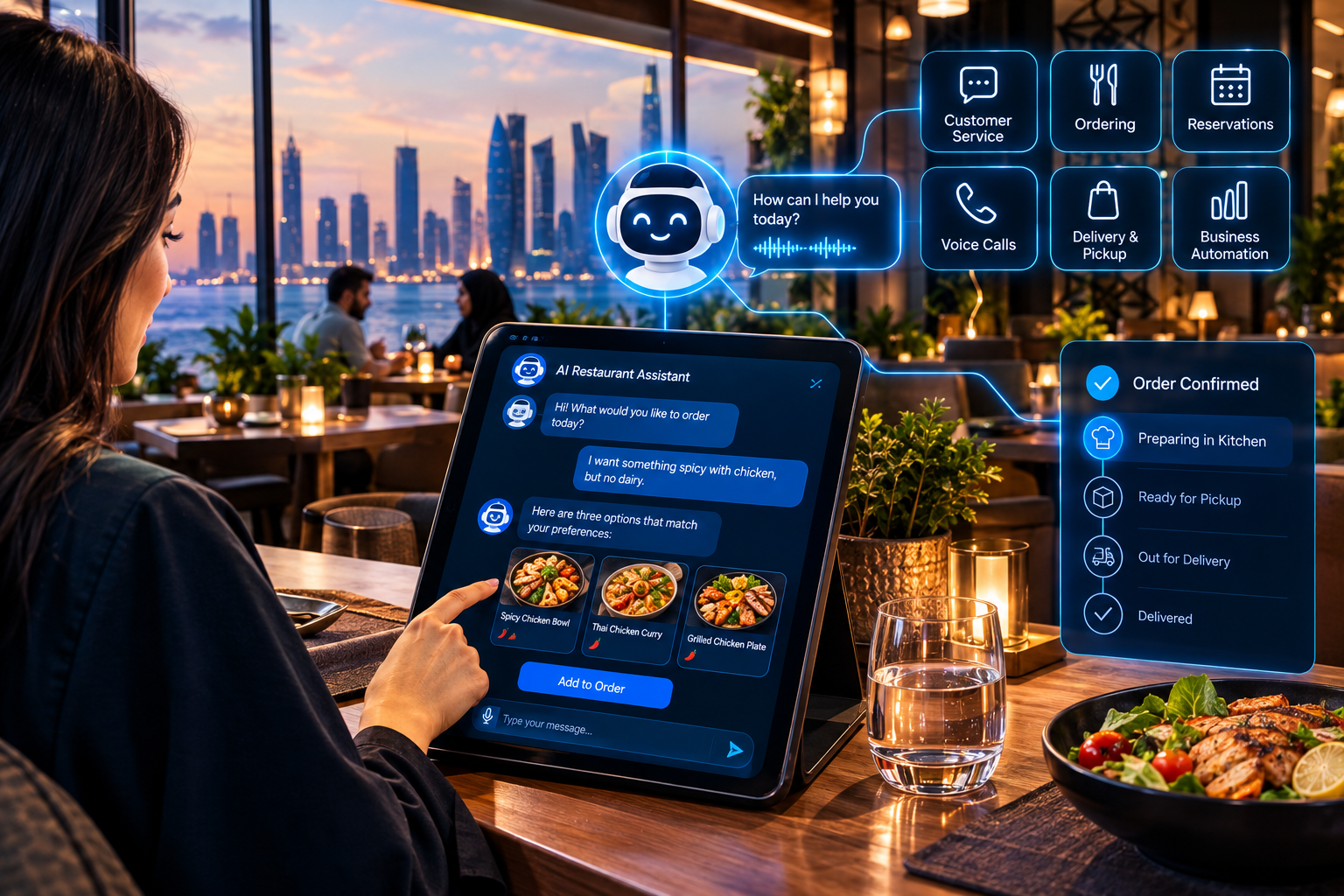
AI can connect restaurant customer service, ordering, voice assistance and business automation into one intelligent digital workflow.
AI for Restaurants: Customer Service, Ordering and Business Automation
Restaurants operate in a high-speed environment where small delays can quickly become customer complaints, missed orders, wasted inventory or unnecessary pressure on employees.
A customer may want to know whether a dish is available. Another may want to modify an order. Someone else may be calling to book a table while online orders are arriving at the same time. Meanwhile, restaurant managers need visibility into sales, inventory, staff performance and customer demand.
Artificial intelligence can help connect these activities.
AI for restaurants is no longer limited to chatbots or futuristic concepts. Modern AI can support customer service, online ordering, phone calls, recommendations, workflow automation, reporting and internal operations when it is properly connected to restaurant systems.
For restaurants considering digital transformation, the goal should not be to add AI simply because it is popular. The goal should be to identify repetitive or time-sensitive processes where intelligent automation can create measurable value.
For example:
Customer message → AI understands request → Restaurant system checks information → Order or request is processed → Staff is notified → Customer receives confirmation
This approach turns AI from a standalone chatbot into part of the restaurant's operating system.
Restaurants interested in building technology around their own workflows can explore custom software development services from Galaxium Coding.
What Is AI for Restaurants?
AI for restaurants refers to the use of artificial intelligence technologies to automate, assist or improve restaurant-related activities.
These activities can include:
Customer support
Online ordering
Phone ordering
Table reservations
Menu questions
Order modifications
Customer recommendations
Delivery communication
Customer feedback
Marketing automation
Inventory analysis
Sales forecasting
Employee assistance
Business reporting
Workflow automation
CRM and customer data management
The important distinction is between AI assistance and AI-powered automation.
A basic AI chatbot might answer:
"What time do you close?"
A more connected AI restaurant assistant could potentially answer the question, check the restaurant's current operating information, help the customer place an order, send the order to the appropriate system and provide confirmation.
The second approach requires integration with the restaurant's actual technology infrastructure.
Why Are Restaurants Using AI?
Restaurants deal with several characteristics that make automation particularly useful:
High volume of repetitive questions
Customers repeatedly ask about:
Opening hours
Menu items
Prices
Ingredients
Allergens
Delivery areas
Reservations
Discounts
Payment methods
Order status
Restaurant location
Employees can answer these questions manually, but doing so repeatedly takes time.
AI can handle many routine interactions while allowing employees to focus on tasks that require human judgment.
Peak-hour pressure
Restaurant demand is rarely evenly distributed.
Lunch, dinner, weekends, holidays and special events can create sudden increases in:
Orders
Phone calls
Messages
Reservations
Delivery requests
Customer complaints
An automated system can help absorb some of this demand.
Multiple customer channels
Modern restaurants may receive orders or enquiries through:
Website
Mobile application
Phone
WhatsApp
Social media
Third-party delivery platforms
In-store kiosks
Without integration, employees may have to move information manually between systems.
AI becomes more useful when these channels connect to the restaurant's central software.
How AI Can Improve Restaurant Customer Service
Customer service is one of the most practical starting points for restaurant AI.
A restaurant AI assistant can be designed to answer frequently asked questions and guide customers through common requests.
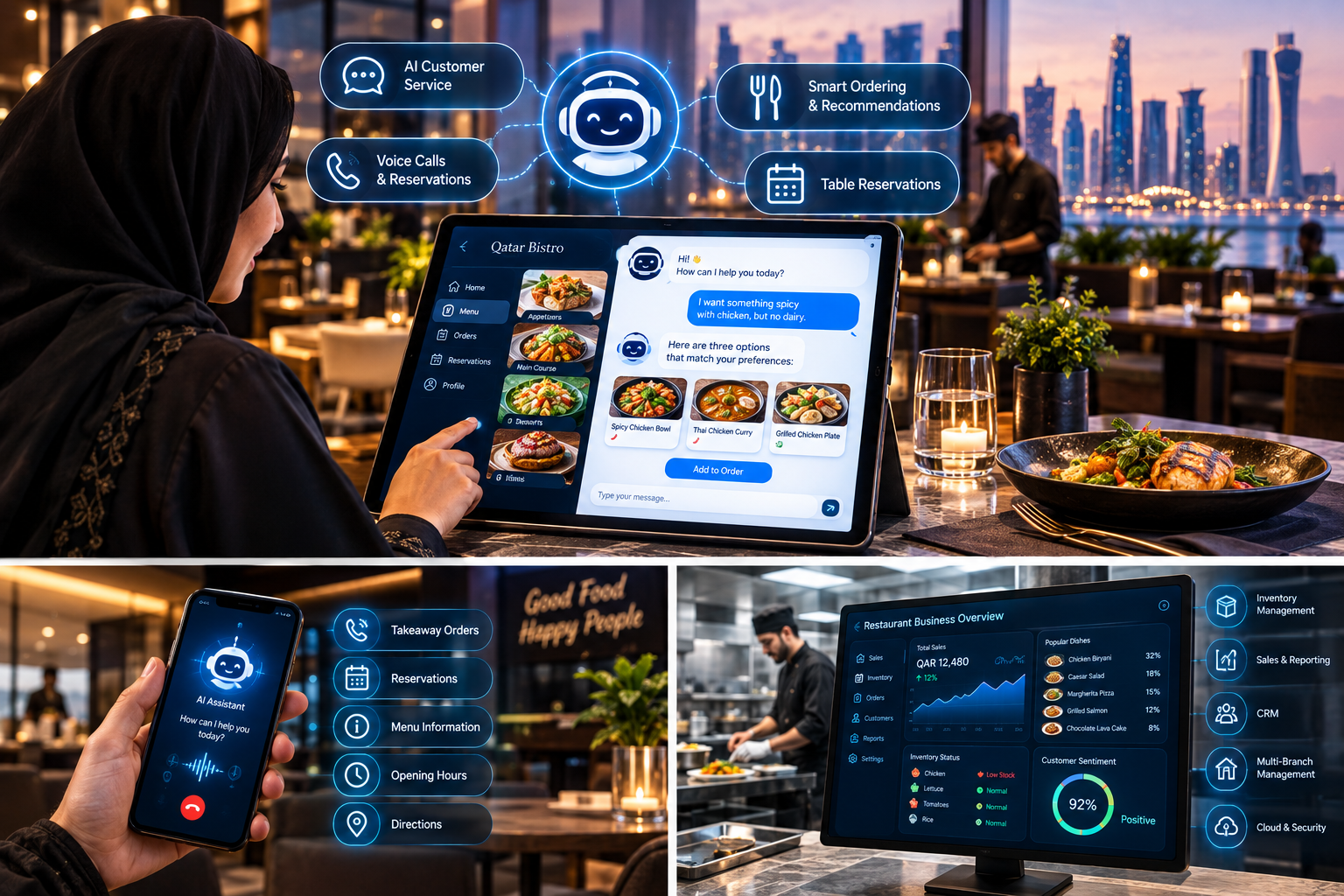
1. AI Chat Assistants
An AI assistant can operate on a restaurant website or digital platform.
Customers could ask:
"Do you have vegetarian options?"
"What are today's specials?"
"Can I order without onions?"
"Do you deliver to West Bay?"
"What time do you close?"
"Can I reserve a table for six?"
"Where is your restaurant?"
"What payment methods do you accept?"
Instead of requiring an employee to respond to every basic question, the AI can provide immediate answers based on approved restaurant information.
The restaurant should still define which questions require human involvement.
For example, an AI could answer a general menu question but transfer a complicated complaint to a manager.
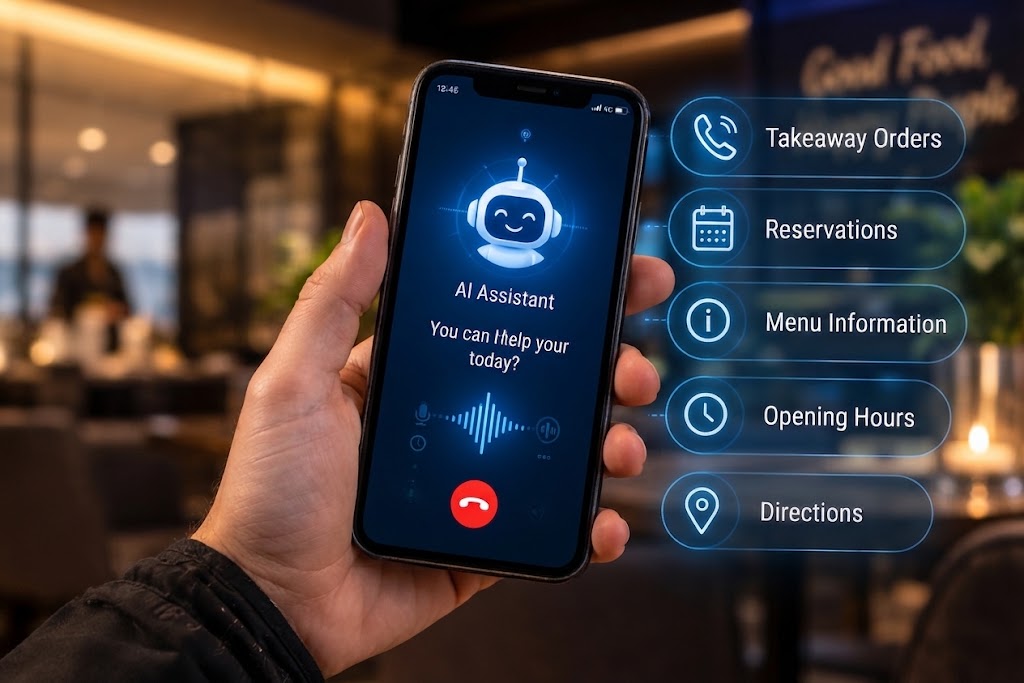
2. AI Voice Agents for Restaurant Calls
Restaurants receive a large number of phone calls.
Calls may involve:
Reservations
Takeaway orders
Delivery questions
Menu information
Opening hours
Directions
Order status
Special requests
Complaints
During busy periods, employees may not be able to answer every call.
A voice AI agent can potentially handle routine calls and transfer complex situations to staff.
A typical workflow could look like this:
Customer calls → AI answers → AI identifies intent → AI checks approved information → Customer request is processed → Confirmation is provided
Voice AI becomes particularly valuable when it is connected to the restaurant's software rather than operating independently.
Galaxium Coding's recent coverage of Voice AI agents in Qatar also highlights the wider role of voice agents in customer support, bookings and business workflows.
3. Multilingual Customer Service
Restaurants in Qatar often serve customers from different linguistic backgrounds.
A restaurant may need to support customers using different languages depending on its target market.
AI can potentially assist with multilingual conversations across:
Website chat
Mobile applications
Messaging
Voice
Customer support
However, restaurants should carefully test translations for menu terminology, food ingredients, allergens and special instructions.
Food-related communication can have real consequences, so human escalation should remain available when accuracy is uncertain.
AI-Powered Restaurant Ordering
Ordering is one of the strongest use cases for restaurant AI.
An AI ordering system can help customers navigate a menu conversationally rather than forcing them to browse every category manually.
For example:
Customer:
"I want something spicy with chicken, but no dairy."
AI:
"Here are three menu options that match those preferences."
The customer can then continue:
Customer:
"Which one is available for delivery?"
The system can potentially check availability and continue the order process.
AI ordering systems can operate through channels such as websites, applications, kiosks and other digital ordering interfaces.
How an AI Restaurant Ordering Workflow Works
A connected ordering workflow might look like this:
1. Customer starts conversation
↓
2. AI understands the request
↓
3. AI identifies menu preferences
↓
4. Restaurant system checks menu and availability
↓
5. AI presents suitable options
↓
6. Customer confirms the order
↓
7. Order enters the restaurant workflow
↓
8. Kitchen receives the order
↓
9. Customer receives confirmation
↓
10. Order status can be communicated automatically
This is more advanced than simply adding a chatbot to a website.
The AI needs access to reliable business information and clearly defined permissions.
AI for Menu Recommendations
AI can also help customers discover menu items.
Instead of simply displaying a static menu, a restaurant can allow customers to describe what they want.
For example:
"I want a light lunch."
"What is good for two people?"
"Recommend something without seafood."
"What is popular for families?"
"I want a high-protein meal."
"I want something spicy."
The recommendation engine can use available menu information to suggest relevant items.
However, restaurants should avoid making unsupported claims about nutrition, allergens or health benefits.
If an ingredient or allergen is important to a customer's decision, the system should rely on verified restaurant data and provide a human escalation option when necessary.
AI for Restaurant Reservations
Reservations are another area where automation can reduce repetitive work.
A restaurant AI assistant could potentially help customers:
Request a table
Select a date
Select a time
Specify party size
Provide contact information
Request special arrangements
Receive confirmation
Receive reminders
A connected reservation workflow can reduce the amount of manual coordination required by restaurant staff.
For example:
Customer requests table → AI checks availability → Available slot identified → Customer confirms → Reservation created → Confirmation sent
The system should be connected to the restaurant's actual reservation data to avoid showing unavailable tables.
AI for Order Status and Customer Updates
After placing an order, customers often want to know what is happening.
Typical questions include:
"Has my order been accepted?"
"Is my food ready?"
"When will it arrive?"
"Why is my delivery late?"
An integrated AI assistant can potentially retrieve order information from the relevant restaurant system and provide status updates.
For example:
Order received
↓
Kitchen preparing
↓
Order ready
↓
Driver assigned
↓
Out for delivery
↓
Delivered
Automated updates can reduce the number of calls employees need to answer.
AI for Restaurant Business Automation
Customer-facing AI is only one part of the opportunity.
The larger opportunity may come from connecting AI to internal restaurant workflows.
Sales and Reporting Automation
Restaurant managers often need to understand:
Which dishes are selling?
What are the busiest periods?
Which branches perform best?
Which items are declining?
What are average order values?
Which channels generate the most orders?
AI can help analyze structured business data and turn it into more accessible summaries.
For example:
"Summarize yesterday's sales and identify unusual changes."
The system could produce a management summary based on the restaurant's actual data.
The quality of the result depends heavily on data quality, integration and system design.
Inventory Management
Inventory is another area where automation can create value.
A restaurant needs to manage ingredients such as:
Meat
Vegetables
Dairy
Rice
Flour
Sauces
Beverages
Packaging
Frozen products
AI can potentially help identify patterns in consumption and sales.
For example:
Historical sales + Current inventory + Menu demand → Forecast → Purchasing recommendation
This does not mean the AI should automatically purchase everything without oversight.
A better approach for many businesses is to allow the system to make recommendations while a manager approves significant purchasing decisions.
AI for Food Waste Reduction
Food waste can occur when restaurants prepare more food than necessary or purchase ingredients that are not used efficiently.
AI can help identify patterns by analyzing historical information.
For example:
If a restaurant repeatedly sells significantly more of a particular dish on weekends, the system could identify the pattern and help managers plan inventory accordingly.
Potential inputs include:
Historical orders
Day of week
Time of day
Seasonal demand
Promotions
Holidays
Weather data where appropriate
Branch-level sales
AI should be treated as a decision-support system rather than an unquestioned source of truth.
AI for Restaurant Marketing
AI can also support restaurant marketing activities.
Possible applications include:
Personalized promotions
A restaurant could segment customers based on legitimate business data and send relevant offers.
Automated campaign assistance
AI can help draft:
Email campaigns
Promotional messages
Social media copy
Menu announcements
Customer notifications
Customer segmentation
Restaurants may categorize customers based on factors such as:
Order frequency
Preferred products
Purchase channel
Location
Average order value
The restaurant must ensure that customer-data processing follows applicable privacy requirements.

AI and CRM for Restaurants
A restaurant CRM can help organize customer relationships.
Instead of keeping customer information across disconnected systems, a connected platform can bring together:
Customer profiles
Orders
Preferences
Feedback
Loyalty information
Communication history
Marketing permissions
AI can then help staff interpret this information.
For example:
"Show customers who have ordered from us at least five times in the last three months."
Or:
"Summarize this customer's recent support history."
A restaurant-specific CRM can therefore become more than a contact database.
It can become part of a connected customer-experience system.
AI for Restaurant Loyalty Programs
Loyalty programs can become more intelligent when combined with customer data and automation.
A restaurant could potentially use AI to help:
Identify frequently returning customers
Recommend relevant menu items
Suggest personalized promotions
Automate loyalty notifications
Identify customers who have become inactive
Analyze redemption patterns
However, personalization should remain useful rather than intrusive.
Customers should understand what information is being collected and how it is being used.
AI for Restaurant Staff
AI should not be viewed only as customer-facing technology.
Employees can also benefit.
A restaurant employee assistant could help answer internal questions such as:
"What is today's opening procedure?"
"How do I process this type of order?"
"What is the procedure for a customer complaint?"
"Where can I find the cleaning checklist?"
"What is the escalation process?"
"What are today's operational instructions?"
The assistant could be connected to approved internal documentation.
This can make information easier to find without requiring managers to repeatedly answer the same internal questions.
AI for Restaurant Managers
Managers often spend significant time collecting information from different systems.
An AI management assistant could provide a conversational interface for business information.
For example:
"How did the branch perform yesterday?"
"Which menu items sold the most this week?"
"What were the biggest customer complaints?"
"Which orders were delayed?"
"Compare this week's sales with last week."
Instead of manually reviewing multiple dashboards, managers could ask questions in natural language.
The underlying data still needs to be accurate and properly structured.
AI Restaurant Technology Stack
A serious AI restaurant solution may include several technology layers.
Layer | Example Function |
|---|---|
Customer Interface | Website, mobile app, chat, voice |
AI Layer | Natural-language understanding, recommendations, agents |
Restaurant Software | Orders, reservations, customers |
POS | Sales and transaction processing |
Kitchen System | Order routing and preparation |
Inventory | Ingredient and stock management |
CRM | Customer profiles and interactions |
Payment | Online and in-store payments |
Analytics | Reports and business intelligence |
Cloud Infrastructure | Hosting, scaling and monitoring |
APIs | Connecting different systems |
This architecture demonstrates why restaurant AI should be considered a software project rather than simply a chatbot installation.
For businesses that need connected digital systems, web application development can provide the foundation for customer portals, ordering systems, dashboards and internal platforms.
AI Restaurant App Development
A restaurant may also choose to build a dedicated mobile application.
A restaurant app could allow customers to:
Browse the menu
Place orders
Make payments
Track orders
Save favorite meals
Manage profiles
Receive notifications
Join loyalty programs
Request support
Make reservations
AI can then be integrated into the application.
For example, instead of navigating through dozens of menu categories, customers could simply ask:
"Show me a vegetarian dinner under my preferred budget."
A restaurant considering this approach can combine mobile application development with AI and backend integrations.
AI and WhatsApp for Restaurants
Messaging can be an important customer-service channel.
A restaurant could potentially use an AI assistant through a supported messaging workflow to handle:
Menu questions
Order enquiries
Reservations
Delivery questions
Promotions
Customer support
The key is integration.
If a customer places an order through messaging but employees must manually re-enter every order into another system, much of the automation benefit is lost.
A better architecture connects the conversation to the restaurant's ordering and business systems.
AI and Cloud Infrastructure
Restaurant systems may experience changing demand.
A restaurant chain could have:
Multiple branches
Hundreds of employees
Large order volumes
Mobile applications
Online ordering
Customer databases
AI services
Analytics dashboards
Cloud infrastructure can help support these connected systems.
Galaxium Coding provides cloud and DevOps solutions that can be relevant when businesses need scalable application infrastructure and deployment workflows.
AI for Restaurant Chains and Multiple Branches
AI becomes particularly interesting for restaurant groups operating multiple branches.
A centralized platform can potentially connect:
Branch sales
Inventory
Customers
Orders
Employees
Menus
Promotions
Customer feedback
Analytics
A management team could then compare performance across locations.
For example:
Business Question | AI-Supported Analysis |
|---|---|
Which branch sells the most? | Sales comparison |
Which products perform best? | Product analysis |
Which branch has delays? | Operational analysis |
What complaints repeat? | Customer feedback analysis |
Which ingredients need attention? | Inventory analysis |
Which promotions perform? | Campaign analysis |
The value comes from connecting AI to reliable operational data.
AI in Restaurants in Qatar
For restaurants operating in Qatar, AI adoption should be approached with both business and local operational considerations.
Restaurants may serve diverse customer groups and operate across multiple digital channels.
Potential use cases include:
Arabic and English customer support
Digital ordering
Voice ordering
Reservation automation
Delivery communication
Customer relationship management
Branch management
AI-assisted reporting
Inventory workflows
Mobile applications
Data protection is also an important consideration.
Qatar's Personal Data Privacy Protection Law is established under Law No. 13 of 2016. Qatar's official sources explain obligations around the handling and protection of personal data.
Restaurant AI systems may process customer names, contact details, order information, preferences and communication records. Therefore, businesses should assess what information they collect, why they collect it, where it is stored, who can access it and how long it is retained.
The National Cyber Security Agency's privacy guidance also emphasizes appropriate technical, administrative and financial precautions for protecting personal data.
For a production implementation, restaurants should obtain appropriate legal and compliance advice rather than assuming that an AI vendor's default configuration automatically satisfies every applicable requirement.
Security Considerations for Restaurant AI
Restaurant systems can contain valuable information.
Security should therefore be designed into the architecture from the beginning.
Important areas include:
Authentication
Only authorized users should access administrative systems.
Role-Based Permissions
A cashier may need access to orders but not payroll information.
A manager may need broader reporting access.
An AI agent should only have the permissions required for its task.
Data Encryption
Sensitive data should be protected during transmission and storage using appropriate security controls.
Audit Logs
Businesses should be able to understand important actions performed by users and automated systems.
Human Approval
High-impact actions should require human approval where appropriate.
For example:
Refunds above a threshold
Major pricing changes
Large purchasing decisions
Account deletion
Sensitive customer-data actions
Modern AI-agent systems increasingly use permissions, evaluations, monitoring and human approval mechanisms to keep automated workflows under control.
AI Should Not Replace Restaurant Employees Everywhere
One of the biggest misconceptions about restaurant AI is that the objective is to remove humans from the operation.
In many cases, a better model is:
AI handles repetitive work.
Employees handle human judgment.
For example:
AI Can Help With | Humans Should Handle |
|---|---|
Basic menu questions | Sensitive complaints |
Order status | Complex customer problems |
Reservation requests | Exceptional arrangements |
Routine messages | Difficult negotiations |
Data summaries | Strategic decisions |
Standard recommendations | Situations requiring judgment |
Repetitive administrative tasks | Leadership and supervision |
This approach can make AI a productivity layer rather than a replacement strategy.
AI vs Traditional Restaurant Automation
Traditional automation and AI are not the same.
Traditional automation
A traditional workflow may follow fixed rules:
If order received → send notification.
AI-assisted automation
An AI system can interpret less structured input:
Customer message → AI understands intent → system identifies required action → workflow executes appropriate process.
Both approaches are useful.
In fact, the strongest restaurant systems may combine them.
AI can interpret the request.
Traditional software can execute predictable business rules.
This combination can be more reliable than asking an AI model to control everything.
How Much Does Restaurant AI Cost?
There is no single price for restaurant AI.
The cost depends on what the restaurant wants to automate.
A simple FAQ chatbot is very different from a complete AI ordering and restaurant-management platform.
Factors include:
Number of AI channels
Website integration
Mobile application
Voice AI
POS integration
Ordering system
CRM
Inventory system
Payment integration
Number of branches
AI model usage
Cloud infrastructure
Security requirements
Admin dashboards
Analytics
Custom workflows
Ongoing maintenance
A practical way to estimate cost is to divide the project into layers.
Basic AI implementation
Could include:
FAQ assistant
Website chat
Basic menu information
Simple lead or enquiry collection
Intermediate implementation
Could include:
AI ordering
Customer profiles
Reservation integration
WhatsApp or messaging
CRM
Analytics
Advanced implementation
Could include:
Voice AI
POS integration
Inventory
Multi-branch management
AI recommendations
Automated workflows
Advanced analytics
Mobile application
Cloud infrastructure
Restaurants should define the business problem first and then determine which technology is actually necessary.
How to Implement AI in a Restaurant
A successful AI project should start with the workflow rather than the technology.
Step 1: Identify Repetitive Problems
List the tasks employees perform repeatedly.
For example:
Answering the same questions
Taking phone orders
Confirming reservations
Checking order status
Creating reports
Step 2: Measure the Current Process
Determine:
How many requests occur?
How long does each request take?
When are peak periods?
How many employees are involved?
What mistakes occur?
Step 3: Select the Highest-Value Use Case
Do not automate everything at once.
Start with one problem where automation has a clear benefit.
Step 4: Prepare Business Data
AI needs accurate information.
Prepare:
Menu
Prices
Opening hours
Branches
Delivery zones
Reservation rules
Policies
FAQs
Product availability
Step 5: Design the Integration
Determine which systems the AI must access.
Possible integrations include:
POS
CRM
ERP
Inventory
Payment
Reservation
Delivery
Website
Mobile app
Step 6: Define Permissions
Specify exactly what the AI can and cannot do.
Step 7: Add Human Escalation
Create clear rules for transferring conversations to employees.
Step 8: Test Real Scenarios
Test:
Normal orders
Ambiguous requests
Complaints
Menu changes
Out-of-stock products
Unusual questions
Payment problems
Reservation conflicts
Step 9: Launch Gradually
Start with a controlled workflow before expanding automation.
Step 10: Monitor and Improve
Measure:
Response accuracy
Order errors
Escalations
Customer satisfaction
Employee workload
Conversion
Average handling time
AI systems should be continuously evaluated rather than launched and forgotten.
Common Mistakes When Implementing AI in Restaurants
1. Adding AI Without a Business Problem
An AI chatbot is not automatically valuable.
Start with the problem.
2. Connecting AI to Poor Data
If the menu is outdated, the AI can provide outdated information.
3. Giving AI Too Much Access
An AI agent should have only the permissions required for its workflow.
4. Ignoring Human Escalation
Customers should have a way to reach a person when the AI cannot help.
5. Automating Sensitive Decisions Without Review
Some decisions require human oversight.
6. Forgetting Integration
A disconnected AI assistant may create another system for employees to manage.
7. Ignoring Security and Privacy
Customer information should be handled responsibly and according to applicable requirements.
8. Measuring Only Chatbot Usage
The real question is whether the system improves the business.
Measure outcomes such as:
Orders completed
Response time
Customer satisfaction
Staff workload
Conversion
Error rate
Operational efficiency
What Should Restaurants Automate First?
For many restaurants, a practical priority order could be:
Priority 1: Frequently Asked Questions
Low-risk and relatively simple.
Priority 2: Order Status
Useful for reducing repetitive customer enquiries.
Priority 3: Reservations
A structured workflow that can often be clearly defined.
Priority 4: Online Ordering Assistance
More valuable but requires stronger integration.
Priority 5: Voice AI
Potentially powerful for high call volumes.
Priority 6: Inventory and Forecasting
More complex because data quality becomes critical.
Priority 7: Advanced Autonomous Workflows
Best introduced after the underlying systems are reliable.
The correct order will depend on the restaurant's actual operations.
Example: An AI-Powered Restaurant Customer Journey
Consider a fictional restaurant called Qatar Bistro.
A customer opens the restaurant website and asks:
"I want dinner for four. Two people don't eat spicy food."
The AI identifies suitable menu options.
The customer then asks:
"Can I order delivery to West Bay?"
The system checks the restaurant's configured delivery area.
The customer selects dishes.
The AI sends the order into the restaurant's ordering workflow.
The customer receives confirmation.
Later, the customer asks:
"Where is my order?"
The AI retrieves the order status and provides an update.
After delivery, the system can request feedback.
Meanwhile, the restaurant manager sees the order in the management dashboard.
This example demonstrates the real potential of AI:
One conversation can connect customer service, ordering, operations and data.
The Future of AI for Restaurants
Restaurant AI is likely to become increasingly integrated into broader business software.
Instead of separate tools for:
Chat
Ordering
CRM
Analytics
Inventory
Reservations
restaurants may increasingly use connected platforms where AI acts as an intelligent interface across multiple systems.
A future restaurant employee might ask:
"Which branch had the highest number of delayed orders yesterday?"
The system could analyze operational data and provide an answer.
A customer might say:
"Order my usual dinner, but replace the drink with water."
The system could potentially recognize the customer's preference, check the current menu and process the request.
A manager might ask:
"What should we investigate today?"
The system could summarize unusual changes in sales, inventory, customer feedback or operational performance.
The underlying principle remains the same:
AI should make useful business information and workflows easier to access.
How Galaxium Coding Can Help Restaurants Build AI Solutions
Restaurant AI can range from a relatively simple customer-service assistant to a complete connected software ecosystem.
Galaxium Coding can support businesses that need technology such as:
Custom software
Web applications
Mobile applications
AI integrations
Business automation
CRM
ERP
API integrations
Cloud infrastructure
Business management systems
The right solution depends on the restaurant's workflow, existing technology and business objectives.
For example, one restaurant may need an AI ordering assistant.
Another may need a multi-branch management platform.
A restaurant group may need a connected ecosystem combining customer applications, ordering, CRM, inventory, analytics and AI.
You can review Galaxium Coding's projects and portfolio to understand the type of digital products and technology solutions the company works with.
If you are planning an AI-powered restaurant platform, the best first step is to map the current workflow, identify the highest-value automation opportunities and then design the technology around those requirements.
Businesses can contact Galaxium Coding to discuss a custom software, AI or automation project.
Final Thoughts
AI for restaurants is not simply about installing a chatbot.
The bigger opportunity is to connect customer service, ordering, reservations, business software and automation into a more intelligent operating environment.
Restaurants can use AI to:
Answer customer questions
Support phone calls
Assist with ordering
Recommend menu items
Automate reservations
Provide order updates
Support employees
Analyze business data
Improve inventory workflows
Personalize customer experiences
Automate repetitive administrative work
But successful implementation requires more than an AI model.
Restaurants need accurate data, reliable integrations, appropriate permissions, security controls, human escalation and continuous monitoring.
The best restaurant AI strategy is therefore not:
"Where can we add AI?"
It is:
"Which restaurant processes create the most repetitive work or customer friction, and where can intelligent technology improve them safely?"
That shift in thinking can turn AI from a marketing feature into a practical business capability.
Frequently Asked Questions About AI for Restaurants
What is AI for restaurants?
AI for restaurants uses artificial intelligence to support or automate activities such as customer service, ordering, reservations, recommendations, reporting, inventory analysis and business workflows.
Can AI take restaurant orders?
Yes. An AI ordering system can potentially take orders through supported digital channels such as websites, applications, kiosks or voice systems. It should be connected to the restaurant's actual menu and ordering infrastructure.
Can AI answer restaurant phone calls?
Yes. Voice AI can handle certain routine restaurant calls, including common questions, reservation requests and order-related enquiries. Complex situations should be transferred to human employees.
Can AI work with a restaurant POS system?
Potentially, yes. AI can be connected to POS and other restaurant systems through APIs or integration layers. The exact capabilities depend on the POS provider and available integration options.
Can AI help restaurants reduce staff workload?
Yes. AI can reduce repetitive work by handling routine customer questions, status requests, information searches and certain administrative workflows. It should complement employees rather than automatically replace human judgment.
Can AI recommend food to customers?
Yes. An AI system can recommend menu items based on customer preferences and restaurant-defined information. Restaurants should ensure that allergen, ingredient and nutritional information is accurate.
Can restaurants use AI on WhatsApp?
AI can be integrated into supported messaging workflows where the necessary business and platform integrations are available. The system can potentially handle customer enquiries, ordering and support.
How much does restaurant AI cost?
There is no universal price. Cost depends on the number of channels, integrations, AI functionality, voice capabilities, mobile apps, POS connectivity, number of branches, cloud infrastructure and custom development requirements.
Is AI useful for small restaurants?
Yes. Small restaurants do not necessarily need a large AI platform. They can start with a focused use case such as customer FAQs, ordering assistance, reservations or automated customer communication.
Is AI safe for restaurant customer data?
AI systems can be designed with security and privacy controls, but restaurants must consider how personal information is collected, processed, stored, shared and accessed. Businesses operating in Qatar should also consider the requirements of Qatar's applicable personal-data protection framework.
Should a restaurant completely automate customer service?
Usually, no. A strong approach is to automate predictable, repetitive requests while providing a clear path to human assistance for complaints, unusual requests, sensitive issues and situations requiring judgment.
What is the best first AI project for a restaurant?
The best starting point is usually a high-volume, repetitive workflow with measurable business value. Common starting points include FAQs, order-status enquiries, reservations or ordering assistance.