AI for E-Commerce: Personalization, Customer Service and Sales Automation
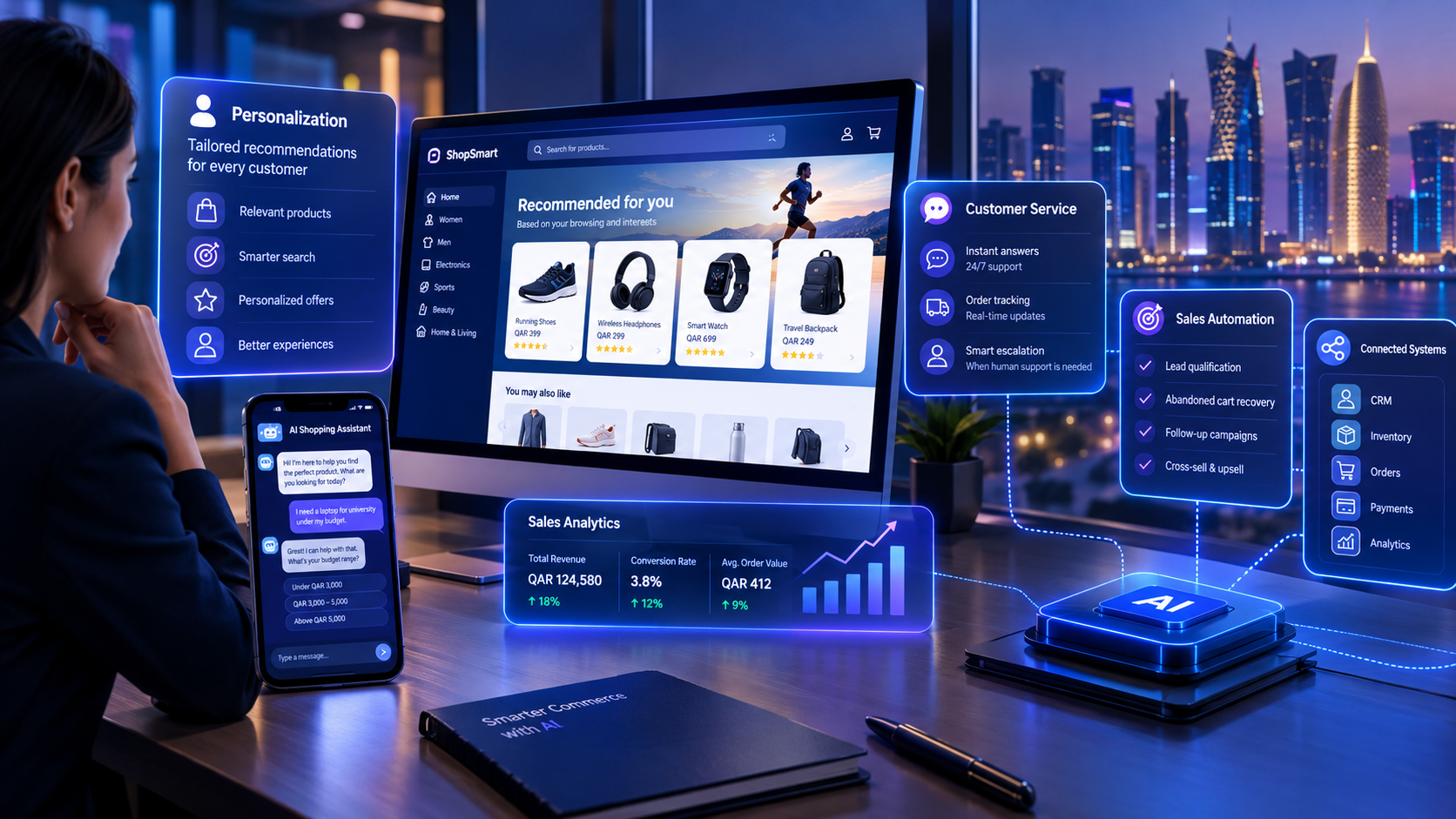
AI can connect personalized shopping, customer service and sales automation into one intelligent e-commerce experience.
AI for E-Commerce: Personalization, Customer Service and Sales Automation
E-commerce is no longer simply about putting products online and waiting for customers to purchase them.
Modern online stores have to understand customer behavior, answer questions quickly, recommend relevant products, manage large volumes of enquiries, follow up with potential buyers, and keep customers engaged after a purchase.
Artificial intelligence can support many of these activities.
AI for e-commerce can analyze customer interactions, personalize product recommendations, automate routine customer-service conversations, assist sales teams, identify purchasing patterns, and connect different business systems.
The important point is that AI should not be added simply because it is a popular technology trend. It should be connected to a genuine business objective.
For example, an e-commerce company might use AI to:
Recommend products based on customer behavior
Improve product discovery
Answer frequently asked questions
Help customers choose between products
Respond to enquiries outside business hours
Identify high-intent shoppers
Recover abandoned carts
Automate follow-up messages
Analyze customer feedback
Predict purchasing patterns
Support sales representatives
Connect e-commerce with CRM and inventory systems
A well-designed AI strategy can therefore turn an online store into a more intelligent business system rather than simply adding a chatbot to a website.
For companies considering this approach, custom software development services can provide a way to build AI functionality around existing business workflows instead of forcing the business into a fixed platform.
What Is AI for E-Commerce?
AI for e-commerce refers to the use of artificial intelligence and machine learning technologies to improve online shopping, customer interaction, sales processes, product discovery, and business operations.
AI can work with information such as:
Products
Product categories
Customer interactions
Search behaviour
Previous purchases
Cart activity
Browsing history
Customer enquiries
Product reviews
Inventory information
Order history
Marketing interactions
Depending on the system, this information can be used to provide recommendations, automate conversations, identify patterns, or support business decisions.
For example:
Customer visits store → views running shoes → searches for sports socks → adds shoes to cart → leaves website
An AI-enabled system could potentially recognize the customer's interests and later recommend relevant sports accessories or send an appropriate abandoned-cart reminder.
The objective is not simply automation.
The objective is to make the customer journey more relevant while reducing repetitive work for employees.
Why Is AI Becoming Important for E-Commerce?
Online stores can have thousands or even millions of interactions.
A human employee cannot manually examine every customer's browsing behaviour and determine which products should be shown next.
AI systems can process large amounts of structured and behavioural data much more efficiently.
Recommendation systems, for example, can use previous interactions and product information to identify potentially relevant products. Google describes recommendation systems using stages such as candidate generation, scoring, and re-ranking to determine which items should be presented to users.
This creates opportunities in several areas:
E-Commerce Area | Potential AI Application |
|---|---|
Product discovery | Personalized recommendations |
Search | Intelligent product search |
Customer service | AI assistants and chatbots |
Sales | Lead qualification and follow-up |
Marketing | Customer segmentation |
Cart recovery | Automated personalized reminders |
Reviews | Sentiment and feedback analysis |
Inventory | Demand-pattern analysis |
Analytics | Customer behaviour insights |
Operations | Workflow automation |
The right combination depends on the business model, available data, technology infrastructure, and customer journey.
How AI Personalizes the E-Commerce Experience
Personalization is one of the most visible applications of AI in online shopping.
Instead of showing exactly the same products to every visitor, an AI-powered system can use available signals to determine which products or content may be more relevant.
For example, two customers could visit the same online fashion store.
Customer A frequently browses formal clothing.
Customer B frequently browses sportswear.
A personalized system could display different recommendations to each customer.
Product Recommendations
Product recommendations can appear throughout an e-commerce website.
Common examples include:
Recommended for you
Customers also viewed
You may also like
Frequently bought together
Similar products
Recently viewed
Trending products
Products related to your interests
Google's machine-learning documentation describes content-based recommendation as recommending items based on item characteristics and user interactions, while collaborative filtering can use similarities between users and items.
An e-commerce business can use these approaches separately or combine multiple recommendation signals.
Personalized Homepages
Instead of presenting every visitor with exactly the same homepage, an e-commerce platform can potentially adjust sections based on customer activity.
For example:
A returning customer who frequently purchases skincare products could see:
Recommended for you
Moisturizer
Sunscreen
Cleanser
Related skincare products
A new visitor may instead see:
Popular products
Best-selling items
New arrivals
Current promotions
This can make product discovery more relevant without requiring the customer to search through the entire catalogue.
Personalized Search
Search is another important area.
Imagine a customer searches for:
“black shoes”
An intelligent search system could consider:
Product relevance
Previous browsing
Customer preferences
Product availability
Size availability
Brand preference
Price range
Popularity
Search context
The result can be more useful than simply matching the exact words in the product title.
Personalized Offers
AI can also support more targeted promotions.
For example, instead of sending every customer the same discount, a business could segment customers based on behaviour.
Possible segments include:
New customers
Frequent buyers
Inactive customers
High-value customers
Customers interested in a particular category
Customers who repeatedly abandon carts
The business can then design different campaigns for each group.
AI should support the strategy rather than automatically deciding every commercial action.
Personalization and the Cold-Start Problem
Personalization becomes more difficult when a customer has no previous interaction history.
This is commonly called the cold-start problem.
A new visitor may have:
No purchase history
No browsing history
No saved preferences
No previous interactions
In this situation, an e-commerce system may rely more heavily on:
Popular products
Current trends
Product categories
Search terms
Context
Location where appropriate
Device information
New-user behaviour
Recommendation systems therefore need to balance personalization with useful general recommendations.
AI-Powered Customer Service for E-Commerce
Customer service is another major opportunity.
E-commerce businesses receive repetitive questions every day.
Customers may ask:
Where is my order?
How long does delivery take?
What is your return policy?
Is this product available?
Which size should I choose?
Do you deliver to my location?
How can I cancel an order?
Can I change my delivery address?
What payment methods are accepted?
When will this product be back in stock?
An AI assistant can potentially handle many routine questions and direct more complex cases to human employees.
This does not mean removing humans from customer service.
A better model is often:
AI handles routine conversations → human handles complex situations
This approach allows employees to spend more time on cases requiring judgement, negotiation, empathy, or exception handling.
Galaxium Coding's existing business-automation guidance similarly identifies website chat, WhatsApp automation, AI assistants, voice AI, and FAQ systems as possible customer-service automation approaches.

AI Shopping Assistants
An AI shopping assistant can go beyond answering basic FAQs.
For example, a customer could ask:
“I need a laptop for university under my budget.”
The assistant could ask follow-up questions such as:
What is your budget?
What will you use it for?
Do you need gaming performance?
How important is battery life?
Do you prefer a particular brand?
It could then retrieve suitable products from the store catalogue.
The important technical requirement is that the AI should be connected to reliable product information.
An AI assistant should not invent:
Product specifications
Prices
Stock availability
Delivery times
Return policies
The system should retrieve these details from trusted business data sources.
AI Sales Automation for E-Commerce
AI can also support the sales process.
Traditional e-commerce sales automation may already include:
Visitor → Product page → Cart → Checkout → Purchase
AI can make this workflow more intelligent.
For example:
Visitor → Behaviour analysis → Product recommendation → AI assistance → Lead identification → Personalized follow-up → Purchase
Identifying High-Intent Customers
Not every website visitor has the same level of buying intent.
One visitor might browse a product for ten seconds.
Another might:
View the product five times
Check specifications
Read reviews
Compare variants
Add the product to cart
Start checkout
These actions can indicate different levels of purchase intent.
AI can help businesses identify patterns in customer behaviour and prioritize appropriate actions.
For example, a system could flag customers who repeatedly interact with a high-value product.
A sales representative could then receive a notification.
Automated Follow-Ups
AI-powered workflows can help automate follow-up activities.
For example:
Customer enquiry
↓
AI captures information
↓
Customer record created
↓
Product interest identified
↓
Follow-up task created
↓
Personalized message sent
↓
Sales representative notified if human intervention is required
This can reduce the amount of manual administrative work.
Abandoned Cart Recovery
Abandoned carts are a common e-commerce challenge.
A customer may add products to a cart but leave before completing checkout.
A basic automation might send:
“You left items in your cart.”
AI can potentially make the message more context-aware.
For example, the system might determine whether the customer:
Has purchased previously
Is a first-time visitor
Has viewed the product repeatedly
Has shown interest in similar products
Has encountered a checkout problem
The business could then create different follow-up workflows.
The system should still respect applicable privacy, marketing, consent, and communication requirements.
AI for Cross-Selling and Upselling
AI can also identify products that may logically complement a customer's purchase.
For example:
Customer purchases a camera
Possible recommendations:
Memory card
Camera bag
Tripod
Extra battery
Or:
Customer purchases running shoes
Possible recommendations:
Running socks
Sportswear
Insoles
Running accessories
The purpose should be relevance rather than showing as many products as possible.
Poor recommendations can create a frustrating shopping experience.
Google's recommendation guidance specifically notes that ranking objectives need to be selected carefully and that recommendation systems can require considerations such as relevance, freshness, diversity, and fairness.
AI for E-Commerce Analytics
AI can help businesses analyze customer and sales data.
Traditional analytics may answer:
What happened?
AI-supported analytics can help investigate:
What patterns are appearing, and what might we need to investigate next?
Potential areas include:
Product demand
Customer segments
Repeat purchases
Cart abandonment
Search behaviour
Product performance
Customer-service conversations
Campaign engagement
Sales trends
For example, an e-commerce business may discover that customers frequently search for a product that is not prominently displayed in the catalogue.
That information could lead to improvements in:
Navigation
Search
Product categorization
Inventory planning
Product pages
Connecting AI With E-Commerce Systems
AI becomes more useful when it can access the information required to perform its task.
An e-commerce business may have:
E-Commerce Platform
↕
CRM
↕
Inventory System
↕
Payment Gateway
↕
Accounting Software
↕
Customer Support
↕
AI Layer
APIs can allow these systems to communicate.
For example:
Customer places order
↓
E-commerce platform records order
↓
Payment is confirmed
↓
Inventory is updated
↓
CRM receives customer information
↓
Customer receives confirmation
↓
Support system receives order status
↓
Analytics platform records transaction
This type of connected architecture can reduce duplicate data entry and manual workflows.
Businesses requiring more complex integrations can explore web application development designed around their specific digital workflows.
AI + CRM for E-Commerce
A CRM can contain valuable customer information.
An AI layer can potentially use that information to support:
Customer segmentation
Lead scoring
Follow-up recommendations
Sales prioritization
Customer-service history
Personalized communication
Customer retention workflows
For example:
E-commerce store → CRM → AI analysis → Sales team
A sales representative could receive a prioritized list of customers requiring attention rather than manually reviewing every customer record.
The actual implementation depends on the CRM's APIs, data structure, permissions, and integration capabilities.
AI and Inventory Management
Personalization and sales automation are only useful if the business can actually fulfil orders.
Imagine an AI system recommending a product that is out of stock.
That creates a poor customer experience.
For this reason, AI recommendations should ideally take product availability and other business rules into account.
An intelligent e-commerce architecture may connect:
Recommendation engine
Product catalogue
Inventory
Pricing
Promotions
Customer information
This allows recommendations to be more practical.
For example:
“Recommended for you”
should ideally mean products that are both relevant and currently available for the customer.
AI for Product Content
Large e-commerce catalogues often contain thousands of products.
Businesses may need to manage:
Product descriptions
Product attributes
Categories
Search metadata
Product FAQs
Structured information
Images
Variants
AI can assist teams with content workflows, but human review remains important.
For example, AI could help identify missing product attributes or draft descriptions from structured product information.
However, businesses should verify important product claims before publishing them.
AI-generated content should not be treated as automatically accurate.
AI Chatbots vs AI Shopping Assistants
These terms are sometimes used interchangeably, but they can describe different capabilities.
Capability | Basic Chatbot | AI Shopping Assistant |
|---|---|---|
Answer FAQs | Yes | Yes |
Understand natural language | Limited to advanced | Yes |
Product discovery | Limited | Yes |
Product recommendations | Limited | Yes |
Access catalogue | Sometimes | Ideally |
Order information | Sometimes | Yes, with integration |
Personalization | Limited | Stronger potential |
Complex conversations | Limited | Better with appropriate design |
Human handoff | Yes | Yes |
The technology should be selected based on the actual customer journey.
A simple FAQ chatbot may be sufficient for a small business.
A large e-commerce platform may require an AI assistant connected to product data, orders, CRM, inventory, and customer-service systems.
AI for E-Commerce in Qatar
Qatar-based e-commerce businesses can use the same fundamental AI approaches, but local business requirements can influence implementation.
For example, an e-commerce platform serving Qatar may need to consider:
Arabic and English customer experiences
Local payment options
Delivery workflows
Customer-service channels
Inventory management
Local business processes
Mobile-first customer behaviour
Data protection and privacy requirements
Integration with existing business software

A bilingual AI assistant can be particularly useful when a business serves customers communicating in both Arabic and English.
However, translation alone is not enough.
The underlying product, pricing, delivery, returns, and business information must also remain consistent across languages.
For Qatar businesses, AI should therefore be treated as part of a broader digital architecture rather than an isolated chatbot.
What Technology Is Needed for AI E-Commerce?
The technology stack depends on the project's complexity.
A modern AI-enabled e-commerce platform may contain:
Frontend
Web application
Mobile application
Customer portal
Search interface
Product pages
Backend
Application server
Business logic
APIs
Authentication
Databases
AI Layer
Recommendation models
Large language models
AI assistants
Classification systems
Search and retrieval systems
Analytics
Business Systems
CRM
ERP
Inventory
Accounting
Payment gateway
Shipping
Customer support
Infrastructure
Cloud hosting
Monitoring
Backups
Security
Deployment pipelines
Businesses that require mobile shopping experiences can also consider mobile application development so that customers can access personalized products, accounts, orders, loyalty features, and notifications from mobile devices.
How to Implement AI in an E-Commerce Business
AI implementation should begin with the business problem rather than the technology.
Step 1: Identify the Problem
Ask:
What is currently taking too much employee time?
Where are customers leaving the buying journey?
Which questions are repeated most often?
Are customers struggling to find products?
Is the sales team missing follow-ups?
Is product discovery poor?
Step 2: Collect and Organize Data
AI systems require useful data.
Potential sources include:
Product catalogue
Customer records
Orders
Search history
Website events
Customer-support conversations
Reviews
Inventory
Poor-quality data can reduce the usefulness of AI.
Step 3: Select the AI Use Case
Do not automate everything simultaneously.
A business could begin with:
AI customer support
Product recommendations
Search improvement
Abandoned-cart automation
Sales lead qualification
The order depends on the company's priorities.
Step 4: Connect Existing Systems
The AI solution may need APIs connecting:
E-commerce
CRM
Inventory
Payment
Customer service
Analytics
This is where system architecture becomes important.
Step 5: Add Human Oversight
AI should not necessarily make every decision independently.
Human employees may need to review:
Refund disputes
Complex complaints
Sensitive customer requests
Unusual orders
Pricing exceptions
High-value sales
Policy decisions
Step 6: Test Before Scaling
Test the system using realistic scenarios.
For example:
Customer: “Where is my order?”
Can the system identify the customer?
Can it retrieve the correct order?
Can it provide accurate status information?
Can it escalate the issue if the order is delayed?
These questions matter more than simply asking whether the chatbot works.
Common Mistakes When Using AI in E-Commerce
1. Adding AI Without a Business Objective
AI should solve a business problem.
A chatbot that does not actually help customers is not valuable simply because it uses AI.
2. Using Poor Data
Incorrect product information can lead to incorrect recommendations or answers.
3. Ignoring Human Handoff
Customers should have a path to human support when AI cannot appropriately resolve the issue.
4. Making Recommendations Too Aggressive
Showing too many recommendations can make the website feel overwhelming.
5. Ignoring Privacy
Customer information must be handled responsibly and according to applicable requirements.
6. Failing to Monitor AI Responses
AI systems should be monitored for inaccurate, irrelevant, or inappropriate responses.
7. Building AI Without Integration
An AI assistant that cannot access current product, order, or inventory information may provide limited value.
8. Measuring Only Sales
Sales matter, but businesses should also consider:
Customer satisfaction
Response time
Conversion rate
Cart recovery
Support workload
Recommendation engagement
Repeat purchases
Human escalation rate
How to Measure the Success of AI in E-Commerce
Businesses should define measurable objectives before implementation.
For personalization:
Recommendation click-through rate
Product discovery
Conversion rate
Average order value
For customer service:
First response time
Automated resolution rate
Escalation rate
Customer satisfaction
For sales automation:
Lead response time
Qualified leads
Follow-up completion
Conversion rate
Revenue per customer
For operational automation:
Manual tasks reduced
Processing time
Error rate
Employee workload
The appropriate metrics depend on the business model and implementation.
Should Every E-Commerce Business Use AI?
Not necessarily.
AI may be more valuable when a business has:
A large product catalogue
Significant customer traffic
Repetitive customer questions
Large volumes of customer data
Complex sales workflows
Multiple business systems
A significant customer-service workload
A smaller business may begin with simple automation before investing in sophisticated machine-learning systems.
The right question is not:
“How can we add AI?”
A better question is:
“Which business problem can AI solve better than our current process?”
Custom AI vs Off-the-Shelf E-Commerce AI
Businesses generally have several implementation options.
Approach | Suitable For | Main Consideration |
|---|---|---|
Built-in AI features | Smaller/simple needs | Limited customization |
Third-party AI tools | Specific functions | Integration requirements |
Custom AI integration | Complex workflows | Higher development effort |
Fully custom AI platform | Large/unique businesses | Greater control and complexity |
A business with straightforward requirements may not need a completely custom AI platform.
However, a company with complex workflows involving e-commerce, CRM, inventory, payments, delivery, and customer service may benefit from a more customized architecture.
The Future of AI in E-Commerce
The relationship between customers and online stores is becoming increasingly conversational.
Instead of:
Search → Product page → Cart → Checkout
future experiences can increasingly involve:
Customer asks → AI understands intent → Products are discovered → Options are compared → Customer receives assistance → Purchase is completed
AI can also increasingly connect front-end customer experiences with back-office systems.
For example:
Customer conversation
↓
AI assistant
↓
Product catalogue
↓
Inventory
↓
CRM
↓
Payment
↓
Order management
↓
Customer notification
This creates a connected commerce environment.
At the same time, businesses need to consider accuracy, transparency, privacy, security, human oversight, and customer trust.
The goal should not be maximum automation.
The goal should be useful automation.
How Galaxium Coding Can Help With AI-Powered E-Commerce
AI-powered e-commerce often requires more than adding a chatbot.
It may involve:
E-commerce development
Custom software
AI integration
Web applications
Mobile applications
CRM integration
API development
Business automation
Cloud infrastructure
Data integration
Galaxium Coding is a Qatar-based technology company working across custom software, web applications, mobile applications, AI solutions, e-commerce, and business automation.
For businesses that need a connected digital platform, Galaxium Coding's projects and portfolio can provide a useful starting point for understanding the company's technology work.
If your business is evaluating an AI-enabled e-commerce platform, the first step should be defining the customer journey and identifying where AI can provide measurable value.
You can contact Galaxium Coding to discuss an e-commerce, AI, automation, or software development requirement.
Final Thoughts
AI for e-commerce is much broader than chatbots.
It can support the entire customer journey, from product discovery and personalized recommendations to customer service, sales follow-up, cart recovery, analytics, and post-purchase support.
The strongest implementations connect AI with real business systems.
That could mean:
E-commerce + AI + CRM + Inventory + Payments + Customer Service + Analytics
Rather than replacing every human interaction, AI can handle repetitive tasks and give employees better information for the situations that require human judgement.
For e-commerce businesses in Qatar and other markets, the opportunity is to build AI around genuine customer and operational needs.
The technology should serve the business—not the other way around.
Frequently Asked Questions
What is AI for e-commerce?
AI for e-commerce refers to using artificial intelligence to improve product recommendations, search, customer service, sales automation, analytics, personalization, and business workflows.
How does AI personalize an online store?
AI can analyze available customer interactions and product information to recommend products, personalize content, improve search results, and create more relevant shopping experiences.
Can AI handle e-commerce customer service?
Yes. AI assistants can handle many routine questions such as order status, product information, delivery questions, and basic policies. Complex cases can be transferred to human employees.
Can AI increase e-commerce sales?
AI can support sales by improving product discovery, recommendations, lead qualification, follow-up, cart recovery, and customer engagement. However, results depend on implementation, data quality, product-market fit, and the overall customer experience.
Can AI recommend products?
Yes. Recommendation systems can use customer interactions, product information, and other contextual signals to generate personalized or related-product recommendations.
Can AI connect with a CRM?
Yes, provided the CRM and surrounding architecture offer suitable integration mechanisms such as APIs. AI can then potentially use CRM information to support customer service, segmentation, sales workflows, and follow-ups.
Can AI work with inventory systems?
Yes. AI applications can be integrated with inventory systems so recommendations and customer-service responses can take product availability into account.
Is AI suitable for small e-commerce businesses?
It can be, but the appropriate level of AI depends on the business's size, data, customer volume, budget, and operational requirements. A small business may begin with a focused use case rather than implementing a complex AI platform.
Does AI replace e-commerce employees?
Not necessarily. AI can automate repetitive tasks while employees handle complex customer situations, strategy, relationship management, exceptions, and other work requiring human judgement.
How much does AI e-commerce development cost?
There is no universal price. Cost depends on the number of AI features, integrations, data requirements, e-commerce platform, custom development, security, cloud infrastructure, testing, and ongoing maintenance.