What Is Confidential Computing? Benefits, Use Cases

Confidential computing protects sensitive data during processing using hardware-based security and trusted execution environments.
What Is Confidential Computing and Why Businesses Need It in 2026?
Businesses increasingly depend on cloud computing, artificial intelligence, digital platforms, and connected applications to manage their daily operations. These technologies allow organizations to process large amounts of information, improve productivity, and deliver better customer experiences. However, as businesses handle more sensitive information, protecting data throughout its entire lifecycle has become a major security priority.
Traditional security solutions focus primarily on protecting information when it is stored or transferred. However, sensitive information can also become vulnerable while applications actively process it. This creates an important security challenge for organizations that work with financial records, customer information, business transactions, confidential documents, and proprietary data.
This is where confidential computing becomes important.
Confidential computing is a security technology that protects sensitive data while it is being processed by using hardware-based Trusted Execution Environments (TEEs). These environments create isolated processing areas designed to prevent unauthorized access to sensitive information and application code.
For businesses adopting cloud platforms, AI solutions, enterprise applications, and digital services, confidential computing provides an additional layer of protection. It can help organizations reduce exposure to security threats, strengthen data privacy, and build greater trust in their digital infrastructure.
In this guide, we explore what confidential computing is, how it works, its key benefits, business applications, implementation challenges, and why organizations should consider it in 2026.
What Is Confidential Computing?
Confidential computing is a data security approach that protects information while it is actively being processed inside a computer system.
According to the Confidential Computing Consortium, confidential computing protects data in use by performing computations inside a hardware-based, attested Trusted Execution Environment.
Unlike traditional encryption methods that primarily protect stored and transmitted information, confidential computing introduces additional protection during active processing.
For example, consider a business application that processes customer payment information. Encryption can protect the payment records while they are stored in a database and transferred between systems. However, the application must access the information to calculate transactions or generate reports.
Confidential computing helps protect sensitive information during this processing stage by isolating the workload inside a protected hardware environment.
Its main objectives include:
Protecting sensitive information during processing.
Preventing unauthorized access to application memory.
Reducing exposure to privileged infrastructure administrators.
Maintaining the integrity of applications and their data.
Supporting secure cloud computing environments.
Improving privacy when organizations share or analyze information.
The technology is particularly valuable for organizations handling confidential business information, regulated data, and sensitive AI workloads.
Why Is Confidential Computing Important for Businesses?
Modern businesses rarely operate using a single software application or infrastructure platform. They depend on interconnected systems that exchange and process information across cloud environments, databases, mobile applications, and third-party services.
Although traditional cybersecurity solutions provide important protection, organizations must also consider the risks associated with data processing.
For example, a company may encrypt its customer database and use secure network connections. However, when an application retrieves customer information to generate analytics, the data must be processed in memory.
This processing stage creates another potential exposure point.
Confidential computing helps address this challenge through hardware-based isolation.
Businesses may benefit from this approach for several reasons.
1. Protecting Sensitive Business Information
Organizations manage valuable information such as:
Customer personal information.
Financial and payment records.
Employee information.
Business contracts.
Intellectual property.
Proprietary software and algorithms.
Confidential operational data.
Unauthorized access to this information can result in financial losses, reputational damage, operational disruption, and legal complications.
Confidential computing adds protection around sensitive workloads during processing, helping organizations reduce certain security risks.
2. Strengthening Cloud Security
Cloud computing allows businesses to access flexible infrastructure without maintaining all their own physical servers.
However, organizations may have concerns about processing confidential information on infrastructure managed by external providers.
Confidential computing helps reduce these concerns by isolating sensitive workloads inside hardware-backed environments.
This is particularly relevant for businesses using cloud-based financial applications, enterprise platforms, healthcare systems, and data analytics services.
Organizations exploring secure cloud infrastructure can also learn more about cloud and DevOps solutions for modern business applications.
3. Supporting Artificial Intelligence Security
AI applications frequently process sensitive information, including business documents, customer records, internal reports, and proprietary datasets.
Confidential computing can help protect these workloads while AI models process sensitive information.
For example, an organization may want to use AI to analyze confidential financial documents without unnecessarily exposing the underlying data to infrastructure operators.
Hardware-based isolation and attestation can provide additional assurance about the environment in which the workload operates.
4. Building Customer Trust
Customers expect organizations to handle their personal and financial information responsibly.
Businesses that adopt stronger security controls can improve confidence among customers, partners, and stakeholders.
Confidential computing can contribute to a broader security strategy by protecting information during an important stage of its lifecycle.
How Does Confidential Computing Work?
Confidential computing works through a combination of hardware-based security, isolated processing environments, encryption mechanisms, and verification processes.
Its central component is the Trusted Execution Environment.
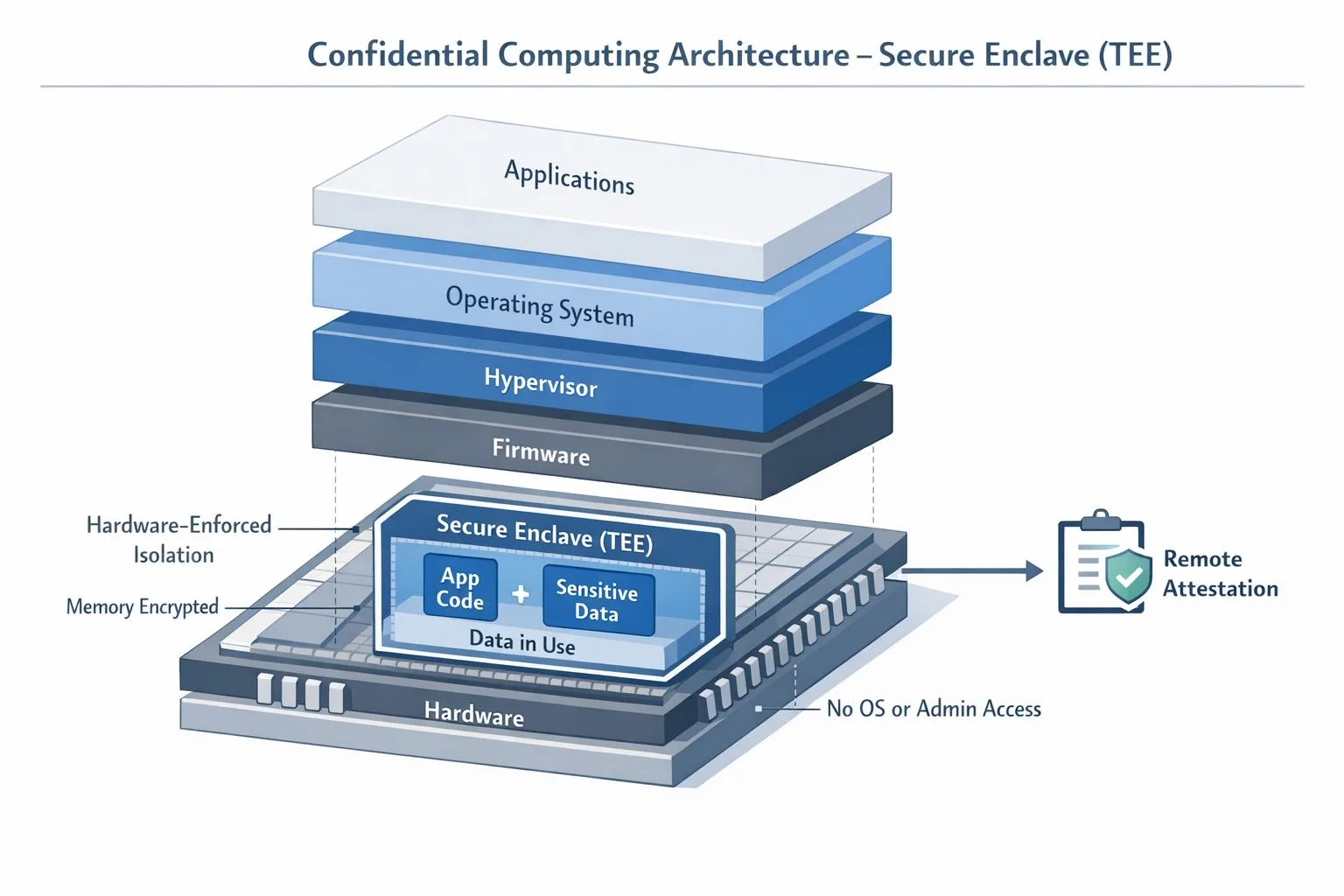
A TEE creates an isolated environment within supported hardware where sensitive data and application code can be processed with additional confidentiality and integrity protections.
Here is a simplified explanation of how the process works.
Confidential Computing in Cloud Security: Protecting Data in Use (2026 Guide)
Step 1: Sensitive Data Enters the System
A business application receives information that requires processing.
This could include:
Customer financial records.
Medical information.
Employee data.
Business analytics.
Confidential AI training datasets.
The application prepares the information for processing inside a supported confidential computing environment.
Step 2: A Trusted Execution Environment Is Created
The hardware establishes an isolated processing area known as a Trusted Execution Environment.
This environment is designed to separate sensitive workloads from other software and processes running on the same infrastructure.
The isolation helps reduce the ability of unauthorized software or privileged infrastructure components to access protected information.
Step 3: Data Is Processed in the Protected Environment
The application performs its required operations inside the TEE.
Depending on the hardware and implementation, sensitive information can remain protected through hardware-backed memory encryption and isolation mechanisms.
For example, a financial application might calculate transaction totals or analyze confidential account information inside the protected environment.
Step 4: Remote Attestation Verifies the Environment
Remote attestation is an important feature of confidential computing.
It allows an authorized party to verify information about the security state and configuration of a Trusted Execution Environment before releasing sensitive data or cryptographic keys.
This verification helps establish whether the workload is running in an expected and trusted environment.
Step 5: Processing Results Are Delivered
After the computation is completed, the application returns the required output to the authorized system.
The business can use the results for reporting, analytics, transactions, or other operational activities.
The goal is to protect sensitive information throughout the processing operation while allowing applications to perform their required functions.
What Are the Main Components of Confidential Computing?
Confidential computing relies on several technical components that work together to create protected processing environments.
Component | Purpose |
|---|---|
Trusted Execution Environment (TEE) | Creates an isolated environment for sensitive processing |
Hardware-based isolation | Separates protected workloads from other system components |
Memory encryption | Helps protect sensitive information in memory |
Remote attestation | Verifies the security state of the protected environment |
Cryptographic keys | Control access to protected information |
Secure boot and firmware | Help establish a trusted foundation for system startup |
1. Trusted Execution Environment (TEE)
A Trusted Execution Environment is a protected area supported by hardware that provides security guarantees for sensitive code and data.
Its primary security objectives include:
Data confidentiality.
Data integrity.
Code integrity.
A TEE helps prevent unauthorized entities outside the protected environment from reading or modifying sensitive workloads.
2. Hardware-Based Isolation
Hardware-based isolation separates confidential workloads from other applications and system components.
This reduces reliance on software-only security controls and helps protect information against certain attacks involving operating systems, hypervisors, or privileged infrastructure components.
3. Memory Encryption
Data must be available in memory when applications process it.
Memory encryption helps protect sensitive information stored in system memory from unauthorized access, depending on the hardware architecture and implementation.
4. Remote Attestation
Remote attestation provides cryptographic evidence about a protected computing environment.
Businesses can use attestation policies to verify whether an environment meets their security requirements before allowing access to sensitive workloads.
5. Cryptographic Key Management
Cryptographic keys are essential for protecting sensitive information.
Confidential computing implementations can integrate with key management systems to control when and where encryption keys are released.
This helps ensure that only approved workloads can access protected information.
Confidential Computing vs Traditional Data Encryption
One of the most important aspects of confidential computing is how it complements traditional encryption.
Businesses generally need to protect data in three different states:
Data at rest: Information stored in databases, hard drives, or cloud storage.
Data in transit: Information transferred between applications, servers, and networks.
Data in use: Information actively processed by applications or computing systems.
Traditional encryption technologies help protect the first two states. Confidential computing focuses on strengthening protection for the third.
Servers - Unified Computing - Cisco Confidential Computing Overview White Paper - Cisco
Security approach | What it protects | Example |
|---|---|---|
Encryption at rest | Stored information | Encrypted customer database |
Encryption in transit | Information moving between systems | HTTPS and TLS connections |
Confidential computing | Sensitive processing workloads | Financial calculations inside a TEE |
These approaches are complementary rather than competing technologies.
For example, an enterprise application can encrypt customer information in its database, transfer it through secure network connections, and process sensitive records inside a confidential computing environment.
This creates a more comprehensive data protection strategy.
Key Benefits of Confidential Computing for Businesses
Confidential computing offers several advantages for organizations that process sensitive information or operate in security-conscious industries.
1. Improved Data Privacy
Data privacy is a major concern for organizations handling personal, financial, and confidential business information.
Confidential computing helps protect sensitive data during processing by isolating workloads within hardware-backed environments.
This can reduce exposure to unauthorized access from other software components and certain privileged infrastructure actors.
2. Enhanced Cloud Security
Businesses increasingly use cloud infrastructure to host applications, store information, and manage digital operations.
However, cloud security involves more than protecting storage and network connections.
Confidential computing adds another protection layer by helping secure sensitive workloads during execution.
It is particularly useful when organizations need stronger security assurances while processing confidential information on shared infrastructure.
3. Protection Against Insider Threats
Insider threats can originate from employees, administrators, contractors, or individuals with privileged access to IT systems.
Confidential computing can reduce the ability of certain privileged infrastructure users to inspect sensitive workloads.
However, it does not eliminate all insider risks. Authorized application users, compromised credentials, malicious application code, and improperly configured access policies still require attention.
4. Secure Data Collaboration
Organizations sometimes need to analyze information from multiple sources without exposing the underlying datasets to one another.
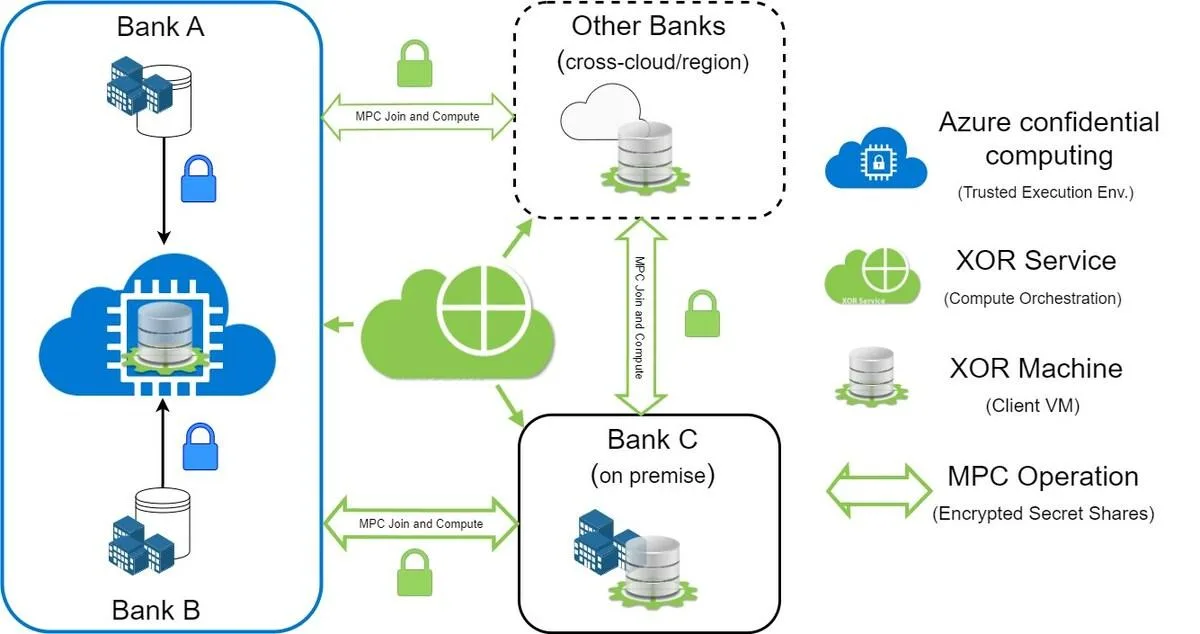
For example, two financial institutions may want to compare fraud patterns without directly sharing their complete customer databases.
Confidential computing can support these types of collaborative workloads by processing sensitive information inside protected environments.
5. Better AI Workload Protection
AI systems process large amounts of information, including proprietary datasets, business documents, and customer information.
Confidential computing can help protect:
Sensitive AI input data.
Proprietary machine learning models.
Model inference workloads.
Confidential business prompts.
Certain AI training and analytics processes.
This is particularly relevant as organizations integrate generative AI into internal applications and customer-facing services.
6. Stronger Security Assurance
Remote attestation allows organizations to verify important characteristics of a protected environment before trusting it with sensitive workloads.
This can improve transparency and support security policies that require evidence about where and how confidential information is processed.
7. Support for Compliance and Data Governance
Organizations in regulated industries must consider how sensitive information is collected, processed, stored, and shared.
Confidential computing can support technical safeguards within a broader compliance strategy.
However, adopting this technology does not automatically make a business compliant with any particular law or regulation. Organizations must also address governance, access controls, data retention, documentation, and legal obligations.
Top Business Use Cases of Confidential Computing
Confidential computing has applications across industries where sensitive information needs additional protection during processing.
INPHER XOR INTEGRATES WITH MICROSOFT AZURE
Introducing Confidential Computing, powered by Evervault Enclaves — Blog — Evervault
Confidential Computing Meets AI: How Cube AI Protects Your LLM Prompts | Ultraviolet Blog
10
1. Banking and Financial Services
Financial institutions process highly sensitive information, including customer accounts, payment records, transaction histories, and financial reports.
Confidential computing can help protect these workloads while financial applications perform calculations and analytics.
Potential applications include:
Secure financial transaction processing.
Fraud detection and analytics.
Confidential credit risk analysis.
Secure collaboration between financial institutions.
Protection of sensitive customer information.
For example, a financial institution could process transaction patterns inside a protected environment to identify suspicious activity while reducing exposure of the underlying customer information.
2. Healthcare and Medical Systems
Healthcare organizations manage sensitive patient information that requires strong privacy and security controls.
Confidential computing can help protect medical information while healthcare applications perform processing and analysis.
Potential applications include:
Medical data analysis.
Patient record processing.
Secure research collaboration.
AI-assisted medical data analysis.
Confidential healthcare reporting.
For example, multiple healthcare research organizations may want to analyze combined datasets without unnecessarily exposing individual patient records to one another.
3. Artificial Intelligence and Machine Learning
AI development often involves processing valuable business datasets and proprietary machine learning models.
Confidential computing can help organizations protect these assets during certain AI operations.
Common use cases include:
Secure AI model inference.
Confidential machine learning.
Protected AI data processing.
Collaborative model development.
Sensitive document analysis.
Enterprise generative AI applications.
For example, a company could deploy an AI-powered document analysis system that processes confidential internal reports within a protected computing environment.
This can help reduce exposure of sensitive information to the underlying infrastructure.
4. Government and Public Sector
Government organizations handle sensitive citizen information, administrative records, and confidential operational data.
Confidential computing may help support secure digital services where sensitive workloads require stronger protection.
Potential applications include:
Secure citizen data processing.
Digital identity verification.
Confidential public-sector analytics.
Secure interdepartmental data collaboration.
Sensitive government application workloads.
5. Telecommunications
Telecommunications companies manage customer information, network operations, usage records, and other sensitive data.
Confidential computing can help protect selected workloads involving customer analytics, network data, and collaborative processing.
6. E-Commerce and Retail
E-commerce businesses process customer profiles, payment information, purchasing patterns, and business analytics.
Confidential computing can provide additional protection for selected workloads involving sensitive customer and commercial information.
Examples include:
Secure customer analytics.
Payment-related data processing.
Fraud detection.
Customer behavior analysis.
Confidential retail intelligence.
7. Enterprise Software and Business Applications
Modern enterprise applications connect different business departments through centralized software platforms.
These systems often process confidential information related to employees, customers, suppliers, finance, and operations.
Confidential computing can help protect selected processing workloads within:
Enterprise Resource Planning (ERP) systems.
Customer Relationship Management (CRM) platforms.
Human Resource Management Systems.
Business intelligence applications.
Financial management software.
Enterprise reporting platforms.
Businesses developing specialized enterprise platforms can also explore custom software development to build applications around their operational and security requirements.
Confidential Computing in Cloud Environments
Cloud computing is one of the most important areas where confidential computing can provide additional value.
Organizations use cloud infrastructure to run websites, business applications, databases, AI workloads, and enterprise systems.
However, some organizations have security concerns about processing sensitive information on infrastructure that they do not physically own or directly manage.
Confidential computing helps address part of this challenge through hardware-based workload isolation.
How Does Confidential Computing Improve Cloud Security?
Confidential computing can strengthen cloud security in several ways:
Protecting sensitive workloads during processing.
Reducing exposure to certain privileged infrastructure users.
Supporting verification through remote attestation.
Helping protect confidential application memory.
Supporting secure processing of regulated information.
Enabling selected workloads to operate in lower-trust infrastructure environments.
Examples of Cloud Confidential Computing Platforms
Several major technology providers offer confidential computing capabilities.
Provider | Relevant technology |
|---|---|
Microsoft Azure | Azure Confidential Computing |
Google Cloud | Confidential Computing and Confidential VMs |
AWS | AWS Nitro Enclaves |
IBM Cloud | IBM Cloud Confidential Computing |
These platforms use different architectures and capabilities. Not every service provides identical protections or supports the same workloads.
Businesses should evaluate the available hardware, supported applications, attestation mechanisms, deployment requirements, and security guarantees before selecting a solution.
For technical information, explore the official documentation:
Confidential Computing and AI Security: Why They Matter Together
Artificial intelligence is changing how businesses analyze information, automate processes, and interact with customers.
However, enterprise AI systems often require access to confidential business data.
For example, an organization might use AI to:
Analyze internal financial reports.
Review confidential contracts.
Process customer support conversations.
Generate business forecasts.
Analyze employee information.
Support automated decision-making.
This creates a challenge: how can organizations use AI capabilities while maintaining stronger control over sensitive information?
Confidential computing can help address part of this challenge.
Protecting Sensitive AI Data
When AI workloads run inside supported confidential computing environments, hardware-backed isolation can help protect data during processing.
This is particularly valuable for organizations that want to use AI without unnecessarily exposing sensitive input data to infrastructure operators.
Protecting Proprietary AI Models
Businesses may invest significant resources in developing proprietary AI models, algorithms, and machine learning systems.
Confidential computing can help protect selected model assets while they are being executed.
Supporting Secure AI Collaboration
Different organizations may want to collaborate on AI projects without directly exposing their private datasets.
Confidential computing can support selected collaborative analytics and machine learning workloads in protected environments.
However, businesses should remember that confidential computing does not automatically prevent AI-related risks such as prompt injection, insecure application integrations, data leakage through outputs, or compromised user accounts.
A complete AI security strategy still requires application-level protections, access management, monitoring, and governance.
What Is the Difference Between Confidential Computing and Traditional Cloud Security?
Traditional cloud security and confidential computing address different but complementary security requirements.
Traditional cloud security includes controls such as:
Network firewalls.
Identity and access management.
Encryption.
Intrusion detection.
Security monitoring.
Backup and disaster recovery.
Confidential computing focuses specifically on protecting selected data and workloads during processing through hardware-based trusted environments.
Feature | Traditional cloud security | Confidential computing |
|---|---|---|
Network protection | Yes | Not its primary purpose |
Storage encryption | Commonly supported | Can complement it |
Data-in-transit protection | Commonly supported | Can complement it |
Data-in-use protection | Depends on implementation | Primary objective |
Hardware isolation | Not always included | Core capability |
Remote attestation | Not generally a standard cloud security feature | Important capability |
The strongest approach is usually to combine confidential computing with established cloud security controls rather than treating it as a replacement.
What Are the Challenges of Confidential Computing?
Although confidential computing offers important security advantages, organizations should understand its limitations before adopting it.
1. Implementation Complexity
Deploying confidential computing may require changes to application architecture, infrastructure configuration, key management, and deployment processes.
Applications may need to be modified to support specific TEE technologies.
Businesses should evaluate technical compatibility before beginning implementation.
2. Hardware Compatibility
Confidential computing depends on supported hardware and platform capabilities.
Not every processor, cloud service, or application supports the same confidential computing features.
Organizations must confirm compatibility with their existing technology environment.
3. Performance Considerations
Hardware-based isolation and additional security mechanisms may introduce performance or operational overhead, depending on the workload and implementation.
For this reason, organizations should benchmark applications before moving production workloads into confidential environments.
4. Development and Operational Costs
Confidential computing may require investment in:
Supported hardware or cloud services.
Application development.
Security engineering.
Testing and validation.
Key management.
Monitoring and maintenance.
The overall cost depends on the workload, infrastructure, deployment model, and security requirements.
5. Limited Application Support
Some applications may not work directly within a particular confidential computing environment.
Organizations may need to modify software components, redesign workloads, or select compatible infrastructure.
6. Additional Security Risks Still Exist
Confidential computing is not a complete cybersecurity solution.
Potential risks can include:
Vulnerabilities in application code.
Side-channel attacks.
Compromised credentials.
Insecure software dependencies.
Misconfigured attestation policies.
Firmware and hardware vulnerabilities.
Data exposure through application outputs.
Businesses must continue using layered security controls, regular testing, and vulnerability management.
How to Implement Confidential Computing in a Business
Successful implementation requires more than selecting a cloud provider or enabling a hardware security feature.
Organizations should first identify which workloads require stronger protection and then choose an architecture that meets their requirements.
Confidential Computing Enclave: Secure Genomic AI | Inference Systems
Here is a practical implementation process.
Step 1: Identify Sensitive Data
Start by identifying the information your business needs to protect.
Examples include:
Financial information.
Customer records.
Employee information.
Proprietary business data.
Intellectual property.
AI training datasets.
Classify information according to its sensitivity and business importance.
Step 2: Evaluate Existing Infrastructure
Review your current infrastructure and identify where sensitive information is processed.
Consider:
Cloud platforms.
Application servers.
Databases.
AI systems.
Enterprise software.
Third-party integrations.
This helps determine which workloads could benefit from confidential computing.
Step 3: Define Security Requirements
Establish what your organization expects confidential computing to protect.
Important considerations include:
Data confidentiality.
Code integrity.
Hardware isolation.
Remote attestation.
Encryption key management.
Access control.
Monitoring and auditing.
Your requirements should be based on a realistic threat model rather than assuming every workload needs the same protection.
Step 4: Select a Suitable Platform
Evaluate available confidential computing solutions from cloud providers and hardware vendors.
Compare:
Supported TEE technologies.
Application compatibility.
Attestation capabilities.
Performance requirements.
Key management integrations.
Infrastructure costs.
Data residency requirements.
Step 5: Develop or Adapt Applications
Some applications may require modifications to operate inside a confidential computing environment.
Developers should evaluate application architecture, dependencies, memory requirements, and integration points.
Organizations building new digital platforms can consider web application development or custom software solutions designed around their business and security requirements.
Step 6: Configure Access and Key Management
Establish strict policies governing access to confidential workloads.
Configure:
Authentication mechanisms.
Authorization rules.
Cryptographic key management.
Attestation verification.
Secure secrets management.
Administrative permissions.
Only approved and verified workloads should receive access to sensitive resources.
Step 7: Test and Validate the Environment
Before production deployment, conduct security and performance testing.
Important activities include:
Application compatibility testing.
Attestation validation.
Security configuration reviews.
Performance benchmarking.
Vulnerability assessments.
Access-control testing.
Step 8: Monitor and Maintain the System
Confidential computing environments require continuous management.
Organizations should regularly review security updates, platform configurations, application dependencies, attestation policies, and operational performance.
A structured maintenance process helps ensure that security controls remain effective as infrastructure and business requirements evolve.
Confidential Computing Considerations for Businesses in Qatar
Qatar is investing in digital transformation across financial services, healthcare, telecommunications, government services, retail, and other business sectors.
As organizations adopt cloud platforms, AI-powered applications, and connected enterprise systems, protecting sensitive information becomes increasingly important.
Confidential computing may be relevant to businesses in Qatar that process information requiring additional privacy and security safeguards.
1. Financial Institutions and FinTech Companies
Financial organizations handle sensitive customer records, transaction information, and financial analytics.
Confidential computing can help protect selected financial processing workloads and support secure data collaboration.
2. Healthcare Organizations
Healthcare providers and medical technology companies process confidential patient information.
Protected computing environments may support secure medical analytics, research collaboration, and selected AI-powered healthcare applications.
3. Government and Public Sector Organizations
Government platforms often process citizen information and confidential administrative records.
Confidential computing can support selected workloads where hardware-backed isolation and verifiable execution environments are important.
4. Businesses Using Cloud Applications
Companies in Qatar increasingly depend on cloud-based business applications to manage finance, HR, customer relationships, inventory, and operational activities.
Confidential computing can complement existing cloud security controls where sensitive data processing requires additional protection.
5. Companies Developing AI Solutions
Businesses developing AI-powered products may need to process proprietary information, customer records, and confidential documents.
Confidential computing can help strengthen the security of selected AI workloads.
Qatar Data Protection Considerations
Organizations operating in Qatar should also consider applicable privacy and cybersecurity requirements.
The Qatar Personal Data Privacy Protection Law (Law No. 13 of 2016) establishes a legal framework for protecting personal data.
Businesses should evaluate their data processing activities, security controls, responsibilities, and applicable regulatory requirements before adopting new computing technologies.
Confidential computing can contribute to technical data protection measures, but it does not replace legal compliance, privacy governance, or organizational security policies.
Confidential Computing vs Homomorphic Encryption
Confidential computing and homomorphic encryption are both approaches to protecting sensitive information during computation, but they work differently.
Confidential computing generally uses hardware-based Trusted Execution Environments to isolate sensitive processing.
Homomorphic encryption allows certain computations to be performed directly on encrypted data without first decrypting it into its ordinary readable form.
Comparison | Confidential computing | Homomorphic encryption |
|---|---|---|
Main approach | Hardware-based isolation | Cryptographic computation |
Processing environment | Trusted Execution Environment | Encrypted data operations |
Hardware dependency | Typically relies on supported hardware | Not inherently dependent on TEEs |
Performance | Depends on hardware and workload | Can be computationally intensive |
Main purpose | Protect data and code during isolated execution | Perform supported operations on encrypted information |
Use cases | Secure cloud workloads and AI processing | Privacy-preserving analytics and encrypted computations |
Neither approach is universally better.
The right choice depends on the type of computation, performance requirements, threat model, and security objectives.
Some organizations may also combine different privacy-enhancing technologies for stronger protection.
What Technologies Are Used in Confidential Computing?
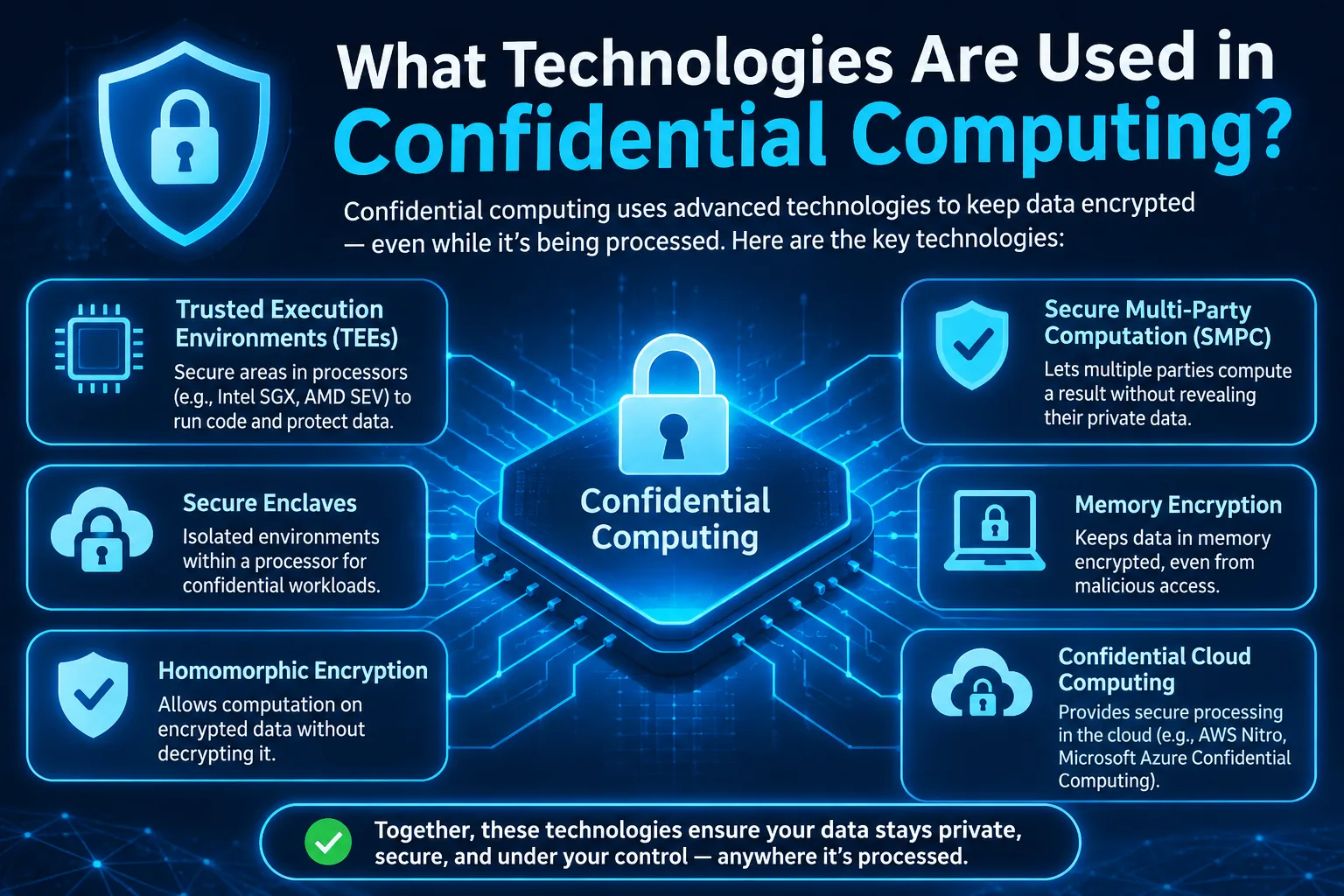
Several hardware and software technologies support confidential computing.
Intel SGX
Intel Software Guard Extensions (SGX) is a technology designed to create protected memory regions, known as enclaves, for sensitive application code and data.
It helps applications isolate selected operations from other software running on the same system.
AMD SEV
AMD Secure Encrypted Virtualization (SEV) provides hardware-assisted memory protection for virtual machines.
It is designed to help isolate virtual machine memory from the hypervisor and other software components.
ARM TrustZone
ARM TrustZone is a hardware-based security architecture that separates secure and non-secure execution environments.
It is used in various embedded, mobile, and connected-device applications.
AWS Nitro Enclaves
AWS Nitro Enclaves enables organizations to create isolated computing environments for processing highly sensitive information.
It can help protect sensitive workloads from the broader application environment.
Google Cloud Confidential Computing
Google Cloud offers confidential computing capabilities that help protect data in use through hardware-based trusted execution environments.
These capabilities support selected workloads running on confidential virtual machines and related services.
Businesses should review current vendor documentation because supported hardware, available features, and platform configurations vary.
How to Choose the Right Confidential Computing Solution
Selecting a suitable confidential computing platform requires evaluating business objectives, technical requirements, and security expectations.
Before making a decision, consider the following factors.
Selection factor | What to evaluate |
|---|---|
Security requirements | Which threats and sensitive workloads must be addressed? |
Hardware compatibility | Does the platform support your required TEE technology? |
Application compatibility | Can existing applications run in the environment? |
Cloud integration | Does it work with your current cloud infrastructure? |
Attestation | Can the environment be verified before sensitive data is released? |
Performance | Can it handle expected processing workloads? |
Scalability | Can it support future business growth? |
Cost | What are the infrastructure, development, and maintenance expenses? |
Compliance | Does the architecture support your applicable security and privacy obligations? |
Should Businesses Build Custom Confidential Computing Applications?
Some organizations may require custom applications to support specific confidential computing workflows.
For example, a financial organization might need a secure analytics platform, while an enterprise business may require a protected environment for confidential AI document processing.
In these situations, custom application development can help align software architecture with the organization's operational and security requirements.
A suitable development partner should understand application security, cloud infrastructure, system integrations, data management, and deployment requirements.
Common Mistakes Businesses Should Avoid
Organizations planning to adopt confidential computing should avoid several common implementation mistakes.
1. Treating Confidential Computing as a Complete Security Solution
Confidential computing provides additional protection for selected workloads, but it does not eliminate every cybersecurity risk.
Businesses must continue using encryption, access management, endpoint security, monitoring, and application testing.
2. Ignoring Application Security
A protected execution environment cannot automatically fix insecure application code.
Developers must follow secure coding practices and test applications for vulnerabilities.
3. Choosing Technology Without Evaluating Compatibility
Not every application supports every confidential computing architecture.
Businesses should evaluate hardware, software, deployment requirements, and integration compatibility before choosing a solution.
4. Neglecting Remote Attestation
Attestation is an important part of establishing trust in a confidential computing environment.
Organizations should define verification policies and ensure sensitive information is not released to environments that fail their security requirements.
5. Overlooking Key Management
Poorly managed cryptographic keys can weaken the overall security architecture.
Businesses should establish secure key storage, rotation, authorization, and access policies.
6. Failing to Monitor Performance
Confidential computing may introduce additional operational considerations.
Organizations should monitor resource utilization, application response times, infrastructure performance, and security events after deployment.
The Future of Confidential Computing in 2026 and Beyond
Confidential computing is becoming increasingly relevant as organizations adopt more advanced cloud infrastructure, AI systems, and data-driven business applications.
Several developments are likely to influence its adoption.
1. Growth of Confidential AI
Organizations want to use advanced AI capabilities while protecting confidential datasets, model assets, and business information.
Confidential computing can support selected AI workloads that require stronger protection during processing.
2. Increased Cloud Security Requirements
As businesses move sensitive applications to cloud environments, they may demand stronger assurances about how their information is handled.
Hardware-based isolation and remote attestation can help address some of these requirements.
3. Secure Collaboration Between Organizations
Businesses increasingly collaborate with external partners, research institutions, and service providers.
Confidential computing may help enable certain collaborative analytics and data processing activities without requiring participants to expose all their underlying information.
4. Greater Focus on Data Privacy
Privacy requirements and customer expectations continue to influence how organizations design their digital platforms.
Confidential computing can become one component of broader privacy-focused infrastructure strategies.
5. Expansion of Confidential Computing Across Infrastructure
Confidential computing is not limited to traditional cloud servers.
Its concepts can also apply to edge computing, specialized processors, and other supported infrastructure environments.
As hardware and software capabilities evolve, businesses may have more options for protecting sensitive workloads across different deployment models.
How Galaxium Coding Can Help Businesses Build Secure Digital Solutions
Adopting advanced security technologies requires a combination of software engineering, infrastructure planning, and application-level security.
Businesses need digital platforms that can support their operational requirements while considering data protection, scalability, and integration needs.
Galaxium Coding is a technology company in Qatar focused on digital solutions and software development for businesses.
Organizations planning digital transformation projects can explore solutions involving:
Custom business software.
Web application development.
Mobile application development.
Cloud infrastructure and DevOps.
Business automation.
Enterprise application integrations.
AI-powered business solutions.
For companies exploring confidential computing, application architecture and infrastructure compatibility are important starting points. The appropriate technical approach depends on the workload, supported hardware, security requirements, and deployment environment.
Whether you are planning a new enterprise application or improving an existing digital platform, choosing the right development architecture can help establish a stronger foundation for future security requirements.
Explore Galaxium Coding's software development services or contact the team to discuss your business technology requirements.
Final Thoughts
Confidential computing is an important development in modern data security because it addresses a stage of the data lifecycle that traditional security approaches do not always adequately protect: active processing.
By using hardware-based Trusted Execution Environments, isolation mechanisms, and remote attestation, organizations can strengthen the protection of sensitive applications and information while they are being processed.
Its applications extend across financial services, healthcare, artificial intelligence, government, telecommunications, and enterprise software.
However, confidential computing should be part of a broader cybersecurity strategy rather than treated as a standalone solution.
For businesses in Qatar and beyond, understanding this technology can help inform future decisions about cloud infrastructure, AI adoption, enterprise software, and sensitive data management.
As digital systems become more interconnected, protecting information throughout its entire lifecycle will remain an important business priority.
Frequently Asked Questions (FAQs)
1. What is confidential computing in simple terms?
Confidential computing is a security technology that protects sensitive data while applications process it. It uses hardware-based Trusted Execution Environments to isolate workloads and help prevent unauthorized access to information during computation.
2. How does confidential computing work?
Confidential computing works by running sensitive applications and data inside a hardware-protected Trusted Execution Environment. It uses isolation, security mechanisms, and remote attestation to help protect information and verify the computing environment.
3. What is a Trusted Execution Environment (TEE)?
A Trusted Execution Environment is an isolated computing environment supported by hardware. It is designed to protect the confidentiality and integrity of sensitive data and code during execution.
4. Why do businesses need confidential computing?
Businesses may need confidential computing to strengthen data protection, reduce exposure during processing, support secure cloud workloads, protect AI applications, and improve security assurances when handling sensitive information.
5. Is confidential computing the same as encryption?
No. Traditional encryption protects information while it is stored or transmitted. Confidential computing focuses on protecting sensitive workloads during processing using hardware-based trusted environments. Both approaches can work together.
6. What industries use confidential computing?
Industries that may benefit include:
Banking and financial services.
Healthcare.
Government.
Telecommunications.
Retail and e-commerce.
Artificial intelligence.
Enterprise software.
7. Does confidential computing improve cloud security?
Yes. Confidential computing can strengthen cloud security by protecting selected workloads during processing through hardware-based isolation and attestation. It complements existing cloud security controls rather than replacing them.
8. Can confidential computing protect AI applications?
Yes. It can help protect sensitive data and selected AI workloads during processing. It may also support protection of proprietary models and confidential AI inference environments, depending on the platform and implementation.
9. What is the difference between confidential computing and homomorphic encryption?
Confidential computing generally uses hardware-based Trusted Execution Environments to isolate processing. Homomorphic encryption allows certain computations to be performed on encrypted information without first decrypting it into its ordinary readable form.
10. Is confidential computing suitable for small businesses?
It can be suitable for small businesses if they process sensitive information or have specific security requirements. However, implementation costs, platform compatibility, and operational complexity should be evaluated before adoption.
11. Does confidential computing guarantee complete data security?
No. It provides additional protection for data during processing, but it does not eliminate every security risk. Application vulnerabilities, compromised credentials, side-channel attacks, and poor configuration can still create security problems.
12. What is remote attestation in confidential computing?
Remote attestation is a verification process that provides cryptographic evidence about a Trusted Execution Environment. It helps organizations confirm that a computing environment meets expected security requirements before releasing sensitive data or keys.
13. Is confidential computing useful for businesses in Qatar?
Yes. It may benefit financial institutions, healthcare providers, government organizations, technology companies, and businesses using cloud-based applications or AI systems to process sensitive information.
14. What are the main challenges of confidential computing?
The main challenges include implementation complexity, hardware compatibility, performance considerations, development costs, limited application support, and the need for additional security management.
15. What is the future of confidential computing?
Confidential computing is expected to remain relevant as businesses adopt AI, cloud computing, secure data collaboration, and privacy-focused digital infrastructure. Its future development will depend on hardware improvements, platform support, and wider enterprise adoption.