Website Redesign Cost in Qatar: What Businesses Should Know
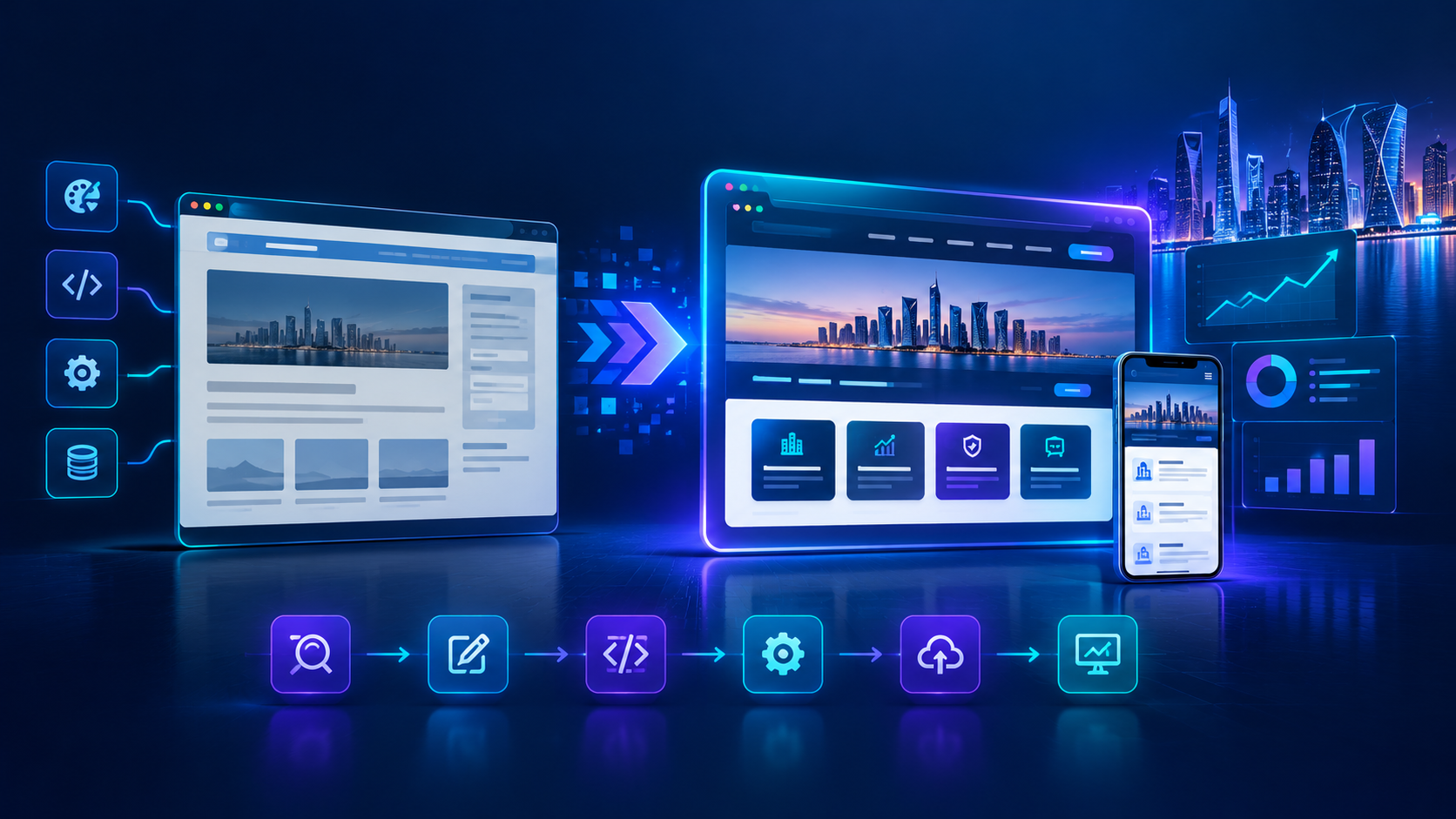
A successful website redesign combines modern UI/UX, responsive development, technical improvements, and SEO preservation to support business goals.
Website Redesign Cost in Qatar: What Businesses Should Know
A website redesign is more than changing colours, updating images, or choosing a modern template. For a business, it can involve improving the user experience, restructuring pages, rebuilding outdated functionality, protecting existing search rankings, and creating a website that turns more visitors into enquiries or customers.
For businesses in Qatar, the cost of a website redesign depends on the website's current condition, the scope of the changes, and the business goals behind the project. Updating a few landing pages is very different from redesigning a bilingual corporate website, migrating a large content library, or rebuilding an e-commerce platform.
There is no single official price for website redesign in Qatar. Publicly available 2026 website pricing guides show substantial variation across project types and providers. Some published estimates put smaller business websites in the low thousands of Qatari riyals, while more complex websites can cost tens of thousands or more. These are market references, not verified averages or fixed quotations for redesign projects. See published Qatar website pricing guidance for additional context.
This guide explains the main cost factors, how to plan a realistic budget, which expenses to include, and how to evaluate a redesign proposal before committing to a provider.
How Much Does Website Redesign Cost in Qatar?
Website redesign costs vary according to the work required. A visual refresh may reuse the existing platform and content, while a full redesign may require new layouts, development, integrations, content migration, and technical SEO work.
The following figures are illustrative planning ranges in QAR, not verified market averages or supplier quotations. They are suggested budgeting bands for discussing a potential project; actual quotations may fall outside them.
Redesign project type | Illustrative budget (QAR) | Typical scope |
|---|---|---|
Small website refresh | 2,000–5,000 | Visual updates, limited page changes, basic usability improvements |
Small business website redesign | 5,000–12,000 | Updated layouts, mobile improvements, forms, and essential SEO checks |
Corporate website redesign | 12,000–30,000 | Multiple page templates, improved navigation, content restructuring, and CMS updates |
Bilingual corporate redesign | 15,000–40,000+ | Arabic and English layouts, right-to-left support, content migration, and language-specific testing |
E-commerce redesign | 20,000–60,000+ | Product pages, category navigation, checkout improvements, and payment or shipping integrations |
Complex portal or web application redesign | 30,000–100,000+ | Custom dashboards, user accounts, integrations, permissions, and workflow changes |
These categories overlap because project complexity matters more than the label. A bilingual corporate website with hundreds of pages may require more work than a smaller website with a custom design.
Before using these figures as a budget, ask providers to define the deliverables, exclusions, and assumptions behind their proposals.
What Is Included in a Website Redesign?
A well-scoped redesign can include several separate workstreams. Understanding them helps explain why two quotations for the same website may differ considerably.
1. Website Audit and Discovery
Before changing the design, a team should examine the existing website and identify what works, what needs improvement, and what must be preserved.
A discovery phase may include:
Reviewing the current page structure and navigation.
Identifying usability issues and outdated layouts.
Reviewing mobile performance and accessibility.
Checking existing forms, integrations, and business workflows.
Reviewing important landing pages and organic search traffic.
Identifying outdated content and duplicate pages.
Establishing business objectives and measurable success criteria.
A simple website may need only a limited review. A large website with multiple systems or business departments may require more extensive discovery.
2. UI/UX Design
User interface (UI) design covers the visual presentation of the website. User experience (UX) design focuses on how visitors navigate, understand information, and complete tasks.
Redesign work may include new page layouts, navigation structures, typography, visual hierarchy, calls to action, and responsive components.
For example, a company may have a services page that receives traffic but generates few enquiries. A redesign could make service information easier to scan, improve the placement of contact options, and simplify the enquiry form.
The cost depends on how many unique layouts need to be designed, the number of review rounds, and whether the provider is creating a custom design or adapting an existing theme.
3. Website Development
Once designs are approved, developers implement them using the existing CMS, a website platform, or a custom technology stack.
Development may involve:
Rebuilding page templates.
Improving responsive layouts.
Updating navigation and menus.
Reworking forms and interactive components.
Updating the content management system.
Integrating third-party tools.
Improving loading performance.
Testing compatibility across browsers and devices.
A redesign that retains the existing platform and technical architecture may be less expensive than one requiring a complete rebuild.
Businesses that need new functionality as part of the project may also consider web application development where a conventional marketing website is no longer sufficient.
4. Content Updates and Migration
Website redesign projects often reveal content that needs rewriting, consolidating, translating, or migrating.
Typical tasks include:
Updating company information and service descriptions.
Rewriting page headings and calls to action.
Moving blog articles and resources.
Updating images and downloadable documents.
Migrating customer-facing content into a new CMS.
Reviewing internal links and page relationships.
Content migration is especially important for websites with many pages. Copying content without checking formatting, links, metadata, and media files can introduce problems after launch.
If a business needs new copywriting, professional photography, Arabic translation, or extensive editing, these should be identified as separate deliverables in the quotation.
5. SEO Preservation and Technical Checks
A redesign can affect search visibility if URLs change, important content disappears, internal links break, or technical settings are misconfigured.
SEO-related redesign work may include:
Recording existing URLs before development.
Preserving useful content and search intent.
Reviewing page titles and meta descriptions.
Mapping changed URLs to relevant destinations.
Implementing appropriate redirects.
Updating internal links and canonical tags.
Checking XML sitemaps and indexing directives.
Testing structured data where relevant.
Monitoring important landing pages after launch.
Google's website migration guidance explains important considerations when URLs change. Although a redesign does not always involve a domain migration, the same principle applies: changes to URLs and page content should be planned carefully.
SEO preservation should be part of the redesign scope, not an afterthought once the new website is live.
The Main Factors That Affect Website Redesign Cost
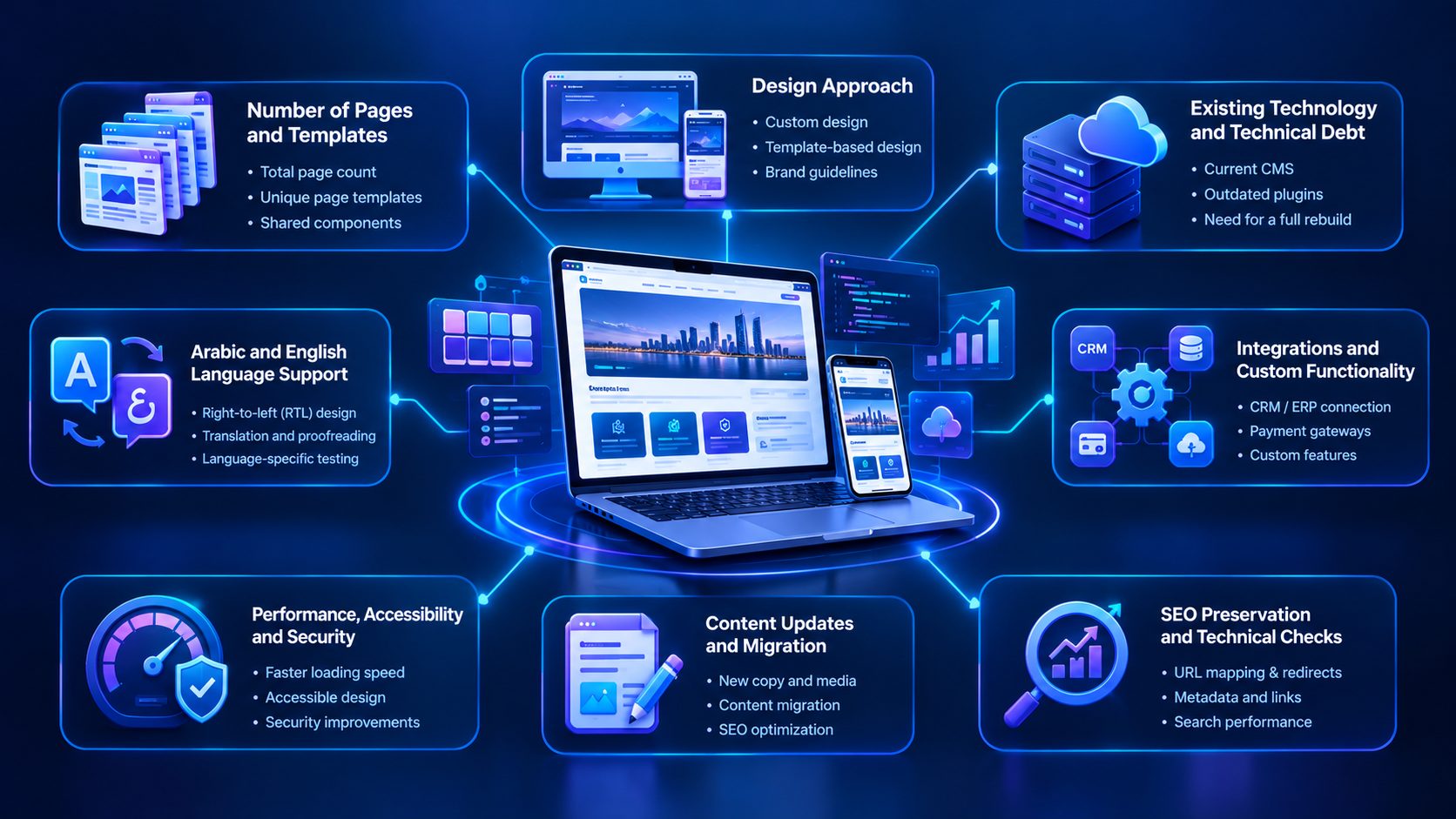
Number of Pages and Unique Templates
A website with five pages usually requires less work than a large corporate website with dozens of service pages, resource articles, and location-specific landing pages.
However, page count alone is not enough to determine cost. Twenty pages using a small number of shared templates may be simpler to redesign than ten pages with unique functionality.
Ask the provider how many unique page templates, components, and content types are included.
Custom Design Versus Template-Based Redesign
A template-based redesign generally starts from an existing design system and modifies it to suit the business. This can reduce design time when the requirements fit the template.
A custom redesign involves more tailored layouts and components. It may be appropriate when the existing brand, user journey, or functionality cannot be accommodated by a standard theme.
Neither option is automatically better. The right choice depends on the required flexibility, expected lifespan, maintenance needs, and available budget.
Existing Technology and Technical Debt
Some websites can be redesigned within their existing CMS. Others rely on outdated plugins, unsupported software, fragile custom code, or integrations that are difficult to maintain.
If the current technology creates security, performance, or compatibility problems, rebuilding parts of the system may be necessary.
A provider should explain whether the proposal covers a visual redesign, a technical upgrade, or a complete rebuild. These are different scopes and should not be treated as interchangeable.
Arabic and English Language Support
For many businesses in Qatar, a bilingual website may be an important requirement.
Arabic support can involve more than translating English text. The website may need right-to-left layouts, appropriate typography, adjusted menus, language-specific forms, and separate testing for each language.
The budget may also need to cover translation, proofreading, and maintaining equivalent content across both languages.
The exact cost depends on the number of pages, the amount of content, the CMS, and whether both language versions are designed and tested from the beginning.
Integrations and Custom Functionality
A basic contact form is relatively straightforward compared with a website that connects to a CRM, ERP, booking system, payment gateway, inventory platform, or customer portal.
Integration costs depend on API availability, data mapping, authentication, error handling, testing, and the complexity of the business rules.
For example, a real estate company might want every website enquiry to create a CRM lead, capture the requested property, and notify the appropriate salesperson. A redesign that includes this workflow requires more than a visual update.
Businesses planning these changes should define the desired workflow before requesting a final quote.
Performance, Accessibility, and Security
A redesign may include improvements to page speed, keyboard navigation, form usability, image optimization, software dependencies, and security controls.
The required effort depends on the existing website and the standards the business needs to meet.
Do not assume that a modern-looking design automatically delivers strong performance or accessibility. Ask how the provider will test the finished website and what acceptance criteria will be used.
Website Redesign Cost Breakdown: Where the Budget Goes
A useful quotation separates the project into understandable components instead of presenting one unexplained total.
Cost component | What to clarify |
|---|---|
Discovery and audit | Current-site review, requirements, content inventory, and project plan |
UI/UX design | Number of layouts, design concepts, and revision rounds |
Development | CMS changes, templates, responsive implementation, and functionality |
Content and translation | Copywriting, editing, migration, Arabic content, and media |
Integrations | CRM, ERP, booking, payments, and third-party services |
SEO migration | URL mapping, redirects, metadata, internal links, and technical checks |
Quality assurance | Browser, device, form, performance, and accessibility testing |
Launch and handover | Deployment, backups, training, and documentation |
Ongoing support | Maintenance, monitoring, updates, and support arrangements |
Not every project needs every component. A small refresh may require limited development and testing, while a complex redesign may need substantial work across all of them.
A good proposal identifies what is included, what is excluded, and which assumptions could change the final price.
Hidden Costs Businesses Should Budget For
The initial redesign quote is not necessarily the full cost of operating the website.
Domain and Hosting
The business may need to continue paying for its domain, hosting, email services, and related infrastructure. A platform change can also affect hosting requirements.
Confirm who owns the domain, who controls the hosting account, and whether ongoing fees are included.
CMS, Plugins, and Software Licences
Premium themes, plugins, stock media, analytics tools, and other software may require recurring subscriptions.
Ask which licences are included, who owns them, and what happens if the contract ends.
Content Production
A redesign can require new photography, video, illustrations, service copy, case studies, and translated content.
If these are not included in the quote, obtain a separate estimate before approving the project.
SEO and Analytics
Technical SEO setup does not guarantee higher rankings. Ongoing content improvements, search-performance monitoring, and analytics reviews may require a separate budget.
Ensure that analytics access and relevant historical data are preserved during the redesign.
Maintenance and Support
Websites need updates, backups, security monitoring, bug fixes, and occasional compatibility work.
Before signing, confirm whether the provider offers a maintenance plan, what it covers, and how additional work is charged.
Additional Revisions
A proposal may include only a limited number of design revisions. Major changes after approval can extend the timeline and increase costs.
Agree on the approval process and the procedure for handling changes outside the original scope.
How to Protect SEO During a Website Redesign
A redesign should improve the website without unnecessarily sacrificing its existing search visibility.
Step 1: Record the Existing Website
Create a list of current URLs and identify pages that attract relevant search traffic, generate enquiries, or serve important customers.
Review existing analytics and search-performance data where available.
Step 2: Preserve Useful Content
Do not remove valuable pages simply because they do not fit the new visual design. Determine whether each page should be retained, improved, consolidated, or redirected.
Step 3: Plan URL Changes
If a page URL must change, map the old address to the most relevant new destination and implement an appropriate permanent redirect.
Avoid redirecting every old URL to the homepage when a relevant replacement exists.
Step 4: Check Technical SEO
Review page titles, meta descriptions, canonical tags, robots directives, internal links, structured data, and XML sitemaps.
Ensure that staging or test environments are not accidentally made publicly indexable and that the live website is configured correctly at launch.
Step 5: Test Before Launch
Check important pages, forms, navigation, redirects, analytics, mobile layouts, and page performance.
Make sure search engines can access the intended public pages.
Step 6: Monitor After Launch
Review crawl errors, indexing, organic traffic, conversions, and key landing pages after deployment.
Some changes may require investigation and correction. A redesign cannot guarantee that rankings will remain unchanged, but careful planning reduces avoidable risks.
How to Reduce Website Redesign Costs Without Sacrificing Quality
Reducing cost should mean prioritizing the work that matters most, not removing essential testing or safeguards.
Keep What Already Works
If the current CMS, URL structure, or parts of the design remain suitable, preserving them may reduce unnecessary development.
Use evidence from customer feedback, analytics, and technical reviews to decide what genuinely needs to change.
Prioritize High-Value Pages
Start with pages that support the main business goals, such as core service pages, product pages, pricing information, and contact forms.
Less important pages can be updated in a later phase if the content and technical plan allow it.
Reuse Design Components
A consistent design system can reduce repeated work across page templates while keeping the website visually coherent.
Prepare Content Early
Providing approved copy, brand assets, images, and product information on time helps prevent delays and last-minute revisions.
Separate Essential Features From Future Improvements
Create a minimum launch scope and a roadmap for later enhancements. This can make the initial project more manageable without losing sight of long-term goals.
Compare Proposals Fairly
Request the same deliverables from every provider. Compare design, development, migration, integrations, testing, handover, support, and ownership terms—not only the headline price.

How to Choose a Website Redesign Company in Qatar
Selecting a provider involves more than finding the lowest quotation.
Review Relevant Experience
Ask to see examples of comparable websites and understand which services the provider actually delivered. Do not assume a portfolio item proves experience with every technology or integration.
You can review Galaxium Coding's projects and portfolio when evaluating its publicly presented work.
Ask About the Redesign Process
A clear process should explain discovery, design approval, development, testing, migration, launch, and post-launch support.
The provider should also explain how it handles unexpected technical problems and changes to scope.
Confirm Ownership and Access
The business should understand who owns the domain, website content, code, design assets, and paid licences.
Clarify access to the CMS, hosting, analytics, and other critical accounts before the project begins.
Request a Detailed Quote
Ask for a written breakdown of deliverables, timelines, payment milestones, exclusions, revisions, third-party costs, and support arrangements.
A transparent quotation makes it easier to compare providers and reduce disagreements later.
Discuss Measurable Outcomes
Define what the redesign is expected to improve. Depending on the business, these measures might include enquiry submissions, mobile usability, page speed, task completion, or the number of qualified leads.
The provider should explain how the results will be measured rather than promising guaranteed traffic or search rankings.
Website Redesign for Businesses in Qatar
Businesses in Qatar may have specific requirements involving Arabic and English content, regional customer journeys, local contact methods, and integration with existing business systems.
For example, a professional services company may need clearer service pages and enquiry forms, while an online retailer may need a more efficient product discovery and checkout experience.
Before starting, consider:
Whether the website needs Arabic and English versions.
Whether layouts and forms work correctly in both reading directions.
Whether the site needs local payment, booking, or customer-management integrations.
Whether the website collects personal information and needs appropriate privacy notices and data-handling controls.
Whether hosting, security, accessibility, and maintenance requirements are clearly defined.
Whether the content supports the search intent of the intended audience.
For data protection planning, businesses should consult the applicable requirements of Qatar's Personal Data Privacy Protection Law framework and obtain appropriate legal advice for their specific circumstances.
A redesign is a useful opportunity to address these requirements alongside usability and technical improvements.
Website Redesign Project Timeline
The timeline depends on the number of pages, review cycles, technical complexity, content readiness, and integration requirements.
As an illustrative planning guide, a small visual refresh may take a few weeks, while a corporate redesign may take several weeks to a few months. Complex e-commerce platforms or custom portals may require a longer phased project.
Typical stages include:
Discovery and requirements.
Content and SEO audit.
Wireframes and visual design.
Design review and approval.
Development and integration.
Content migration.
Testing and corrections.
Launch and post-launch monitoring.
Delays often occur when content approvals are late, requirements change after development begins, or third-party integrations prove more complex than expected.
Ask for a milestone-based plan that includes time for feedback and testing rather than relying on a launch date without defined deliverables.
Final Thoughts: Plan Your Website Redesign as a Business Investment
Website redesign cost in Qatar depends on what the business needs to change and how much technical work is involved. A focused visual refresh may require a modest budget, while a bilingual corporate website, integrated online store, or custom portal can require a much larger investment.
The most effective approach is to audit the current website, prioritize improvements, protect valuable content and SEO, define the required functionality, and compare detailed proposals.
Avoid choosing a provider based on price alone. A redesign should leave the business with a website that is easier to use, maintain, and improve—not simply one that looks newer.
Galaxium Coding offers web application development and custom software development services for businesses with broader digital requirements. To discuss your website goals and potential scope, contact Galaxium Coding.
Frequently Asked Questions
1. How much does a website redesign cost in Qatar?
There is no single standard price. A small refresh may cost a few thousand QAR, while corporate, bilingual, e-commerce, and custom portal redesigns can require substantially larger budgets. The final price depends on scope, technology, content, integrations, and testing. Any planning range should be confirmed through a project-specific quotation.
2. Is redesigning a website cheaper than building a new one?
It can be cheaper when the existing CMS, content, URLs, and technical architecture are suitable. If the website has outdated technology, security problems, or major functionality gaps, a partial or complete rebuild may offer better long-term value.
3. How long does a website redesign take?
A small refresh may take a few weeks. A corporate redesign may take several weeks to a few months, while a complex e-commerce platform or portal may require longer. Content readiness, feedback, integrations, and testing all affect the schedule.
4. Will a redesign affect Google rankings?
It can. Changes to URLs, content, internal links, page performance, and technical settings may affect search visibility. An SEO audit, redirect plan, careful testing, and post-launch monitoring help reduce avoidable risks, but no provider can guarantee unchanged rankings.
5. Does a website redesign include SEO?
Not automatically. Some proposals include basic on-page SEO and technical checks, while others charge separately for SEO audits, content optimization, URL migration, redirects, and ongoing search marketing. Confirm the exact deliverables in writing.
6. Does a bilingual Arabic-English website cost more?
It may require additional design, translation, content management, and testing work. Arabic layouts may also need right-to-left support. The additional cost depends on the number of pages and how the existing website handles multiple languages.
7. What ongoing costs should businesses expect?
Potential costs include domain renewal, hosting, software licences, security updates, backups, technical maintenance, content updates, and ongoing SEO. Some are recurring subscriptions, while others depend on the amount of work required.
8. Should a business use a template or custom redesign?
A template can be appropriate when the website has straightforward requirements and the template supports the desired design. Custom development may be more suitable when the business needs distinctive user journeys, complex integrations, or functionality that standard templates cannot support efficiently.
9. What should be included in a website redesign quotation?
The quotation should specify discovery, design, development, content migration, integrations, SEO tasks, testing, launch, training, revisions, exclusions, ownership, and post-launch support. It should also explain payment milestones and how additional work is priced.
10. How can businesses measure whether a redesign succeeded?
Define a baseline before work begins. Depending on the project, success measures can include enquiry conversion rate, qualified leads, task completion, mobile usability, page performance, support requests, and organic search performance. Compare results after launch rather than judging the project only by appearance.