SaaS Application Development Cost in Qatar: A Complete 2026 Guide

Understand SaaS development costs, essential features, hosting expenses, and budgeting considerations for businesses in Qatar.
SaaS Application Development Cost in Qatar: A Complete 2026 Guide
Building a Software-as-a-Service (SaaS) application can help businesses in Qatar deliver digital services, automate operations, and generate recurring revenue. However, before investing in a new software product, founders and business owners need to understand the development budget, ongoing operating expenses, and features required to launch successfully.
The estimated SaaS application development cost in Qatar can range from QAR 25,000 for a limited proof of concept to QAR 500,000 or more for a sophisticated enterprise platform. A production-ready SaaS product with user accounts, subscription management, an administration dashboard, secure data storage, and payment integration may require a considerably larger investment than a basic prototype.
These are indicative planning estimates, not verified market averages or fixed quotations from development companies. The final cost depends on the product requirements, architecture, integrations, security standards, and development team's rates.
This guide explains the cost of building a SaaS application in Qatar in 2026, the main pricing factors, typical development stages, ongoing expenses, and practical ways to control your budget.
What Is a SaaS Application?
Software-as-a-Service is a software delivery model in which customers access an application over the internet, usually through a browser or mobile application. Instead of purchasing and installing a separate copy of the software, customers commonly pay a monthly or annual subscription.
Examples of SaaS products include:
Customer relationship management (CRM) platforms
Human resource management systems
Accounting and invoicing software
Project management applications
Online booking and appointment platforms
Inventory and business management systems
E-learning and learning management platforms
AI-powered business productivity tools
For example, a Qatar-based company could develop a subscription-based appointment management platform for salons, clinics, consultants, or service businesses. Each business could have its own account, staff members, appointments, reports, and subscription plan while using the same underlying application.
This shared platform model can make SaaS attractive because the provider maintains one core product while serving multiple customers.
Businesses planning a tailored product can explore custom software development services from Galaxium Coding to understand how a software solution can be designed around specific operational requirements.
How Much Does SaaS Application Development Cost in Qatar in 2026?
The cost depends primarily on the application's complexity, the number of features, and whether you are building an initial minimum viable product (MVP) or a mature commercial platform.
Estimated SaaS Development Cost by Project Type
The following ranges are illustrative budgeting estimates in Qatari riyals (QAR). They are not official industry statistics and should be validated through project-specific quotations.
SaaS project type | Estimated development cost |
|---|---|
Proof of concept or clickable prototype | QAR 10,000–25,000 |
Basic SaaS MVP | QAR 25,000–60,000 |
Standard commercial SaaS platform | QAR 60,000–150,000 |
Advanced SaaS application | QAR 150,000–300,000 |
Enterprise SaaS platform | QAR 300,000–500,000+ |
A prototype demonstrates an idea or user journey; it is not necessarily a secure, production-ready application. A commercial SaaS product requires additional engineering for authentication, data management, billing, testing, deployment, and ongoing support.
1. Proof of Concept or Prototype
Estimated budget: QAR 10,000–25,000
A proof of concept is useful when a founder needs to validate an idea before committing to full development.
It may include:
Clickable interface designs
A small number of sample screens
A demonstration of the main workflow
Basic technical feasibility testing
Early feedback from prospective customers
This stage can help answer an important question: will the proposed solution address a genuine customer problem?
The estimate assumes a limited scope. It should not be interpreted as the cost of a complete SaaS product ready to accept paying customers.
2. Basic SaaS MVP
Estimated budget: QAR 25,000–60,000
A minimum viable product contains the essential features needed to test a product with real users.
A basic SaaS MVP may include:
User registration and login
A customer dashboard
One principal business workflow
Basic database functionality
An administration panel
Simple reporting
Basic subscription or payment integration, if required
Initial deployment and testing
For example, a startup might launch a basic appointment booking system with customer registration, booking management, and an administrator dashboard before adding advanced analytics or mobile applications.
An MVP should be small enough to control the budget but reliable enough to provide meaningful customer feedback.
3. Standard Commercial SaaS Platform
Estimated budget: QAR 60,000–150,000
A standard SaaS platform typically includes a more complete customer experience and the functionality required to operate a subscription business.
Potential features include:
Multiple user roles
Organization or team accounts
Subscription plans
Billing workflows
Customer management
Email notifications
Search and filtering
Usage reports
Basic integrations
Improved security controls
Automated deployment and backups
This category may suit a business developing CRM software, a team collaboration platform, or an industry-specific management application.
The actual scope matters more than the number of screens. A system with complicated business rules can cost more than a visually larger application with straightforward functionality.
4. Advanced SaaS Application
Estimated budget: QAR 150,000–300,000
An advanced SaaS application may serve multiple customer organizations with more sophisticated operational requirements.
It could include:
Advanced tenant management
Customizable permissions
Complex workflows
Third-party API integrations
Advanced analytics
Audit logs
Automated invoicing
Mobile-responsive dashboards
AI-assisted features
Performance optimization
More extensive automated testing
For instance, an advanced property management SaaS product might connect tenants, property owners, maintenance teams, payment records, documents, and reporting in one platform.
Projects in this range require careful architecture and a clearly defined scope.
5. Enterprise SaaS Platform
Estimated budget: QAR 300,000–500,000+
Enterprise platforms generally involve more demanding security, reliability, scalability, and integration requirements.
Depending on the product, requirements may include:
Complex organizational structures
Single sign-on and enterprise identity management
Advanced audit and access controls
High-availability architecture
Multiple external systems
Large-scale data migration
Advanced analytics and reporting
Dedicated mobile applications
Extensive performance and security testing
Disaster recovery planning
Enterprise support arrangements
Some enterprise products can exceed QAR 500,000 substantially. The appropriate budget depends on the required service levels, technical complexity, and business risks.
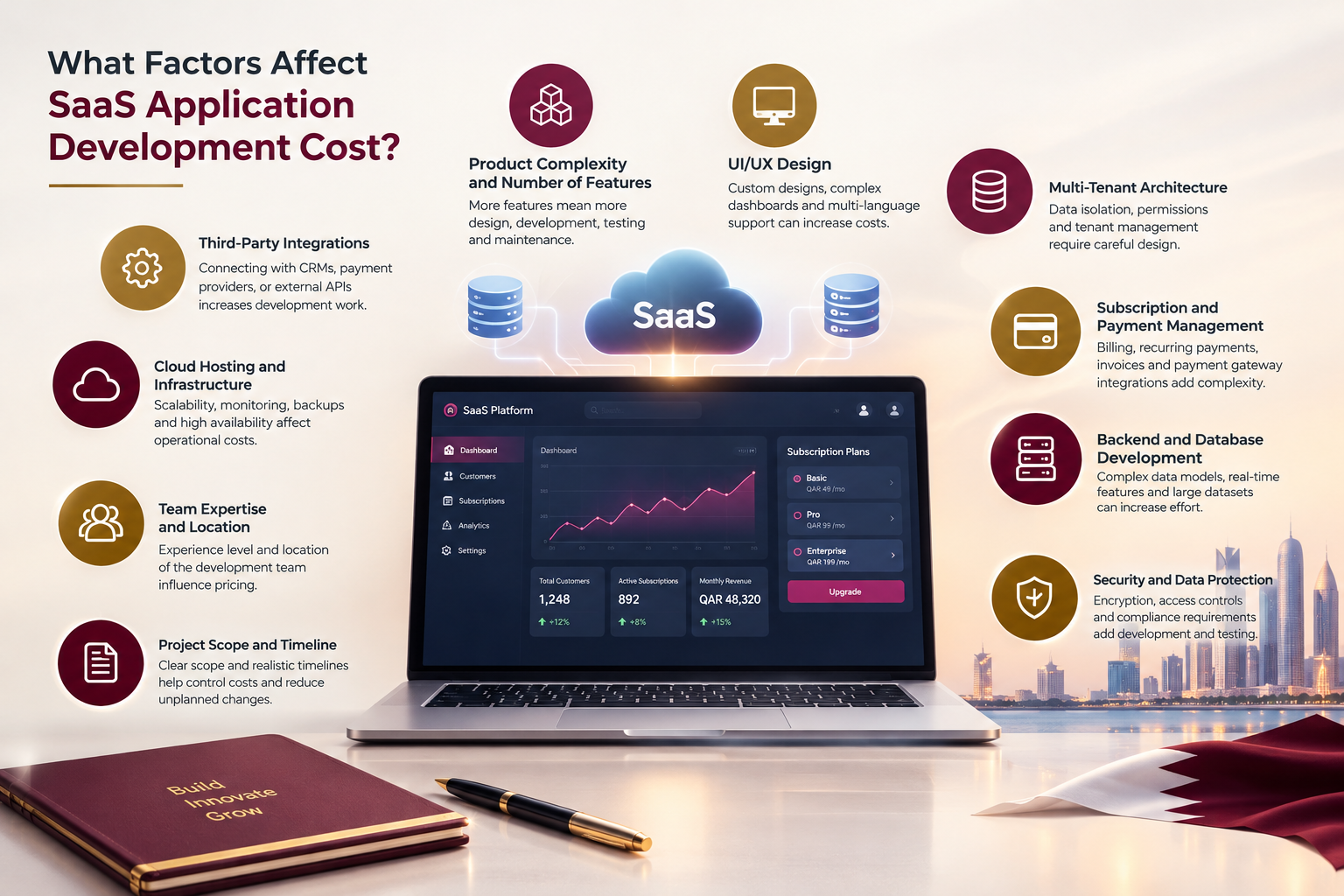
What Factors Affect SaaS Application Development Cost?
Understanding the cost drivers helps businesses prioritize the features that create the most value.
1. Product Complexity and Number of Features
Every additional feature requires some combination of planning, design, development, testing, and maintenance.
A basic customer dashboard is generally simpler than a configurable workflow engine that supports multiple departments, approval rules, automated notifications, and detailed reporting.
Before development starts, divide requirements into three categories:
Essential: features required for the first release.
Important: features that improve usability or customer retention.
Future enhancements: features that can wait until the product has been validated.
This approach helps prevent unnecessary spending on features customers may not need.
2. UI/UX Design
User interface and user experience design influence both development cost and customer adoption.
A SaaS application should make important tasks easy to understand and complete. Users should be able to navigate dashboards, manage records, configure settings, and understand errors without unnecessary confusion.
Design costs may increase when a project requires:
A completely custom visual identity
Complex dashboards and data visualizations
Multiple user journeys
Arabic and English interfaces
Accessibility improvements
Extensive usability testing
A consistent, reusable design system can reduce repeated design work as the product grows.
3. Multi-Tenant Architecture
Multi-tenancy is one of the defining technical considerations for many SaaS products.
In a multi-tenant application, multiple customers use the same core platform while their information and permissions remain appropriately separated.
For example, three companies might use the same HR management software. Each company should be able to access its own employee records without seeing another company's confidential information.
Development considerations include:
Tenant identification
Data isolation
Organization-level permissions
Tenant-specific settings
Subscription limits
Database design
Tenant administration
Testing for cross-tenant access vulnerabilities
A shared platform can simplify product maintenance, but its security and architecture must be carefully designed.
4. Subscription and Payment Management
If customers pay to use the application, the product may need subscription management functionality.
This can include:
Monthly and annual plans
Free trials
Paid upgrades and downgrades
Recurring billing
Invoice generation
Failed-payment handling
Cancellation workflows
Usage limits
Refund management
Payment status reporting
Integrating a payment provider may be simpler than building a billing system from scratch, but provider availability, supported currencies, transaction fees, and settlement arrangements must be checked.
For a business operating in Qatar, confirm that the selected payment provider supports the intended merchant, payment methods, and QAR transactions before committing to an integration.
5. Backend and Database Development
The backend manages the application's business logic, data processing, authentication, and communication with other systems.
A simple SaaS product may require a relatively straightforward database. A more advanced product may need complex relationships, reporting pipelines, background jobs, and high-volume data processing.
Costs can rise when the application requires:
Large datasets
Real-time updates
Complex reporting
Advanced search
Data import and migration
Multiple external APIs
High transaction volumes
Sophisticated backup and recovery
Selecting an architecture that fits the expected workload helps avoid paying for unnecessary complexity too early.
6. Security and Data Protection
Security should be included in the initial design rather than added after the product has launched.
Depending on the application, relevant controls may include:
Secure authentication
Role-based access
Encryption in transit and at rest
Secure password recovery
Input validation
Audit logging
Backup and restoration procedures
Vulnerability testing
Incident response planning
Businesses handling personal information in Qatar should evaluate their obligations under applicable requirements, including Qatar's Personal Data Privacy Protection Law, Law No. 13 of 2016. The official announcement of the law provides a primary reference. Appropriate legal advice may be necessary for the product's specific data-processing activities.
The cost of security depends on the sensitivity of the data, the architecture, contractual commitments, and the level of assurance required.
7. Third-Party Integrations
Integrations allow a SaaS application to communicate with other services.
Common examples include:
CRM and ERP systems
Accounting software
Email delivery services
SMS notifications
Payment gateways
WhatsApp Business services
Cloud storage
Analytics platforms
Identity providers
AI APIs
Each integration may require API access, authentication, error handling, data mapping, testing, and ongoing maintenance.
A simple integration can be relatively inexpensive. A complex integration involving legacy systems or inconsistent data can require considerably more work.

8. Cloud Hosting and Infrastructure
A SaaS product needs infrastructure to run its backend, database, background jobs, and supporting services.
Infrastructure expenses may include:
Application hosting
Database hosting
File storage
Bandwidth
Monitoring
Backups
Email delivery
Security services
Development and testing environments
A small application may run on modest infrastructure, while a high-traffic platform may require more powerful resources, redundancy, and advanced monitoring.
Cloud costs should be estimated according to expected usage rather than choosing the most expensive infrastructure by default.
Businesses can also explore cloud and DevOps solutions when evaluating deployment, infrastructure management, and operational reliability.
SaaS Development Cost Breakdown
A useful project budget separates one-time development work from recurring operating expenses.
The following is an illustrative allocation for a hypothetical commercial SaaS project with a total development budget of QAR 100,000.
Development activity | Example allocation |
|---|---|
Requirements and technical planning | QAR 8,000 |
UI/UX design | QAR 12,000 |
Frontend development | QAR 20,000 |
Backend and database development | QAR 25,000 |
Billing and integrations | QAR 10,000 |
Quality assurance and security testing | QAR 12,000 |
Deployment and launch preparation | QAR 5,000 |
Project coordination and contingency | QAR 8,000 |
Total | QAR 100,000 |
These amounts are a budgeting example, not a vendor quote or a universal industry cost distribution. Actual allocations vary by project. Some projects require more integration work, while others need more design, security, or backend engineering.
It is also important to clarify whether the quotation includes taxes, paid third-party tools, hosting, content creation, and post-launch support.
How Long Does It Take to Build a SaaS Application?
The development timeline depends on scope, team size, technical uncertainty, and how quickly stakeholders provide feedback.
Project type | Illustrative timeline |
|---|---|
Proof of concept | 2–4 weeks |
Basic SaaS MVP | 6–12 weeks |
Standard commercial SaaS | 3–6 months |
Advanced SaaS platform | 5–9 months |
Enterprise SaaS platform | 9–12 months or longer |
These are planning ranges rather than guaranteed delivery dates. They may overlap because a small project with complex integrations can take longer than a larger but more straightforward one.
The Main Development Stages
Stage 1: Discovery and requirements
Define the target customers, main business problem, essential features, user roles, and success criteria.
Stage 2: UX/UI design
Create user flows, wireframes, and interface designs before implementing the complete application.
Stage 3: Architecture and development
Build the frontend, backend, database, authentication, core business logic, and required integrations.
Stage 4: Testing
Test the application across supported devices and browsers. Verify functionality, permissions, billing workflows, performance, and security.
Stage 5: Deployment
Prepare production infrastructure, configure domains and monitoring, set up backups, and release the application.
Stage 6: Post-launch improvement
Monitor actual usage, fix defects, collect feedback, and prioritize the next set of improvements.
A structured software development process helps businesses understand these stages before approving a development budget.
What Are the Ongoing Costs of Running a SaaS Application?
SaaS development does not end when the first version launches. A subscription product requires continuing technical and operational investment.
The following monthly figures are illustrative planning allowances, not guaranteed provider prices.
Expense | Indicative monthly budget |
|---|---|
Basic hosting and database | QAR 300–1,500 |
Monitoring, backups, and security tools | QAR 200–1,000 |
Email, messaging, and other APIs | QAR 100–1,000 |
Routine maintenance and technical support | QAR 1,000–5,000 |
Illustrative combined budget | QAR 1,600–8,500 |
These categories can overlap, and actual expenses may fall below or exceed the ranges shown. The total depends on usage, support arrangements, infrastructure design, and the number of customers.
Additional expenses may include:
Payment processing fees
Customer support staff
Product analytics
Marketing and sales
Legal and accounting services
Compliance reviews
Major feature development
AI usage charges
An AI-enabled SaaS application may incur variable costs every time it processes a document, generates a response, or calls an external model.
For this reason, founders should estimate both the cost of building the product and the cost of serving each additional customer.
SaaS Application Development Cost by Business Model
Different SaaS business models create different technical requirements.
B2B SaaS
Business-to-business software serves organizations rather than individual consumers.
Examples include CRM, HR, inventory, accounting, and project management platforms.
Common cost drivers include team accounts, permission management, organization settings, reporting, and integrations.
B2C SaaS
Business-to-consumer SaaS serves individual users.
Examples include personal productivity, education, and digital planning tools.
Cost drivers may include onboarding, user subscriptions, mobile responsiveness, account management, and customer support.
Vertical SaaS
Vertical SaaS focuses on a particular industry.
A product designed for property management, hospitality, education, or healthcare may need industry-specific workflows, terminology, reports, and integrations.
The narrower focus can help clarify the MVP, but specialist requirements may increase development effort.
AI-Powered SaaS
AI SaaS products may provide document analysis, intelligent search, content assistance, customer support, or workflow automation.
Development costs depend on whether the product uses an external AI API, retrieval from private business data, custom models, or multi-step automated workflows.
Additional planning should cover AI usage costs, data privacy, output quality, error handling, and human review where appropriate.
How Can Startups Reduce SaaS Development Costs?
A limited budget does not necessarily mean a weak product. The key is to avoid building functionality before there is evidence that customers need it.
1. Start With One Clear Customer Problem
Choose a specific problem for a specific audience.
For example, instead of building an all-in-one business management platform immediately, begin with a booking and reminder system for a defined customer group.
2. Prioritize an MVP
Build only the features needed to test the main value proposition.
Features such as advanced AI analytics, extensive customization, and multiple mobile applications can often wait until customer demand is clearer.
3. Use Proven Components
Established authentication libraries, payment integrations, managed databases, and reusable interface components can reduce implementation effort.
However, third-party dependencies should be evaluated for security, licensing, maintenance, and compatibility.
4. Avoid Premature Scaling
Do not automatically build a highly distributed architecture for a product with very few users.
Start with a design that meets realistic performance, security, and reliability requirements and can evolve as usage grows.
5. Define the Scope in Writing
Document the deliverables, integrations, supported devices, acceptance criteria, and excluded features.
A clear scope reduces misunderstandings and helps prevent unplanned changes from increasing cost.
6. Reserve a Contingency Budget
Set aside an appropriate reserve for uncertainty, technical discoveries, and launch adjustments. The amount should reflect the maturity of the requirements and the risks of the project.
7. Measure Customer Demand Before Expanding
Use interviews, pilot customers, product analytics, and feedback to determine which features deserve further investment.
A product roadmap based on real usage is usually more useful than building every suggested feature at once.
Build a SaaS MVP or a Complete Platform?
The decision depends on your business objectives and the risks you need to manage.
Consideration | SaaS MVP | Complete platform |
|---|---|---|
Initial investment | Lower | Higher |
Time to initial release | Usually shorter | Usually longer |
Feature coverage | Core workflows | Broader functionality |
Customer validation | Early-stage testing | More mature offering |
Operational complexity | More limited | Greater |
Best suited for | Validating demand | Established requirements and growth |
An MVP is not an excuse to ignore security or reliability. Even an early release that handles customer information and payments needs appropriate protections.
The best strategy is to launch a focused, dependable product and expand it as evidence supports the investment.
SaaS Application vs Custom Software: What Is the Difference?
Custom software is designed around particular business requirements. SaaS describes a delivery and commercial model in which software is provided as a service, commonly through subscriptions.
A business can use custom development to create a SaaS product, but the terms are not interchangeable.
For example:
An internal employee management system may be custom software used by one company.
A subscription-based HR platform serving hundreds of companies is a SaaS product.
A custom SaaS platform can be designed for a particular industry or audience.
Businesses comparing the approaches can read custom software versus off-the-shelf software to understand the trade-offs between flexibility, initial cost, subscriptions, and maintenance.
Qatar-Specific Considerations When Building SaaS
A SaaS product intended for Qatar should be designed around its actual customers, payment requirements, language needs, and regulatory obligations.
Arabic and English Support
Depending on the target audience, users may expect an Arabic interface, English interface, or both.
Bilingual support can involve more than translating labels. Arabic interfaces may require right-to-left layouts, appropriate typography, date and number formatting, and additional testing.
Qatari Riyal Pricing
If the intended customers are in Qatar, displaying subscription prices in QAR can make the product easier to understand.
The billing system should also handle the chosen currency, invoices, subscription changes, failed payments, and refunds appropriately.
Data Privacy and Security
Determine what personal data the application collects, why it is processed, who can access it, and how long it is retained.
Review the applicable requirements under Qatar's data protection framework and any additional contractual or sector-specific obligations. Data hosting location should be evaluated against the actual legal, contractual, and security requirements rather than assumed to be mandatory in every case.
Local Business Workflows
Some SaaS products may need to support local business practices, Arabic documentation, regional payment methods, or integrations used by the target customers.
These requirements should be confirmed during discovery rather than added unexpectedly during development.
Infrastructure and Digital Growth
Qatar's Digital Agenda 2030 outlines national priorities around digital infrastructure, innovation, and the digital economy.
For SaaS founders, this is useful context for considering how a digital product might support businesses and users. It does not guarantee demand for any particular product, so customer research remains essential.
How to Choose a SaaS Development Company in Qatar
Choosing a development partner requires more than comparing the lowest quotation.
Evaluate potential providers against the following criteria:
Relevant experience: Can the team demonstrate experience with comparable technical requirements?
Architecture: Can they explain authentication, data isolation, backups, and future scalability?
Scope and pricing: Does the proposal specify deliverables, exclusions, milestones, and payment terms?
Communication: Will you have a clear contact for decisions, updates, and issue resolution?
Testing: Is quality assurance included, and what acceptance criteria will be used?
Ownership: Who owns the source code, design assets, domain, and relevant accounts?
Support: What happens after launch, and which services are covered by the agreement?
Security: How will vulnerabilities, incidents, access controls, and customer data be managed?
Ask for a proposal that separates initial development, third-party costs, hosting, and ongoing maintenance.
You can review Galaxium Coding's projects and portfolio to explore its available project information and contact the team to discuss the requirements of a proposed SaaS product.
Final Thoughts
The SaaS application development cost in Qatar in 2026 depends on the product you want to build, the customers you intend to serve, and the technical requirements needed to operate it reliably.
A proof of concept may be possible with a relatively small budget, while a production-ready commercial SaaS platform can require a much larger investment. Hosting, maintenance, security, integrations, customer support, and product improvements should also be included in the financial plan.
For startups, a practical approach is to validate the idea, define a focused MVP, estimate both development and operating costs, and expand the product based on customer feedback.
The goal is not simply to build software at the lowest possible price. It is to build a useful, secure, maintainable product that can support a sustainable business.
If you are planning a SaaS platform for Qatar, contact Galaxium Coding to discuss your business goals, required features, and development options.
Frequently Asked Questions (FAQs)
1. How much does SaaS application development cost in Qatar?
For initial budgeting, a basic SaaS MVP might cost approximately QAR 25,000–60,000, while a standard commercial platform might cost QAR 60,000–150,000. Advanced and enterprise products can cost QAR 150,000–500,000 or more. These are illustrative estimates, not fixed market rates.
2. How much does it cost to build a SaaS MVP in Qatar?
A basic SaaS MVP may require an estimated QAR 25,000–60,000, depending on the core features, interface, authentication, database, administration tools, and integrations. A prototype may cost less but will not necessarily be suitable for production use.
3. How long does SaaS application development take?
A basic MVP may take approximately 6–12 weeks, while a standard commercial product may take 3–6 months. Advanced platforms can take longer. The timeline depends on scope, integrations, testing, and decision-making speed.
4. What is included in SaaS development costs?
Development costs can include requirements analysis, UI/UX design, frontend and backend development, database setup, authentication, subscription management, integrations, testing, deployment, and launch preparation. Always confirm what the developer's quotation includes.
5. What are the monthly costs of running a SaaS application?
A small SaaS product might use an illustrative operating budget of QAR 1,600–8,500 per month for hosting, monitoring, messaging services, and routine technical maintenance. Actual costs vary with usage, support needs, and infrastructure.
6. Can I build a SaaS application with a limited budget?
Yes. You can start with a narrowly defined MVP, use proven components, avoid unnecessary integrations, and postpone advanced features. However, essential security, data protection, and reliability requirements should not be sacrificed.
7. Is SaaS development different from custom software development?
SaaS describes a software delivery model, commonly based on recurring subscriptions. Custom software describes software built for particular requirements. Custom development can be used to create a SaaS product.
8. Does a SaaS application need a mobile app?
Not always. Many SaaS products begin with a responsive web application that works on desktop and mobile browsers. Dedicated Android or iOS applications can be added when customer needs justify the additional development and maintenance.
9. What technologies are used to develop SaaS applications?
The technology stack depends on the requirements. A typical product may use a modern frontend framework, a backend framework, a relational database, cloud infrastructure, authentication services, and APIs. The team should select technologies based on security, maintainability, performance, and available expertise.
10. What should I prepare before requesting a SaaS development quotation?
Prepare a description of the target customers, the problem the product solves, the main features, expected user roles, required integrations, preferred platforms, security needs, and budget range. A prioritized feature list helps development teams provide a more meaningful estimate.
11. Can a SaaS application support Arabic and English?
Yes. A SaaS application can support both languages, including right-to-left layouts for Arabic. The project should account for translation, layout design, text expansion, date and number formatting, and testing in both languages.
12. How can I estimate the return on investment of a SaaS product?
Estimate potential revenue using realistic assumptions about paying customers, subscription prices, churn, and acquisition costs. Then subtract hosting, support, payment fees, development, maintenance, and sales expenses. Treat forecasts as scenarios rather than guaranteed outcomes.