Pharmacy Software in Qatar vs Saudi Arabia: The Future of Intelligent Pharmacy Technology | Galaxium Coding

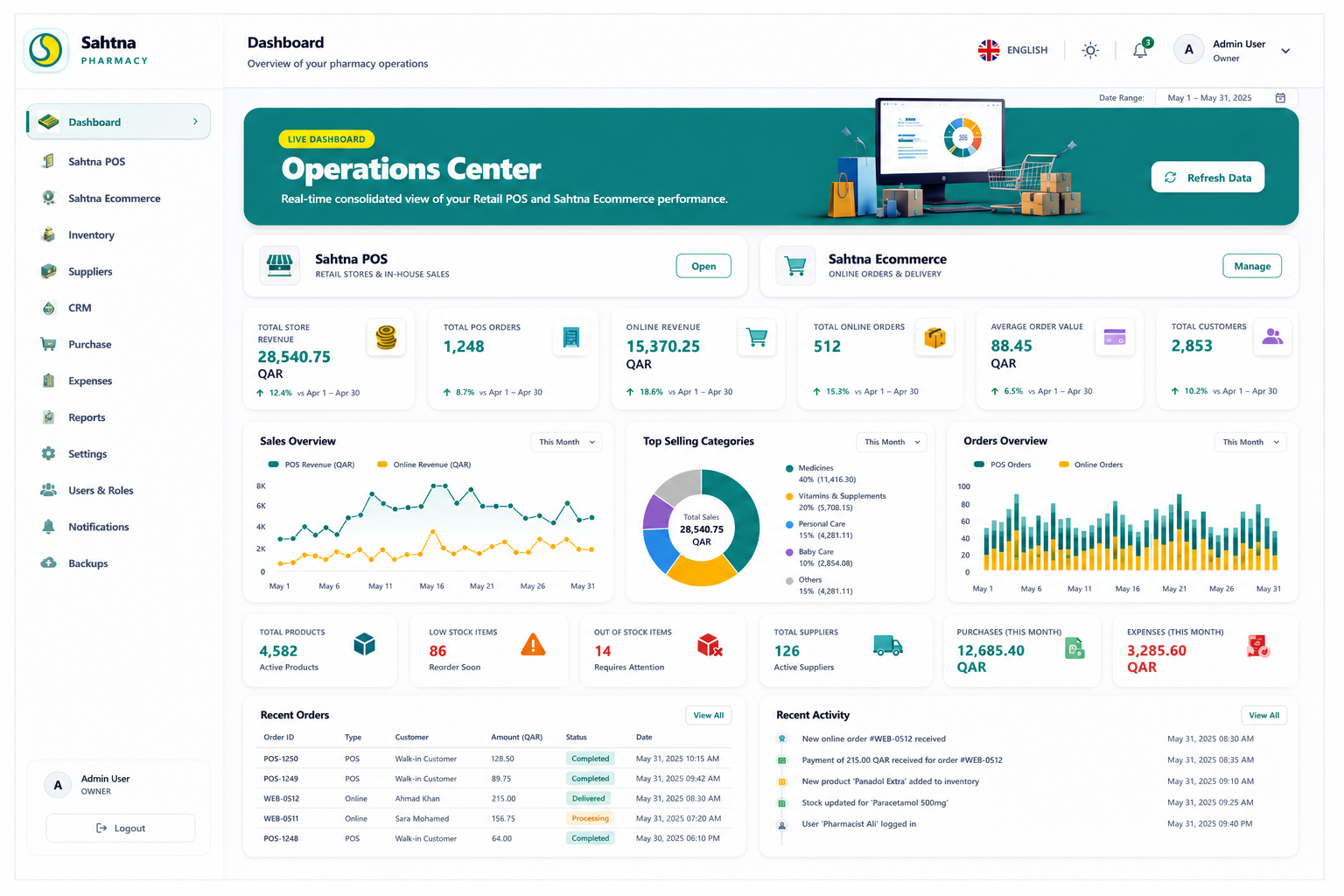
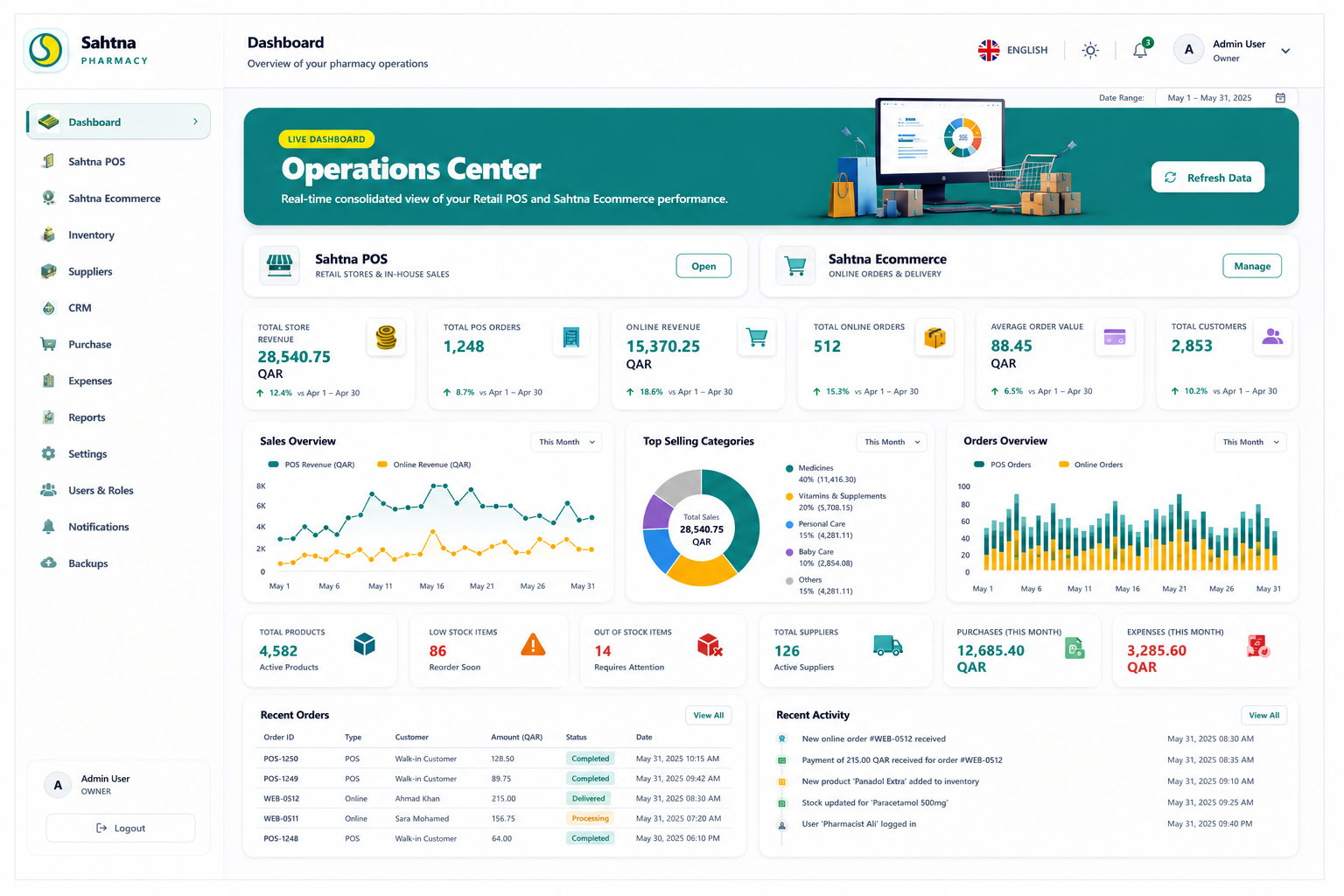
The future of pharmacy technology connects POS, ERP, inventory, AI, mobile applications, e-commerce and healthcare operations in one intelligent ecosystem.
Pharmacy Software in Qatar vs Saudi Arabia: How Galaxium Coding Is Building the Next Generation of Intelligent Pharmacy Technology
The pharmacy industry is changing rapidly.
A modern pharmacy is no longer simply a place where a pharmacist receives a prescription, finds a medicine, and completes a sale. Today, pharmacies are becoming highly connected healthcare businesses involving inventory management, prescription processing, patient records, procurement, accounting, insurance, e-commerce, delivery, multiple branches, regulatory requirements, analytics, and increasingly artificial intelligence.
This transformation creates a major technology challenge.
A pharmacy may have thousands of medicines, multiple suppliers, hundreds or thousands of customers, different prices, batches and expiry dates, returns, prescriptions, insurance transactions, employees, branches and financial transactions—all operating simultaneously.
A basic POS system is not enough.
A traditional accounting system is not enough.
And a generic ERP that was not designed around pharmacy operations can create more problems than it solves.
This is where Galaxium Coding sees an opportunity to build something fundamentally different: a healthcare technology platform designed around the real operational problems faced by pharmacies and healthcare businesses in the GCC.
The Future of Pharmacy Is Not Just a POS System
For many years, pharmacy software has been built around one central function:
Sell the medicine and record the transaction.
That model is becoming outdated.
A modern pharmacy needs to answer much bigger questions:
Which medicines are approaching expiry?
Which branch has excess stock?
Which branch is about to run out?
Which products are selling faster than expected?
Which suppliers offer the best purchasing terms?
How much capital is sitting in inventory?
Which medicines are being returned?
What is the real profit after purchasing costs?
Which customers are returning?
What prescriptions are being processed?
Which insurance transactions are pending?
Which employees are handling which transactions?
What is happening across every branch right now?
Can management monitor the entire pharmacy group from one dashboard?
Can the system identify problems before they become expensive?
This requires something much more powerful than a cash register.
It requires an intelligent pharmacy operating system.
Qatar and Saudi Arabia: Similar Industry, Different Environment
At first glance, Qatar and Saudi Arabia appear to have very similar pharmacy environments.
Both markets have sophisticated healthcare sectors, rapidly growing digital infrastructure, modern pharmacy chains, private healthcare providers, and increasing demand for integrated technology.
However, a software company entering both markets quickly discovers an important reality:
Pharmacy software cannot simply be copied from one country to another.
The underlying pharmacy operations may be similar, but regulatory structures, healthcare platforms, licensing requirements, e-invoicing requirements, drug-related systems, insurance workflows and government integrations can differ.
That means the right solution needs a common technology foundation with country-specific configuration.
Pharmacy Software in Qatar
Qatar's pharmaceutical sector operates within a regulated healthcare environment.
The country's pharmacy profession and pharmaceutical establishments are governed by legislation including Law No. 3 of 1983, which regulates pharmacy professions and pharmaceutical establishments. The law establishes licensing requirements and conditions surrounding pharmaceutical establishments.
The Ministry of Public Health also provides a formal process for licensing pharmaceutical establishments.
According to the Ministry's published service information, the licensing process includes initial approval, preliminary inspection and final inspection, with requirements including documentation related to the responsible pharmacist, commercial registration, trade licence, civil defense and other establishment requirements.
The broader role of Qatar's Ministry of Public Health also includes regulation of pharmacy, pharmaceutical institutions and health information systems.
This means pharmacy technology in Qatar needs to be designed with the local operating environment in mind.
A Qatar pharmacy system should therefore be capable of supporting:
Pharmacy POS
Prescription management
Patient profiles
Medicine database
Batch tracking
Expiry tracking
Purchase orders
Supplier management
Inventory control
Multi-branch operations
Sales management
Returns
Accounting
Employee management
Reporting
Audit trails
Secure access controls
E-commerce
Delivery management
Mobile applications
Management dashboards
Business intelligence
AI-assisted decision support
And most importantly, it needs to be flexible enough to adapt as healthcare regulations and digital services evolve.
Pharmacy Software in Saudi Arabia
Saudi Arabia represents an even larger opportunity for pharmacy technology.
The Saudi pharmaceutical market operates within a highly developed regulatory and digital ecosystem involving bodies and systems such as the Saudi Food and Drug Authority (SFDA) and other healthcare and financial platforms.
The SFDA publishes regulations governing pharmaceutical establishments and pharmaceutical products. Its current regulatory resources include requirements and regulations relating to pharmaceutical establishments and products.
Saudi Arabia also has a dedicated Electronic Controlled Drug System (CDS) operated through the SFDA for monitoring narcotic and psychotropic substances within licensed entities.
The Saudi Ministry of Health also publishes licensing requirements covering pharmacies and electronic pharmacy establishments, as well as requirements related to pharmaceutical care and medication management services.
This makes the Saudi market particularly interesting from a software architecture perspective.
The system cannot simply be a pharmacy POS with a few additional buttons.
It needs to be capable of operating within a connected healthcare ecosystem.
The Biggest Difference Between Qatar and Saudi Arabia
The most important difference is not simply the size of the market.
It is the digital and regulatory ecosystem surrounding the pharmacy.
A pharmacy software platform intended for Saudi Arabia may need to account for Saudi-specific workflows, regulatory requirements and integrations.
A Qatar deployment may require a different configuration.
Therefore, instead of developing two completely separate systems, the smarter approach is:
One Core Platform + Country-Specific Intelligence
Imagine a platform where the central architecture remains the same, but the system automatically adapts according to the country in which the pharmacy operates.
Qatar Mode
The system can be configured around:
Qatar pharmacy operations
Local pharmacy workflows
Local business requirements
Local accounting requirements
Local tax/e-invoicing configuration where applicable
Local healthcare workflows
Qatar-specific reporting
Qatar-specific integrations
Saudi Mode
The same platform can be configured around:
Saudi pharmacy workflows
SFDA-related processes
Saudi pharmaceutical requirements
Saudi e-invoicing requirements
Saudi healthcare/insurance workflows
Saudi-specific reporting
Saudi-specific integrations
Controlled-substance workflows where applicable
This is the foundation of what could become a much bigger healthcare technology platform.
Introducing the Concept: Galaxium MedOS
At Galaxium Coding, the opportunity is not simply to build another pharmacy management application.
The bigger vision is:
Galaxium MedOS
One Intelligent Operating System for Pharmacies, Medical Stores and Healthcare Businesses
The concept is simple:
Instead of forcing pharmacies to operate ten different systems, connect their entire business through one intelligent platform.
The platform would connect:
POS → Inventory → Procurement → Pharmacy → Patients → Prescriptions → Insurance → Accounting → HR → E-commerce → Mobile App → AI → Management
Everything communicates with everything else.
That is where the real value begins.
1. Intelligent Pharmacy POS
The POS would remain one of the most important parts of the platform—but it would no longer be the entire system.
The pharmacist could search medicines using:
Product name
Generic name
Brand name
Barcode
SKU
Scientific name
Strength
Dosage form
Manufacturer
The system could display relevant information such as:
Selling price
Purchase price
Available quantity
Batch
Expiry date
Alternative products
Branch availability
Promotional pricing
Customer pricing
Insurance-related information where applicable
The POS would communicate directly with inventory, accounting and management.
One sale could therefore automatically update multiple parts of the organization.
2. Intelligent Inventory Management
Inventory is one of the biggest financial assets—and one of the biggest risks—in a pharmacy.
A pharmacy can lose significant money through:
Expired medicines
Overstocking
Slow-moving products
Incorrect purchasing
Stock discrepancies
Theft
Damaged products
Poor branch distribution
Emergency purchases
Supplier pricing differences
Galaxium MedOS should transform inventory from a passive database into an intelligent decision-making system.
Imagine a dashboard showing:
🔴 32 products approaching expiry
🟠 17 products overstocked
🟡 46 products selling faster than expected
🟢 21 products requiring replenishment
Management would no longer have to discover these problems manually.
The software could identify them automatically.
3. FEFO-Based Pharmacy Inventory
For pharmacy operations, inventory management needs to go beyond simple FIFO.
The platform can be designed around FEFO — First Expiry, First Out.
The system could prioritize products according to expiry dates and help pharmacy employees identify which batch should be sold or transferred first.
This can help reduce avoidable expiry losses and improve inventory discipline.
4. Multi-Branch Pharmacy Management
Imagine a company with:
5 branches.
Then:
20 branches.
Then:
50 branches.
Then:
100+ branches.
Managing each pharmacy independently becomes increasingly difficult.
Galaxium MedOS could provide a central command center where management sees the entire organization.
One dashboard could display:
Total sales
Sales by branch
Gross margin
Inventory value
Low-stock products
Expiring products
Purchase orders
Supplier balances
Customer activity
Employee performance
Branch performance
Returns
Insurance transactions
Revenue trends
Management could drill down from:
Group → Region → City → Branch → Department → Employee → Transaction
This is where pharmacy software starts becoming enterprise healthcare technology.
5. Intelligent Stock Transfers Between Branches
One of the most powerful opportunities is branch-to-branch inventory optimization.
Imagine:
Branch A
Has 120 units of a medicine.
Branch B
Has 3 units.
Branch C
Has 0 units.
The system understands that Branch A has excess stock while Branch B and C have demand.
Instead of purchasing more from a supplier, the system can recommend an internal transfer.
This could reduce:
Overstocking
Emergency purchases
Expiry losses
Unnecessary capital investment
And increase:
Stock availability
Inventory efficiency
Branch profitability
6. AI Demand Forecasting
This is where Galaxium MedOS could move beyond traditional pharmacy software.
The system could analyze historical:
Sales
Seasons
Branch performance
Product movement
Promotions
Customer patterns
Stock levels
Supplier lead times
and generate demand forecasts.
For example:
Expected demand for Product X next month: +24%
or:
Branch 7 may run out of Product Y within 6 days.
Or:
Product Z has declining demand and may become overstocked if another order is placed.
Instead of asking:
“What happened?”
management can begin asking:
“What is likely to happen next?”
7. Pharmacy Accounting
A pharmacy system should not operate separately from finance.
Every transaction creates financial information.
Galaxium MedOS could connect:
Sales → Purchases → Expenses → Supplier Payables → Customer Receivables → Inventory Cost → Profitability
Management should be able to see:
Daily revenue
Gross profit
Net profitability
Cost of goods sold
Supplier balances
Purchase expenses
Branch profitability
Product profitability
Employee-related costs
Customer receivables
Corporate account settlements
The objective is to give management one version of the truth.
8. Supplier and Procurement Intelligence
Pharmacies often deal with many suppliers.
A sophisticated procurement module could compare:
Supplier price
Historical price
Available quantity
Delivery time
Payment terms
Purchase history
Product availability
The system could then recommend purchasing decisions.
For example:
Supplier A: QAR 42
Supplier B: QAR 39
Supplier C: QAR 40
But the cheapest supplier isn't always the best supplier.
The software could also consider:
Delivery reliability
Credit terms
Historical performance
Minimum order quantities
This turns procurement into a data-driven process.
9. Patient Management
A modern pharmacy is also a healthcare touchpoint.
A patient profile could contain appropriate information such as:
Basic customer information
Prescription history
Purchase history
Medication history
Allergies where properly captured
Refills
Loyalty information
Insurance information
Communication preferences
The system should be designed with strong privacy, security and access-control principles.
Patient information should not be accessible to everyone.
10. Prescription Management
A modern pharmacy platform can connect prescription workflows with dispensing operations.
The pharmacist could manage:
Prescription records
Prescriber information
Medication
Dosage information
Dispensing history
Refill information
Patient information
Relevant warnings
Any clinical decision-support functionality should be designed as support for qualified healthcare professionals—not as a replacement for professional judgment.
11. Insurance Management
Insurance creates another layer of complexity.
A pharmacy may need to manage:
Eligibility
Claims
Approvals
Rejections
Pending transactions
Patient contribution
Insurer contribution
Claim reconciliation
Outstanding amounts
The architecture of Galaxium MedOS can therefore be designed with an insurance integration layer rather than treating insurance as an isolated feature.
This is particularly important for a system intended to operate across different GCC healthcare environments.
12. E-Commerce Connected Directly to the Pharmacy
Why should a pharmacy have:
POS
and separately:
Website
and separately:
Mobile application
and separately:
Inventory system?
They shouldn't.
The ideal architecture is:
One central inventory.
Then:
Physical Pharmacy
↕
Website
↕
Mobile App
↕
POS
↕
Delivery
All connected.
When a product is sold in-store, availability can be reflected online.
When an online order is completed, inventory can update.
When a branch receives stock, the central system knows.
That is true digital transformation.
Galaxium Coding already specializes in web application development and mobile application development, making this type of connected architecture a natural direction for the company's broader technology capabilities.
13. The Pharmacy Mobile Application
The customer should not need to call the pharmacy every time they need information.
A dedicated pharmacy mobile application could provide:
Medicine search
Prescription upload
Prescription history
Refill requests
Order placement
Delivery tracking
Branch locator
Loyalty points
Offers
Notifications
Customer support
Order history
Digital invoices
For pharmacy chains, the mobile application could become a direct relationship between the healthcare business and its customers.
The mobile experience could be developed as part of a broader mobile application solution from Galaxium Coding.
14. The Pharmacist Application
The customer is not the only person who needs mobile access.
Imagine a pharmacist receiving an alert:
Branch 12: Product approaching critical stock level.
Or:
Prescription waiting for pharmacist review.
Or:
Manager requested stock verification.
The pharmacist could use a secure application to perform authorized tasks without being permanently tied to a desktop computer.
15. The Management App
The owner or CEO should be able to open a phone and see:
Today's Revenue: QAR 428,500
Branches: 37
Low Stock Alerts: 42
Expiring Products: 18
Pending Purchases: 31
Insurance Claims Pending: 76
Top Performing Branch: Doha Branch 7
This transforms management from reactive decision-making into real-time control.
16. AI Pharmacy Assistant
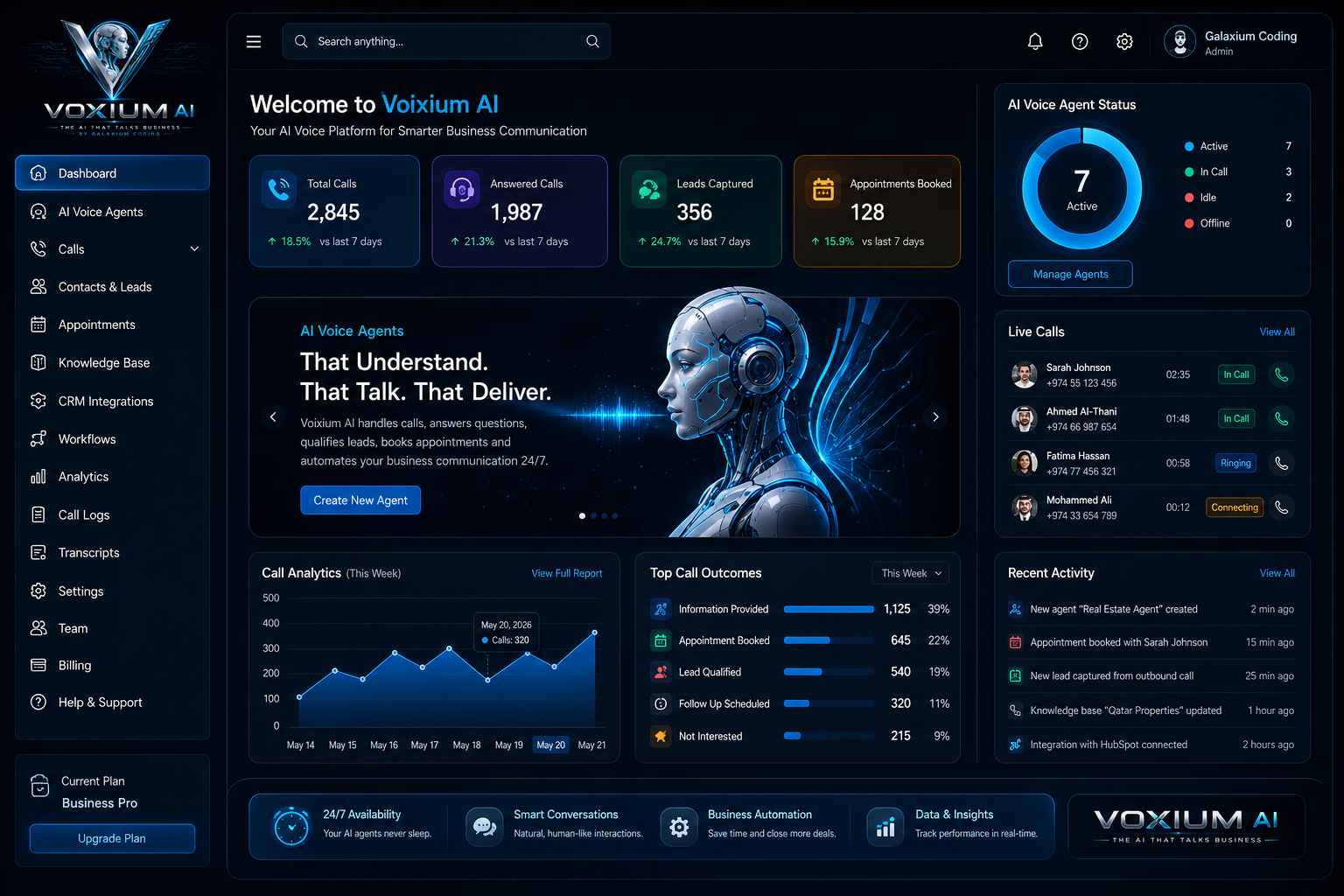
The most exciting part of the concept could be an AI layer sitting above the entire business.
Instead of opening five reports, a manager could ask:
“Which branches are losing money this month?”
The system could analyze the relevant business data and provide an answer.
Another question:
“Which medicines are at risk of expiring?”
Another:
“What are our top 20 products by gross margin?”
Another:
“Which branches should receive stock transfers today?”
Another:
“Why did sales decrease in Branch 12?”
This is not simply a chatbot.
It is an AI business intelligence layer connected to the pharmacy's operational data.
17. AI for Expiry Prevention
One of the biggest opportunities for pharmacy AI is preventing losses before they happen.
Instead of waiting for an employee to notice an expiry date, the system could calculate:
Current stock
Average sales
Remaining shelf life
Historical movement
Branch demand
Then generate an alert:
High expiry risk detected.
The system could recommend:
Transfer stock to another branch.
Adjust purchasing.
Prioritize the batch.
Review pricing/promotional strategy.
Notify management.
The final business decision remains with authorized personnel, but the software provides the intelligence.
18. AI for Pharmacy Profitability
Not every high-selling medicine is highly profitable.
A product may generate significant revenue but have a small margin.
Another product may sell fewer units but generate considerably better profitability.
AI analytics could therefore identify:
Revenue Leaders
Products generating the most sales.
Margin Leaders
Products generating the strongest gross margins.
Inventory Traps
Products consuming capital but moving slowly.
Expiry Risks
Products likely to expire before sale.
Growth Products
Products experiencing accelerating demand.
This creates a completely different level of pharmacy management.
19. Security and Role-Based Access
Healthcare software must take security seriously.
The platform should be designed with:
Role-based access control
User permissions
Audit logs
Secure authentication
Session controls
Data encryption
Backup strategies
Activity monitoring
Branch-level permissions
Financial permissions
Pharmacy permissions
Administrative permissions
For example:
A cashier should not have access to financial reports.
A pharmacist should not automatically have access to HR information.
An HR manager should not be able to change medicine purchasing prices.
The system should understand who the user is and what they are authorized to do.
20. Complete Audit Trail
Every important action should be traceable.
For example:
User: Ahmed
Branch: Doha 4
Action: Inventory adjustment
Product: Medicine X
Previous Quantity: 120
New Quantity: 112
Time: 10:42 AM
Reason: Damaged stock
This creates accountability.
For pharmacy chains, auditability can become an essential part of operational control.
Qatar + Saudi Arabia: One Platform, Two Operating Environments
This is one of the strongest ideas behind the proposed Galaxium MedOS architecture.
Instead of building:
Galaxium Qatar System
and separately:
Galaxium Saudi System
the company can develop:
Galaxium MedOS GCC
with a common core and country-specific modules.
Common Core
POS
Inventory
Procurement
Accounting
CRM
HR
Reporting
AI
Mobile apps
E-commerce
Multi-branch management
Security
Audit logs
Qatar Layer
Country-specific workflows and integrations.
Saudi Layer
Country-specific workflows and integrations.
Future GCC Layer
Potential expansion into additional GCC markets through configurable country modules.
This architecture is significantly more scalable than developing a completely separate product for every country.
Why Galaxium Coding?
The opportunity is not only about writing software.
It is about understanding the business first.
That philosophy is reflected in the company's approach to software development.
A pharmacy owner does not wake up thinking:
“I need a Laravel application.”
They wake up thinking:
“Why am I losing money on expired stock?”
“Why is Branch 4 always out of stock?”
“Why can't I see my company's real profit?”
“Why are my employees entering the same information into three systems?”
“Why can't I manage the business from my phone?”
“Why can't my website see the same inventory as my pharmacy?”
These are business problems.
Software is the solution.
From Business Problems to Technology
This is where Galaxium Coding can position itself differently from companies selling generic pharmacy software.
The process begins with understanding:
1. The Business
How does the pharmacy operate?
2. The People
Who uses the system?
Owners
Managers
Pharmacists
Cashiers
Accountants
Procurement teams
Warehouse staff
HR
Customers
3. The Problems
Where is money being lost?
Where is time being wasted?
Where are mistakes happening?
4. The Regulations
What does the operating country require?
5. The Technology
Which systems need to communicate?
6. The Future
What should the platform be capable of five years from now?
This is how software becomes a strategic business asset rather than another application.
The Technology Behind the Platform
A system of this scale requires more than a beautiful interface.
The architecture should be designed for:
Scalability
High availability
Security
API integration
Cloud deployment
Database reliability
Backup and disaster recovery
Monitoring
Automated deployments
Performance optimization
Galaxium's Cloud & DevOps services can form part of this infrastructure strategy.
The platform can be designed as a modular ecosystem where individual components can evolve without requiring the entire system to be rebuilt.
APIs: The Key to Healthcare Connectivity
The future pharmacy will not operate alone.
It will need to communicate with external systems.
The architecture therefore needs an integration layer capable of connecting with appropriate third-party and government platforms where APIs, approvals and technical access are available.
Potential categories include:
Regulatory systems
E-invoicing
Insurance
Healthcare networks
Drug databases
Payment gateways
Delivery services
Accounting systems
E-commerce
Customer communication platforms
Importantly, a software company should never claim that a system is officially integrated or certified until that integration has actually been completed and approved where approval is required.
The architecture should instead be integration-ready from day one.
Why Saudi Arabia Requires a Different Approach
Saudi Arabia's pharmaceutical ecosystem has its own regulatory framework.
The SFDA maintains regulations governing pharmaceutical establishments and pharmaceutical products, and Saudi healthcare software may also need to interact with specialized national systems depending on the pharmacy's business model.
Saudi Arabia also provides a specific electronic system for controlled drugs, demonstrating the importance of specialized digital workflows for regulated medicines.
The Saudi Ministry of Health also publishes requirements relating to pharmacies, electronic pharmacies and pharmaceutical care.
Therefore, a serious pharmacy technology company cannot simply take a Qatar product and rename it for Saudi Arabia.
It needs a Saudi operating layer.

Why Qatar Requires Local Understanding
Qatar's regulatory environment is also specific.
The country's pharmacy legislation establishes requirements around pharmaceutical establishments and pharmacy management, while the Ministry of Public Health oversees licensing and regulation of pharmaceutical facilities.
Qatar's current pharmaceutical establishment licensing process includes multiple stages and supporting documentation.
Therefore, a pharmacy software platform operating in Qatar should be designed around the realities of Qatar's pharmacy environment—not simply translated into Arabic.
That distinction matters.
Translation is not localization.
A Saudi system translated into Arabic is still a Saudi system.
A Qatar system localized for Qatar is something entirely different.
The Galaxium Difference: Localization by Architecture
The proposed Galaxium approach is:
Don't build the software around one country's assumptions.
Build the core platform so that country-specific requirements become configurable modules.
This could allow the system to support:
Country
Qatar / Saudi Arabia / Future GCC markets
Currency
QAR / SAR / other supported currencies
Language
Arabic / English
Tax & E-Invoicing
Country-specific configuration
Regulatory Workflows
Country-specific
Healthcare Integrations
Country-specific
Reporting
Country-specific
User Roles
Organization-specific
This creates a scalable GCC healthcare platform.
The Bigger Vision: From Pharmacy to Healthcare
The most important point is that Galaxium MedOS does not have to stop at pharmacies.
The same technology foundation could eventually expand into:
Medical clinics
Hospital pharmacies
Medical warehouses
Healthcare groups
Medical distributors
Laboratory operations
Medical inventory
Home healthcare
Healthcare e-commerce
Patient applications
Telehealth
Healthcare analytics
This is where a pharmacy project can become the foundation of a much larger healthcare technology ecosystem.
Galaxium Health Intelligence
The long-term vision could therefore become:
Galaxium Health Intelligence
An ecosystem connecting:
Pharmacies
↓
Clinics
↓
Patients
↓
Healthcare Providers
↓
Insurance
↓
Medical Supply Chain
↓
AI
↓
Business Intelligence
The objective is not to replace healthcare professionals.
The objective is to give healthcare professionals and healthcare businesses better technology.
What Would Make This Different From Existing Pharmacy Software?
The market already has pharmacy management systems.
The goal should therefore not be:
“We built another pharmacy POS.”
The goal should be:
“We built an intelligent operating system for the entire pharmacy business.”
The difference is substantial.
Traditional Pharmacy Software
Sale → Receipt → Inventory update
Galaxium MedOS
Sale
↓
Inventory
↓
Patient
↓
Prescription
↓
Accounting
↓
Insurance
↓
Analytics
↓
AI
↓
Management Decision
That is a fundamentally different approach.
The Future Pharmacy
Imagine a pharmacy owner opening the application every morning.
The dashboard says:
Good Morning
Group Revenue: QAR 1.24M
Revenue Growth: +12.4%
Low Stock: 37 items
Expiry Risk: 14 items
Recommended Transfers: 9
Pending Purchase Orders: 18
Insurance Claims: 64
High-Margin Products: 26
Branches Requiring Attention: 3
Then the AI assistant says:
“I identified three branches that may experience stock shortages this week. I recommend transferring 42 units from Branch 2 and Branch 8 before placing a new supplier order.”
That is the type of experience that can change how a pharmacy is managed.
From Software Company to Healthcare Technology Partner
This is ultimately where Galaxium Coding wants to position itself.
Not simply as a company that delivers code.
Not simply as a company that creates websites.
Not simply as a company that builds mobile apps.
But as a technology partner capable of understanding a complex business, designing the architecture, developing the software, integrating the systems and continuously improving the platform.
The company's broader projects and portfolio demonstrate the importance of approaching software as a business solution rather than merely a technical product.
The Role of Web, Mobile, Cloud and AI
A healthcare platform of this scale requires multiple technologies working together.
Web Applications
For:
Administration
Management
Accounting
Inventory
Procurement
HR
Reporting
See Galaxium Coding's Web Applications solutions.
Mobile Applications
For:
Customers
Pharmacists
Managers
Delivery teams
See Galaxium Coding's Mobile Applications solutions.
Cloud & DevOps
For:
Scalability
Deployment
Monitoring
Security
Backup
Availability
Explore Cloud & DevOps at Galaxium Coding.
Artificial Intelligence
For:
Forecasting
Business intelligence
Automation
Anomaly detection
Inventory optimization
Operational recommendations
And ultimately, AI becomes the intelligence layer sitting above the entire system.
A New Standard for Pharmacy Technology in the GCC
The GCC healthcare market is entering a new phase.
The question is no longer:
“Does the pharmacy have software?”
The better question is:
“How intelligent is the pharmacy's software?”
Can it predict?
Can it automate?
Can it connect?
Can it understand?
Can it identify problems?
Can it help management make better decisions?
Can it operate across multiple branches?
Can it adapt to different countries?
Can it integrate with the wider healthcare ecosystem?
These are the questions that the next generation of pharmacy technology needs to answer.
Galaxium Coding: Building Technology Around Real Problems
The strongest software is rarely created by starting with technology.
It starts with a problem.
A pharmacy says:
“We are losing money because of expiry.”
Technology responds:
“Let's build intelligent expiry management.”
A pharmacy says:
“We cannot control stock across branches.”
Technology responds:
“Let's build a centralized multi-branch inventory intelligence system.”
A pharmacy says:
“We don't know our real profitability.”
Technology responds:
“Let's connect inventory, purchasing, sales and accounting.”
A pharmacy says:
“Our customers want mobile ordering.”
Technology responds:
“Let's connect your mobile app directly to the pharmacy platform.”
A pharmacy says:
“We have too much data and not enough insight.”
Technology responds:
“Let's put AI on top of your business data.”
That is the philosophy behind the proposed Galaxium healthcare platform.
The Vision
The ultimate objective is to create a system where:
The Pharmacist
gets the information needed to serve the patient efficiently.
The Manager
gets operational visibility.
The Accountant
gets accurate financial information.
The Procurement Team
gets better purchasing intelligence.
The Warehouse
gets better inventory control.
The Customer
gets a better digital experience.
The Owner
gets a complete view of the business.
The AI
helps everyone understand what is happening and what deserves attention.
And all of them operate on the same connected platform.
Why This Could Be Much Bigger Than Pharmacy Software
Pharmacy is only the beginning.
If the architecture is built correctly, the platform can eventually become a broader healthcare operating system.
One technology foundation.
Multiple healthcare industries.
Multiple countries.
Multiple business models.
That is the opportunity.
And that is why Galaxium Coding's approach should not be limited to developing another pharmacy management application.
The bigger opportunity is to build a GCC-ready intelligent healthcare technology platform.
Final Thoughts
Qatar and Saudi Arabia are both moving toward increasingly digital healthcare environments, but their regulatory and operational ecosystems are not identical.
Qatar has its own pharmaceutical licensing and regulatory framework.
Saudi Arabia has its own pharmaceutical regulatory ecosystem through authorities such as the SFDA, including dedicated digital systems for regulated medicines.
The answer is therefore not to create one generic pharmacy system and deploy it everywhere.
The answer is to create a flexible healthcare technology platform with a common core and country-specific intelligence.
That is the opportunity for Galaxium Coding.
A platform that brings together:
Pharmacy + POS + Inventory + Procurement + Accounting + Patients + Prescriptions + Insurance + E-Commerce + Mobile + Cloud + AI + Business Intelligence
into one connected ecosystem.
And the most important principle is simple:
Don't build software just to manage a pharmacy. Build technology that helps the pharmacy understand itself.
That is where the next generation of pharmacy technology begins.
Explore Galaxium Coding
If you are a pharmacy group, healthcare organization, medical business or technology partner looking to build a customized healthcare platform, explore Galaxium Coding and learn more about the company through its About Us page.
For organizations looking for custom software development, Galaxium Coding can design solutions around specific business workflows rather than forcing businesses into a one-size-fits-all platform.
Explore the company's Web Applications, Mobile Applications, and Cloud & DevOps capabilities.
You can also explore the company's Projects and Portfolio and follow the latest technology insights through the Galaxium Coding Blog and Digital Intelligence resources.
For healthcare technology discussions, software development projects or strategic technology partnerships, visit the Galaxium Coding Contact page.
You can also find Galaxium Coding through its Google Business Profile and Doha location.
For organizations interested in technology for other sectors, Galaxium also develops solutions for areas such as Education and other business environments.
Galaxium Coding also maintains its Privacy Policy and Terms of Service as part of its digital presence.