How to Choose a Mobile App Development Company in Qatar

Key factors to evaluate when choosing a mobile app development company in Qatar in 2026.
How to Choose a Mobile App Development Company in Qatar: A 2026 Evaluation Checklist
Choosing a mobile app development company in Qatar is an important decision for any business planning to launch a digital product. The right development partner can help transform an idea into a practical application that improves customer experience, streamlines business operations, and supports long-term growth.
However, comparing app development companies can be challenging. One provider may focus on attractive designs, another may emphasize low prices, while a third may offer complete development services, including backend systems, integrations, testing, and maintenance.
The best choice is not necessarily the company with the lowest quotation or the longest list of technologies. It is the company that understands your business objectives, explains its technical decisions clearly, follows a reliable development process, and provides appropriate support after launch.
This guide provides a practical checklist for evaluating a mobile app development company in Qatar in 2026, with particular attention to project scope, technology, security, pricing, ownership, and long-term value.
What Should You Look for in a Mobile App Development Company in Qatar?
A reliable mobile app development partner should demonstrate technical expertise, relevant project experience, clear communication, transparent pricing, secure development practices, and a realistic approach to ongoing maintenance.
Before signing a contract, evaluate these essential areas:
Relevant experience: Has the company developed applications with similar features or workflows?
Technical capability: Can it handle mobile interfaces, backend systems, APIs, databases, and integrations?
Project transparency: Are deliverables, milestones, costs, and responsibilities clearly documented?
Security: Does the team consider authentication, data protection, access controls, and testing?
Scalability: Can the application support future features and increased usage?
Ownership: Will you have clearly defined rights and access to your code, designs, and infrastructure?
Post-launch support: Is there a documented process for bug fixes, updates, and maintenance?
Use these criteria to compare providers consistently instead of relying only on marketing claims.
1. Define Your Business Requirements Before Contacting Developers
The first step is understanding what you want your application to achieve. Without clear requirements, it is difficult to compare quotations or determine whether a proposed solution is suitable.
Start by identifying the problem the application will solve.
For example, a retail business might want to allow customers to browse products, place orders, make payments, and track deliveries. A professional services company might need appointment scheduling, customer accounts, reminders, and an administrative dashboard.
These applications have different workflows, integrations, and technical requirements.
Identify your target users
Consider who will use the application:
Customers purchasing products or services
Employees accessing internal business tools
Drivers or delivery personnel
Students, teachers, or parents
Business partners or service providers
Each user group may require a different interface and set of permissions.
Separate essential features from future improvements
Create two lists before requesting quotations.
Essential features for the first release:
User registration and login
Main service or product catalogue
Core booking, ordering, or transaction workflow
Notifications where required
Administrative dashboard
Basic reporting and error monitoring
Potential future features:
Loyalty programmes
Advanced analytics
AI-powered recommendations
Additional payment options
More languages
Advanced automation
Launching with a focused minimum viable product (MVP) can help businesses test their assumptions before investing in a larger feature set.
For a broader technology project, you can also explore custom software development services to understand how mobile applications may connect with other business systems.
2. Evaluate the Company's Portfolio and Relevant Experience
A portfolio is useful when it demonstrates how a company approaches real development challenges. However, the number of projects displayed is less important than the relevance and quality of the work.
Ask potential providers to demonstrate projects that resemble your intended application in complexity, functionality, or business purpose.
What should you examine in a portfolio?
Look at the following elements:
User experience: Are the screens understandable? Can users complete important tasks without unnecessary steps?
Technical functionality: Do the demonstrated applications include the types of workflows, integrations, or dashboards your project requires?
Performance: Does the app respond appropriately during common tasks? Has the provider explained how performance is tested?
Business logic: Does the application do more than display information? For example, can it manage orders, bookings, payments, or role-based workflows?
Maintenance: Can the company explain how the application can be updated and supported after launch?
Ask for a demonstration where possible. A set of attractive screenshots cannot establish whether an application works reliably.
You can review Galaxium Coding's projects and portfolio as part of your research into technology solutions and project presentations.
Questions to ask about previous work
What was the original business problem?
Which features did your team implement?
What technologies were selected, and why?
What challenges arose during development?
How was the application tested?
What support was provided after launch?
A professional provider should explain its contribution accurately and respect client confidentiality. Do not assume that every project shown on a website was developed entirely by the company displaying it.
3. Check Technical Expertise and Technology Selection
A mobile application involves more than the screens users see. Depending on its purpose, it may require a backend, database, authentication system, APIs, cloud infrastructure, payment integrations, and administrative tools.
The development company should explain how these components will work together.
Native app development
Native development uses platform-specific technologies for Android or iOS.
It may be suitable when an application needs specialised platform functionality, particular performance characteristics, or extensive integration with device capabilities.
The trade-off is that maintaining separate native implementations can require additional development effort.
Cross-platform app development
Frameworks such as Flutter and React Native allow developers to share substantial portions of application code across Android and iOS.
Potential advantages include:
Shared business logic and interface components
More consistent feature development across platforms
Reduced duplication in some projects
A common development strategy for multiple platforms
However, cross-platform development does not eliminate all platform-specific work. Certain features, integrations, or performance requirements may still need native implementation.
How should you choose?
Requirement | What to discuss with the developer |
|---|---|
Standard business app | Whether a cross-platform framework meets the requirements |
Complex device integration | Native functionality and platform-specific limitations |
High-performance workflows | Performance benchmarks and testing strategy |
Existing website or software | API availability and integration architecture |
Future expansion | Maintainability, documentation, and architecture |
The best technology depends on the application—not simply on which framework is most popular.
Review the provider's mobile application development services to understand the type of service offering relevant to your requirements.
4. Confirm That the Company Can Build the Complete Solution
Some projects need only a relatively straightforward mobile interface. Others require a complete digital platform.
Before hiring a mobile app development company in Qatar, confirm whether the proposed team can manage the full scope or whether additional providers will be needed.
Depending on the project, required capabilities may include:
Mobile UI and UX design
Android and iOS development
Backend development
Database design
API development and integration
Customer or employee authentication
Payment gateway integration
Admin dashboards
Cloud deployment
Automated testing
Analytics and monitoring
Example: An online booking application
Imagine a business that wants customers to book appointments through a mobile app.
The customer interface may allow users to select a service and appointment time. Behind that interface, the system may also need to:
Retrieve available time slots.
Prevent conflicting bookings.
Store customer and appointment information.
Send booking confirmations.
Allow staff to manage schedules.
Support cancellations or rescheduling.
Record relevant transactions securely.
If a quotation covers only the mobile screens, these supporting requirements may be excluded.
Ask the company to provide a system diagram or written description showing the mobile app, backend, database, external services, and administrative tools.
5. Assess Security and Data Privacy
Security should be considered from the planning stage rather than added only after development is complete.
Applications that handle customer profiles, payments, business records, location information, or other personal data require appropriate safeguards.
Essential security questions
Ask the development team how it plans to handle:
Secure authentication and password management
Role-based access controls
Encryption for data in transit and, where appropriate, at rest
Secure API communication
Input validation and protection against common vulnerabilities
Dependency and third-party library updates
Backup and recovery procedures
Logging, monitoring, and incident response
Collection and retention of personal data
The appropriate controls depend on the application's risk profile and the sensitivity of the information it handles.
Consider Qatar's data protection requirements
Businesses operating in Qatar should assess how the applicable data protection requirements relate to their application and business processes.
Qatar's National Cyber Security Agency provides information and guidance concerning the Personal Data Privacy Protection Law. Review the official personal data privacy protection resources and seek qualified legal advice where necessary.
Do not assume that using a particular cloud provider or development framework automatically makes an application compliant.
Clarify responsibility for security
Your agreement should explain who is responsible for security testing, infrastructure configuration, third-party services, incident handling, and ongoing updates.
For applications distributed through Apple's App Store, the provider should also consider the applicable App Store Review Guidelines. Android applications should be evaluated against relevant Android app quality guidelines.
Store acceptance cannot be guaranteed by a development company, but planning for platform requirements early can help avoid preventable problems.
6. Evaluate the User Experience and Design Process
An application can have extensive functionality and still fail to meet user needs if it is difficult to navigate.
Ask whether the development company includes structured UI and UX design in its process.
A good design process should consider:
User journeys and common tasks
Clear navigation and understandable labels
Consistent visual components
Readable typography and appropriate contrast
Form validation and helpful error messages
Loading, empty, and failure states
Accessibility considerations
Testing with representative users where appropriate
Consider Arabic and English support
For businesses serving customers in Qatar, bilingual support may be an important requirement.
Discuss whether the application needs Arabic and English interfaces, right-to-left layouts, localised content, suitable fonts, and translated notifications.
Translation alone is not enough. The team should also check whether layouts, navigation, dates, and other interface elements work correctly in each supported language.
If the business serves customers with different levels of digital experience, usability testing can help reveal confusing steps before launch.
7. Compare Project Quotes and Total Cost
The lowest initial quotation is not always the least expensive option over the application's lifetime.
Two providers may quote different prices because they have made different assumptions about functionality, design, integrations, testing, deployment, and support.
Request a written breakdown rather than comparing only the final totals.
What should a quotation include?
Cost component | What to clarify |
|---|---|
Discovery and planning | Requirements workshops, documentation, and technical planning |
UI and UX design | Screens, prototypes, revisions, and design assets |
Mobile development | Supported platforms and included features |
Backend development | APIs, databases, authentication, and business logic |
Integrations | Payment providers, CRM, ERP, or third-party services |
Quality assurance | Device testing, bug fixing, and acceptance testing |
Deployment | Store submission assistance and production configuration |
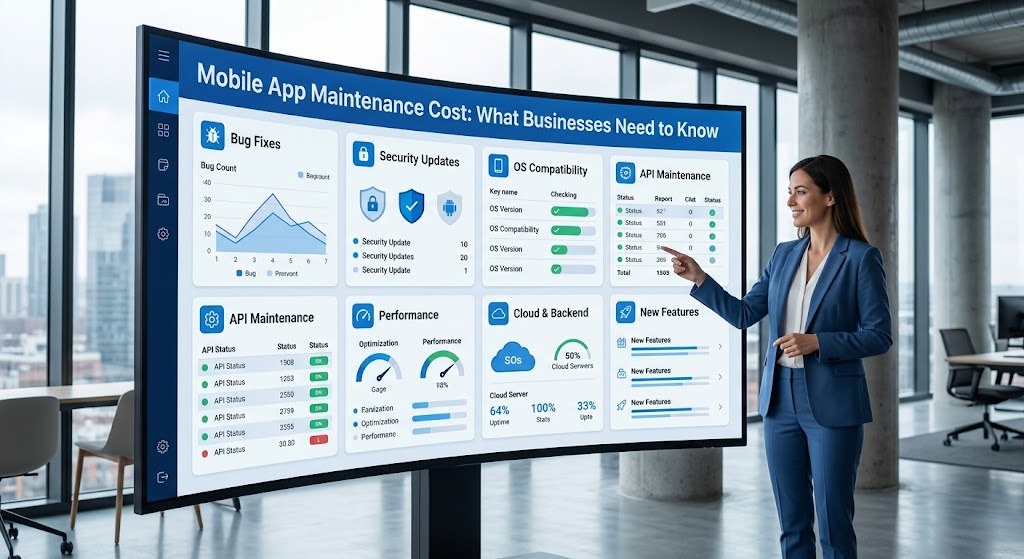
Maintenance | Support hours, updates, and bug-fix terms |
Third-party costs | Hosting, subscriptions, messaging, and other service fees |
What affects mobile app development cost in Qatar?
The total cost depends on the project's scope and delivery requirements, including:
Number and complexity of features
Android, iOS, or both
Custom interface requirements
Backend and administrative functionality
External system integrations
Security and testing requirements
Data migration
Performance and availability requirements
Maintenance arrangements
A basic information app and a multi-role marketplace are very different projects. Giving one price for both without understanding the scope would be misleading.
Ask each company to identify exclusions, assumptions, payment milestones, change-request rates, and any recurring costs. For budgeting, request separate estimates for the initial release and future enhancements.
8. Examine the Development Process and Communication
A transparent development process helps businesses understand progress, identify problems early, and make decisions without unnecessary delays.
Ask how the company will move from requirements to design, development, testing, and launch.
A practical development workflow
Step 1: Discovery and requirements
The team clarifies business objectives, target users, core workflows, technical constraints, and success criteria.
Step 2: Scope and planning
The parties agree on features, deliverables, milestones, responsibilities, budget assumptions, and acceptance criteria.
Step 3: UI and UX design
The team prepares user flows, wireframes, and interface designs for review.
Step 4: Development
Developers implement the mobile application, backend services, integrations, and administrative functionality included in the agreed scope.
Step 5: Testing
The application is tested for functionality, usability, performance, security issues, and compatibility with supported devices.
Step 6: Deployment
The team prepares the production environment and helps with app store submissions where included in the agreement.
Step 7: Maintenance
The company and client follow an agreed process for monitoring, bug fixes, updates, and future improvements.
Questions about project management
Before signing, ask:
Who is the main point of contact?
How often will progress be reported?
Will you review working versions during development?
How are delays and scope changes handled?
Who approves designs and features?
What happens if a milestone is not accepted?
How are project files and decisions documented?
A clear process is more valuable than an unrealistic promise that everything will be delivered immediately.
9. Confirm Source Code Ownership and Contract Terms
Your mobile application may become an important business asset. Therefore, the contract should clearly explain ownership, access, licensing, and responsibilities.
Do not assume that paying for development automatically resolves every intellectual property question.
Review these contract points
Source code: Clarify who owns the custom code and how it will be delivered.
Design assets: Establish rights to the interface designs, icons, graphics, and other project materials.
Third-party components: Identify libraries, frameworks, paid services, and their licensing conditions.
Accounts and credentials: Decide who controls the app store accounts, hosting accounts, domain names, and production credentials.
Documentation: Specify whether the company will deliver technical documentation, deployment instructions, and API details.
Confidentiality: Explain how business information, credentials, and customer data will be handled.
Exit arrangements: Define how the project can be transferred to another developer if the relationship ends.
Warranty and support: Distinguish included bug fixes from new features or changes to the original scope.
Have the agreement reviewed by an appropriate professional when the project involves significant investment, sensitive data, or complex ownership arrangements.
10. Ask About Post-Launch Support and Maintenance
Launching an app is the beginning of its operational life, not the end of development.
Operating systems change, dependencies require updates, user feedback reveals new needs, and external services can change their APIs or pricing.
Ask the provider to describe its post-launch support model before the project begins.
What should maintenance cover?
Depending on your agreement, support may include:
Bug fixes
Operating-system compatibility updates
Dependency updates
Performance monitoring
Security improvements
Backup checks
Crash reporting
Store submission assistance
Technical support
Planned feature enhancements
Clarify support hours, response targets, escalation procedures, included work, and additional charges.
For business-critical applications, also ask about incident recovery, access to monitoring tools, and continuity if the original development team becomes unavailable.
If the app relies on cloud services, review the relevant cloud and DevOps solutions and clarify who will manage production infrastructure.
11. Understand Integrations and Future Scalability
A mobile application often needs to exchange information with existing business systems.
For example, an e-commerce app may need to synchronise products and orders with inventory software. A service business may need customer information to connect with its CRM. An employee app may require integration with internal databases or an ERP platform.
Discuss these requirements before the team finalises its architecture.
Questions to ask
Are documented APIs available?
Who will develop and maintain the integrations?
How will authentication between systems work?
What happens if an external service is unavailable?
How will duplicate or failed transactions be handled?
How will data consistency be maintained?
Can new features be added without rebuilding the entire application?
Scalability should be planned according to realistic needs. Not every app requires a complex distributed architecture from day one, but its design should account for foreseeable growth and technical constraints.
12. Create a Consistent Vendor Evaluation Scorecard
Once you have shortlisted two or three providers, use the same criteria to evaluate each one.
The following scorecard is an example. Adjust the weights to match your project's priorities.
Evaluation criterion | Suggested weight |
|---|---|
Relevant experience and portfolio | 15% |
Technical expertise | 15% |
Understanding of business requirements | 15% |
Security and privacy approach | 15% |
Project management and communication | 10% |
Scope clarity and pricing transparency | 10% |
Source code and asset ownership terms | 10% |
Post-launch support | 10% |
Total | 100% |
Score each company from 1 to 5 for every criterion:
1: Major concerns or insufficient evidence
2: Below expectations
3: Acceptable
4: Strong
5: Excellent evidence and a good fit
Multiply each score by the criterion's weight, using the same scoring method for every provider. Treat the final score as a comparison aid, not a guarantee of project success.
Some requirements should also be treated as mandatory. For example, unclear ownership terms or an unacceptable security approach should not be overlooked simply because a company receives a high overall score.
13. Common Mistakes to Avoid When Hiring an App Development Company
Businesses can reduce project risk by avoiding several common mistakes.
Choosing based only on price
A low quotation may exclude important features, testing, infrastructure, or maintenance. Compare the scope and assumptions behind each proposal.
Starting development without clear requirements
Unclear requirements can lead to repeated revisions, delays, and disagreements. Document the core workflows and acceptance criteria before development begins.
Selecting technology before defining the problem
A framework should support your requirements, not dictate them. Ask providers to explain the benefits and trade-offs of their recommendations.
Ignoring security until launch
Security and privacy considerations should influence data collection, architecture, authentication, access controls, and testing from the beginning.
Assuming app store approval is guaranteed
Apple and Google have their own policies and review processes. The development company can prepare and submit the application, but final decisions remain with the relevant platform.
Failing to clarify ownership
Unclear ownership or account access can make future maintenance and vendor transitions difficult. Put these terms in writing.
Forgetting maintenance costs
A functioning app still needs updates and operational support. Include recurring expenses in the long-term budget.
14. A Practical Checklist Before Signing the Contract
Use this checklist before making your final decision.
The business objectives and target users are documented.
The first-release features and exclusions are clear.
The company has demonstrated relevant experience.
The proposed technology has been explained.
The backend, integrations, and infrastructure requirements are documented.
Security and data privacy responsibilities are defined.
The quotation includes milestones and payment terms.
Testing and acceptance criteria are agreed upon.
Source code, intellectual property, and account ownership are addressed.
Deployment and app store submission responsibilities are clear.
Maintenance, bug fixes, and support terms are documented.
There is a clear process for changes and project handover.
If several important items remain unanswered, request clarification before committing to the project.
Why Consider Galaxium Coding for Your Mobile App Project?
Businesses planning a mobile application need a development partner that can understand their objectives and consider how the app fits into their wider digital operations.
Galaxium Coding provides technology services covering mobile applications, custom software, web applications, and related business solutions. The right project approach depends on the client's requirements, technical constraints, and planned scope.
Before selecting any provider, discuss your proposed features, integrations, timeline, budget, ownership expectations, and support requirements. Review the available Galaxium Coding projects and ask questions about the capabilities relevant to your application.
If your project also requires a connected website or business platform, explore web application development and determine whether a broader solution would be more appropriate than a standalone mobile app.
Ready to Discuss Your Mobile App Requirements?
Start with a clear description of your business problem, target users, essential features, and preferred launch timeline.
You can contact Galaxium Coding to discuss your requirements and explore possible development approaches.
The goal is not simply to launch an app. It is to build a useful, secure, maintainable digital product that supports your business objectives.
Frequently Asked Questions
1. How do I choose the best mobile app development company in Qatar?
Evaluate the company's relevant portfolio, technical expertise, development process, security practices, pricing transparency, ownership terms, and post-launch support. Request a written proposal and compare shortlisted providers using consistent criteria.
2. How much does mobile app development cost in Qatar in 2026?
There is no single price that applies to every project. Costs depend on feature complexity, supported platforms, backend requirements, integrations, design, testing, security, and maintenance. Request a scope-based quotation with clear exclusions and recurring costs.
3. Should I choose native or cross-platform app development?
Native development may suit projects requiring extensive platform-specific functionality or particular performance characteristics. Cross-platform frameworks can reduce duplicated work for many business applications. The best option depends on your requirements, budget, and long-term maintenance plans.
4. How long does it take to develop a mobile app?
The timeline depends on the application's scope, complexity, integrations, approvals, testing requirements, and the availability of decision-makers. A small MVP may take substantially less time than a complex platform. Ask for a milestone-based schedule after requirements have been assessed.
5. Should a mobile app development company provide maintenance?
You should establish a clear maintenance plan, whether the original developer provides it or another team takes responsibility. Define bug-fix terms, operating-system updates, security maintenance, response times, and additional charges.
6. Will I own the source code after development?
Ownership depends on the contract and applicable intellectual property terms. Your agreement should explicitly address custom source code, designs, third-party components, documentation, and access to project accounts.
7. Can one application support both Android and iOS?
Yes. Native applications can be developed separately for each platform, while cross-platform frameworks can share substantial portions of code. Platform-specific features and testing may still be required.
8. What security measures should a mobile application include?
Depending on the application's risk and data, important measures may include secure authentication, access controls, encrypted communication, safe API design, appropriate data retention, dependency updates, backups, and security testing.
9. Can a mobile app integrate with an existing CRM or ERP system?
Yes, provided the existing system supports a suitable integration method and the required access is available. Integration planning should cover APIs, permissions, data synchronisation, error handling, and maintenance responsibilities.
10. What should I prepare before requesting an app development quotation?
Prepare a short project brief covering the business objective, target users, core features, supported platforms, required integrations, design expectations, approximate budget, and desired timeline. You can refine the details with the development team during discovery.
Final Thoughts
Choosing a mobile app development company in Qatar requires more than comparing prices or reviewing interface designs. Businesses should assess technical capability, security, project transparency, ownership, integration requirements, and long-term support.
A structured evaluation helps you identify a provider whose approach fits your requirements and reduces avoidable uncertainty before development begins.
Define your goals, compare written proposals, ask specific questions, and make sure responsibilities are documented. With the right planning and a suitable development partner, your mobile application can become a practical and maintainable part of your digital strategy.