How Much Does ERP Software Cost in Qatar in 2026? Complete Pricing & Implementation Guide
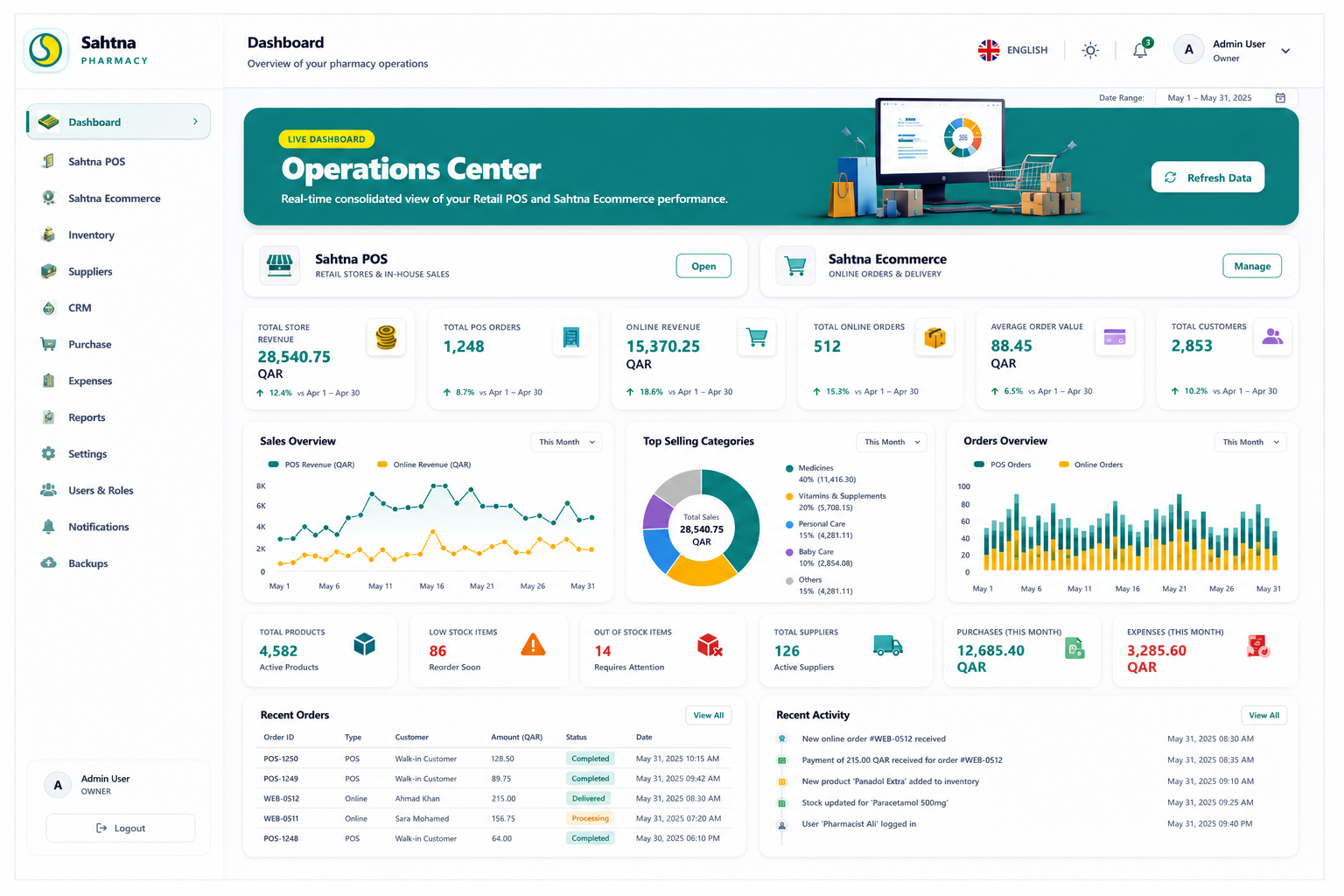
ERP software connects finance, sales, inventory, HR, procurement and business operations into one integrated digital system.
ERP software has become an important technology investment for businesses that want to move beyond spreadsheets, disconnected applications and manual processes.
But when a company starts researching ERP systems, one of the first questions is usually:
How much does ERP software cost in Qatar in 2026?
The difficult part is that there is no single ERP price.
An ERP system for a small trading company can be completely different from an enterprise platform connecting finance, inventory, procurement, HR, sales, warehouses, branches, customers, suppliers and management dashboards.
The total investment can depend on:
Number of ERP modules
Number of users
Business size
Customization requirements
Cloud or on-premise deployment
Data migration
Third-party integrations
Mobile applications
AI functionality
Automation
Reporting and dashboards
Security requirements
Implementation services
Training
Support and maintenance
For businesses in Qatar, ERP should therefore be evaluated as a business transformation project, not simply as software that can be purchased from a price list.
Qatar is also actively encouraging digital transformation and adoption of digital technologies. The country's Digital Agenda 2030 focuses on areas including digital infrastructure, digital government, digital technologies, digital innovation and the digital economy.
This makes ERP particularly relevant for businesses looking to improve operational efficiency and build stronger digital infrastructure.
In this guide, we will explain the different ERP pricing models, what affects the final cost, implementation expenses, hidden costs and how to determine whether your business actually needs ERP.
How Much Does ERP Software Cost in Qatar?
ERP pricing can range from relatively affordable subscription-based systems to highly customized enterprise platforms requiring significant implementation and development work.
A useful way to think about ERP investment is:
Software + Implementation + Customization + Integration + Data Migration + Training + Support
Rather than asking only:
"How much is the ERP?"
business owners should ask:
"How much will it cost to successfully implement an ERP system that solves our business problems?"
A basic ERP may have a lower software price but require significant customization.
Another ERP may have a higher subscription price but already include most of the functionality a company needs.
Therefore, comparing only the monthly subscription can produce a misleading result.
ERP Software Pricing Models in Qatar
There are several common ways ERP systems are priced.
1. Monthly Subscription ERP
Cloud ERP systems are often sold using a subscription model.
The business may pay according to:
Number of users
Modules
Storage
Features
Usage
Support level
Integration requirements
For example:
Monthly ERP cost = Number of users × Subscription price
This model can reduce the initial investment because the company does not necessarily need to purchase servers or build the entire infrastructure itself.
However, businesses should calculate the total cost over several years, not just the first month.
2. Annual ERP Subscription
Some providers offer annual contracts instead of monthly billing.
This can make budgeting easier because the company knows its software expense for the year.
However, businesses should check:
Renewal pricing
User expansion costs
Additional module charges
Support fees
Storage fees
Integration charges
Contract terms
A low initial annual price can increase significantly as the business adds employees and functionality.
3. Per-User ERP Pricing
Another common model charges according to the number of users.
For example, a company with:
10 users
may pay considerably less than a company with:
100 users
But not every employee necessarily needs the same level of access.
A good ERP implementation should therefore define user roles carefully.
For example:
Sales employee
→ Customers
→ Sales orders
→ Quotations
Warehouse employee
→ Inventory
→ Stock transfers
→ Goods receiving
Accountant
→ Invoices
→ Payments
→ Financial reports
Manager
→ Dashboards
→ Reports
→ Approvals
This is also important for security because employees should not automatically receive access to information they do not need.
4. Custom ERP Development
Some businesses discover that ready-made ERP software does not properly match their operations.
This can happen when a company has:
Unique workflows
Specialized approval processes
Complex inventory requirements
Multiple branches
Industry-specific operations
Existing software that must be integrated
Special customer portals
Custom mobile applications
Complex reporting requirements
In such cases, custom ERP development may be considered.
A custom ERP can be developed around the company's actual workflow instead of forcing employees to change their processes to fit generic software.
For businesses requiring this level of flexibility, custom software development services in Qatar can be used to build business-specific platforms and integrations.
What Is Included in ERP Software?
ERP is not one single feature.
It is normally a collection of interconnected business modules.
A company might require:
Finance
Accounts payable
Accounts receivable
Expenses
Invoicing
Payments
Financial reporting
Sales
Leads
Customers
Quotations
Sales orders
Invoices
Sales performance
CRM
Customer records
Communication history
Lead management
Sales pipelines
Follow-ups
Inventory
Products
Warehouses
Stock movements
Stock adjustments
Reordering
Inventory reports
Procurement
Suppliers
Purchase requests
Purchase orders
Receiving
Supplier invoices
Human Resources
Employees
Attendance
Leave
Payroll
Employee records
Projects
Projects
Tasks
Employees
Budgets
Project reporting
Management Dashboard
Revenue
Expenses
Sales
Inventory
Employee performance
Business KPIs
The more modules a company requires, the more complicated the implementation can become.
What Factors Affect ERP Software Cost in Qatar?
The software license is only one part of the total investment.
Here are the major factors.
1. Number of Users
A company with 15 ERP users will generally have different licensing requirements from a company with 500 users.
However, user count is not the only consideration.
Different users may require different permissions and functionality.
2. Number of Modules
A basic ERP might include:
Sales + Inventory + Finance
A larger system could include:
CRM + Sales + Procurement + Inventory + Finance + HR + Payroll + Projects + Reporting + Mobile + AI
More modules usually mean:
More configuration
More testing
More training
More integrations
More data
More complex workflows
3. Customization
This is one of the biggest factors affecting ERP implementation cost.
A company may want:
Custom screens
Custom reports
Approval workflows
Special calculations
Custom notifications
Industry-specific features
Custom dashboards
Customer portals
Employee portals
The more the ERP is changed from its standard functionality, the greater the development effort can become.
4. ERP Integrations
Modern businesses rarely operate with one system.
An ERP may need to communicate with:
Payment gateways
Banks
Accounting systems
CRM platforms
E-commerce websites
Mobile applications
HR systems
SMS providers
Email platforms
WhatsApp-related business workflows
Government or third-party services
Inventory systems
For example:
Website
↓
ERP
↓
Inventory
↓
Finance
↓
Management Dashboard
This type of integration can dramatically improve operational visibility.
If your business already has a website, web application development solutions can also be used to create custom portals or interfaces that communicate with the ERP.
5. Data Migration
A company may already have years of business data.
This could include:
Customers
Suppliers
Products
Inventory
Employees
Invoices
Payments
Sales history
Purchase records
Moving this information into a new ERP is called data migration.
Data migration can become complicated when old information contains:
Duplicate records
Missing fields
Incorrect formatting
Different product codes
Inconsistent customer names
Outdated records
Therefore, businesses should budget for data cleaning and migration rather than assuming that old spreadsheets can simply be uploaded.
6. ERP Implementation
Buying ERP software does not automatically mean the project is complete.
Implementation may involve:
Business analysis
Requirement gathering
System configuration
Module setup
Workflow development
Data migration
Integration
Testing
Employee training
Deployment
Post-launch support
Implementation is often one of the most underestimated ERP expenses.
7. Cloud ERP vs On-Premise ERP
Businesses generally need to consider how the ERP will be hosted.
Cloud ERP
The software is hosted on cloud infrastructure.
Advantages can include:
Remote access
Easier scaling
Reduced hardware requirements
Centralized updates
Easier access for distributed teams
However, recurring subscription and infrastructure costs should be considered.
On-Premise ERP
The organization hosts the software on its own infrastructure.
Potential advantages include greater control over infrastructure.
However, the business may need to manage:
Servers
Networking
Backups
Security
Maintenance
Updates
Disaster recovery
The right choice depends on the company's requirements, budget, security considerations and technical capabilities.
Businesses that need cloud infrastructure, deployment or DevOps support can also consider cloud and DevOps services as part of their wider technology strategy.
ERP Implementation Cost vs ERP Software Cost
This distinction is extremely important.
Imagine a business purchases an ERP subscription.
The subscription is only one expense.
The company may also need:
ERP License
Implementation
Customization
Integration
Data Migration
Training
Support
Maintenance
The total project cost can therefore be considerably higher than the advertised software price.
This is why businesses should request a complete ERP project quotation rather than asking only for the monthly license price.
How Much Should a Small Business in Qatar Spend on ERP?
There is no universal number that applies to every small business.
A small business might only need:
Sales
Customers
Inventory
Purchasing
Finance
Basic reporting
Another company of the same size might require:
Multiple branches
Mobile applications
Advanced approvals
Customer portals
Automated workflows
AI
Complex integrations
The second project could require considerably more development.
For a small business, the goal should not be to purchase the biggest ERP available.
The goal should be to implement the right level of functionality.
ERP Cost for Medium-Sized Businesses
Medium-sized businesses often have more complicated requirements.
They may have:
Multiple departments
Several warehouses
Large product catalogs
Hundreds of customers
Multiple sales channels
Purchasing teams
Finance teams
HR departments
Branch offices
At this stage, integration becomes especially important.
For example:
Sales
↓
CRM
↓
Inventory
↓
Procurement
↓
Finance
↓
Management
When these systems operate separately, employees may have to enter the same information multiple times.
ERP can centralize these processes.
ERP Cost for Large Enterprises
Large organizations can have significantly more complex ERP requirements.
They may need:
Multiple companies
Multiple branches
Multiple warehouses
Advanced financial management
Complex permissions
Enterprise reporting
Large databases
High availability
Advanced security
Mobile applications
APIs
Business intelligence
AI
Automation
Enterprise ERP implementation therefore requires much more planning.
At this level, the project should be treated as a major digital transformation initiative.
Hidden ERP Costs Businesses Should Know About
One of the biggest mistakes businesses make is focusing only on the advertised ERP subscription.
Other expenses may include:
Customization
Changing standard functionality.
Integration
Connecting ERP to other systems.
Data migration
Moving old business records.
Training
Teaching employees how to use the new system.
Support
Resolving technical or operational issues.
Maintenance
Keeping the platform secure and functional.
Additional users
Costs can increase as the company grows.
Additional modules
Businesses may later discover that they need functionality that wasn't included in the initial package.
Reports and dashboards
Advanced reporting can require additional configuration or development.
Mobile applications
A company may eventually want employees or customers to access ERP functionality through mobile apps.
If a mobile application becomes part of the ERP strategy, mobile application development in Qatar can be used to create dedicated Android and iOS experiences.
Should You Buy Ready-Made ERP or Build Custom ERP?
This is one of the most important decisions.
Ready-Made ERP
A ready-made ERP can be attractive because it may provide:
Faster deployment
Existing modules
Established workflows
Lower initial development effort
Existing documentation
Existing support
However, limitations can include:
Limited customization
Subscription costs
Unused features
Difficult integrations
Workflow restrictions
Custom ERP
A custom ERP is developed around the organization's specific requirements.
Potential advantages include:
Custom workflows
Custom modules
Custom dashboards
Custom integrations
Greater flexibility
Easier expansion around unique requirements
But custom ERP generally requires greater planning and development effort.
The right decision depends on the business.
A Simple ERP Decision Framework
Ask these questions before choosing your ERP.
Question 1
Does a ready-made ERP already solve 80–90% of our requirements?
If yes, a ready-made system may be appropriate.
Question 2
Do we have highly specialized workflows?
If yes, customization may be necessary.
Question 3
Do we need multiple integrations?
If yes, integration capability should be a major selection criterion.
Question 4
Will our company grow significantly?
If yes, scalability should be considered from the beginning.
Question 5
Do we need mobile access?
If yes, verify whether the ERP provides a suitable mobile experience or whether a custom mobile application will be required.
Question 6
Do we need AI and automation?
If yes, make sure the system can integrate AI capabilities rather than becoming another isolated software platform.
ERP + AI: The Next Step for Businesses
ERP systems are increasingly becoming more than databases for business transactions.
AI can potentially be connected to ERP information to help businesses:
Analyze sales
Identify unusual activity
Summarize reports
Forecast demand
Assist customer service
Automate repetitive tasks
Process documents
Support employees
Generate management insights
For example:
Traditional ERP
Manager opens five reports.
↓
Reviews numbers.
↓
Compares performance.
↓
Creates conclusions.
ERP + AI
Manager asks:
"Which products had declining sales this quarter?"
↓
AI analyzes permitted business data.
↓
AI provides a summary.
↓
Manager investigates the important areas.
This does not mean AI should replace management decisions.
Instead, AI can make business information easier to understand and act upon.
Galaxium Coding's existing content also explores how businesses can use AI for customer service, automation, analysis and AI agents.
ERP and Business Automation
ERP becomes even more valuable when repetitive processes are automated.
Consider a purchase workflow.
Traditional Process
Employee identifies low stock.
↓
Creates request.
↓
Manager receives message.
↓
Manager approves.
↓
Employee creates purchase order.
↓
Supplier receives order.
↓
Warehouse receives goods.
↓
Finance processes invoice.
This can involve many manual steps.
An automated ERP workflow could potentially trigger notifications, approvals and records automatically according to predefined business rules.
Automation should therefore be considered during ERP planning.
ERP for Trading Companies in Qatar
Trading companies can particularly benefit from centralized ERP systems because their operations may involve:
Products
Suppliers
Purchasing
Warehouses
Sales
Customers
Delivery
Invoicing
Payments
Inventory
A typical workflow could be:
Supplier
↓
Purchase Order
↓
Warehouse
↓
Inventory
↓
Sales Order
↓
Customer
↓
Invoice
↓
Payment
ERP connects these stages into one system.
ERP for Construction Companies
Construction companies can have completely different requirements.
They may need:
Projects
Employees
Contractors
Materials
Procurement
Equipment
Expenses
Project budgets
Invoices
Progress tracking
A construction ERP should therefore be designed around project operations rather than simply copying a generic accounting system.
ERP for Service Businesses
Service companies may prioritize:
Customers
Employees
Appointments
Projects
Tasks
Invoicing
Contracts
Support tickets
Performance reports
For these businesses, CRM and project management can be just as important as inventory.
ERP for Retail Businesses
Retail ERP may focus heavily on:
Products
Point of sale
Inventory
Warehouses
Suppliers
Purchasing
Customers
Promotions
Sales reports
The ERP may also need to connect with an e-commerce website.
ERP and Mobile Applications
Employees increasingly expect to access business systems from mobile devices.
A mobile ERP interface can potentially allow employees to:
Approve requests
Check inventory
View customers
Create quotations
Track tasks
Receive notifications
Review reports
For field employees, mobile access can be especially valuable.
Instead of returning to the office to update the ERP, an employee can potentially update information directly from the field.
How Long Does ERP Implementation Take?
ERP implementation time depends heavily on project complexity.
A basic system may require significantly less time than a customized enterprise platform.
The implementation process can include:
Phase 1 — Discovery
Understand the business.
Phase 2 — Requirements
Document the required modules and workflows.
Phase 3 — Architecture
Design the technical structure.
Phase 4 — Configuration
Set up standard ERP functionality.
Phase 5 — Development
Build custom features.
Phase 6 — Integration
Connect external systems.
Phase 7 — Data Migration
Move existing business information.
Phase 8 — Testing
Test workflows and integrations.
Phase 9 — Training
Teach employees.
Phase 10 — Launch
Deploy the system.
Phase 11 — Optimization
Improve the system based on real-world usage.
A business should avoid choosing an ERP based solely on promises of extremely fast deployment.
A rushed implementation can create operational problems later.
How to Reduce ERP Implementation Costs
ERP does not necessarily need to become an enormous project.
Businesses can control costs by following a phased approach.
Start With Core Modules
For example:
Phase 1
CRM + Sales + Inventory + Finance
Then later:
Phase 2
HR + Procurement + Projects
Then:
Phase 3
Mobile + AI + Advanced Automation
This allows the business to start generating value before implementing every possible feature.
Avoid Unnecessary Customization
Not every ERP feature needs to be customized.
If the standard ERP already performs the required function correctly, changing it may create unnecessary costs.
Customize only where there is a genuine business requirement.
Document Requirements Before Development
Poor requirements can increase project costs.
Before development begins, document:
Users
Roles
Departments
Modules
Workflows
Reports
Integrations
Approvals
Notifications
Security requirements
The clearer the requirements, the easier it becomes to estimate the project.
Choose Scalability Over Complexity
Businesses sometimes try to build everything on day one.
This can make ERP unnecessarily complicated.
A better approach is:
Build what the business needs today.
↓
Design the architecture for tomorrow.
↓
Expand when required.
This provides a balance between current affordability and future scalability.
What Should You Ask an ERP Development Company?
Before signing an ERP agreement, ask:
1. What exactly is included?
Ask for a detailed list of modules and features.
2. How many users are included?
Clarify whether user limits apply.
3. What is the implementation cost?
Do not assume implementation is included.
4. What customization is included?
Ask what happens when additional features are requested.
5. What integrations are supported?
Check APIs and third-party integrations.
6. Who owns the data?
This is extremely important.
7. Can the system be expanded later?
Your business will change.
8. What happens if we need additional users?
Understand future pricing.
9. What support is provided?
Ask about response times and maintenance.
10. What happens after launch?
ERP should not become an unsupported system immediately after deployment.
ERP Security Should Not Be an Afterthought
ERP can contain some of a company's most important information.
It may contain:
Customer information
Employee information
Financial data
Supplier information
Business documents
Sales information
Inventory information
Therefore, security should be considered during architecture and development.
Important areas include:
Authentication
Role-based access
Permissions
Encryption
Secure APIs
Database protection
Backups
Monitoring
Audit logs
Disaster recovery
A cheap ERP system that exposes sensitive information can ultimately become far more expensive than a properly designed system.
ERP and Qatar's Digital Transformation
ERP adoption also fits into the broader digital transformation direction in Qatar.
Qatar's Ministry of Communications and Information Technology has programs aimed at helping businesses adopt digital technologies, while the country's Digital Agenda 2030 focuses on strengthening the digital economy and digital transformation.
The Qatar Development Bank also describes ERP as a system that can integrate areas such as planning, purchasing, inventory, sales, marketing, finance and HR, highlighting the visibility and operational benefits that integrated systems can provide.
This is important because ERP is not simply an IT project.
It can become part of a company's wider digital operating model.
How to Calculate the Real ERP Investment
Instead of looking at one number, calculate:
Year 1
Software
Implementation
Customization
Integration
Data migration
Training
Infrastructure
Support
Then calculate:
Year 2
Subscription
Support
Additional users
Maintenance
New integrations
Then:
Year 3
Repeat the calculation.
This provides a much more realistic Total Cost of Ownership (TCO).
Example ERP Budget Structure
A company could structure its ERP budget like this:
Cost Area | What It Covers |
|---|---|
ERP Software | License or subscription |
Implementation | Configuration and deployment |
Customization | Business-specific features |
Integration | Connecting other systems |
Data Migration | Moving existing records |
Training | Employee training |
Hosting | Cloud or infrastructure |
Security | Protection and monitoring |
Support | Technical assistance |
Maintenance | Updates and improvements |
The exact cost of each category depends on the project.
The Cheapest ERP Is Not Always the Cheapest Solution
Suppose Company A selects a low-cost ERP.
It looks affordable.
But after implementation, employees discover that:
Inventory doesn't match their workflow.
Reports are insufficient.
Website integration is difficult.
Employees need manual workarounds.
Management cannot get the required dashboards.
The company then pays for:
Customization
Additional tools
Integrations
Manual processes
Training
Support
The original "cheap" ERP can become expensive.
Company B may spend more initially on a system that properly matches its requirements.
But if that system reduces manual work and improves visibility, the overall business value may be significantly higher.
Therefore:
Don't compare ERP systems only by purchase price. Compare them by business value and total cost of ownership.
When Should a Qatar Business Invest in ERP?
ERP may become worth considering when a business experiences problems such as:
Too many spreadsheets
Duplicate data
Manual reporting
Inventory inaccuracies
Poor customer visibility
Multiple disconnected systems
Difficult financial reporting
Slow approvals
Growing employee numbers
Multiple branches
Increasing transaction volumes
If employees spend significant time moving information between systems, ERP may provide an opportunity to centralize operations.
When You May Not Need ERP Yet
Not every business needs a large ERP platform.
If your company is very small and has:
Few employees
Simple operations
Limited transactions
Simple accounting
No inventory
Few customers
a full ERP may be unnecessary.
Starting with a simpler business system may be more appropriate.
The goal should be to solve the company's actual problems rather than buying technology simply because other companies are using it.
ERP Implementation Mistakes to Avoid
Mistake 1: Choosing Based Only on Price
The cheapest quote is not necessarily the best investment.
Mistake 2: Trying to Automate a Bad Process
Automation does not automatically fix inefficient workflows.
First improve the process.
Then automate it.
Mistake 3: Ignoring Employees
Employees are the people who will actually use the ERP.
Their feedback matters.
Mistake 4: Poor Data Preparation
Incorrect data can create problems immediately after launch.
Mistake 5: Too Much Customization
Customize where necessary, not everywhere.
Mistake 6: Ignoring Integrations
An ERP that cannot communicate with important systems may create another data silo.
Mistake 7: No Post-Launch Plan
ERP requires continuous improvement.
ERP Should Become the Company's Digital Backbone
The best ERP implementation is not simply a collection of screens.
It becomes the backbone connecting:
Customers
↓
Sales
↓
Procurement
↓
Inventory
↓
Finance
↓
Employees
↓
Projects
↓
Management
↓
AI & Automation
This creates a connected digital environment where information can move between departments instead of remaining trapped inside separate systems.
How Galaxium Coding Can Help With Business Software
Every business has different requirements.
Some companies need a ready-made ERP.
Others need customization.
Some need an ERP integrated with their website.
Others need mobile applications, AI, automation or custom dashboards.
Galaxium Coding works across software development services in Qatar, web applications, mobile applications, cloud technologies and AI-enabled business solutions.
You can also explore Galaxium Coding's technology projects to understand the type of digital solutions a development company can build.
The right technology should be selected according to the company's actual business requirements.
A Practical ERP Roadmap for Qatar Businesses
A sensible implementation can look like this:
Stage 1 — Business Analysis
Identify problems and requirements.
↓
Stage 2 — ERP Selection
Compare ready-made and custom options.
↓
Stage 3 — Core ERP
Implement essential modules.
↓
Stage 4 — Integration
Connect websites, payments, CRM and other systems.
↓
Stage 5 — Automation
Automate repetitive workflows.
↓
Stage 6 — Mobile
Provide mobile access where required.
↓
Stage 7 — AI
Introduce AI where it creates measurable value.
↓
Stage 8 — Optimization
Improve the system using real business data.
This phased approach can prevent businesses from spending heavily on unnecessary features before they understand what they actually need.
Final Thoughts
So, how much does ERP software cost in Qatar in 2026?
There is no single price that applies to every business.
The final investment depends on:
ERP modules
Number of users
Business complexity
Customization
Integrations
Data migration
Hosting
Security
Implementation
Training
Support
AI
Automation
Mobile applications
The most important lesson is simple:
Don't buy ERP based only on the cheapest quotation.
Instead, calculate the complete project cost, understand what is included, identify future expenses and evaluate how the system can improve your business.
For a small company, a simple ERP may be enough.
For a growing organization, a more integrated platform may be appropriate.
For a company with highly specialized workflows, custom ERP development may provide greater flexibility.
The objective should always be the same:
Build or choose an ERP system that makes the business easier to manage, easier to scale and easier to understand.
And if you are considering a new ERP project, start with the business problem—not the software.
Technology should serve the business. Not the other way around.