ERP Software in Qatar 2026: Complete Guide to Choosing the Right ERP System
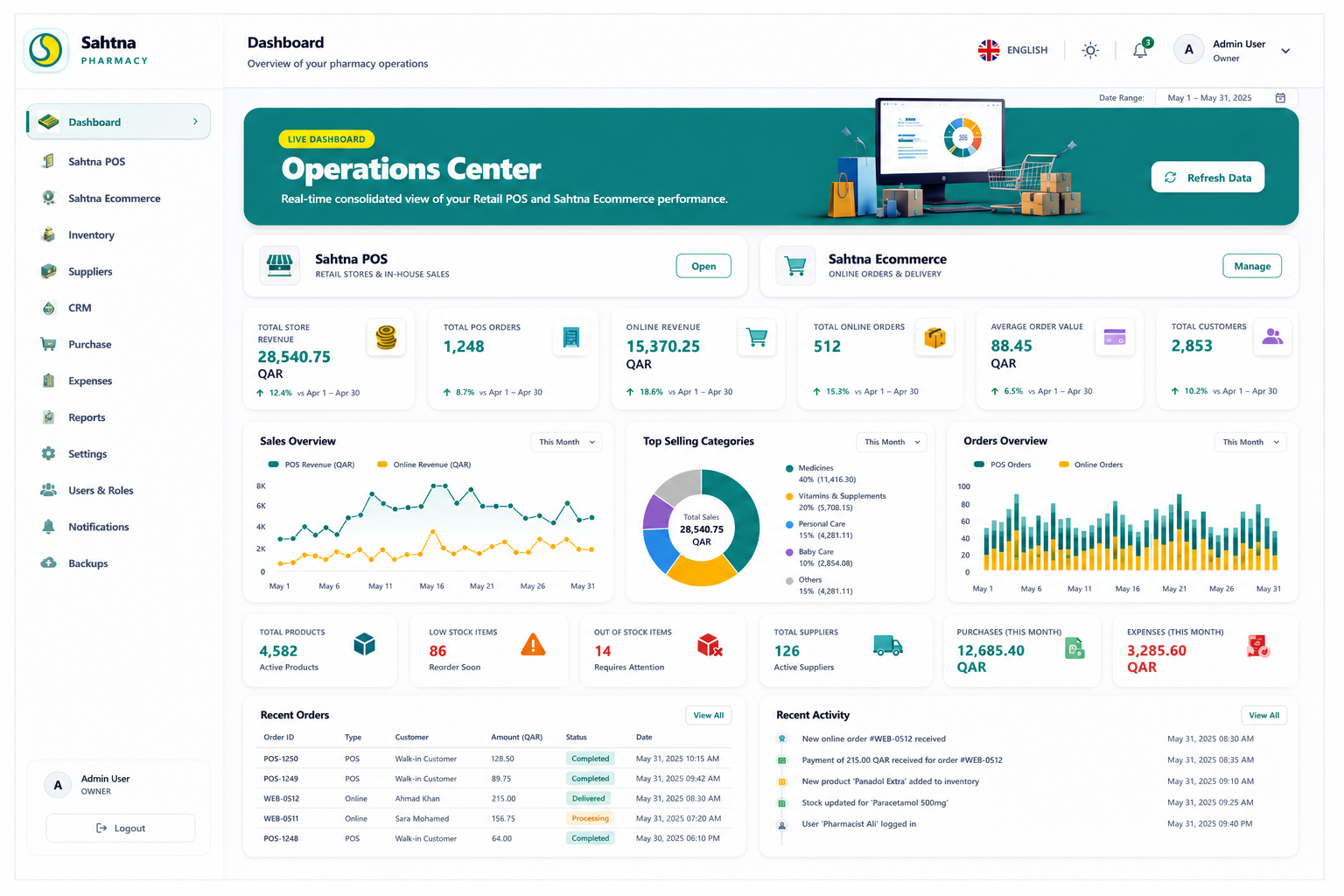
ERP software in Qatar can connect finance, sales, inventory, HR, procurement, projects and business operations through one integrated digital platform.
ERP Software in Qatar 2026: Complete Guide to Choosing the Right ERP System
For many businesses in Qatar, growth eventually creates the same problem: too many systems, too many spreadsheets, too much manual work, and not enough visibility.
Sales may use one system. Accounting may use another. Inventory may be managed in spreadsheets. HR may maintain separate employee records. Management may depend on manually prepared reports to understand what is happening across the business.
An ERP system brings these processes together.
ERP stands for Enterprise Resource Planning. An ERP platform can connect finance, accounting, sales, purchasing, inventory, human resources, projects, customer management, reporting and other business processes through one integrated environment.
For businesses in Qatar, ERP software is becoming an increasingly important part of digital transformation. Qatar Development Bank describes ERP as a way for SMEs to integrate important business functions and highlights benefits including streamlined processes, automation, visibility, reporting, customer service, cost savings and better business processes.
But choosing an ERP is not simply a matter of searching for the “best ERP software in Qatar.”
The right ERP depends on:
Your industry
Number of employees
Number of users
Number of branches
Business processes
Accounting requirements
Inventory complexity
HR and payroll requirements
Customer management needs
Project management requirements
Existing software
Integration requirements
Cloud or on-premise preference
Budget
Future growth
Security requirements
Reporting requirements
Localization requirements
This guide explains how businesses in Qatar can evaluate ERP software in 2026 and choose a system that can grow with the organization.
What Is ERP Software?
ERP software is a business management platform designed to connect multiple departments and processes through a shared system and centralized data.
Instead of having separate applications for accounting, inventory, purchasing, sales and HR, an ERP can connect these functions.
For example:
Customer → Sales → Quotation → Order → Inventory → Purchase → Delivery → Invoice → Payment → Accounting → Reporting
The same business transaction can therefore flow through multiple departments without employees repeatedly entering the same information.
A modern ERP can include modules such as:
Accounting
Finance
Sales
CRM
Purchasing
Procurement
Inventory
Warehouse management
Human resources
Payroll
Project management
Manufacturing
Asset management
Document management
Customer support
Point of sale
Business intelligence
Reporting
Workflow automation
Mobile applications
AI-powered automation
The exact modules depend on the ERP platform and how it is configured.
Why Are Businesses in Qatar Looking for ERP Software?
Qatar has a diverse business environment covering trading, construction, contracting, real estate, hospitality, retail, professional services, education, healthcare, logistics, manufacturing and technology.
Different industries have different operational requirements.
A trading company may need:
Purchasing → Suppliers → Inventory → Warehouses → Sales → Customers → Accounting
A construction company may need:
Projects → Contracts → Procurement → Materials → Employees → Expenses → Progress → Billing
A service company may need:
Leads → CRM → Quotations → Projects → Employees → Timesheets → Invoicing → Accounts
A retail company may need:
POS → Products → Inventory → Purchasing → Customers → Payments → Accounting
Without integration, businesses can end up with duplicated data and disconnected workflows.
ERP software is designed to create one connected operating environment.
Qatar Development Bank specifically identifies ERP components such as financial and accounting management, CRM, supply chain management and HR management, while highlighting reporting, customer service, cost-saving and process improvements as major benefits.
ERP Software vs Accounting Software
One of the most common mistakes businesses make is assuming that accounting software and ERP software are the same thing.
They are not.
Accounting software
Accounting software primarily focuses on:
Invoices
Expenses
Payments
Accounts receivable
Accounts payable
General ledger
Financial reports
Bank reconciliation
ERP software
ERP can include accounting while also connecting:
Finance
Sales
CRM
Procurement
Inventory
HR
Payroll
Projects
Manufacturing
Operations
Assets
Customer service
Reporting
Automation
For a small business that only needs bookkeeping, full ERP may be unnecessary.
For a growing organization with multiple departments, branches, warehouses, employees or complex workflows, an ERP can provide much greater operational visibility.
What Are the Main ERP Modules?
A good ERP implementation does not necessarily mean activating every available module.
The goal is to implement the modules that solve actual business problems.
1. Accounting and Finance
Finance is usually one of the most important ERP components.
Typical functions include:
Chart of accounts
General ledger
Accounts payable
Accounts receivable
Invoicing
Expenses
Payments
Bank reconciliation
Financial statements
Budgeting
Cost centers
Financial reporting
Audit trails
A connected financial system can reduce the need to manually transfer information between operational departments and accounting.
2. Sales Management
An ERP sales module can manage the journey from quotation to payment.
Typical workflow:
Lead → Opportunity → Quotation → Sales Order → Delivery → Invoice → Payment
Sales teams can track:
Customers
Leads
Opportunities
Quotations
Orders
Sales representatives
Products
Pricing
Discounts
Payments
3. CRM
Customer Relationship Management can be integrated directly into an ERP.
A CRM module can help businesses manage:
Leads
Prospects
Customer information
Calls
Emails
Follow-ups
Opportunities
Sales pipelines
Customer history
Support requests
This becomes especially valuable when sales and customer information needs to connect directly with orders, invoices and accounts.
4. Inventory Management
Inventory is one of the strongest reasons companies move from spreadsheets to ERP.
An inventory module can provide:
Real-time stock levels
Warehouses
Product catalogs
Stock transfers
Goods receipts
Deliveries
Stock adjustments
Reorder levels
Serial numbers
Batch tracking
Inventory valuation
Purchase integration
Sales integration
For companies handling large numbers of products, multiple warehouses or frequent transactions, inventory visibility can have a direct impact on profitability.
5. Procurement and Purchasing
Procurement can be connected to inventory and finance.
A typical process may look like:
Purchase Request → Approval → Purchase Order → Goods Receipt → Supplier Invoice → Payment
This can create better control over:
Suppliers
Purchase requests
Purchase orders
Pricing
Approvals
Deliveries
Supplier invoices
Payments
6. Human Resources and Payroll
An ERP can also centralize employee information.
HR features may include:
Employee records
Departments
Job positions
Attendance
Leave management
Recruitment
Documents
Payroll
Performance
Employee self-service
End-of-service calculations
Employee reporting
Payroll requirements should be carefully reviewed during ERP selection because the exact configuration depends on the company's workforce, policies and applicable Qatar requirements.
7. Project Management
Project-based businesses can connect project management with finance and HR.
Features may include:
Projects
Tasks
Milestones
Employees
Timesheets
Expenses
Budgets
Project profitability
Client billing
Project reports
This can be particularly useful for consulting companies, software companies, engineering firms, contractors and professional services businesses.
8. Manufacturing
Manufacturing ERP can include:
Bills of materials
Production orders
Raw materials
Work centers
Quality control
Production planning
Inventory consumption
Finished goods
Production costing
Manufacturing requirements should be assessed separately because manufacturing ERP can be considerably more complex than a basic finance-and-inventory system.
9. Point of Sale
Retail and hospitality businesses may need POS integration.
A connected POS system can communicate with:
Inventory
Products
Customers
Payments
Sales
Accounting
Promotions
Reporting
This eliminates the need to manually transfer sales information into another accounting or inventory system.
Cloud ERP vs On-Premise ERP in Qatar
One of the most important ERP decisions is deployment.
Cloud ERP
Cloud ERP is hosted on cloud infrastructure and accessed through the internet.
Advantages
Lower infrastructure requirements
Easier remote access
Scalability
Centralized updates
Easier multi-location access
Reduced server management
Potentially faster deployment
Cloud ERP can be particularly useful for organizations with distributed teams or multiple locations.
On-Premise ERP
With on-premise ERP, the organization operates the system on its own infrastructure or dedicated servers.
Advantages
Greater infrastructure control
Custom infrastructure policies
Potentially useful for specific security or operational requirements
Greater control over the hosting environment
Disadvantages
Hardware and infrastructure costs
Maintenance requirements
Backup responsibility
IT administration
Upgrade management
More complex scaling
Hybrid ERP
Some businesses may prefer a hybrid approach.
A hybrid architecture can combine:
Cloud services
Dedicated servers
Existing systems
Private infrastructure
Third-party integrations
The correct model depends on the company's technical, operational, financial and security requirements.
What Should a Qatar Business Look for in ERP Software?
Choosing an ERP only because it has a long feature list can be a mistake.
Instead, evaluate the system against your actual business.
1. Arabic and English Support
Businesses operating in Qatar may require bilingual workflows, documents, invoices, reports or interfaces.
Ask the ERP provider:
Does the interface support Arabic?
Can invoices be generated in Arabic and English?
Can reports be bilingual?
Can employee documents support Arabic?
Does the system handle Arabic correctly across web and mobile interfaces?
2. Qatar Accounting and Tax Requirements
The ERP should be configurable for the company's applicable Qatar accounting and tax processes.
Qatar's General Tax Authority publishes the country's Income Tax Law and related regulations. The GTA currently states an applicable income tax rate of 10% of taxable income under the relevant income tax framework.
This does not mean every business has the same tax treatment.
The ERP configuration should therefore be reviewed with the company's accountant or tax adviser.
Do not select an ERP simply because a vendor says “tax ready.”
Ask exactly what the system supports.
3. Payroll and Employee Management
Ask whether the ERP can support your organization's:
Payroll structure
Allowances
Deductions
Leave policies
Attendance
Employee documents
End-of-service processes
Reporting requirements
Payroll should be tested using realistic employee scenarios before implementation.
4. Multi-Company Support
If you operate more than one legal entity, the ERP may need:
Multiple companies
Separate accounting
Consolidated reporting
Inter-company transactions
Shared products
Shared customers
Shared suppliers
This should be considered before selecting the system.
5. Multi-Branch Support
Businesses with multiple branches should check whether the ERP can handle:
Branch-level sales
Branch inventory
Branch expenses
Branch employees
Branch reporting
Central management
6. Multi-Currency
Companies dealing with international suppliers or customers may require:
Multiple currencies
Exchange rates
Foreign currency invoices
Foreign currency payments
Currency gains and losses
Multi-currency reporting
ERP Integration Is More Important Than Many Businesses Realize
Your ERP should not necessarily operate as an isolated system.
A modern business may already use:
Website
E-commerce platform
Mobile app
Payment gateway
CRM
Accounting software
POS
HR platform
Email
WhatsApp integrations
Shipping systems
Banking services
Government or tax-related systems
Customer portals
The ERP should be able to integrate with relevant systems through APIs or other supported integration methods.
For example:
Website → ERP → Inventory → Order → Invoice → Payment
Or:
Mobile App → API → ERP → Customer Account → Order → Delivery
This is where custom software development becomes important.
If your company needs an ERP that works with an existing website, customer portal, mobile application or specialized business process, a standard configuration may not always be enough.
Galaxium Coding provides custom software development services in Qatar for businesses that need software designed around their specific workflows.
ERP and Web Applications
Some organizations need an ERP but also need a custom customer or employee portal.
For example:
Customer portal
Customers could:
Log in
View orders
Download invoices
Submit requests
Track deliveries
Make payments
Contact support
Employee portal
Employees could:
View attendance
Apply for leave
Access documents
Submit expenses
View tasks
Receive notifications
The portal can communicate with the ERP through APIs.
Businesses needing this type of system can also explore web application development services.
ERP and Mobile Applications
Employees and management increasingly expect business systems to work on mobile devices.
A mobile ERP companion application could provide:
Sales information
Customer information
Inventory
Approvals
Notifications
Tasks
Attendance
Expenses
Reports
Dashboards
For example, a manager could approve a purchase request from a mobile phone instead of waiting until they return to a computer.
Galaxium Coding also provides mobile application development services for organizations that need mobile applications connected to their business systems.
ERP and Cloud Infrastructure
Cloud architecture is another major consideration.
A reliable ERP environment may require:
Secure hosting
Backups
Monitoring
Access controls
Disaster recovery
SSL/TLS
Database management
Performance monitoring
Deployment processes
System updates
For organizations requiring cloud infrastructure and DevOps support, Galaxium Coding provides cloud and DevOps services.
ERP Security in 2026
ERP systems contain extremely valuable business information.
A single system may contain:
Financial information
Customer records
Supplier records
Employee information
Payroll information
Contracts
Inventory
Sales data
Business reports
Security should therefore be considered during ERP selection rather than after deployment.
Important controls include:
Role-based access
Employees should only access the information required for their jobs.
Multi-factor authentication
Additional authentication can reduce the risk of compromised passwords.
Audit logs
The organization should be able to determine who changed important records.
Encryption
Data should be protected during transmission and, where appropriate, at rest.
Backups
Backups should be tested, not merely configured.
Disaster recovery
Businesses should know what happens if the primary ERP environment becomes unavailable.
Access reviews
Employee permissions should be reviewed when employees change roles or leave the organization.
AI and ERP Software in Qatar
ERP is also moving beyond simple record keeping.
AI can potentially assist with:
Sales forecasting
Demand forecasting
Invoice processing
Document extraction
Customer support
Anomaly detection
Financial analysis
Inventory recommendations
Automated reporting
Workflow automation
Natural-language business queries
Imagine asking:
“Which products had the highest sales this month?”
Instead of manually opening multiple reports, an AI assistant connected to authorized ERP data could potentially answer the question.
Another example:
“Which invoices are overdue by more than 30 days?”
AI can help make business information easier to access, provided the underlying data, permissions and system integrations are properly designed.
The most important principle is this:
AI should improve the ERP workflow, not replace proper data governance.
How Much Does ERP Software Cost in Qatar in 2026?
There is no single ERP price for every Qatar business.
ERP cost can include:
Software licensing
User licenses
Hosting
Implementation
Configuration
Custom development
Data migration
Integrations
Training
Support
Maintenance
Mobile applications
Third-party services
Some ERP platforms use subscription pricing.
Others may involve implementation fees, user-based pricing, module-based pricing or customized commercial agreements.
Qatar Development Bank's ERP program provides a useful indication of how ERP pricing can vary by solution, business size and module selection. Its published program materials include different ERP solutions and pricing structures for different SME categories.
For example, QDB's ERP program currently lists options including Odoo, Microsoft Dynamics, WallPost, AdlER, Bright and other solutions.
Therefore, instead of asking:
“How much does ERP software cost?”
ask:
“What will my complete ERP implementation cost over three to five years?”
That calculation should include licensing, implementation, support, customization, hosting, integrations and future users.
ERP Implementation Cost vs ERP Software Cost
These are two different things.
You might purchase an ERP license for a relatively predictable monthly or annual amount but spend significantly more on:
Business analysis
Configuration
Data migration
Custom workflows
API integrations
Training
Testing
Deployment
Support
A cheap ERP with a poor implementation can become an expensive project.
A more expensive ERP with excellent implementation may produce better long-term value.
How Long Does ERP Implementation Take?
There is no universal implementation timeline.
A basic ERP for a small company may be implemented much faster than a multi-company enterprise ERP with:
Multiple branches
Large databases
Complex inventory
Payroll
Manufacturing
Custom workflows
Mobile applications
Customer portals
Multiple integrations
A practical implementation process can look like:
Phase 1 — Discovery
Understand:
Current systems
Departments
Processes
Pain points
Goals
Users
Reports
Integrations
Phase 2 — Requirements
Document exactly what the ERP must do.
Phase 3 — System Selection
Compare suitable ERP platforms.
Phase 4 — Architecture
Define:
Hosting
Database
Security
Integrations
Users
Permissions
Phase 5 — Configuration
Configure the selected ERP according to the business.
Phase 6 — Custom Development
Build only the features that genuinely require customization.
Phase 7 — Data Migration
Move and clean:
Customers
Suppliers
Products
Employees
Opening balances
Historical records where appropriate
Phase 8 — Testing
Test real business scenarios.
Phase 9 — Training
Train employees by department and role.
Phase 10 — Go-Live
Launch the ERP.
Phase 11 — Support and Optimization
Monitor performance, fix issues and improve workflows.
The Most Common ERP Implementation Mistakes
Mistake 1: Choosing ERP Based Only on Price
The cheapest software is not necessarily the cheapest solution.
Look at total cost of ownership.
Mistake 2: Buying Too Many Modules
More modules do not automatically mean a better ERP.
Implement what the business actually needs.
Mistake 3: Ignoring Data Quality
If old customer, product and accounting data is inaccurate, moving it into a new ERP will not solve the problem.
Bad data + new ERP = bad data in a new system.
Mistake 4: Ignoring Employees
Employees are the people who will actually use the ERP.
If they find it difficult or irrelevant, adoption can fail.
Mistake 5: Excessive Customization
Customization can be valuable, but unnecessary customization can increase:
Cost
Complexity
Maintenance
Upgrade difficulty
Customize where the business has a genuine competitive or operational requirement.
Mistake 6: No Integration Strategy
If the company already has a website, mobile application, POS, payment gateway or CRM, integration should be considered before selecting the ERP.
Mistake 7: No Post-Go-Live Support
ERP implementation is not finished when the system goes live.
The first weeks and months reveal real-world issues.
A good implementation partner should provide support and optimization after launch.
How to Choose the Right ERP System in Qatar
Use this process.
Step 1: Identify Your Business Problems
Write down the problems you want ERP to solve.
For example:
Inventory discrepancies
Slow invoicing
Duplicate customer data
Manual approvals
Poor reporting
Spreadsheet dependency
Payroll complexity
Lack of sales visibility
Poor procurement control
Step 2: Map Your Current Processes
Document what actually happens.
For example:
Customer inquiry → Salesperson → Quotation → Approval → Order → Warehouse → Delivery → Invoice → Payment
Do not design the ERP around assumptions.
Design it around real processes.
Step 3: Identify Required Modules
Separate requirements into:
Must-have
Critical for operations.
Should-have
Important but not essential for launch.
Future
Useful later.
This prevents unnecessary complexity.
Step 4: Compare ERP Platforms
Compare:
Features
Cost
Scalability
Security
Arabic support
Integrations
Mobile support
Reporting
Customization
Implementation partner
Support
Data ownership
Step 5: Request a Real Demonstration
Do not accept a generic presentation.
Give the vendor a real business scenario.
For example:
“A customer places an order for 100 products. The stock is insufficient, so the system must generate a purchase requirement. After receiving the products, the warehouse delivers the order, the system generates the invoice, and finance records the payment.”
Ask the ERP provider to demonstrate the complete workflow.
This reveals much more than a list of features.
ERP Evaluation Checklist for Qatar Businesses
Before signing an ERP contract, ask:
Business
Does it fit our industry?
Can it support our current workflows?
Can it support future growth?
Finance
Does it support our accounting requirements?
Can it handle multiple currencies?
Can it produce the reports we need?
HR
Can it manage employees?
Can it handle attendance and leave?
Can it support our payroll process?
Inventory
Can it manage multiple warehouses?
Can it track batches and serial numbers if needed?
Can it connect inventory with purchasing and sales?
Technology
Is it cloud, on-premise or hybrid?
Does it have APIs?
Can it integrate with our website?
Can it integrate with our mobile app?
Can it connect to other systems?
Security
Does it have role-based access?
Does it provide audit logs?
How are backups handled?
How is disaster recovery managed?
Support
Who will implement it?
Who provides support?
What is included in the support agreement?
How quickly are critical issues handled?
Cost
What is the license cost?
What is the implementation cost?
What does customization cost?
What do integrations cost?
What does support cost?
What happens when the company adds users?
Should You Buy an ERP or Build Custom ERP Software?
This is an important decision.
Choose an existing ERP when:
Your processes are relatively standard.
You need proven modules quickly.
You want to reduce development time.
Standard functionality covers most requirements.
You do not need highly specialized workflows.
Consider custom ERP development when:
Your business has unique processes.
Standard ERP systems require excessive customization.
Your industry has specialized workflows.
You need a unique customer portal.
You need deep integration with existing software.
You need specialized mobile applications.
You want complete control over the product roadmap.
A hybrid approach can be even better
Many businesses do not need to choose between “100% standard ERP” and “100% custom ERP.”
A practical approach can be:
ERP Core + Custom Modules + Web Portal + Mobile App + APIs + AI Automation
This allows the company to use established ERP functionality while developing the specialized parts of the business separately.
Why Custom ERP Development Can Be Valuable for Qatar Businesses
Every business has differences.
Two trading companies may sell similar products but operate completely different:
Approval systems
Pricing structures
Sales processes
Delivery processes
Customer relationships
Reporting requirements
Commission structures
A custom ERP can be designed around the company's actual workflow.
Galaxium Coding specializes in software development in Qatar and can help businesses evaluate whether a standard ERP, customized ERP or integrated software architecture makes more sense for their requirements.

ERP + Website + Mobile App + AI: The Future Business Stack
ERP should not necessarily be treated as one isolated application.
A modern business ecosystem can look like:
Website
↓
Customer / Lead
↓
CRM
↓
ERP
↓
Sales + Inventory + Procurement + Finance
↓
Employee Mobile App
↓
Management Dashboard
↓
AI + Automation
This architecture allows different parts of the organization to work from connected information.
For example:
A customer submits an inquiry through the website.
The CRM records the lead.
Sales creates a quotation.
The customer accepts.
The ERP creates the order.
Inventory checks availability.
If stock is unavailable, procurement is triggered.
The warehouse receives the request.
Finance generates the invoice.
The customer receives an online notification.
Management sees the transaction on a dashboard.
AI can then help analyze patterns in the resulting data.
That is much more powerful than simply purchasing accounting software.
ERP for Different Industries in Qatar
ERP for Trading Companies
Important features may include:
Purchasing
Inventory
Warehouses
Sales
Customers
Suppliers
Accounting
Delivery
Multi-currency
ERP for Construction Companies
Important features may include:
Projects
Contracts
Procurement
Materials
Subcontractors
Employees
Expenses
Progress tracking
Project accounting
ERP for Retail
Important features may include:
POS
Inventory
Purchasing
Sales
Customers
Promotions
Multi-branch
Accounting
ERP for Restaurants
Important features may include:
POS
Kitchen workflows
Inventory
Purchasing
Recipes
Suppliers
Staff
Sales
Financial reporting
ERP for Professional Services
Important features may include:
CRM
Leads
Projects
Employees
Timesheets
Expenses
Contracts
Invoicing
Project profitability
ERP for Education
Education organizations may require:
Student management
Admissions
Fees
Attendance
Staff management
Communication
Finance
Reporting
Businesses and organizations working in education can also explore education technology solutions.
ERP and Business Intelligence
ERP creates a large amount of operational data.
That data becomes valuable when management can understand it.
Dashboards can show:
Sales
Revenue
Expenses
Profitability
Inventory
Outstanding invoices
Purchasing
Employee information
Project performance
Customer activity
The objective is not simply to collect data.
The objective is to turn data into decisions.
How ERP Improves Business Decision-Making
Imagine a company has QAR 500,000 worth of inventory.
Without integrated reporting, management may not know:
Which products sell fastest
Which products are slow-moving
Which customers owe money
Which suppliers are expensive
Which branches are profitable
Which projects are losing money
With an integrated ERP and reporting layer, management can make decisions using current operational information.
That can improve:
Planning
Purchasing
Cash flow management
Inventory management
Sales strategy
Resource allocation
ERP Software in Qatar: What Should Businesses Do in 2026?
The best approach is not:
“Which ERP is the most famous?”
Instead ask:
“Which ERP architecture is right for our business?”
For some businesses, an existing ERP may be ideal.
For others, a customized ERP may make more sense.
For others, the best option may be an ERP combined with:
Custom web applications
Mobile applications
CRM
Customer portals
APIs
Cloud infrastructure
AI
Business intelligence
The correct answer depends on the business.
Why ERP Implementation Should Start With Business Processes
ERP projects often fail when companies begin with software instead of processes.
The correct order is:
Business Goals
↓
Business Processes
↓
Requirements
↓
ERP Selection
↓
Architecture
↓
Implementation
↓
Data Migration
↓
Testing
↓
Training
↓
Go-Live
↓
Optimization
This approach reduces the risk of purchasing software that does not actually solve the organization's problems.
How Galaxium Coding Can Help With ERP-Related Software Projects in Qatar
ERP is more than installing software.
Businesses may need help with:
Business software development
ERP integrations
Custom modules
Web portals
Mobile applications
APIs
Cloud infrastructure
Workflow automation
AI integration
Business dashboards
Custom CRM
Database integration
Galaxium Coding provides custom software development services in Qatar for businesses that need software built around their operational requirements.
If the business needs a web-based business platform, web application development can provide a flexible interface for customers, employees or management.
For organizations that need mobile access, mobile application development can connect employees, customers and management with business systems.
For cloud infrastructure, deployment and operations, explore cloud and DevOps services.
You can also review Galaxium Coding's projects and portfolio to understand the company's software development capabilities.
If you are evaluating an ERP project or need a custom business software solution, contact Galaxium Coding to discuss your requirements.
Frequently Asked Questions About ERP Software in Qatar
What is ERP software?
ERP software is an integrated business management system that can connect departments such as finance, sales, procurement, inventory, HR, projects and customer management through a shared platform.
What is the best ERP software in Qatar?
There is no single ERP that is best for every company in Qatar. The right system depends on the organization's size, industry, users, processes, budget, integrations, security requirements and future growth.
Qatar Development Bank's ERP program currently lists several ERP solutions for SMEs, demonstrating that businesses have multiple solution options rather than one universal system.
How much does ERP software cost in Qatar?
ERP costs vary according to software licensing, number of users, modules, implementation, customization, hosting, integrations, training and support. Businesses should calculate total cost of ownership rather than comparing only monthly license prices.
Is cloud ERP better than on-premise ERP?
Not necessarily. Cloud ERP can provide easier scalability and remote access, while on-premise ERP can provide greater control over infrastructure. The correct choice depends on the company's technical, security and operational requirements.
Can ERP software support Arabic?
Many modern ERP systems can support Arabic, but businesses should verify Arabic interfaces, invoices, reports, documents and right-to-left functionality before purchasing.
Can ERP integrate with a website?
Yes. Depending on the ERP's API and integration capabilities, an ERP can connect with websites, e-commerce systems, customer portals, payment gateways and other applications.
Can ERP connect with a mobile app?
Yes. A mobile application can communicate with an ERP through APIs, allowing authorized users to access selected business information and workflows.
Can ERP software include CRM?
Yes. Many ERP platforms include CRM functionality or can integrate with a separate CRM.
Is ERP suitable for small businesses in Qatar?
ERP can be suitable for small businesses when the system is appropriately sized. A small company does not necessarily need a large enterprise implementation. The important factor is matching the ERP scope to the company's actual requirements.
Should a company customize its ERP?
Customization can be useful when standard ERP functionality does not meet an important business requirement. However, excessive customization can increase cost and maintenance complexity.
What is the difference between ERP and CRM?
CRM primarily focuses on customer and sales relationships. ERP covers a broader range of business processes, including finance, procurement, inventory, HR, projects and operations. Many ERP systems include CRM functionality.
Can AI be added to an ERP?
Yes. AI can potentially be integrated into ERP workflows for document processing, forecasting, reporting, anomaly detection, customer service and workflow automation. AI implementation should respect data access controls and business requirements.
How long does ERP implementation take?
Implementation time varies depending on company size, number of users, modules, data volume, integrations, customization and business complexity. A simple implementation may be much faster than a multi-company enterprise deployment.
What should I ask an ERP vendor before buying?
Ask about:
Total cost
Licensing
Implementation
Customization
Integrations
Security
Data ownership
Backups
Support
Training
Arabic support
Scalability
Mobile access
APIs
Upgrade process
Can Galaxium Coding build custom ERP software in Qatar?
Galaxium Coding provides software development services and can help businesses evaluate and develop custom software, integrations, web applications, mobile applications and other business technology solutions. The appropriate approach depends on the company's requirements and whether an existing ERP, customized ERP or custom platform is the best fit.
Final Thoughts
Choosing ERP software in Qatar in 2026 should not be treated as simply buying another business application.
An ERP can become the central operating system of a company.
The right system can connect:
Sales → Customers → Procurement → Inventory → Projects → HR → Finance → Reporting → Automation
The wrong system can create another layer of complexity.
Before selecting an ERP, understand your processes, document your requirements, compare total costs, test real workflows and think about how the business will operate three to five years from now.
And remember:
The best ERP is not necessarily the ERP with the most features. It is the ERP that fits your business, your people, your processes and your future.
For companies in Qatar that need more than standard ERP functionality, the next step may be an integrated technology ecosystem combining ERP with custom software, web applications, mobile apps, cloud infrastructure, APIs and AI automation.
Start with the business problem. Then choose the technology.

Sources and Qatar Context
For Qatar-specific ERP context, Qatar Development Bank describes ERP as a solution for integrating functions such as planning, purchasing, inventory, sales, marketing, finance and HR, and highlights benefits including reporting, customer service, cost savings, process improvement, automation and security.
QDB also currently maintains an ERP program with multiple solution providers and an application process for SMEs, showing that ERP selection in Qatar can involve different platforms and implementation models.
For taxation context, the General Tax Authority publishes Qatar's Income Tax Law and regulations and states the applicable income tax rate under the relevant framework.
ERP features, pricing, tax rules and regulatory requirements can change. Businesses should verify current requirements with the relevant Qatar authorities, ERP provider and qualified accounting/tax professionals before implementation.