How AI Is Transforming the Real Estate Industry

Explore how artificial intelligence is transforming property search, valuation, marketing, and property management in 2026.
How AI Is Transforming the Real Estate Industry in 2026
Artificial intelligence is changing how real estate businesses attract customers, market properties, analyze data, manage buildings, and support property transactions. In 2026, AI is moving beyond basic chatbots and content generation toward connected workflows that can help professionals make better-informed decisions and reduce repetitive administrative work.
For real estate agencies, property developers, investors, landlords, and property management companies, the opportunity is not simply to add an AI tool to an existing website. It is to connect useful AI capabilities with reliable property information, customer relationship management (CRM), communication channels, and operational systems.
According to the National Association of REALTORS®' September 2026 technology report, 23% of surveyed REALTORS® used AI daily and 25% used it weekly. Among agents who used AI, 75% used it to write listing descriptions, 56% used it for social media posts, and 52% used it to create emails and follow-ups. These findings illustrate how AI is already being applied to everyday real estate work rather than remaining purely experimental. Read the National Association of REALTORS®' 2026 technology report coverage.
This guide explains how AI in real estate works, which applications offer practical value, what businesses should consider before investing, and how companies can implement AI responsibly.
What Is AI in Real Estate?
AI in real estate refers to the use of artificial intelligence technologies to analyze property data, understand customer requests, generate content, identify patterns, automate workflows, and support business decisions.
Depending on the application, AI systems may use machine learning, natural language processing, computer vision, generative AI, predictive analytics, or AI agents that coordinate multiple tasks.
Examples include:
Recommending properties based on a buyer's preferences.
Answering common questions about available properties.
Helping agents prepare listing descriptions.
Analyzing historical sales data and comparable properties.
Identifying potential maintenance issues.
Summarizing property documents for professional review.
Forecasting demand using historical and current market information.
Automating lead follow-ups and appointment scheduling.
AI does not eliminate the need for real estate professionals. Property transactions involve financial commitments, negotiations, legal documentation, local market knowledge, and individual circumstances that require human judgment.
The most effective approach is to use AI for suitable information-processing and administrative tasks while keeping qualified people responsible for consequential decisions.
How Does AI Work in the Real Estate Industry?
AI systems work by processing information, identifying patterns, generating outputs, or performing defined tasks. The specific process depends on the type of AI being used.
1. Data Collection and Integration
A real estate business may hold information in several systems, including:
Property listing databases.
CRM platforms.
Website enquiry forms.
Rental and maintenance records.
Customer communication histories.
Market reports and historical transactions.
Building management systems.
AI becomes more useful when the relevant information is accurate, organized, current, and accessible through appropriate integrations.
If property availability is outdated or records contain errors, AI may recommend an unavailable apartment or provide an inaccurate response. Data quality is therefore a business requirement, not simply a technical detail.
2. AI Analysis and Understanding
Different AI techniques perform different jobs.
AI technology | Real estate application |
|---|---|
Machine learning | Identifying patterns in historical property and customer data |
Natural language processing | Understanding enquiries and summarizing documents |
Generative AI | Drafting listing descriptions, emails, and marketing content |
Computer vision | Analyzing images and identifying certain visual features |
Predictive analytics | Estimating demand, lead conversion, or maintenance risk |
Recommendation systems | Suggesting properties based on preferences |
AI agents | Coordinating defined workflows across connected systems |
These technologies are not interchangeable. A content-generation model may write a useful property description, but that does not mean it can independently determine a property's market value or verify ownership.
3. Workflow Automation
Once an AI system has processed information, it may trigger an approved workflow.
For example, a prospective tenant submits an enquiry about a two-bedroom apartment. A connected system can identify the requested property type, budget, preferred location, and move-in date. It can then search available inventory, prepare a shortlist, and route the enquiry to the appropriate agent.
The system should retrieve current availability from an authoritative database rather than inventing property details.
4. Human Review and Continuous Improvement
Real estate professionals should review important outputs before they affect customers or transactions.
Businesses can monitor response accuracy, lead quality, appointment completion, customer satisfaction, and the number of corrections required. These measurements help determine whether the AI system is producing genuine business value.
Top 10 Applications of AI in Real Estate in 2026
AI can support several stages of the property lifecycle, from the first customer enquiry to ongoing building operations.
1. AI-Powered Property Search and Recommendations
Traditional property search tools generally rely on filters such as location, price, property type, and number of bedrooms. AI can extend this experience by interpreting natural-language requests and combining several preferences.
A buyer might write:
"I need a two-bedroom apartment near my workplace, with parking, a balcony, and a budget of QAR 1.2 million."
An AI-powered search assistant could identify the important requirements and retrieve matching properties from the company's verified inventory.
Potential benefits
More natural property searches.
Recommendations based on multiple preferences.
Less time spent reviewing unsuitable listings.
Easier discovery of relevant alternatives.
Better support for customers who do not know which filters to use.
Practical example
A property portal could allow users to ask follow-up questions such as whether an apartment has a balcony, whether pets are permitted, or whether a parking space is included.
The AI should answer from verified listing information. If the information is missing, it should explain that the detail needs confirmation instead of guessing.
2. AI-Based Property Valuation and Pricing Support
Property valuation is one of the most commercially significant potential applications of AI.
Machine-learning models can analyze historical transactions, property characteristics, location, market conditions, and other relevant variables to produce an estimated value or pricing range.
Depending on the available data, a model may consider:
Property type and size.
Number of bedrooms and bathrooms.
Building age and condition.
Location and nearby amenities.
Comparable sales or rental transactions.
Recent market trends.
Relevant supply and demand indicators.
How AI valuation works
A model is trained or configured using suitable property data. It evaluates the characteristics of a property and compares them with patterns in the available information to generate an estimate.
For example, a model may estimate a range for an apartment based on recent comparable transactions. A real estate professional can then review the selected comparables, assess the property's condition, and consider factors the model may not understand.
Benefits
Faster initial pricing analysis.
More consistent comparison workflows.
Identification of unusual data patterns.
Support for large property portfolios.
Easier monitoring of changing market indicators.
Limitations
AI-generated valuations can be inaccurate when transaction data is limited, market conditions change quickly, or important property characteristics are missing.
An estimated price is not automatically an independent professional valuation, a guaranteed sale price, or a substitute for a qualified valuation where one is required.
3. Predictive Analytics for Market Trends
Predictive analytics uses historical and current information to estimate possible future outcomes. In real estate, it can help businesses explore demand patterns, rental trends, customer enquiries, and investment scenarios.
Potential applications include:
Forecasting enquiry volumes.
Identifying locations with increasing customer interest.
Estimating rental demand.
Predicting which leads may require follow-up.
Modeling different occupancy scenarios.
Planning inventory and marketing resources.
Example: Demand forecasting
Suppose a property management company operates several residential buildings. It can analyze historical enquiries, lease renewals, occupancy levels, and seasonal patterns to estimate future demand.
Management may use these estimates when planning marketing campaigns or maintenance schedules.
However, forecasts should be presented as estimates with uncertainty, not as guaranteed predictions. Economic conditions, infrastructure changes, financing costs, and unexpected events can influence property markets.
4. AI Chatbots and Virtual Property Assistants
AI-powered chatbots can answer routine property enquiries through websites, mobile applications, or supported messaging channels.
Unlike a static FAQ page, a well-designed assistant can interpret questions in natural language and retrieve relevant information from connected systems.
Common chatbot functions
Answering questions about listings.
Explaining property features.
Collecting customer preferences.
Sharing viewing availability.
Scheduling appointments.
Routing enquiries to agents.
Providing basic rental-process information.
Escalating complex questions to human staff.
Example workflow
A customer visits a property website outside normal business hours and asks about a villa's availability.
The chatbot checks the current listing database, shares the confirmed information, asks whether the customer wants a viewing, and offers available appointment slots if scheduling is integrated.
The lead can then be recorded in the CRM for follow-up.
Important implementation considerations
A property chatbot should not make unsupported promises about ownership, legal rights, financing approval, rental eligibility, or property condition.
It should also explain when it cannot answer a question reliably and provide an appropriate way to contact a real person.
Businesses planning connected digital experiences can explore web application development services for customer portals, enquiry systems, and property search platforms.
5. AI-Powered Real Estate Marketing
Real estate marketing involves property descriptions, listing pages, email campaigns, social media posts, advertising creative, and customer follow-ups.
Generative AI can help teams prepare first drafts, adapt messaging for different channels, and organize marketing workflows.
Common applications
Drafting property descriptions.
Creating social media captions.
Preparing email follow-ups.
Summarizing neighbourhood information.
Generating campaign ideas.
Reformatting approved content for different channels.
Creating first drafts of property guides and FAQs.
Example
An agent provides verified details about a three-bedroom apartment, including its size, amenities, location, and asking price.
AI can turn these details into a structured listing description and several social media captions. The agent then checks every factual claim, confirms the price and availability, and approves the final content.
This approach can reduce repetitive writing without sacrificing accountability.
Avoid misleading property advertising
AI-generated marketing must not invent features, views, amenities, distances, rental returns, or property conditions. Images should not be altered in ways that misrepresent the actual property.
Virtual staging and digitally enhanced images should be clearly disclosed when appropriate, and original property photographs should remain available when needed.
6. AI for Property Management and Predictive Maintenance
Property management teams handle tenant communication, maintenance requests, inspections, invoices, contractor coordination, and building operations.
AI can help organize these activities and identify patterns that deserve attention.
Applications in property management
Classifying tenant maintenance requests.
Prioritizing work orders based on defined criteria.
Summarizing maintenance histories.
Identifying recurring equipment problems.
Forecasting possible maintenance needs.
Answering routine tenant questions.
Generating management reports.
Supporting energy-consumption analysis.
Predictive maintenance example
A commercial building may collect data from air-conditioning systems, lifts, sensors, and maintenance logs.
An analytical model can identify patterns associated with equipment faults and flag assets that may need inspection.
The maintenance team can then investigate before deciding whether repair or replacement is necessary.
The accuracy of such predictions depends on sensor quality, historical records, and the suitability of the model. Safety-critical inspections should not be skipped because an AI system reports no problem.
Energy management
AI can also help analyze energy usage, occupancy patterns, and equipment performance. When connected to appropriate building systems, it may identify opportunities to adjust schedules or investigate unusual consumption.
Actual savings depend on the building, its equipment, operating practices, and implementation quality.
7. AI for Lead Generation and CRM Automation
Real estate agencies may receive enquiries from websites, property portals, phone calls, email, advertising campaigns, and messaging applications.
Managing these leads manually can result in delayed responses and missed follow-ups.
AI-enabled CRM workflows can help organize incoming enquiries and recommend appropriate next steps.
Useful features
Lead classification.
Duplicate enquiry detection.
Customer preference extraction.
Follow-up reminders.
Appointment scheduling.
Conversation summaries.
Lead-source reporting.
Agent assignment based on defined rules.
Example
A buyer requests information about apartments in a particular area. The system records the budget, preferred property type, and expected purchase timeline.
It can then suggest relevant available listings, assign the enquiry to an agent, and create a follow-up reminder.
A lead-prioritization model may help staff organize their workload, but it should not automatically reject customers or disadvantage people based on sensitive characteristics or unreliable assumptions.
AI should support customer service rather than create unfair barriers to access.
8. Computer Vision, Virtual Tours, and Property Visualization
Computer vision allows AI systems to analyze visual information. In real estate, this can support image organization, certain property inspection tasks, and the creation of digital property experiences.
Applications may include:
Classifying property photographs.
Identifying visible room types.
Organizing images by property features.
Supporting image-based search.
Analyzing certain visible defects.
Helping create interactive property experiences.
Virtual tours, 3D models, and augmented reality can allow prospective buyers or tenants to explore spaces remotely.
AI and virtual staging
Virtual staging can illustrate how furniture and decorative elements might look in an empty room. It can help prospective buyers understand the possible use of a space.
However, virtual staging does not prove that a property has a particular feature or that a renovation is feasible. Marketing materials should distinguish genuine photographs from generated or altered visuals.
Computer vision should also not be treated as a substitute for professional structural inspections, engineering assessments, or other specialist evaluations.
9. AI-Assisted Document Processing and Transaction Workflows
Real estate transactions can involve contracts, tenancy documents, property disclosures, invoices, identity checks, inspection reports, and other records.
AI tools can help organize documents, extract specified information, summarize lengthy text, and flag missing fields for review.
Potential applications
Extracting dates and amounts from documents.
Identifying missing information in a checklist.
Summarizing lengthy reports.
Comparing document versions.
Routing files for approval.
Tracking deadlines and reminders.
Preparing transaction status summaries.
Example
A transaction coordinator receives several documents for a property sale. An AI-enabled workflow can extract relevant dates, organize the documents, and flag fields that appear incomplete.
The coordinator checks the original records and confirms the information before updating the transaction system.
AI summaries can omit important details or misinterpret legal language. Contracts, ownership records, legal obligations, and other consequential documents should receive appropriate professional review.
10. AI for Real Estate Investment and Portfolio Analysis
Investors and asset managers often need to evaluate multiple properties, income streams, expenses, occupancy levels, financing assumptions, and potential risks.
AI can help organize this information and explore different scenarios.
Common applications
Analyzing rental income and expenses.
Comparing portfolio performance.
Identifying unusual operating costs.
Modeling occupancy changes.
Summarizing market reports.
Evaluating possible investment scenarios.
Highlighting assumptions that need further investigation.
Example
An investor compares two commercial properties. One has higher rental income but also higher operating expenses and uncertain future occupancy.
An AI-supported analysis can organize the available figures and model scenarios using different assumptions. The investor can then review the calculations, verify the underlying data, and seek appropriate financial advice.
AI-generated investment analysis should not be treated as a guaranteed return or a replacement for due diligence.
Benefits of AI in Real Estate
The business value of AI depends on the problem being addressed, the quality of implementation, and whether the resulting improvements can be measured.
Benefit | Practical impact | Important condition |
|---|---|---|
Faster administration | Less repetitive drafting and data entry | Outputs still require suitable checks |
Better customer service | More consistent answers and quicker routing | Information must be current |
Improved property discovery | More relevant recommendations | Inventory and preferences must be accurate |
Data-informed decisions | Easier analysis of patterns and scenarios | Models require reliable data |
Scalable operations | Support for larger enquiry volumes | Infrastructure and workflows must be tested |
Maintenance planning | Earlier identification of potential problems | Predictions require verification |
Marketing support | Faster production of initial content | Human approval protects accuracy |
Portfolio visibility | More accessible operational reporting | Data must be consistent across systems |
Improved Productivity
AI can reduce time spent on repetitive tasks such as drafting descriptions, preparing summaries, and categorizing enquiries.
The saved time is valuable only when the workflow is genuinely improved. If employees must spend substantial time correcting inaccurate outputs, the expected productivity gains may not materialize.
More Responsive Customer Service
A well-configured assistant can provide routine information outside standard office hours and help customers reach the correct department.
Businesses should monitor whether responses are accurate, whether enquiries are resolved, and whether customers can easily reach a human representative.
More Consistent Operations
Connected AI workflows can apply the same approved process across multiple enquiries, properties, or teams.
This can reduce inconsistency, although poorly designed automation can also repeat mistakes at scale. Appropriate controls and exception handling remain essential.
Better Use of Business Data
AI can make large volumes of operational information easier to analyze. Real estate managers may gain a clearer view of enquiries, maintenance patterns, occupancy, and marketing performance.
The resulting insights are only as dependable as the underlying information and analytical method.
Challenges and Risks of AI in Real Estate
AI adoption introduces technical, operational, financial, and ethical challenges. Businesses should consider these risks before deploying tools that affect customers or important decisions.
1. Inaccurate or Outdated Information
AI can generate convincing answers that contain incorrect details. Property availability, prices, lease terms, and building features can change frequently.
Recommended approach: Connect systems to authoritative data sources, display relevant update times where useful, and require confirmation for consequential information.
2. Data Privacy and Cybersecurity
Real estate businesses may process contact details, identity documents, financial information, tenancy records, and property access information.
Sending sensitive data to an AI service without appropriate safeguards can create privacy and security risks.
Recommended approach:
Collect only necessary information.
Restrict access according to job responsibilities.
Evaluate third-party data-processing terms.
Apply appropriate encryption and access controls.
Establish data-retention and deletion procedures.
Avoid placing confidential records into unapproved public AI tools.
Test integrations and monitor unusual activity.
3. Bias and Fair Housing Concerns
Historical data may contain patterns that reflect unfair treatment. Automated systems can reproduce or amplify those patterns if they are not carefully designed and evaluated.
For example, an AI system used to screen tenants or rank prospective buyers could produce unfair outcomes if it uses inappropriate proxies or discriminatory criteria.
Recommended approach: Review the variables used by the system, test outcomes for unfair patterns, document decision rules, and ensure qualified people can investigate and challenge consequential decisions.
Real estate businesses should check the applicable fair-housing, anti-discrimination, and consumer-protection requirements in the jurisdictions where they operate.
4. Integration With Existing Systems
A real estate company may use separate platforms for its website, CRM, listings, accounting, property management, and messaging.
If these systems do not share reliable information, AI may provide inconsistent answers or create duplicate records.
Recommended approach: Map existing workflows, identify authoritative data sources, and test integrations before expanding automation.
5. Cost and Uncertain Return on Investment
AI projects can involve development, subscriptions, data preparation, integrations, staff training, ongoing monitoring, and security work.
A sophisticated system may not be worthwhile if the business problem is small or poorly defined.
Recommended approach: Begin with a measurable use case, establish baseline performance, and compare the total cost with actual operational improvements.
6. Overreliance on Automation
AI cannot reliably resolve every unusual situation, negotiate every transaction, or understand every personal circumstance.
Recommended approach: Define clear escalation rules for legal questions, complaints, sensitive customer situations, valuation concerns, and other high-impact decisions.
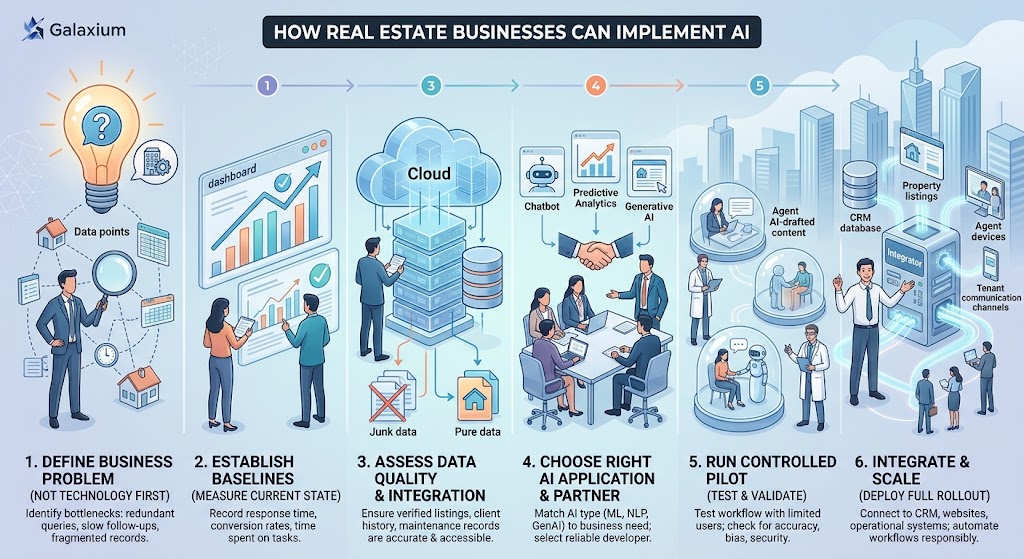
How Real Estate Businesses Can Implement AI
A successful AI project starts with a business problem, not with a particular technology.
The following implementation process can help real estate age
ncies, property developers, and property management companies plan a realistic rollout.
Step 1: Identify a Specific Business Problem
Start by identifying where the business loses time, misses opportunities, or struggles with information.
Examples include:
Repeated questions about property availability.
Slow responses to website enquiries.
Inconsistent listing descriptions.
Manual preparation of reports.
Difficulties tracking maintenance requests.
Fragmented property and customer records.
Choose a problem that is frequent enough to matter and measurable enough to evaluate.
Step 2: Establish Baseline Measurements
Before implementation, record the current performance of the selected workflow.
Possible measurements include:
Average response time.
Number of enquiries handled.
Staff time spent on repetitive tasks.
Appointment completion rate.
Lead-to-viewing conversion.
Number of incorrect responses.
Maintenance resolution time.
Customer satisfaction.
A baseline makes it easier to determine whether the AI system has improved the process.
Step 3: Review Data Quality and Access
Identify the data required for the proposed application and determine whether it is accurate, current, and legally appropriate to use.
For a property recommendation system, this may include verified listing details, current availability, location information, and user-provided preferences.
For a maintenance system, it may include work orders, asset records, sensor data, and repair histories.
Step 4: Select the Appropriate AI Approach
Different problems require different solutions.
Business requirement | Potential approach |
|---|---|
Drafting listing descriptions | Generative AI with approved property details |
Answering property enquiries | AI assistant connected to verified listings |
Predicting demand | Predictive analytics using relevant historical data |
Organizing maintenance requests | Classification and workflow automation |
Recommending properties | Search and recommendation systems |
Summarizing documents | Document-processing AI with human review |
Coordinating several business tasks | Controlled AI-agent workflows |
Not every business needs a custom AI model. An existing tool may be sufficient for a narrow task, while a business with complex workflows may benefit from custom software and carefully selected integrations.
Step 5: Run a Controlled Pilot
Test the selected workflow with a limited group of users or properties.
Review outputs for accuracy, response quality, data protection, and operational reliability. Include difficult cases, incomplete records, unusual customer requests, and situations that require escalation.
Do not expand the system solely because it performs well on simple examples.
Step 6: Integrate With Business Systems
Where appropriate, connect the AI application to the company's property database, CRM, communication tools, scheduling system, or reporting platform.
Use defined permissions and limit which actions the system can perform. For example, an assistant might be allowed to create a viewing request but not independently change a signed lease or approve a financial transaction.
Businesses exploring connected digital systems can review custom software development services for approaches to building software around their specific workflows.
Step 7: Train Employees and Define Responsibilities
Staff should understand what the AI system can do, where it may fail, and when human review is required.
Create internal guidance covering approved tools, confidential information, output verification, customer disclosures where appropriate, and escalation procedures.
Step 8: Measure Results and Improve
Compare the pilot results with the original baseline.
Evaluate whether the application reduces administrative work, improves response quality, increases customer satisfaction, or produces another measurable benefit.
If the system introduces too many errors or fails to deliver meaningful improvements, revise the workflow before scaling it.
AI in Real Estate in Qatar: Opportunities for Local Businesses
Qatar's real estate market includes residential properties, commercial developments, offices, retail spaces, hospitality-related assets, and property management operations.
For businesses operating in Qatar, AI may be useful when it addresses specific customer-service or operational challenges. The right use case will depend on the company's size, property portfolio, data availability, and existing digital infrastructure.
Multilingual Customer Support
Real estate businesses may serve customers who communicate in different languages. AI-assisted customer support can help interpret routine enquiries and prepare responses in supported languages.
However, translations and property-specific terminology should be reviewed when accuracy matters. A translated answer should not change the meaning of contractual or financial information.
Property Search and Lead Management
A connected property portal could let customers describe their requirements in natural language, search available listings, request viewings, and receive relevant follow-ups.
The system should use current property information and clearly route enquiries that require an agent's judgment.
Property Management and Maintenance
Landlords and property managers can explore AI-assisted maintenance classification, tenant enquiry handling, work-order tracking, and operational reporting.
These applications may be particularly useful where staff manage multiple buildings or receive a high volume of routine requests.
Investment and Portfolio Reporting
Developers and asset managers may use AI to organize reports, compare operating scenarios, and identify data that needs further analysis.
Any investment recommendations should be based on verified information and reviewed by people responsible for the relevant financial decisions.
Privacy and Local Requirements
Companies operating in Qatar should evaluate applicable data-protection obligations, contractual requirements, and any relevant rules governing their property activities.
Before implementing an AI service, businesses should establish what data it processes, where that data is stored, which third parties can access it, and how it is retained or deleted.
For a broader overview of digital platforms, property operations, CRM, and automation, read Real Estate Technology Solutions in Qatar 2026.
What Does AI in Real Estate Cost?
There is no universal price for implementing AI in real estate. Costs depend on the complexity of the application, the amount and quality of available data, integration requirements, security controls, and ongoing support.
A simple content-generation workflow may require only an existing subscription and staff training. A customer-facing AI assistant connected to property inventory may require application development, database access, testing, and monitoring. A predictive maintenance platform may also require sensor integrations and suitable historical data.
Main Cost Factors
Software and subscriptions: Existing AI services may charge subscription or usage fees.
Custom development: Bespoke applications require planning, design, development, testing, and deployment.
Data preparation: Records may need cleaning, standardization, or migration before AI can use them reliably.
Integrations: Connecting property databases, CRMs, accounting systems, and messaging services can add complexity.
Security and compliance: Access controls, privacy reviews, logging, and testing may be necessary depending on the data and use case.
Training and maintenance: Employees need training, and systems require monitoring, updates, and troubleshooting.
How to Evaluate Return on Investment
Businesses should compare the total cost of the project with measurable operational improvements.
A simple framework is:
Net benefit = Measurable financial benefit − Total implementation and operating cost
For example, if an AI workflow reduces the staff time needed to prepare listing drafts, the business can estimate the value of the time saved. It should also account for subscription costs, staff review time, corrections, and maintenance.
Do not assume that every hour saved will translate directly into cash savings or additional revenue. Measure the actual impact in the context of the business.
AI Tools vs. Custom AI Solutions for Real Estate
Choosing between existing AI tools and custom development depends on the workflow and the company's requirements.
Consideration | Existing AI tools | Custom AI solution |
|---|---|---|
Initial setup | Often simpler | Requires planning and development |
Business-specific workflows | Limited by available features | Can be tailored to defined requirements |
Integration | Depends on supported connectors | Can be designed around existing systems |
Data control | Depends on provider and configuration | Depends on architecture and selected services |
Scalability | Depends on the service plan and platform | Can be engineered for intended workloads |
Maintenance | Shared with the provider | Requires an agreed support and maintenance approach |
Best suited for | Common, well-defined tasks | Specialized or interconnected workflows |
A business should not commission custom development merely because AI is involved. Start with the simplest solution that meets the requirements safely and reliably.
Custom development becomes more attractive when existing tools cannot support the necessary integrations, business rules, data controls, or customer experience.
The Future of AI in Real Estate
Several developments are likely to shape how real estate businesses evaluate AI in the coming years.
More Connected AI Workflows
AI applications are increasingly being designed to coordinate multiple tasks rather than produce isolated answers.
For example, a controlled workflow could interpret a property enquiry, search verified inventory, prepare a response, offer viewing times, and record the interaction in a CRM.
These actions should operate within defined permissions and include approval requirements for consequential decisions.
More Personalized Property Discovery
Property search systems may become better at interpreting preferences and presenting relevant alternatives. This could make online property discovery more conversational.
The quality of recommendations will continue to depend on the accuracy of listing information and the relevance of the underlying matching logic.
Greater Use of Operational Data
Property managers and asset owners may increasingly combine maintenance records, occupancy data, energy consumption, and financial reporting to understand building performance.
The value comes from connecting the information to decisions, not simply collecting more data.
Increased Attention to AI Governance
As AI systems become more involved in customer communication and business workflows, companies will need clearer policies covering data use, human oversight, accountability, and error correction.
Businesses that establish these controls early may find it easier to expand AI responsibly.
Human Expertise Will Remain Important
Real estate transactions involve negotiation, trust, local knowledge, and decisions with significant financial consequences.
AI can help professionals prepare information and manage routine work, but it should not be assumed to replace professional expertise or personal judgment.
Common Mistakes to Avoid When Adopting AI
Real estate businesses can reduce implementation risks by avoiding several common mistakes.
Adopting AI Without a Defined Objective
A tool may appear impressive without solving an important business problem.
Better approach: Identify the workflow, define the expected improvement, and select measurable success criteria before investing.
Using Unverified Property Data
AI can generate convincing but inaccurate descriptions or recommendations if the underlying information is incomplete.
Better approach: Use authoritative property records, validate important facts, and make it easy for staff to correct errors.
Automating High-Impact Decisions Without Oversight
Fully automated screening, pricing, legal interpretation, or financial decisions can introduce serious risks.
Better approach: Set clear limits on automated actions and require appropriate professional review.
Ignoring Privacy and Security
Connecting customer records to AI without evaluating access, retention, and third-party processing can expose sensitive information.
Better approach: Review data flows, permissions, provider terms, and security controls before deployment.
Measuring Activity Instead of Outcomes
Generating hundreds of AI responses does not necessarily mean customers are better served.
Better approach: Track accuracy, resolution rates, conversion, customer satisfaction, and the time required for corrections.
Expanding Too Quickly
Scaling an untested workflow can spread errors across many customers or properties.
Better approach: Begin with a pilot, investigate failures, and expand only after the system meets agreed standards.
How to Choose an AI Development Partner for Real Estate
A real estate company considering custom AI development should evaluate whether a provider understands both the technical requirements and the business workflow.
Useful questions include:
Has the provider clearly understood the business problem?
Can it explain how the AI system will access reliable data?
How will the solution connect to existing property and CRM systems?
What happens when the AI produces an incorrect or uncertain answer?
How will access controls and sensitive information be protected?
Which actions require human approval?
How will performance and return on investment be measured?
What testing, documentation, training, and maintenance are included?
A suitable partner should explain the limitations of the proposed solution as well as its benefits.
Businesses evaluating digital projects can explore Galaxium Coding's projects and portfolio and learn about its software development services.
For organizations that need an AI assistant, a customer portal, a connected property platform, or automated business workflows, the architecture should reflect the actual requirements rather than add AI features without a clear purpose.
Final Thoughts
AI is transforming the real estate industry by helping businesses analyze information, respond to enquiries, prepare marketing content, support property discovery, manage maintenance, and organize operational workflows.
The strongest use cases begin with a clear business need and reliable data. Property recommendations, valuation support, predictive analytics, chatbots, marketing assistance, and document processing can all offer value when implemented appropriately.
However, AI also introduces risks involving accuracy, privacy, bias, security, and overreliance on automation. Real estate companies should establish clear controls, maintain human oversight for consequential decisions, and measure outcomes before expanding a solution.
For real estate businesses in Qatar and beyond, the next step is not necessarily to automate everything. It is to identify one important workflow, determine whether AI can improve it, and implement the technology with appropriate testing and accountability.
If your organization is planning a property portal, AI-powered customer assistant, CRM integration, or custom business application, contact Galaxium Coding to discuss your software development requirements.
Frequently Asked Questions
1. How is AI transforming the real estate industry in 2026?
AI is supporting property search, valuation analysis, predictive analytics, marketing, customer support, property management, maintenance planning, document processing, and investment analysis. The practical benefits depend on data quality, implementation, and human oversight.
2. What are the main uses of AI in real estate?
Common uses include generating listing descriptions, answering property enquiries, recommending listings, analyzing market data, organizing CRM leads, predicting maintenance needs, and summarizing documents.
3. Can AI accurately value a property?
AI can estimate property values using relevant data and comparable transactions, but estimates can be wrong when data is limited or market conditions change. Important valuations should be reviewed appropriately and should not be treated as guaranteed sale prices.
4. How does AI help real estate agents?
AI can help agents draft marketing content, organize enquiries, prepare market summaries, schedule follow-ups, and identify relevant listings. It can reduce repetitive work while allowing agents to focus on customer relationships and professional judgment.
5. Can AI automate property management?
AI can assist with tenant enquiries, maintenance classification, work-order routing, reporting, and potential maintenance forecasting. Physical inspections, repairs, safety decisions, and other consequential actions still require appropriate human involvement.
6. How can real estate companies use AI chatbots?
A property chatbot can answer routine questions using verified listing data, collect customer preferences, suggest available properties, and help schedule viewings. It should clearly escalate questions it cannot answer reliably.
7. Is AI expensive to implement in real estate?
Costs vary according to the application, development requirements, data preparation, integrations, subscriptions, security controls, and ongoing support. Businesses should evaluate the total cost against measurable operational benefits.
8. What are the risks of AI in real estate?
Key risks include inaccurate information, biased recommendations, privacy breaches, cybersecurity vulnerabilities, unreliable predictions, and excessive automation. Clear governance, testing, and human oversight help manage these risks.
9. How can AI improve property marketing?
AI can assist with listing descriptions, social media content, email campaigns, customer segmentation, and approved marketing workflows. All property details and generated claims should be checked before publication.
10. Can AI predict real estate market trends?
Predictive models can estimate patterns using historical and current data, but they cannot reliably predict every market change. Forecasts should include uncertainty and be considered alongside economic conditions and professional analysis.
11. How can AI help real estate businesses in Qatar?
Potential applications include multilingual enquiry support, property recommendations, lead management, maintenance workflows, and investment reporting. Businesses should evaluate applicable local requirements and protect customer information when implementing these systems.
12. Should a real estate company use an existing AI tool or build a custom solution?
Existing tools may be suitable for common tasks such as content drafting or document summarization. Custom development may be appropriate when a business needs specialized workflows, connected property data, specific access controls, or deeper system integration.
13. Will AI replace real estate agents?
AI can automate or assist with certain administrative and analytical tasks, but real estate work also involves negotiation, relationship-building, local expertise, and consequential decisions. The more practical approach is to use AI to support professionals rather than assume it can replace every part of their role.
14. How should a company start using AI in real estate?
Identify one recurring business problem, establish baseline performance, assess the available data, choose an appropriate solution, and run a controlled pilot. Evaluate accuracy, cost, customer impact, and security before expanding the system.