E-Commerce Payment Gateway Integration in Qatar: Complete Guide for Online Businesses
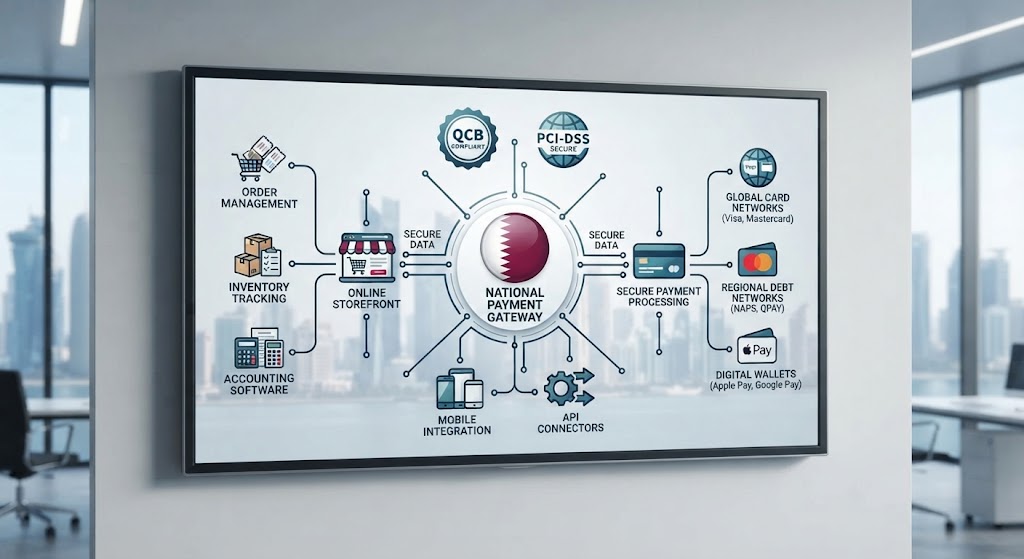
E-commerce payment gateway integration connects online checkout with secure payment processing and the wider business workflow.
What Is E-Commerce Payment Gateway Integration?
E-commerce payment gateway integration is the process of connecting an online store, mobile application, or custom e-commerce platform to a payment service that allows customers to complete transactions electronically.
The basic customer journey looks like this:
Customer → Product → Cart → Checkout → Payment Gateway → Payment Verification → Order Confirmation → Fulfilment
For a business, however, payment processing involves much more than displaying a card-payment form.
A properly integrated system may need to:
Create a payment transaction
Redirect or securely connect the customer to a payment interface
Authenticate the transaction
Receive the payment result
Verify the transaction
Update the order
Record the payment
Send an order confirmation
Update inventory
Notify fulfilment teams
Handle failed transactions
Process refunds
Maintain transaction records
Connect payment information with accounting or ERP systems
For Qatar-based e-commerce businesses, payment integration is therefore both a customer-experience requirement and a software-integration project.
Businesses building a new online store may also need broader web application development alongside the payment component.

Why Payment Gateway Integration Matters for E-Commerce in Qatar
An online store cannot provide a complete digital purchasing experience if customers cannot easily pay for their orders.
Payment integration affects several parts of the e-commerce operation:
Customer Experience
Customers expect checkout to be straightforward.
If payment fails without a clear explanation, if the checkout takes too long, or if the order status is not updated correctly, customers may abandon the purchase.
Order Automation
Payment status can be connected directly to the order-management system.
For example:
Payment successful → Order confirmed → Inventory updated → Warehouse notified → Customer notified
This reduces the need for employees to manually check payments before processing orders.
Financial Reconciliation
Payment information can potentially be connected with accounting or business-management software.
A more connected architecture can reduce manual data entry and make transaction records easier to reconcile.
Mobile Commerce
Many customers access online stores through smartphones.
Payment experiences therefore need to work properly across mobile browsers and, where applicable, mobile applications.
Businesses that require a dedicated mobile shopping experience can also explore mobile application development as part of their broader e-commerce architecture.
Business Scalability
A properly designed payment architecture should not become a bottleneck as transaction volume increases.
The integration should be designed around expected transaction volumes, order workflows, payment methods, reporting requirements, and future expansion.
How Payment Gateway Integration Works
A typical e-commerce payment integration contains several technical stages.
Step 1: Customer Places an Order
The customer selects products and proceeds to checkout.
The e-commerce platform creates an order containing information such as:
Customer details
Products
Quantities
Prices
Discounts
Taxes where applicable
Delivery charges
Final amount
Currency
Order identifier
The system should create a unique reference for the transaction.
Step 2: Payment Session Is Created
The e-commerce backend communicates with the payment provider.
Depending on the provider's architecture, the application may create a payment session, payment request, token, or transaction reference.
The exact implementation depends on the selected payment provider and its API documentation.
Step 3: Customer Completes Payment
The customer completes the payment using the payment method supported by the selected provider.
The customer may remain on the merchant's checkout experience or be redirected to a hosted payment page.
The correct approach depends on the payment provider, security requirements, and technical architecture.
Step 4: Payment Result Is Returned
The payment provider returns information indicating whether the transaction was successful, unsuccessful, cancelled, pending, or otherwise requires further handling.
The application should not simply trust the browser redirect as the final source of truth.
Step 5: Server-Side Verification
The e-commerce backend should verify the transaction using the payment provider's supported server-side mechanism.
This can involve:
Transaction ID
Order reference
Amount
Currency
Status
Signature or authentication data
Provider response
The exact verification mechanism depends on the provider.
Step 6: Order Status Is Updated
Once the payment has been verified, the e-commerce platform can update the order.
For example:
Pending Payment → Paid → Processing → Shipped → Delivered
Failed transactions should follow a separate workflow.
Step 7: Customer Receives Confirmation
The system can then send:
Order confirmation
Payment confirmation
Invoice
Email notification
SMS notification
Application notification
The exact communication channels depend on the business.

Qatar's Payment Environment
Qatar businesses should select payment solutions based on their actual business model and the payment services available to them.
Qatar Central Bank states that Qatar's retail payment infrastructure supports e-commerce transactions. QCB describes the national e-commerce payment gateway as a centralized payment gateway for processing Qatar-issued debit and prepaid card transactions for e-commerce merchants in Qatar.
QCB also identifies additional payment mechanisms within its retail payment systems, including cardless payment services and tokenized transactions.
This means a Qatar-focused e-commerce integration should not be designed around generic assumptions about international payment processing.
Instead, the business should evaluate:
Target customers
Local and international sales
Accepted payment methods
Merchant account requirements
Currency requirements
Settlement arrangements
Refund workflows
Payment provider APIs
Security requirements
Accounting requirements
Delivery and order workflows
Payment-service providers operating in or from Qatar may also be subject to the Qatar Central Bank's regulatory framework. QCB's Payment Services Regulation defines payment service providers and establishes a licensing and regulatory framework for relevant payment services.
Businesses should therefore confirm current requirements directly with their selected payment provider and relevant authorities before implementation.
Common Payment Integration Models
There is no single payment integration architecture that works for every online store.
Hosted Payment Page
The customer is redirected to a payment page operated by the payment provider.
Typical flow:
Store → Payment Provider → Customer Payment → Return to Store
Advantages can include:
Reduced payment-page development
Provider-managed payment interface
Simpler implementation in some cases
Potentially reduced handling of sensitive payment information by the merchant application
However, the exact security responsibilities and integration requirements depend on the provider.
Embedded or API-Based Payment Integration
The payment experience is more closely integrated into the e-commerce application.
This can provide greater control over the checkout experience but may introduce additional technical and security requirements.
A typical architecture could be:
Frontend → E-Commerce Backend → Payment API → Payment Provider
The backend manages the transaction and receives the provider's response.
Mobile Payment Integration
If a business operates a mobile shopping application, payment functionality can be integrated into the app's architecture.
This may require:
Mobile SDKs
APIs
Secure backend services
Transaction verification
Deep links or return URLs
Push notifications
Payment status handling
The correct implementation depends on the payment provider and the mobile platform.
Payment Methods an E-Commerce Business Should Consider
The appropriate payment methods depend on the target audience and provider availability.
Potential categories include:
Payment Method | Typical Use | Integration Consideration |
|---|---|---|
Debit cards | Everyday online purchases | Gateway/API integration |
Credit cards | Online purchases and higher-value transactions | Provider support and authentication |
Prepaid cards | Customers using prepaid payment instruments | Provider support |
Digital wallets | Mobile-focused customers | Wallet/tokenization support |
Bank-based payments | Alternative digital payment workflows | Provider and banking integration |
International cards | Overseas customers | Cross-border and settlement considerations |
Qatar Central Bank's retail payment information specifically identifies e-commerce transactions, debit and prepaid card processing, cardless payment mechanisms, and tokenized transactions within its payment infrastructure.
The business should not assume that every provider supports every payment method. Availability, eligibility, fees, settlement, transaction limits, and technical requirements should be confirmed with the provider.
Essential Features of a Payment Gateway Integration
A reliable e-commerce payment integration should handle more than successful payments.
Payment Creation
The system should generate a payment request linked to a specific order.
Transaction Verification
The backend should verify that the transaction is genuine and corresponds to the expected order.
Payment Status Management
The system should distinguish between:
Paid
Pending
Failed
Cancelled
Refunded
Partially refunded, where supported
Duplicate Payment Protection
The system should be designed to reduce the risk of processing the same order multiple times.
For example, if a customer refreshes a payment result page, the application should not accidentally create a second order or record the same payment twice.
Failed Payment Handling
Customers should receive clear instructions when a transaction fails.
The order should not automatically be marked as paid merely because the customer reached a return page.
Refund Management
A complete payment integration should consider how refunds are initiated, recorded, and reflected in the order-management system.
Transaction Logging
The application should maintain appropriate records for troubleshooting and reconciliation.
Notifications
The system can trigger customer and internal notifications after payment status changes.
Administrative Reporting
Business users may need dashboards showing:
Successful transactions
Failed transactions
Pending payments
Refunds
Daily sales
Payment totals
Order/payment mismatches

Payment Gateway Integration With E-Commerce Platforms
Payment processing should not operate independently from the rest of the store.
A mature e-commerce architecture may look like:
Customer
↓
E-Commerce Website
↓
Checkout
↓
Payment Gateway
↓
Payment Verification
↓
Order Management
↓
Inventory
↓
Accounting / ERP
↓
Customer Notification
This architecture allows payment information to become part of the broader business workflow.
Galaxium Coding's existing software-integration content also describes payment gateways as one of the external systems that may need to communicate with websites, CRM, ERP, accounting, and other business applications.
Payment Gateway + Inventory Integration
Consider an online retailer selling consumer products in Qatar.
A customer orders three products.
After successful payment:
The order is confirmed.
Inventory is reduced.
Warehouse staff receive the order.
The customer receives confirmation.
Delivery information is generated.
Accounting records can be updated.
Management reporting reflects the transaction.
Without integration, staff may need to manually update several systems.
With APIs and appropriate automation, information can move between systems automatically.
Payment Gateway + CRM Integration
Payment data can also be useful to customer-management systems.
For example:
Customer → Order → Payment → CRM Customer Record
A business could potentially use this architecture to understand:
Customer purchase history
Order frequency
Customer value
Previous failed transactions
Refund history
Product preferences
The specific information shared with a CRM should follow the business's privacy, security, contractual, and regulatory requirements.
Payment Gateway + ERP Integration
Larger businesses may connect their e-commerce store to an ERP.
A possible workflow is:
E-Commerce Store
↓
Payment Gateway
↓
Order Management
↓
ERP
↓
Accounting + Inventory + Reporting
This can be particularly useful for businesses with:
Multiple branches
Large inventories
Wholesale and retail operations
Multiple sales channels
Complex accounting workflows
Large order volumes
Security Considerations
Payment integration requires careful security planning.
A payment system should not be treated as an ordinary website feature.
Use HTTPS
All customer-facing payment-related communication should use secure HTTPS connections.
Protect API Credentials
Payment provider API keys, secrets, tokens, and credentials should not be exposed in frontend code.
Sensitive credentials should be stored securely on the server side.
Validate Payment Responses
The backend should validate payment responses using the provider's supported verification mechanism.
Prevent Tampering
The application should not rely solely on values submitted by the customer's browser.
For example, a malicious user should not be able to change a QAR 500 order into QAR 5 by manipulating a frontend request.
The server should calculate and validate transaction amounts against the actual order.
Protect Webhooks
Many payment systems use webhooks or server-to-server notifications.
Webhook endpoints should be authenticated or verified according to the provider's documentation.
Control Access
Only authorized administrators should be able to view transaction information, initiate refunds, or modify payment-related settings.
Logging and Monitoring
Payment failures and unusual transaction behaviour should be logged appropriately for troubleshooting and security monitoring.
Qatar Central Bank states that its technology and digital-transformation activities place emphasis on payment-system security, reliability, integration, and cybersecurity.
Testing a Payment Gateway Integration
Payment integration should be thoroughly tested before launch.
Testing should cover more than a single successful transaction.
Successful Payment
Confirm that:
Payment succeeds
Order becomes paid
Inventory updates correctly
Customer receives confirmation
Internal notifications work
Failed Payment
Confirm that:
Order does not become paid
Customer sees an appropriate message
The order remains recoverable
No inventory is incorrectly deducted
Cancelled Payment
Test what happens when a customer cancels or leaves the payment process.
Duplicate Requests
Test repeated clicks, browser refreshes, and repeated callbacks.
Delayed Payment Confirmation
Test situations where payment confirmation is delayed.
Refund
Verify that refunds are correctly recorded and connected to the original transaction.
Mobile Testing
Test checkout on:
Android devices
iPhones
Mobile browsers
Tablets
Desktop browsers
Network Failure
Test what happens if the customer's internet connection is interrupted during payment.
Currency and Amount Validation
Ensure that the amount sent to the provider matches the order amount stored by the business.
Arabic and English E-Commerce Experiences
Qatar businesses may serve customers with different language preferences.
A bilingual e-commerce platform can provide:
Arabic interface
English interface
Localized product information
Localized checkout
Clear payment messages
Localized notifications
Payment errors should also be understandable in the language selected by the customer.
Language support should be planned at the application level rather than added only to product pages.
Mobile-First Payment Experiences
Mobile checkout deserves special attention.
A customer may be shopping from a smartphone while using a mobile network.
The checkout should therefore minimize unnecessary steps.
Important considerations include:
Responsive design
Fast page loading
Clear payment buttons
Simple form fields
Appropriate error messages
Mobile-friendly authentication
Reliable return URLs
Correct order-status updates
For businesses planning a dedicated mobile commerce experience, mobile application development can be considered alongside the web platform.

How Much Does Payment Gateway Integration Cost in Qatar?
There is no single fixed cost for payment gateway integration.
The total project cost depends on the architecture and business requirements.
A simple store may require:
One e-commerce platform
One payment provider
Basic checkout
Basic order management
Standard confirmation
A more complex platform may require:
Multiple payment methods
Multiple currencies
Custom checkout
Mobile applications
ERP integration
CRM integration
Inventory synchronization
Accounting integration
Automated refunds
Advanced reporting
Subscription billing
Multi-vendor functionality
Custom dashboards
Main Factors Affecting Cost
Factor | Effect on Project |
|---|---|
Payment provider | API and integration requirements differ |
E-commerce platform | Existing capabilities affect development |
Custom checkout | More development may be required |
Number of payment methods | More integration and testing |
ERP integration | Adds backend and data synchronization work |
CRM integration | Adds customer-data workflows |
Mobile app | Requires mobile-side integration |
Refund automation | Requires additional workflows |
Reporting | Requires transaction and analytics architecture |
Security requirements | Can increase architecture and testing requirements |
Custom business logic | Increases development complexity |
The payment provider's own commercial charges are separate from software-development costs. Businesses should obtain current pricing directly from the selected provider.
Payment Gateway Integration vs Payment Link
A payment gateway integration and a simple payment link are not necessarily the same thing.
A payment link may be appropriate for certain businesses that need to request payment without building a complete automated checkout workflow.
A full gateway integration is more appropriate when the business needs payment to connect directly with:
Shopping carts
Orders
Inventory
Customer accounts
CRM
ERP
Accounting
Notifications
Reporting
The correct choice depends on the business model.
Common Payment Integration Mistakes
1. Choosing a Provider Before Understanding Requirements
A business may select a payment provider first and discover later that an important payment method or technical capability is unavailable.
Start by documenting requirements.
2. Treating Payment as Only a Frontend Feature
Payment processing is fundamentally a backend and integration workflow.
The frontend is only one part of the system.
3. Trusting the Redirect Alone
Returning the customer to a “success” page should not automatically be treated as proof that payment has been verified.
Server-side verification should follow the payment provider's documented approach.
4. Ignoring Failed Payments
A business should define what happens when payment fails.
The customer should be able to retry without accidentally creating duplicate orders.
5. Forgetting Refunds
Refunds should be included in the original architecture rather than treated as an afterthought.
6. Not Testing Edge Cases
Testing only successful transactions is insufficient.
Businesses should test cancellations, failures, delays, duplicate requests, refunds, network problems, and mobile checkout.
7. Exposing Sensitive Credentials
API secrets should never be placed where customers can access them through browser-side code.
8. Ignoring Business-System Integration
Payment information often needs to flow into inventory, accounting, CRM, ERP, and reporting systems.
Step-by-Step Payment Gateway Integration Process
A structured implementation can follow these stages.
Stage 1: Define Business Requirements
Document:
Products
Customers
Target markets
Currencies
Payment methods
Refund requirements
Order workflows
Delivery process
Accounting requirements
Stage 2: Select the Payment Provider
Evaluate providers based on:
Supported payment methods
Merchant eligibility
API capabilities
Documentation
Security
Settlement
Refund support
Transaction reporting
Technical support
Current commercial terms
Stage 3: Design the Architecture
Define how the following systems communicate:
Website → Backend → Payment Gateway → Order Management → Inventory → Accounting
Stage 4: Configure the Merchant Account
Complete the provider's onboarding and merchant requirements.
The exact documentation and eligibility requirements depend on the provider and business.
Stage 5: Develop the Integration
Develop the required:
API connections
Checkout workflow
Payment requests
Callback handling
Webhooks
Verification logic
Error handling
Refund workflows
Stage 6: Connect Internal Systems
Where necessary, connect payment processing with:
CRM
ERP
Inventory
Accounting
Delivery
Analytics
Customer notifications
Stage 7: Test
Run successful, failed, cancelled, delayed, duplicate, refund, mobile, and security-related scenarios.
Stage 8: Launch
Move the approved configuration to production after testing and business verification.
Stage 9: Monitor
After launch, monitor:
Payment failures
API errors
Order/payment mismatches
Refund issues
Customer complaints
Performance
Security events
Businesses requiring a broader integration architecture can explore custom software development services when standard e-commerce functionality is not sufficient for their workflows.
How to Choose a Payment Integration Partner in Qatar
A development partner should understand both the e-commerce experience and the backend business process.
Ask potential developers about:
Technical Experience
Can they work with:
REST APIs?
Webhooks?
Authentication?
Payment callbacks?
Secure backend development?
Mobile applications?
Cloud infrastructure?
E-Commerce Experience
Ask whether they can build and integrate:
Shopping carts
Checkout
Customer accounts
Order management
Inventory
Promotions
Delivery systems
Business Integration
Ask whether they can connect the payment system to:
ERP
CRM
Accounting
Inventory
Reporting
Customer notification systems
Security
Ask how they approach:
API credentials
Server-side verification
Access controls
Logging
Encryption
Secure deployment
Vulnerability management
Support
Payment integrations can require maintenance when providers change APIs, authentication methods, requirements, or technical documentation.
Ongoing software maintenance and support can therefore be part of the wider e-commerce technology strategy.
Why Custom Integration May Be Useful
Not every business needs a completely custom e-commerce platform.
However, custom integration can become valuable when the standard platform does not match the company's workflows.
For example, a business may need:
E-Commerce Website
↓
Payment Gateway
↓
Custom Order Engine
↓
ERP
↓
Inventory
↓
Delivery System
↓
CRM
A custom development approach can provide greater control over how these systems communicate.
The decision should be based on actual requirements rather than choosing custom development simply because it is technically possible.
Example: Qatar Retail Business
Consider a hypothetical Qatar-based retailer selling products online.
The business has:
An e-commerce website
Product inventory
Customer accounts
Delivery operations
Accounting software
The desired workflow is:
Customer places order
↓
Payment gateway processes transaction
↓
Backend verifies payment
↓
Order marked as paid
↓
Inventory reduced
↓
Warehouse receives notification
↓
Delivery request created
↓
Customer receives confirmation
↓
Accounting system records transaction
↓
Management dashboard updates
This example shows why payment gateway integration should be considered part of the wider e-commerce architecture.
The payment system is not an isolated component.
It is one part of a connected digital business workflow.
Future Considerations for E-Commerce Payments
Payment technology continues to evolve.
Businesses should design integrations with enough flexibility to accommodate new payment methods and changing customer expectations.
Potential areas to monitor include:
Digital wallets
Tokenized transactions
Mobile commerce
Alternative payment methods
Automated reconciliation
Subscription payments
Payment analytics
Fraud monitoring
API-based financial services
Qatar Central Bank's retail payment information already identifies tokenized transactions and multiple digital payment mechanisms within its payment ecosystem.
The practical lesson for businesses is not to build every possible payment feature immediately.
Instead, build a secure architecture that can evolve as business requirements change.
Frequently Asked Questions
What is payment gateway integration in e-commerce?
Payment gateway integration connects an online store or application with a payment service so customers can make digital payments and the business can receive verified payment results.
Do Qatar e-commerce websites need a payment gateway?
If an online business wants customers to pay electronically through its website or application, it generally needs an appropriate payment-processing solution. The exact requirements depend on the business model, payment provider, and applicable regulatory and commercial arrangements.
What payment gateway options are available in Qatar?
Qatar has a national e-commerce payment infrastructure, and businesses may also evaluate other payment-service providers based on their requirements and eligibility. Qatar Central Bank provides information about Qatar's retail payment systems and e-commerce payment gateway.
Can a payment gateway connect with an ERP?
Yes. Payment transactions can be integrated with ERP systems through APIs or other supported integration mechanisms. The exact workflow depends on the ERP and payment provider.
Can payment gateways be integrated with mobile apps?
Yes. Payment services can be integrated into mobile applications when the selected provider supports the required mobile and backend integration methods.
How long does payment gateway integration take?
The timeline depends on the complexity of the e-commerce platform, payment provider, merchant onboarding, API requirements, testing, and additional integrations.
A basic integration can be significantly simpler than a platform requiring ERP, CRM, inventory, accounting, mobile applications, and custom business workflows.
How much does payment gateway integration cost in Qatar?
There is no universal price. Development cost depends on the payment provider, e-commerce platform, number of payment methods, customization, security requirements, and integrations.
Payment-provider transaction or service charges should be considered separately from software-development costs.
Is payment gateway integration secure?
Security depends on the architecture, payment provider, implementation, configuration, and operational controls.
Important considerations include secure communication, protected credentials, server-side verification, access controls, secure webhook handling, logging, monitoring, and appropriate testing.
Should payment verification happen on the frontend?
The frontend should not be the sole source of truth for payment confirmation. The backend should use the payment provider's supported verification mechanism before marking an order as paid.
Can payment integration support refunds?
Many payment providers support refunds, but the exact capabilities and API workflow vary. Refund handling should be designed into the e-commerce system from the beginning.
Can a payment gateway be connected to CRM and inventory?
Yes. A properly designed integration can connect payment status with order management, inventory, CRM, accounting, ERP, and notification systems where the relevant APIs and business requirements support it.
Final Thoughts
E-commerce payment gateway integration in Qatar is more than adding a payment button to an online store.
A successful implementation connects the customer checkout experience with the systems that operate behind the store.
The complete workflow can look like:
Customer → Checkout → Payment Gateway → Verification → Order → Inventory → Accounting → Delivery → Customer Notification
For Qatar businesses, payment integration should be planned around the selected provider, supported payment methods, merchant requirements, security, local payment infrastructure, and the company's wider technology environment.
Businesses building a new e-commerce platform or upgrading an existing one should consider payment integration at the architecture stage rather than adding it after the rest of the system has been built.
Galaxium Coding can help businesses design and develop connected digital platforms involving e-commerce, web applications, APIs, mobile applications, automation, and business-system integrations. Businesses can contact Galaxium Coding to discuss their specific e-commerce and payment integration requirements.