AI Is Taking Jobs — Or Is It? Why AI Won't Take All Jobs
AI is changing how people work — but the future is more likely to be human-AI collaboration than the disappearance of human work.
AI Is Taking Jobs — Or Is It? Why the Future of Work Is More Complicated Than the Headlines
Artificial intelligence has become one of the biggest sources of excitement — and fear — in the modern workplace.
Every week, people see headlines suggesting that AI will replace programmers, designers, accountants, customer service representatives, marketers, writers, analysts, drivers and even managers.
For someone watching these developments from the outside, the conclusion can seem obvious:
“If AI can do all of these things, what will humans do?”
But the reality is considerably more complicated.
AI is already changing jobs. Some tasks are being automated. Some roles are shrinking. Some new positions are being created. And many existing jobs are being redesigned around AI.
However, the idea that AI will simply take all human jobs is an oversimplification.
Research from the International Labour Organization (ILO) indicates that generative AI is more likely to transform and augment many occupations than completely eliminate them. Its 2025 global analysis found that roughly one in four workers are in occupations with some degree of generative-AI exposure, while continued human involvement means most jobs are more likely to be transformed than made redundant.
The real question, therefore, is not:
“Will AI take all our jobs?”
A better question is:
“How will AI change the work people do?”

Why Are People So Scared of AI Taking Their Jobs?
The fear is understandable.
Previous technologies have changed the labour market dramatically. Computers replaced many manual information-processing tasks. Industrial machines changed manufacturing. ATMs transformed banking operations. E-commerce changed retail.
Generative AI feels different because it can work with language, images, software, data and increasingly complex business processes.
Someone who has spent years developing a particular professional skill may reasonably wonder whether an AI system could eventually perform the same task faster and cheaper.
There is also a psychological difference.
When automation affects a physical task, people can see the machine replacing the process.
With generative AI, the technology can appear to “think.”
It can write an email.
It can generate software code.
It can analyse documents.
It can create images.
It can summarize meetings.
It can answer customer questions.
It can prepare reports.
That makes the technology feel much closer to human professional work.
But there is an important distinction:
Automating a task is not the same as replacing an entire occupation.
AI Can Automate Tasks Without Eliminating the Whole Job
This distinction is one of the most important ideas in the AI-and-employment debate.
Most jobs are not one single task.
A software developer does not simply write code.
A doctor does not simply analyse medical information.
A lawyer does not simply produce documents.
A salesperson does not simply send messages.
A manager does not simply create reports.
A teacher does not simply provide information.
Each occupation involves multiple activities, including communication, judgement, collaboration, problem-solving, responsibility and handling unexpected situations.
AI may automate some of those activities without being able to replace the entire role.
The ILO specifically distinguishes between automation and augmentation. AI can automate tasks while also complementing human labour, depending on how the technology is integrated into the workplace.
This is why the statement:
“AI will replace programmers.”
is far less useful than:
“AI may automate some programming tasks and change what programmers spend their time doing.”
The second statement is much closer to what is actually happening.
What AI Is Most Likely to Replace
AI is particularly powerful when a task is:
Repetitive
Highly structured
Digital
Data-heavy
Predictable
Rules-based
Easy to measure
Based on large amounts of existing information
For example, AI can help automate:
Data entry
Basic document processing
Meeting summaries
Routine customer questions
Simple content drafts
Basic data analysis
Repetitive coding tasks
Standard reports
Appointment scheduling
Document classification
Basic translation
Routine administrative workflows
These are genuine changes.
Businesses should not pretend otherwise.
Some tasks that previously required several hours of human work may eventually take only a few minutes with AI-assisted systems.
But this does not automatically mean the employee disappears.
It can mean the employee moves toward more valuable work.
The Difference Between Replacing a Task and Replacing a Person
Imagine a customer-service employee who spends four hours every day answering repetitive questions:
“What are your opening hours?”
“Where is my order?”
“How can I reset my password?”
“What documents do I need?”
An AI system may be able to handle many of these questions automatically.
That could reduce the amount of repetitive work performed by the employee.
But the same employee may now spend more time handling:
Difficult customers
Complex complaints
Escalations
Customer relationships
Retention
Special requests
Business decisions
The job has changed.
The employee has not necessarily disappeared.
This distinction is critical when discussing the future of employment.
AI Will Replace Some Jobs — and We Should Be Honest About That
It would also be wrong to say:
“AI will never replace any jobs.”
Some jobs and job categories can absolutely be reduced or eliminated through automation.
Businesses make technology investments partly because they want to improve efficiency.
If an organization can automate a process that previously required significant manual labour, it may eventually need fewer people performing that particular task.
That is real.
The ILO's research also recognizes that some occupations have greater automation exposure than others.
The important point is that job displacement is not the same thing as the end of work.
Throughout economic history, technology has eliminated certain occupations while creating new forms of work.
The challenge is helping people move from declining tasks and roles toward emerging opportunities.
The “AI Will Take Everyone's Job” Narrative Is Too Simple
This is where many dramatic headlines create confusion.
A headline might say:
“AI could replace millions of workers.”
That sounds like millions of people will suddenly lose their entire livelihoods.
But labour-market research often measures something different: exposure to AI or potential automation of tasks.
Exposure does not necessarily mean elimination.
The ILO's 2025 research specifically notes that continued human input means most exposed jobs are more likely to be transformed than made redundant.
That distinction is extremely important.
A job can be:
AI-exposed → AI-assisted → AI-transformed
without necessarily becoming:
AI-eliminated.
What About Programmers?
Software development is one of the industries receiving enormous attention because modern AI systems can generate code.
Does that mean programmers are finished?
No.
It means the definition of programming work is changing.
A developer may increasingly spend less time writing repetitive code and more time on:
Architecture
System design
Security
Testing
Requirements
Integrations
Business logic
AI-agent design
Database architecture
Performance
Deployment
Reviewing AI-generated code
Understanding customer requirements
The developer becomes less of a person who manually produces every line of code and more of a person who designs, supervises and engineers the overall system.
That is a major shift.
It is not necessarily the disappearance of software development.
AI May Actually Create More Demand for Some Human Skills
As AI handles more routine digital tasks, certain human capabilities can become more valuable.
These include:
Critical thinking
People still need to determine whether an AI-generated answer is actually correct.
Communication
Businesses still need people who can communicate with customers, employees and partners.
Leadership
AI can provide information, but organizations still need people who establish goals and take responsibility for decisions.
Creativity
AI can generate possibilities, but humans often determine what is meaningful, appropriate and useful.
Domain expertise
An AI system may know a huge amount of information, but a professional still needs to understand how that information applies to a specific real-world situation.
Trust and responsibility
In many situations, someone must ultimately be accountable for the decision.
These human capabilities are becoming increasingly important alongside technical skills.
The Future May Be Humans + AI, Not Humans vs. AI
One of the biggest mistakes in the discussion is treating AI as if it were an employee entering the office to compete with everyone else.
A more realistic model is:
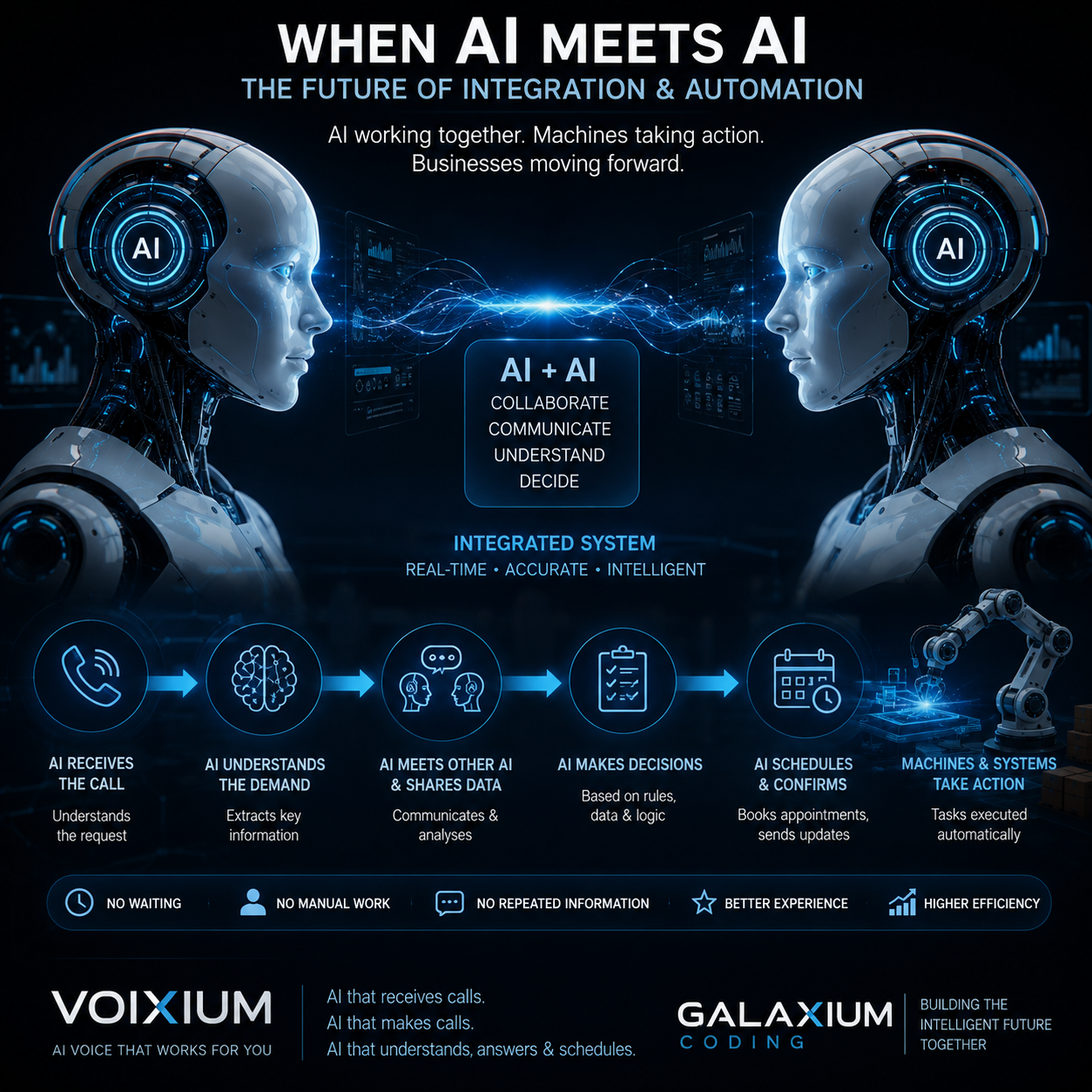
Human + AI + software + automation
For example:
A salesperson can use AI to research prospects.
A developer can use AI to accelerate coding.
A doctor can use AI to assist with information analysis.
An accountant can use AI to automate repetitive financial processes.
A marketer can use AI to analyse campaigns.
An HR professional can use AI to organize recruitment information.
In each case, the professional becomes an AI-assisted worker.
The World Economic Forum's Future of Jobs 2025 report projects significant labour-market disruption by 2030, but it also estimates 170 million new jobs could be created alongside 92 million displaced jobs, producing a projected net increase of 78 million jobs. These are projections, not guarantees, but they demonstrate why “AI equals mass elimination of all work” is an incomplete picture.
The Real Risk May Not Be AI — It May Be Failing to Adapt
This is perhaps the most important message for workers.
The biggest danger is not necessarily:
“AI will take my job tomorrow.”
It may instead be:
“Someone who knows how to use AI will become significantly more productive than someone who refuses to learn it.”
Consider two employees.
Employee A
Uses traditional methods for every task.
Employee B
Uses AI to:
Research faster
Analyse information
Draft documents
Automate repetitive work
Prepare reports
Organize information
Generate ideas
Employee B may become considerably more productive.
The competitive advantage therefore may not belong to:
AI versus humans.
It may belong to:
Humans who use AI versus humans who do not.
AI Will Also Create New Jobs
AI does not only consume labour.
It also creates demand for new skills and services.
Already emerging areas include:
AI engineering
Machine learning
AI security
AI governance
AI product management
AI automation
AI integration
Data engineering
AI testing
AI safety
AI training
AI consulting
AI implementation
AI-agent development
The ILO's 2026 research on skills in the AI era also identifies growing demand for digital, AI, cognitive and socioemotional capabilities, alongside emerging technical roles associated with developing and maintaining AI systems.
The jobs themselves may change.
But new economic activity creates new opportunities.
What Happens When One Job Disappears?
Imagine that a company automates 20 repetitive administrative positions.
That sounds negative when viewed in isolation.
But the company's new AI system may require:
Software developers
AI specialists
System administrators
Cybersecurity professionals
AI trainers
Business analysts
Customer-success staff
Process designers
Integration specialists
The labour has shifted.
This does not mean every displaced worker automatically gets a new job.
That is a real social challenge.
People may need retraining.
Some workers may experience temporary unemployment.
Some communities may be affected more than others.
Some occupations may decline significantly.
So the answer should not be:
“Don't worry. Nobody will lose a job.”
That would be unrealistic.
The better answer is:
AI will change the labour market, but there is no credible basis for assuming that AI will simply eliminate all human employment.
Why Human Judgment Still Matters
AI can process enormous amounts of information.
But real-world situations are messy.
A customer may behave unexpectedly.
A business decision may involve competing priorities.
A manager may need to understand an employee's circumstances.
A doctor may need to communicate difficult information with empathy.
A lawyer may need to negotiate.
An engineer may need to make a safety-critical decision.
A business owner may need to take responsibility for a strategic choice.
These situations involve more than generating an answer.
They involve context, consequences, responsibility and human relationships.
That is why the future of work is unlikely to be as simple as “AI replaces everyone.”
AI Is Not a Magic Employee
Another reason the fear is exaggerated is that AI systems are not perfect.
They can:
Produce incorrect information
Misunderstand context
Generate plausible but false answers
Make reasoning mistakes
Misinterpret instructions
Fail on unusual situations
Require human verification
Depend on the quality of their data and tools
This means organizations cannot simply install AI and walk away.
Someone still needs to design the workflow.
Someone needs to monitor it.
Someone needs to test it.
Someone needs to handle exceptions.
Someone needs to decide when the AI should not act.
Someone ultimately needs to be responsible.
Businesses Should Use AI to Remove Repetitive Work — Not Human Value
For businesses, the best strategy is not:
“How many employees can we replace?”
A better question is:
“Which repetitive processes can we automate so our people can focus on higher-value work?”
This changes the conversation completely.
Imagine a company where employees spend 30% of their time on repetitive administrative tasks.
Automation could potentially reduce that workload.
Those employees could then focus more on:
Customers
Innovation
Strategy
Sales
Problem-solving
Quality
Relationships
This is where AI can become a productivity technology rather than simply a workforce-reduction technology.
Businesses can combine custom software development with AI and automation to design workflows around the way their teams actually work.
AI and the Future of Small Businesses
AI is particularly interesting for small businesses.
A small company that previously needed separate people or systems for certain repetitive tasks may now be able to automate parts of those workflows.
For example:
Sales
AI can help qualify leads and prepare follow-ups.
Customer service
AI can answer routine questions 24/7.
HR
AI can assist with employee information and routine workflows.
Finance
AI can help organize invoices and financial information.
Marketing
AI can support content, research and campaign analysis.
Operations
AI can help connect business systems and automate repetitive processes.
The result does not have to be fewer employees.
It can mean more output from the same team.
Businesses interested in connecting these systems can explore business-focused web applications and cloud and DevOps solutions designed around their operational requirements.
The Human Advantage Is Not Disappearing
There is a tendency to assume that if AI becomes better at one human capability, humans lose their advantage completely.
That is not how technology usually works.
A calculator is better than a human at arithmetic.
But mathematicians did not disappear.
Search engines are better than humans at finding certain information.
But researchers did not disappear.
Spreadsheets are better than humans at repetitive calculations.
But accountants did not disappear.
Cameras are better than humans at recording images.
But photographers still exist.
The technology changes the economics and workflow of the task.
It does not automatically eliminate the entire profession.
AI is likely to do the same thing at a much larger scale.
The Real “AI Job Crisis” Is More Complicated
There are legitimate concerns.
Workers need opportunities to learn new skills.
Companies need responsible implementation strategies.
Governments and educational institutions need to prepare people for changing labour markets.
Workers need access to AI literacy and digital skills.
The ILO's research emphasizes that the transition needs to be managed carefully, particularly because AI can affect job quality, work intensity and worker autonomy as well as employment levels.
So dismissing every concern as a “hoax” would be irresponsible.
But treating every dramatic prediction about mass unemployment as an established fact is equally irresponsible.
The evidence points to something more complicated.
AI Will Change Jobs. Humans Will Change With It.
The future workplace may look very different from today's workplace.
A person might manage AI agents instead of manually completing every task.
A developer might supervise AI-generated software.
A marketer might direct AI systems that produce and analyse campaigns.
A customer-service specialist might handle only complex cases while AI manages routine conversations.
An HR professional might use AI to analyse workforce information.
A business owner might have an AI system monitoring operations continuously.
The job title may remain the same.
The daily work may be completely different.
And that is probably the most realistic way to think about the AI revolution.
So, Will AI Take All Jobs?
No credible evidence says that AI will simply take all human jobs.
There is strong evidence that AI will:
Automate certain tasks
Transform many occupations
Reduce demand for some types of work
Increase productivity
Create new technical and business roles
Change the skills employers value
Create new business models
Require workers to adapt
The ILO's latest evidence review says large-scale job displacement from generative AI remains limited so far, while the broader evidence points to changes in how work is organized and performed.
The World Economic Forum similarly expects substantial job creation and displacement at the same time rather than a simple collapse of employment.
So perhaps the most accurate statement is not:
“AI is taking everyone's jobs.”
And it is not:
“AI will never replace anyone.”
The reality is between those extremes.
AI will replace some tasks.
AI will change some jobs.
AI will eliminate some roles.
AI will create new roles.
And humans will continue doing work that requires judgment, responsibility, creativity, relationships, physical action, leadership and context.
The future is therefore unlikely to be humans versus AI.
It is more likely to be:
Humans using AI to do more.
What Should Workers Do Now?
The best response to AI is not panic.
It is preparation.
Learn how AI works.
Learn how to use AI tools.
Understand your industry.
Develop skills that complement automation.
Improve your communication and problem-solving abilities.
Learn how to verify AI outputs.
And most importantly, understand how AI can be applied to your actual work.
The worker who understands both the profession and the technology may have an advantage over someone who understands only one.
What Should Businesses Do?
Businesses should not adopt AI simply because everyone else is doing it.
Start with the workflow.
Ask:
Which tasks consume the most time?
Which tasks are repetitive?
Which processes generate errors?
Which customer questions are repeated?
Which reports are created manually?
Which systems need to communicate with each other?
Where can AI improve productivity?
Where must humans remain involved?
Then automate responsibly.
For companies looking to build these kinds of systems, Galaxium Coding develops custom software solutions, mobile applications, web applications and AI-driven business solutions designed around specific business requirements.
You can also explore Galaxium Coding's projects and portfolio to see the type of technology solutions a software company can build around real business needs.
Final Thoughts: Don't Fear AI. Understand It.
The fear surrounding AI and employment is understandable.
People have families, careers, mortgages, businesses and futures to protect.
But fear should not be built around the assumption that one technology will suddenly make human work meaningless.
The evidence points toward a much more complicated transition.
AI is powerful.
AI will disrupt industries.
AI will automate tasks.
Some jobs will disappear.
But human work is not disappearing as a whole.
The real transformation is likely to be the relationship between people and technology.
The winners of the AI era may not be the companies that replace the most people.
They may be the companies that learn how to combine human intelligence, artificial intelligence, software and automation most effectively.
And for workers, the message is equally important:
Don't compete with AI on the tasks AI does best. Learn how to use AI to become better at the work humans do best.
The future of work isn't necessarily a world without people.
It may be a world where people have better tools.
Frequently Asked Questions
Will AI take everyone's jobs?
No. AI is likely to automate some tasks, transform many occupations and eliminate some roles, but current evidence does not support the idea that AI will eliminate all human employment. The ILO reports that most jobs exposed to generative AI are more likely to be transformed than made redundant.
Which jobs are most at risk from AI?
Jobs containing large amounts of repetitive, predictable and digital tasks can have higher exposure to AI automation. However, exposure to AI does not automatically mean the entire occupation will disappear.
Will AI replace programmers?
AI will automate some programming tasks, but software development also involves architecture, requirements, security, testing, system design, business logic and decision-making. The role of developers is likely to evolve significantly rather than simply disappear.
Is AI a threat to employment?
AI presents genuine employment risks for some workers and occupations, but it also creates productivity improvements, new roles and new industries. The major challenge is managing the transition fairly and helping workers develop relevant skills.
Will new jobs be created because of AI?
Yes. AI is already creating demand for roles involving AI development, integration, governance, security, data, automation and AI-enabled business operations. The World Economic Forum's 2025 report projects both substantial job creation and displacement through 2030.
Should employees learn AI?
Yes. AI literacy is becoming increasingly useful across many professions. Learning how to use AI responsibly can help workers automate repetitive tasks and focus more on higher-value activities.
Is the fear of AI taking jobs a hoax?
The fear itself is not a hoax because AI can genuinely cause job displacement. However, the claim that AI will simply take all jobs is an exaggerated and unsupported interpretation of the evidence. The more realistic future is a mixture of automation, job transformation, job displacement and job creation.
What is the best way for businesses to approach AI?
Businesses should identify repetitive and high-value opportunities for automation while keeping humans involved where judgment, accountability, relationships and context are important. The goal should be better productivity and better work — not automation for its own sake.
What does the future of work look like?
The future will likely involve closer collaboration between people and AI. Workers will increasingly use AI as a tool, while organizations redesign roles and processes around human judgment, AI capabilities and automation.
About Galaxium Coding
Galaxium Coding is a Qatar-based technology company specializing in custom software, web applications, mobile applications, AI solutions and business automation. We help businesses turn ideas and operational challenges into modern digital solutions.
Contact Galaxium Coding to discuss how AI, software and automation could be applied to your business.