AI-Powered Mobile Apps: Features That Will Shape the Future of Applications

AI-powered mobile applications are introducing smarter user experiences through intelligent automation, personalized recommendations, and machine learning technologies.
AI-Powered Mobile Apps: Features That Will Shape the Future of Applications
Mobile applications have become an essential part of everyday life, helping people communicate, shop, manage finances, access services, and complete business activities. However, traditional mobile applications often depend on predefined instructions and manual user interactions. Artificial intelligence is changing this approach by making applications more intelligent, responsive, and capable of adapting to individual needs.
AI-powered mobile apps use artificial intelligence and machine learning technologies to understand user behavior, analyze information, automate tasks, and deliver personalized digital experiences. Instead of offering the same experience to every user, these applications can provide recommendations, recognize voice commands, process images, predict preferences, and respond to natural language requests.
From intelligent shopping assistants and personalized fitness applications to AI-powered banking platforms and business management tools, artificial intelligence is creating new opportunities for mobile technology.
For businesses considering mobile application development services, integrating AI features can help create more useful products, improve customer interactions, and support efficient digital operations.
This guide explores the most important AI-powered mobile app features, how they work, their business applications, implementation technologies, security considerations, and the future of intelligent mobile applications.
What Are AI-Powered Mobile Apps?
AI-powered mobile apps are smartphone or tablet applications that use artificial intelligence technologies to perform tasks that traditionally require manual input or predefined programming.
These applications can analyze information, recognize patterns, generate responses, understand language, and make predictions based on available data.
Traditional mobile applications generally follow predefined instructions. For example, a basic shopping application displays products according to manually selected categories or filters.
An AI-powered shopping application can analyze previous searches, purchasing behavior, product preferences, and browsing activity to recommend relevant products.
Similarly, a traditional customer support application may require users to navigate multiple menus before finding assistance. An AI-powered application can provide a conversational chatbot that understands questions and guides users toward relevant solutions.
Common technologies used in AI-powered mobile applications include:
Artificial intelligence (AI)
Machine learning (ML)
Natural language processing (NLP)
Generative AI
Computer vision
Predictive analytics
Speech recognition
Recommendation algorithms
Neural networks
Cloud-based AI services
The purpose of these technologies is not simply to add advanced functionality. Their real value comes from solving user problems and making applications more convenient, responsive, and efficient.
Why Are AI-Powered Mobile Apps Becoming Important?
Users increasingly expect mobile applications to provide quick responses, personalized experiences, and convenient access to services.
Businesses also need digital products that can manage growing information, improve customer engagement, and support more efficient operations.
AI helps address these requirements through intelligent automation and data-driven functionality.
1. More Personalized User Experiences
Traditional applications often provide similar interfaces and recommendations to everyone. AI can adapt selected features according to individual preferences and interactions.
For example, a shopping application may recommend products based on previous purchases, while a learning application can suggest educational content according to a student's progress.
2. Faster Customer Support
AI chatbots and conversational assistants can answer common questions, guide users through application features, and provide relevant information without requiring every interaction to involve a human support representative.
Complex or sensitive requests should still have an appropriate option for human assistance.
3. Improved Business Efficiency
AI can automate repetitive tasks such as categorizing information, processing customer requests, summarizing records, and identifying patterns.
This can help businesses reduce unnecessary manual work and allocate resources more effectively.
4. Better Decision-Making
Predictive analytics can help businesses understand patterns in customer activity, identify possible demand changes, and make more informed decisions.
However, predictions should be treated as estimates rather than guaranteed outcomes.
5. Competitive Digital Products
Businesses can differentiate their mobile applications by providing intelligent features that address specific customer needs.
For example, a delivery application with predictive delivery estimates and intelligent customer support may offer a more convenient experience than an application relying entirely on manual processes.
10 AI-Powered Mobile App Features That Will Shape the Future
The following features demonstrate how artificial intelligence can improve mobile applications across different industries.
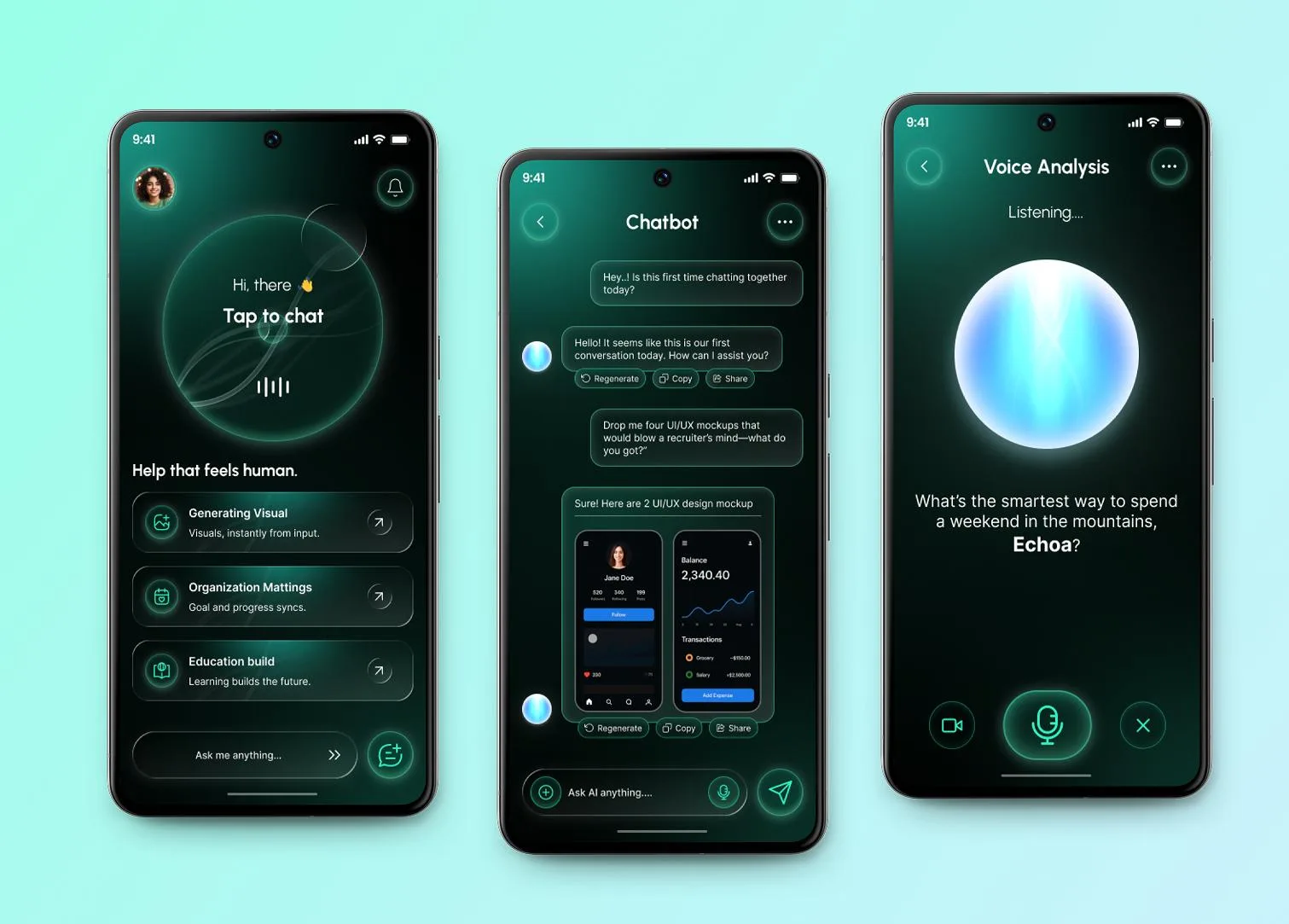
1. AI-Powered Chatbots and Virtual Assistants
"Echoa – Futuristic AI Chat Experience" by Kazi Esrat Jahan on Dribbble
AI-powered chatbots are among the most recognizable applications of artificial intelligence in mobile technology.
Unlike basic rule-based chatbots that respond using predefined scripts, modern AI assistants can interpret natural language, understand conversational context, and generate relevant responses.
Depending on their design and integrations, they can help users:
Find information about products and services.
Track orders and delivery updates.
Book appointments.
Understand application functionality.
Receive account-related assistance.
Submit service requests.
Access frequently requested information.
Practical example:
Imagine a customer using a mobile application developed for an online retail business.
Instead of searching through multiple categories, the customer can ask:
"Show me affordable wireless headphones suitable for working from home."
The AI assistant can interpret the request, identify relevant product information, and present suitable options.
For businesses, this functionality can make customer interactions more convenient and reduce repetitive support requests.
Developers can connect conversational AI models with application databases, product catalogs, customer relationship management systems, and other backend services.
However, assistants should be designed with appropriate access permissions so they cannot expose private information or perform unauthorized transactions.
2. Personalized Recommendations
AI in Ads: Personalizing Product Recommendations | Feedcast.ai
Personalization is another important feature shaping modern mobile applications.
AI recommendation systems analyze relevant information such as user preferences, browsing activity, previous interactions, and selected interests to suggest content or services.
Examples include:
Shopping applications recommending relevant products.
Streaming platforms suggesting movies and entertainment.
Fitness applications recommending suitable workouts.
Learning applications suggesting educational resources.
Travel applications recommending destinations and accommodation.
Practical example:
A user regularly searches for running shoes in a shopping application.
An AI-powered recommendation engine can identify this interest and display related products, suitable accessories, and relevant offers.
The application can become more useful by reducing the time required to find relevant information.
Businesses should also give users meaningful control over personalization and avoid collecting unnecessary personal information.

3. Voice Recognition and AI Voice Assistants
Voice recognition allows users to interact with mobile applications through spoken commands instead of typing.
AI-powered speech technologies can convert spoken language into text, interpret requests, and trigger relevant application functions.
Potential applications include:
Voice-based searches.
Hands-free navigation.
Voice-controlled reminders.
Speech-to-text messaging.
Spoken customer support.
Voice-based information retrieval.
Accessibility assistance.
Practical example:
A user driving to a meeting may ask a navigation application to find the nearest fuel station.
Instead of typing an address, the user can provide a voice command and receive relevant location information.
Voice interfaces can also support people who find traditional typing or navigation difficult.
When developing voice-enabled applications, businesses should consider background noise, language differences, accents, microphone permissions, and situations where voice recognition may produce inaccurate results.
4. Predictive Analytics and Intelligent Insights
Mobile app animation for the AI-powered marketing tool pt.2 by Vito Burhonski for Zajno on Dribbble
Predictive analytics uses historical and current information to identify patterns and estimate possible future outcomes.
In mobile applications, machine learning models can analyze relevant activity and provide insights that help users and businesses make better decisions.
Examples include:
Predicting product demand.
Identifying unusual spending patterns.
Estimating delivery times.
Forecasting inventory requirements.
Analyzing customer engagement.
Identifying possible subscription cancellations.
Suggesting future activities based on previous behavior.
Practical example:
An e-commerce business uses an AI-powered mobile application to analyze product searches, orders, and purchasing patterns.
The system identifies increasing interest in a particular product category and provides an estimate of future demand.
Business owners can use this information when planning inventory and promotional campaigns.
Predictive systems require appropriate data quality, testing, and ongoing monitoring. Their results are estimates and may become less reliable when market conditions or customer behavior change.
5. Computer Vision and Image Recognition
How to Enable Visual Search in Your eCommerce Store? (2026)
Computer vision enables applications to interpret information from images and video.
It can identify objects, recognize text, classify images, detect selected visual patterns, and support camera-based interactions.
Useful applications include:
Visual product searches.
Document scanning.
Barcode recognition.
Image classification.
Object detection.
Text extraction from photographs.
Visual inspection workflows.
Practical example:
A customer sees a chair in a photograph and wants to find a similar product online.
Instead of entering several search terms, the customer uploads the photograph to a shopping application.
The computer vision system analyzes the image and searches for visually similar products in the available catalog.
This can make product discovery more convenient.
Computer vision can also support business applications involving document processing, inventory management, and visual quality checks.
6. AI-Powered Fraud Detection and Security Monitoring
الذكاء الاصطناعي يعزز كشف الاحتيال في المحافظ الرقمية | مدار الساعة
Security is particularly important for applications handling financial information, personal records, payments, and business transactions.
AI-based fraud detection systems can analyze transaction patterns and identify activities that may require additional verification.
Potential capabilities include:
Unusual transaction detection.
Suspicious login identification.
Behavioral pattern analysis.
Risk-based authentication.
Automated security alerts.
Anomaly detection.
Practical example:
A financial application identifies a transaction that differs significantly from a customer's usual activity.
The system can flag the transaction for additional verification or notify the user, depending on the configured security rules.
AI should support security controls rather than replace them.
Strong authentication, encryption, secure APIs, access controls, and appropriate monitoring remain essential.
7. Real-Time Language Translation
Samsung Galaxy S25 Ultra review: AI beast that means serious business - IBTimes India
Language translation features can make mobile applications more accessible to people who communicate in different languages.
AI-powered translation systems can process written text and, depending on the selected technology, spoken conversations.
Useful applications include:
Translating messages.
Multilingual customer support.
Translating product information.
Converting spoken language into translated text.
Supporting international business communication.
Translating selected documents.
Practical example:
A business serving customers in Qatar may need to provide application information in both Arabic and English.
An AI-powered translation feature can help users access selected content in their preferred language.
However, important legal, financial, medical, and contractual information should receive appropriate human review because automated translations may contain errors or lose context.
8. AI-Based Personalization Through Behavioral Analysis
Personalized recommendations and behavioral analytics are related, but they serve different purposes.
Recommendation systems primarily suggest content or products. Behavioral analysis can examine broader interaction patterns to help an application adapt its interface and selected workflows.
For example, an application may analyze:
Frequently used features.
Common navigation paths.
Repeated search activities.
Preferred content categories.
Abandoned application workflows.
Notification interaction patterns.
Practical example:
An educational application identifies that a student frequently uses vocabulary exercises but rarely opens advanced grammar lessons.
The application may suggest additional beginner-level grammar content or provide easier access to vocabulary exercises.
Such personalization should improve convenience without creating intrusive experiences or unfair assumptions about users.
9. Generative AI for Content Creation and Assistance
Ai Powered Mobile App UI/UX Design by Nikita Prokofyev | Dribbble
Generative AI allows mobile applications to create new content based on user instructions and available context.
Unlike traditional software that only retrieves stored information, generative AI can produce responses, summaries, drafts, and other outputs.
Potential features include:
AI writing assistants.
Automatic text summarization.
Product description generation.
Personalized learning explanations.
Email drafting.
Image generation.
Content suggestions.
Conversational information retrieval.
Practical example:
A business owner using a mobile management application wants to create a short promotional message for a new product.
The application can use a generative AI service to prepare a draft based on the product details and the requested tone.
The user can then review, edit, and approve the content.
Generative AI output should be checked for accuracy, relevance, and appropriateness before being used in important business communications.
10. Intelligent Automation and AI Agents
AI agents represent a more advanced approach to intelligent application functionality.
Rather than responding only to individual questions, an AI agent can be designed to complete a sequence of related tasks using approved tools and integrations.
Depending on its permissions and architecture, an agent may:
Retrieve information from connected systems.
Organize customer requests.
Summarize business records.
Create draft reports.
Assist with appointment scheduling.
Coordinate selected workflow steps.
Recommend actions based on available information.
Practical example:
A business management application includes an AI assistant connected to its appointment system.
A user requests a summary of upcoming appointments and asks the assistant to prepare a draft reminder for customers.
The system retrieves the authorized appointment information and prepares the requested draft for review.
For actions involving payments, account changes, customer communications, or other sensitive operations, developers should introduce permission checks and human approval where appropriate.
Comparison of AI Features in Mobile Applications
Different AI capabilities serve different purposes. Businesses should select features according to their application requirements and intended users.
AI Feature | Main Purpose | Example Application |
|---|---|---|
AI Chatbots | Conversational support | Customer service |
Recommendations | Content personalization | Shopping apps |
Voice Recognition | Spoken interaction | Navigation apps |
Predictive Analytics | Pattern identification | Finance apps |
Computer Vision | Image understanding | Retail apps |
Fraud Detection | Identifying suspicious activity | Banking apps |
Language Translation | Multilingual communication | Travel apps |
Behavioral Analysis | Adapting experiences | Learning apps |
Generative AI | Creating new content | Writing apps |
AI Agents | Multi-step task assistance | Business apps |
Industries That Can Benefit from AI-Powered Mobile Apps
Artificial intelligence is not limited to one application category. Its capabilities can support different industries depending on the business problem being addressed.
1. Healthcare and Wellness
AI-powered healthcare applications can support selected administrative and wellness activities.
Possible features include:
Appointment assistance.
Health information organization.
Personalized wellness content.
Activity pattern analysis.
Medical document summarization.
Patient communication support.
Healthcare-related AI must be implemented carefully. It should not present unverified output as a medical diagnosis or replace qualified healthcare professionals.
2. Banking and Financial Services
Financial applications can use AI to improve selected customer experiences and support risk monitoring.
Examples include:
Transaction categorization.
Spending summaries.
Suspicious activity alerts.
Customer support assistants.
Financial information search.
Personalized budgeting insights.
Financial decisions and security-sensitive operations should remain subject to appropriate verification and controls.
3. E-Commerce and Retail
Retail businesses can use AI to improve product discovery and customer engagement.
Potential features include:
Personalized product recommendations.
Visual product searches.
Intelligent shopping assistants.
Demand forecasting.
Automated customer support.
Product description generation.
These capabilities can help customers discover products and make the shopping experience more convenient.
4. Education and E-Learning
Educational applications can use AI to adapt learning experiences to different student requirements.
Features may include:
Personalized learning suggestions.
AI-powered tutoring assistance.
Automated practice questions.
Language learning support.
Learning progress summaries.
Content recommendations.
AI-generated educational content should be reviewed for accuracy and suitability.
5. Travel and Hospitality
Travel applications can use AI to help users organize journeys and discover relevant services.
Examples include:
Personalized destination recommendations.
Travel itinerary assistance.
Multilingual support.
Intelligent booking assistance.
Customer service chatbots.
Travel preference analysis.
6. Logistics and Delivery
AI can support delivery and logistics applications through data analysis and operational automation.
Potential features include:
Delivery time estimates.
Route recommendations.
Demand forecasting.
Inventory analysis.
Customer notifications.
Automated support workflows.
Actual performance depends on the availability and quality of location, traffic, order, and operational data.
Technologies Used to Develop AI-Powered Mobile Apps
Developing an intelligent mobile application requires more than selecting an AI model. The application must combine appropriate mobile technologies, backend services, data systems, and security controls.
1. Machine Learning Frameworks
Machine learning frameworks allow developers to integrate models that recognize patterns, classify information, and generate predictions.
Examples include:
TensorFlow Lite / LiteRT.
Core ML.
Google ML Kit.
Custom machine learning models.
Google's ML Kit developer documentation explains how developers can integrate machine learning capabilities into Android and iOS applications.
2. Generative AI and Large Language Models
Large language models can support conversational interfaces, content generation, summarization, and information retrieval.
Depending on application requirements, developers may integrate hosted AI services or compatible models running on supported devices.
The selection should consider response quality, latency, data privacy, model cost, and integration complexity.
3. Native and Cross-Platform Development
AI features can be integrated into native or cross-platform mobile applications.
Development Approach | Technologies | Suitable For |
|---|---|---|
iOS Native | Swift, SwiftUI | Apple applications |
Android Native | Kotlin | Android applications |
Cross-Platform | Flutter | Shared-codebase applications |
Cross-Platform | React Native | Multi-platform applications |
The right approach depends on the application's performance requirements, device capabilities, available development resources, and integration needs.
4. Cloud Computing and Backend Infrastructure
Cloud services can provide the infrastructure required to process complex AI requests and manage application data.
A typical architecture may include:
Cloud hosting.
Database services.
AI model APIs.
Authentication systems.
File storage.
API integrations.
Application monitoring.
Businesses can explore cloud and DevOps solutions when planning scalable application infrastructure.
5. APIs and Third-Party Integrations
APIs allow mobile applications to communicate with AI services and external business systems.
For example, an intelligent retail application may connect to:
Product databases.
Payment gateways.
Customer management systems.
Inventory software.
Delivery platforms.
AI model services.
These integrations help transform individual application features into connected business workflows.
On-Device AI vs Cloud-Based AI: Which Is Better?
One of the most important architectural decisions when developing an AI-powered mobile application is determining where AI processing should happen.
AI can run directly on a supported smartphone, through remote cloud infrastructure, or through a hybrid combination of both.
On-Device AI
On-device AI processes information directly on the user's smartphone or tablet.
Advantages include:
Potentially faster responses for supported tasks.
Offline functionality for compatible models.
Reduced dependence on network connectivity.
Greater control over certain sensitive data.
Reduced need for repeated server requests.
However, on-device models depend on device hardware, memory, battery capacity, and supported software.
Cloud-Based AI
Cloud-based AI processes requests through remote servers.
Advantages include:
Access to larger models.
Centralized model management.
Support for complex processing.
Easier integration with backend systems.
Greater flexibility for certain advanced AI workflows.
Potential disadvantages include network dependency, server costs, latency, and additional data protection requirements.
On-Device AI vs Cloud AI Comparison
Factor | On-Device AI | Cloud-Based AI |
|---|---|---|
Processing | Local device | Remote servers |
Internet | May work offline | Usually required |
Privacy | Data can remain local | Requires secure data handling |
Model capability | Limited by device resources | Can support larger models |
Maintenance | Device compatibility matters | Centralized model updates |
Infrastructure | Local processing resources | Cloud infrastructure |
Best suited for | Lightweight and sensitive tasks | Complex AI operations |
A hybrid architecture may be the most practical solution for applications that need both local responsiveness and advanced cloud capabilities.
For example, a translation application could process supported speech recognition tasks locally while using cloud services for more complex conversational translation.
Google's AI development guidance for Android provides additional information about choosing between on-device and cloud-based AI.
Apple also provides Core ML for integrating machine learning models into applications, including models that process information directly on supported Apple devices.
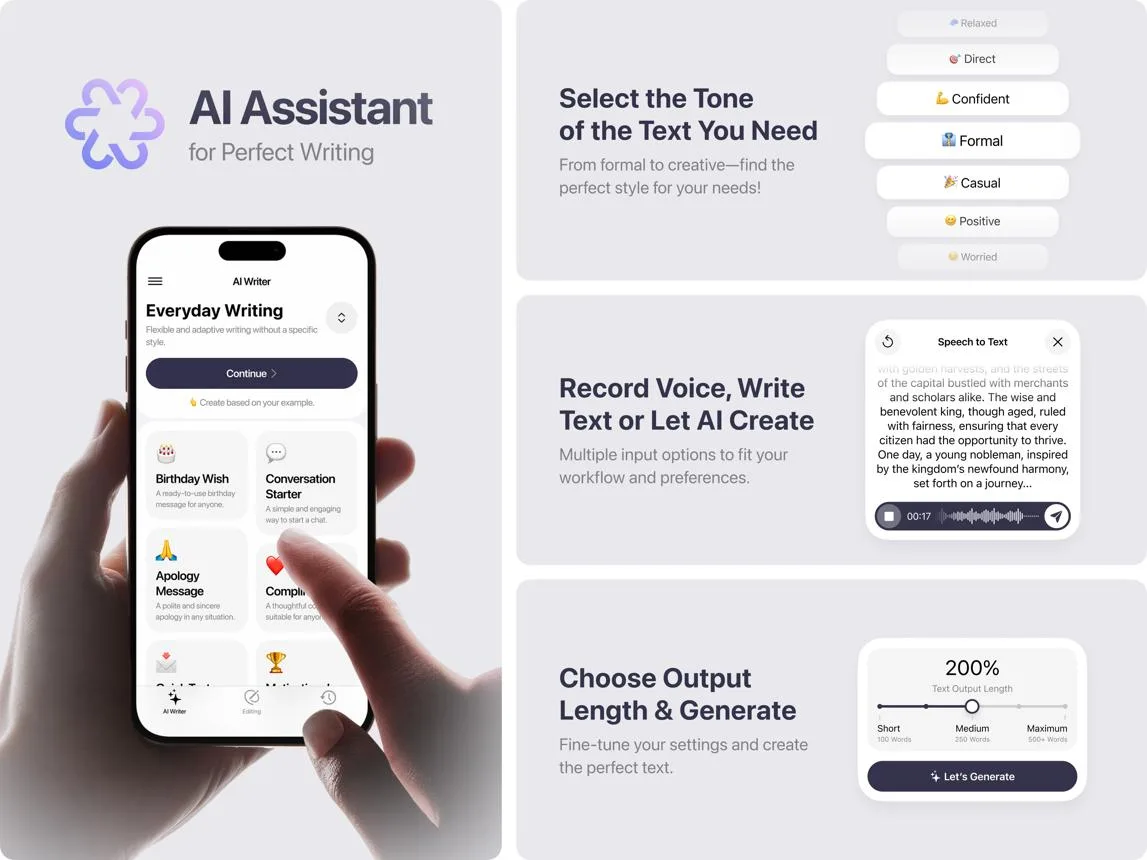
Benefits of AI-Powered Mobile Apps for Businesses
AI integration can provide several business advantages when implemented around genuine customer and operational needs.
Improved Customer Engagement
Personalized recommendations, conversational assistants, and relevant notifications can make applications more useful.
Reduced Repetitive Work
AI can automate selected tasks such as categorizing requests, summarizing records, and preparing draft responses.
Better Business Insights
Machine learning and analytics can help businesses identify patterns in application usage and customer interactions.
More Convenient Digital Services
Voice interaction, image recognition, and natural language interfaces can reduce the number of steps required to complete common tasks.
Scalable Digital Experiences
Cloud-based AI infrastructure can support applications that need to process growing volumes of requests, subject to appropriate capacity planning and cost management.
New Product Opportunities
AI can enable businesses to introduce new digital services, intelligent application features, and specialized customer experiences.
Challenges of Developing AI-Powered Mobile Applications
Despite their potential, AI-powered applications introduce technical and operational challenges that businesses should consider before development.
1. Data Privacy and Protection
AI systems may process personal information, conversations, images, location details, and other sensitive data.
Businesses should:
Collect only necessary information.
Explain how user information is processed.
Implement suitable consent mechanisms.
Use secure storage.
Protect data during transmission.
Provide appropriate data access and deletion controls.
2. AI Accuracy and Reliability
AI systems can produce incorrect predictions, misunderstand requests, or generate inaccurate information.
Applications should include validation mechanisms, error handling, user feedback, and human review for important decisions.
3. Development and Maintenance Costs
AI integration may introduce additional costs related to:
AI model usage.
Cloud infrastructure.
Data storage.
API requests.
Testing and optimization.
Security monitoring.
Model updates.
The total cost depends on the selected technology, feature complexity, usage levels, and infrastructure requirements.
4. Device Compatibility
Some AI features require hardware resources that may not be available on every smartphone.
Developers should consider device performance, operating system compatibility, memory limitations, and alternative functionality for unsupported devices.
5. Integration Complexity
Connecting AI services with existing business systems can require additional backend development, API management, data synchronization, and access-control configuration.
6. User Trust and Transparency
Users should understand when they are interacting with AI and when an application is using their information to generate recommendations.
Applications should make it easy to report incorrect results, adjust preferences, and request human assistance when necessary.
How to Develop an AI-Powered Mobile App
Building a successful AI-powered mobile application requires a structured approach. Businesses should begin with a clear problem rather than adding AI features simply because the technology is available.
Step 1: Identify the Application's Purpose
Define what the application should achieve.
Examples include:
Improving customer support.
Personalizing product recommendations.
Automating appointment management.
Supporting financial information analysis.
Improving digital learning experiences.
A clearly defined purpose helps identify which AI capabilities are genuinely necessary.
Step 2: Understand the Target Audience
Identify the application's intended users and their expectations.
Consider:
Age groups and user requirements.
Preferred languages.
Common customer problems.
Device compatibility.
Accessibility needs.
Data privacy expectations.
Step 3: Select the Right AI Features
Not every application requires every AI feature.
A retail application may benefit from visual search and personalized recommendations, while a business management application may require intelligent reporting and workflow automation.
Start with features that provide measurable value.
Step 4: Choose the Technology Stack
Select suitable mobile development frameworks, AI models, backend infrastructure, and integration technologies.
The decision should account for:
Platform requirements.
AI model capabilities.
Performance.
Security.
Scalability.
Long-term maintenance.
Businesses planning custom solutions can explore custom software development services to understand how application architecture and business requirements can be aligned.
Step 5: Design the User Interface and Experience
AI features should be easy to understand and use.
For example, a chatbot should provide clear suggestions and an accessible way to contact human support.
A recommendation system should display relevant results without overwhelming users with notifications or unnecessary content.
Step 6: Develop and Integrate AI Functionality
Developers can integrate selected AI models through SDKs, APIs, or custom backend services.
The application should be designed to handle:
Successful AI responses.
Incorrect or incomplete output.
Network interruptions.
API failures.
Unsupported devices.
Permission restrictions.
Step 7: Implement Security and Privacy Controls
Security should be part of the application's architecture from the beginning.
Important measures include:
Secure authentication.
Data encryption.
API authorization.
Access management.
Secure database configuration.
Appropriate consent controls.
Security testing.
The OWASP Mobile Application Security Verification Standard provides a useful framework for evaluating mobile application security across areas such as authentication, storage, network communication, and privacy.
Step 8: Test the Application
Testing should cover both conventional application functionality and AI-specific behavior.
Important testing areas include:
Functional testing.
Performance testing.
Device compatibility.
Security testing.
AI response quality.
Accuracy evaluation.
User experience testing.
Network failure handling.
Step 9: Launch, Monitor, and Improve
After launch, businesses should monitor application performance and user feedback.
Useful measurements may include:
AI feature usage.
Response latency.
Task completion rates.
User retention.
Error frequency.
Customer satisfaction.
AI service costs.
Continuous improvements help ensure that AI features remain useful as user requirements and technology evolve.
AI-Powered Mobile App Development Considerations in Qatar
Businesses in Qatar can explore AI-powered mobile applications to improve customer experiences, modernize digital services, and support business operations.
However, successful implementation requires attention to local user expectations and operational requirements.
Arabic and English Language Support
Applications serving customers in Qatar may benefit from Arabic and English interfaces.
AI-powered translation and language processing can support multilingual interactions, although developers should test language quality, including Arabic dialects and right-to-left interface layouts.
Financial and Payment Applications
AI can support spending summaries, transaction categorization, customer assistance, and suspicious activity monitoring.
Applications handling financial information should use appropriate authentication, data protection, and payment security measures.
Retail and E-Commerce
Retail businesses can use AI-powered recommendations, visual product searches, and intelligent customer support to improve online shopping experiences.
Healthcare and Wellness
Healthcare-related applications may benefit from appointment assistance, patient communication, and selected administrative automation.
Businesses should carefully assess applicable healthcare, privacy, and regulatory requirements before introducing AI into sensitive workflows.
Data Protection and Infrastructure
Businesses should evaluate how personal information is collected, stored, processed, and shared with external AI providers.
Relevant legal and contractual requirements should be reviewed before selecting cloud infrastructure or third-party AI services.
How Much Does It Cost to Develop an AI-Powered Mobile App?
The cost of developing an AI-powered mobile application depends on its features, design complexity, technology stack, AI integration requirements, and long-term maintenance needs.
There is no single price that applies to every project.
The following table explains the main factors that influence development costs.
Development Factor | Cost Consideration |
|---|---|
UI/UX Design | Screen layouts, user journeys, and interface complexity |
Mobile Development | Native or cross-platform development |
AI Integration | Model selection, APIs, and custom AI functionality |
Backend Development | Servers, databases, and business logic |
Third-Party APIs | External services and integration charges |
Security | Authentication, encryption, and testing |
Testing | Performance, compatibility, and AI evaluation |
Maintenance | Updates, monitoring, and ongoing support |
What Can Increase AI Development Costs?
Some features require more advanced infrastructure and engineering than others.
For example:
A basic AI chatbot may require a relatively straightforward API integration.
A personalized recommendation engine may require data preparation and model evaluation.
Real-time computer vision may require camera processing and performance optimization.
An AI agent connected to multiple business systems may require complex workflow design and permission management.
Businesses should define a realistic initial scope before requesting development estimates.
A minimum viable product (MVP) can be a practical starting point. It allows a business to test essential functionality before investing in more advanced features.
Future Trends in AI-Powered Mobile Applications
AI technology continues to evolve, creating opportunities for new application experiences.
The following developments are particularly relevant to businesses planning future mobile products.
1. More Capable On-Device AI
Mobile devices are increasingly supporting machine learning capabilities that can process selected tasks locally.
This may enable more responsive applications and reduce the need to send every request to remote servers.
2. Multimodal AI Experiences
Multimodal AI can work with different types of information, including text, images, and audio.
For example, a user may upload a product photograph and ask a question about it through voice input.
3. More Advanced AI Agents
AI agents may increasingly support multi-step workflows within mobile applications.
Their practical usefulness will depend on reliable tool integrations, permission management, and appropriate human oversight.
4. Context-Aware Applications
Future applications may use authorized contextual information to provide more relevant assistance.
For example, a travel application could use a user's selected destination and travel preferences to suggest relevant services.
Such functionality must respect user permissions and privacy preferences.
5. Improved Accessibility
AI-powered speech recognition, image descriptions, language processing, and voice interaction may make applications easier to use for people with different accessibility requirements.
6. Stronger Privacy-Focused AI Architecture
Privacy-conscious design, data minimization, local processing, and transparent AI functionality will remain important considerations as more applications process sensitive information.
These developments are possibilities rather than guaranteed outcomes. Their adoption will depend on technology maturity, device capabilities, business requirements, and user acceptance.
Why Choose Galaxium Coding for AI-Powered Mobile App Development?
Developing an AI-powered mobile application requires a combination of mobile engineering, backend development, intelligent integrations, and thoughtful user experience design.
Galaxium Coding is a Qatar-based technology company offering digital development solutions for businesses.
Its mobile application development services provide a relevant starting point for businesses planning mobile products around their operational requirements.
When evaluating an AI-powered application project, businesses should consider a development partner's ability to address:
Mobile application architecture.
Android and iOS development requirements.
AI and third-party API integrations.
Backend systems and database design.
Application security and privacy.
User interface and experience.
Testing and ongoing maintenance.
Scalability and future enhancements.
Businesses can also review Galaxium Coding's projects and portfolio to explore available project information and development work.
The most effective approach is to define the business problem, identify valuable AI capabilities, and select technologies that support the application's long-term goals.
For project discussions, businesses can contact Galaxium Coding to explore their mobile application requirements.
Conclusion
AI-powered mobile apps are changing how businesses develop digital products and how users interact with technology. Features such as intelligent chatbots, personalized recommendations, voice assistants, predictive analytics, computer vision, generative AI, and intelligent automation are creating opportunities for more responsive and useful applications.
However, successful AI integration requires more than adding advanced features. Businesses must consider application performance, data privacy, security, user experience, device compatibility, and long-term maintenance.
The right AI functionality depends on the application's purpose and the problems it is designed to solve. A focused implementation that delivers genuine user value can be more effective than an application overloaded with unnecessary AI features.
For businesses planning their next digital product, investing in thoughtful mobile application development can provide a foundation for integrating intelligent technologies and building applications that are ready for evolving customer expectations.
Frequently Asked Questions (FAQs)
1. What are AI-powered mobile apps?
AI-powered mobile apps are applications that use artificial intelligence and machine learning to analyze information, understand user requests, automate selected tasks, and provide personalized experiences.
2. What are the most popular AI features in mobile applications?
Common AI capabilities include:
AI chatbots and virtual assistants.
Personalized recommendations.
Voice recognition.
Predictive analytics.
Computer vision.
Fraud detection.
Language translation.
Generative AI.
Intelligent automation.
The appropriate features depend on the application's purpose and users.
3. How does AI improve mobile applications?
AI can make mobile applications more responsive by helping them understand user preferences, automate repetitive activities, recognize patterns, and provide relevant information.
It can also support improved customer interactions and selected business workflows.
4. Can AI work inside mobile applications without an internet connection?
Yes. Certain AI models can run directly on compatible mobile devices without requiring a continuous internet connection.
However, offline functionality depends on the model, device hardware, application design, and processing requirements.
5. What is the difference between AI and machine learning in mobile apps?
Artificial intelligence is the broader field of creating systems capable of performing tasks associated with intelligent behavior.
Machine learning is a subset of AI that allows systems to learn patterns from data and use them to make predictions or classifications.
6. Are AI-powered mobile applications secure?
They can be designed with strong security controls, but AI integration does not automatically make an application secure.
Developers should implement encryption, authentication, authorization, secure APIs, privacy controls, and regular security testing.
7. Which industries benefit most from AI-powered mobile apps?
Industries that can benefit include:
Healthcare.
Banking and finance.
Retail and e-commerce.
Education.
Travel and hospitality.
Logistics.
Real estate.
Business services.
The value depends on the specific application and how AI addresses its users' needs.
8. How much does AI-powered mobile app development cost?
Development costs depend on application complexity, selected AI technologies, mobile platforms, integrations, backend infrastructure, and maintenance requirements.
A basic AI-enabled application generally requires fewer development resources than a complex application involving custom models, real-time processing, and multiple business integrations.
9. Can AI be integrated into an existing mobile application?
Yes. AI capabilities can often be added to existing applications through APIs, SDKs, and backend integrations.
However, the existing application's architecture, performance, security, and compatibility should be evaluated before integration.
10. What technologies are used to build AI-powered mobile applications?
Common technologies include:
Swift and Kotlin.
Flutter and React Native.
TensorFlow Lite / LiteRT.
Apple Core ML.
Google ML Kit.
Cloud AI services.
Machine learning APIs.
Backend databases and cloud infrastructure.
The right technology stack depends on the application's requirements.
11. What is the difference between on-device AI and cloud-based AI?
On-device AI processes information directly on a compatible smartphone, while cloud-based AI uses remote servers for processing.
On-device AI can support offline functionality and local data processing. Cloud-based AI can provide access to larger models and more complex capabilities.
12. Why should businesses invest in AI-powered mobile applications?
Businesses may benefit from improved customer experiences, intelligent automation, personalized services, better operational insights, and new digital product opportunities.
The investment should be based on measurable business needs rather than adopting AI simply because it is a developing technology.