How to Monetize a Mobile App: 10 Proven Revenue Models for 2026
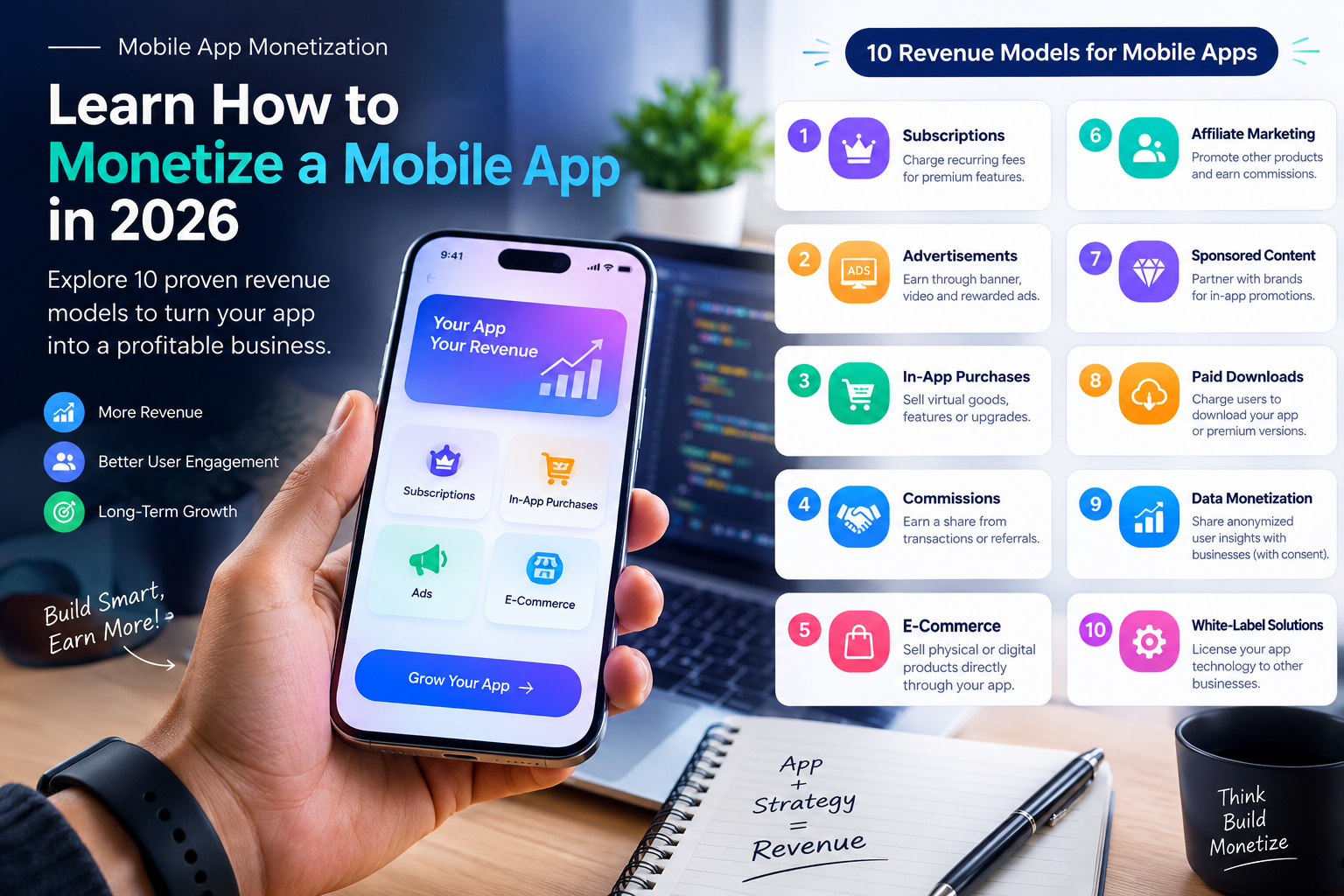
Explore 10 mobile app monetization models to generate revenue, improve retention, and build a sustainable digital business in 2026.
How to Monetize a Mobile App: 10 Proven Revenue Models for 2026
Building a mobile application is only the first step toward creating a successful digital product. To turn an app into a sustainable business, you also need a clear monetization strategy that generates revenue while delivering genuine value to users.
Whether you are launching a startup application, an e-commerce platform, a productivity tool, a fitness app, or a business application, the right revenue model can influence your pricing, features, customer experience, marketing strategy, and long-term growth.
In 2026, mobile app businesses can generate revenue through several approaches, including subscriptions, advertising, premium upgrades, in-app purchases, commissions, and business-to-business licensing. Some applications combine multiple models, while others perform better with one simple and transparent payment structure.
This guide explains 10 proven mobile app monetization models, how each one works, which applications can benefit from it, and how to select a suitable strategy for your business.
If you are planning a new digital product, understanding monetization before development can help you build the right payment flows, analytics, subscription management, and user experience from the beginning.
What Is Mobile App Monetization?
Mobile app monetization is the process of generating revenue from a mobile application. It involves deciding what users will pay for, how payments will be collected, and how the business will earn money while continuing to provide value.
An app does not necessarily need to charge users to download it. A free application may earn revenue from advertisements, premium features, subscriptions, transactions, sponsorships, or business customers.
For example:
A fitness app may charge a monthly subscription for personalized workout plans.
A mobile game may sell virtual items or optional upgrades.
A shopping app may earn money by selling products or taking a commission on marketplace transactions.
A productivity app may offer a free version and charge for advanced features.
A business application may charge companies a monthly fee for each employee account.
The best approach depends on the app's purpose, target audience, usage frequency, operating costs, and the value customers receive.
Why Is a Monetization Strategy Important in 2026?
Mobile app development involves more than writing code and publishing an application. Businesses must also consider hosting, maintenance, customer support, marketing, payment processing, security, and ongoing feature improvements.
A well-planned revenue model helps businesses understand how they will cover these expenses and support future development.
1. It creates a sustainable revenue stream
Revenue helps cover operating expenses and provides resources for improving the application. Depending on the model, income may arrive through recurring subscriptions, individual purchases, advertising impressions, or completed transactions.
2. It helps prioritize product features
When you know what customers are willing to pay for, you can prioritize features that solve important problems instead of spending resources on functionality that provides little value.
3. It improves business planning
A monetization strategy gives you a framework for estimating revenue, customer acquisition costs, conversion rates, retention, and profitability.
4. It supports long-term growth
As your user base expands, your business may introduce additional plans, premium features, new customer segments, or complementary services.
5. It influences the user experience
Poorly placed advertisements, confusing subscription terms, unexpected charges, or excessive payment prompts can damage trust. A transparent revenue model helps balance business goals with customer satisfaction.
10 Proven Mobile App Monetization Models for 2026
The following models are established approaches used across different categories of mobile applications. They are not equally suitable for every product, and none guarantees profitability.
Revenue model | How the app earns money | Best suited for |
|---|---|---|
1. Freemium | Charges for advanced features | Productivity, education, utilities |
2. Subscription | Collects recurring payments | Fitness, SaaS, entertainment |
3. In-app purchases | Sells digital goods or upgrades | Gaming, creative apps |
4. In-app advertising | Earns from ad impressions or actions | Free apps with substantial engagement |
5. Paid downloads | Charges before installation | Specialist tools, premium utilities |
6. Transaction fees | Takes a fee from transactions | Marketplaces, booking platforms |
7. E-commerce sales | Sells physical products | Retail, fashion, food |
8. Affiliate marketing | Earns qualifying referral commissions | Reviews, travel, shopping |
9. Sponsorships and partnerships | Receives payment for agreed promotional placements | Communities, niche audiences |
10. B2B licensing and white-label solutions | Charges businesses to use or rebrand the product | Enterprise and industry-specific apps |
Let's explore each model in detail.
1. Freemium Model
The freemium model allows users to download and use a basic version of an application for free. The business earns revenue by offering optional paid features, additional capacity, premium content, or advanced functionality.
This model reduces the initial barrier to trying an app because users can experience its value before making a purchase.
How does the freemium model work?
A typical freemium app provides essential functionality at no cost and reserves selected benefits for paying customers.
For example, a task management application might provide:
Free plan
Create a limited number of projects.
Add tasks and deadlines.
Receive basic notifications.
Access essential reporting.
Premium plan
Create unlimited projects.
Collaborate with larger teams.
Access advanced analytics.
Automate recurring workflows.
Integrate with additional business tools.
Users upgrade when they need the additional capabilities.
Advantages of the freemium model
Makes it easier for potential customers to try the product.
Allows users to experience value before paying.
Creates opportunities to convert engaged users into paying customers.
Supports organic referrals and product-led growth.
Provides flexibility for different customer needs.
Challenges to consider
A large free user base does not automatically create a profitable business. Free accounts may generate hosting, storage, support, and infrastructure expenses without producing direct revenue.
Another challenge is deciding which features should remain free. If the free plan is too limited, users may leave. If it includes everything users need, few may upgrade.
When should you use freemium?
Freemium works well when your application has clear premium benefits, relatively manageable costs for free users, and a user experience that demonstrates value quickly.
It is especially useful for productivity tools, educational applications, collaboration platforms, and business software.
2. Subscription Model
The subscription model generates recurring revenue by charging users weekly, monthly, annually, or according to another defined billing period.
Instead of paying once, customers continue paying while they find the service valuable.
Subscriptions are particularly attractive for apps that deliver ongoing benefits, such as regularly updated content, cloud services, personalized recommendations, or continuous business functionality.
How does subscription monetization work?
A business can offer several subscription levels.
For example, a hypothetical language-learning app might charge:
Free: Basic lessons and limited daily practice.
Monthly: Full access to lessons and progress tracking.
Annual: The same premium access at a discounted effective monthly price.
The prices should reflect the app's costs, competitive alternatives, customer expectations, and perceived value. The figures used in this example are illustrative rather than market benchmarks.
Benefits of subscriptions
Predictable recurring revenue: Active subscribers can create a more forecastable revenue stream than one-time purchases.
Ongoing customer relationships: Businesses can improve retention through new features, updated content, and better customer support.
Flexible pricing: Different plans can serve individuals, families, professionals, and businesses.
Opportunity for higher customer lifetime value: Customers who remain subscribed for longer may generate more total revenue than customers who make a single purchase.
Challenges of subscriptions
Customers can cancel if the application does not deliver consistent value. Subscription businesses must also manage failed payments, cancellations, renewals, customer support, and clear billing disclosures.
Apps must avoid making cancellation unnecessarily difficult or presenting recurring charges in a misleading way.
How to improve subscription revenue
Provide a useful first experience before asking users to subscribe.
Explain exactly what each plan includes.
Offer a trial only when the economics and customer experience support it.
Remind users about renewal terms where required.
Track subscription activation, cancellation, and renewal rates.
Continue improving the service after customers pay.
Subscriptions are particularly suitable for SaaS applications, fitness platforms, learning apps, streaming services, and professional tools.
3. In-App Purchases
In-app purchases allow customers to buy specific digital products, virtual goods, additional content, or individual features inside an application.
Unlike a subscription, a purchase may be a one-time transaction. Some apps also offer consumable items that users can purchase repeatedly.
Common types of in-app purchases
Consumable items: Virtual coins, credits, extra lives, or digital tokens that can be used up.
Non-consumable purchases: Permanent feature unlocks, additional editing tools, or a paid game expansion.
Digital content: Premium lessons, templates, downloadable content, or specialist resources.
Feature upgrades: Additional storage, advanced filters, enhanced customization, or specialized functionality.
Example: A mobile gaming application
A game could be free to download while offering optional character skins, extra game content, or virtual currency.
Players who enjoy the game may choose to purchase these items. Other players can continue using the free version, depending on the game's design.
Advantages
Enables multiple revenue opportunities within one application.
Lets customers choose which extras they want.
Works with free downloads.
Can generate repeat purchases when the product provides ongoing value.
Potential disadvantages
Revenue may be unpredictable, and some customers may spend nothing. Poorly designed purchase prompts can frustrate users or encourage unhealthy spending behavior.
For games and other digital products, developers should provide clear pricing, purchase confirmation, suitable parental controls, and spending safeguards.
Platform payment requirements
Digital goods and services sold inside mobile applications may be subject to Apple App Store or Google Play billing policies. Exceptions and alternative billing arrangements vary by platform, market, app category, and applicable program.
Before implementation, review the current Apple App Review Guidelines and Google Play's payments policy.
Physical goods and certain services consumed outside the app may follow different payment rules.
4. In-App Advertising
Advertising monetization allows an application to earn revenue by displaying ads to its users. Depending on the advertising arrangement, payment may be associated with impressions, clicks, completed video views, or other qualifying actions.
This model is frequently used by applications that want to offer free access while generating revenue from user engagement.
Common mobile advertising formats
Banner ads: Small advertisements displayed within a section of the interface.
Interstitial ads: Full-screen advertisements shown at appropriate transitions, such as between game levels.
Rewarded video ads: Users voluntarily watch an advertisement in exchange for an in-app benefit.
Native ads: Advertisements designed to fit the surrounding layout while remaining clearly identifiable as advertising.
App-open ads: Ads displayed during eligible app-opening experiences, where supported and appropriate.
How does an app earn money from advertisements?
Advertising revenue depends on several factors, including the number of eligible impressions, user geography, advertiser demand, ad format, viewability, and the advertising network's payment terms.
For a simple planning example, suppose an application records 100,000 monetized ad impressions in a month and achieves an illustrative effective revenue of $2 per 1,000 impressions.
The estimated gross advertising revenue would be:
100,000 ÷ 1,000 × $2 = $200.
This is a hypothetical calculation, not a guarantee or an estimate for any specific app. Actual revenue may be higher or lower.
Benefits of advertising monetization
Users may access the application without paying.
Revenue can grow as eligible usage increases.
Rewarded ads give users a choice about whether to view an advertisement.
Advertising can complement other revenue models.
Challenges
Too many advertisements can reduce engagement, increase abandonment, and harm customer trust. Advertising income can also fluctuate with demand and the quality of the audience.
Apps must follow applicable advertising policies, disclose data practices, obtain consent where required, and avoid invalid traffic.
For implementation guidance, developers can explore Google AdMob and its official documentation.
Best practices
Place ads where they do not interrupt essential tasks.
Test rewarded ads before introducing intrusive formats.
Monitor retention alongside advertising revenue.
Use appropriate consent and privacy controls.
Avoid accidental clicks and misleading ad placements.
Advertising is most suitable when an application has enough recurring engagement to generate meaningful impressions without undermining its usefulness.
5. Paid App Downloads
The paid-download model requires customers to pay an upfront price before installing an application.
Unlike freemium apps, a paid app does not normally depend on a free version to convert users into paying customers.
How does it work?
A developer lists an application with a purchase price in an app store. Customers pay the displayed amount to obtain access, subject to the store's policies and regional pricing arrangements.
For example, a specialist calculator, professional reference tool, or offline utility might charge a one-time fee because it solves a specific problem particularly well.
Advantages
Generates revenue from each successful paid download.
Avoids dependence on advertisements.
Can support a straightforward pricing structure.
May appeal to customers who prefer a single payment over a subscription.
Disadvantages
The upfront price can discourage new users from trying an unfamiliar product. Revenue may also become less predictable after the initial audience has purchased the app.
Customers still expect security updates, compatibility improvements, and reliable performance after buying it.
How to make a paid app more attractive
Communicate the app's unique benefits clearly.
Use screenshots that demonstrate real functionality.
Explain the intended audience and use cases.
Provide a clear description of limitations and requirements.
Build trust through quality, support, and transparent policies.
A paid-download strategy works best when customers can recognize the value before installing the application and when the product offers a distinct advantage over free alternatives.
6. Transaction Fees and Commission-Based Revenue
Transaction-based monetization allows an app to earn a fee when a customer completes a booking, purchase, service request, or other qualifying transaction.
Instead of charging every user simply to access the application, the business earns money when the platform facilitates an exchange.
Examples of commission-based apps
Booking platforms: A platform may charge a commission on eligible reservations.
Service marketplaces: A platform may retain a percentage of payments made to service providers.
Delivery applications: A business may earn delivery fees, service fees, merchant commissions, or a combination, depending on its model and agreements.
Ticketing applications: A platform may charge a disclosed service fee for ticket purchases.
Example calculation
Imagine a marketplace processes 500 completed transactions per month. The average transaction value is QAR 100, and the platform charges a hypothetical 8% commission.
Monthly gross commission revenue:
500 × QAR 100 × 8% = QAR 4,000.
This is an illustrative example. It does not represent net profit and excludes payment processing, refunds, discounts, support, taxes, and other expenses.
Benefits
Revenue is linked to completed business activity.
The model can scale as transaction volume grows.
Customers may not need to pay for basic access.
The platform can align its income with the value it facilitates.
Challenges
A marketplace needs both customers and providers. Building sufficient activity on both sides can be difficult, particularly during the early stages.
Other challenges include payment disputes, refunds, fraud prevention, provider verification, commission transparency, and customer support.
When is this model suitable?
Transaction fees work well for booking systems, delivery services, marketplaces, ticketing platforms, and applications that connect buyers with service providers.
For a company developing such a product, the payment architecture should account for commission calculations, transaction records, refunds, settlements, and reporting from the beginning.

7. E-Commerce and In-App Product Sales
E-commerce monetization generates revenue by selling physical products through a mobile application.
A retailer might use an app to sell clothing, electronics, cosmetics, household products, groceries, or specialized equipment.
Unlike advertising or affiliate marketing, the business earns revenue directly from its own product sales, although its profit depends on the costs of delivering those products.
Features an e-commerce app may need
Product listings and categories.
Search, filters, and product details.
Customer accounts and wish lists.
Shopping cart and checkout.
Supported payment methods.
Inventory and order management.
Delivery tracking and notifications.
Returns and customer support.
Analytics and promotional tools.
Example: A retail app in Qatar
A fashion retailer in Qatar could use a mobile application to showcase products, let customers place orders, provide delivery updates, and offer a loyalty program.
The business may earn revenue from product sales while encouraging repeat purchases through personalized offers and convenient shopping.
Payment options, delivery coverage, local currency support, and return policies should match the actual business operation.
Advantages
Generates direct sales revenue.
Creates opportunities for repeat purchasing.
Supports loyalty programs and personalized shopping experiences.
Can connect mobile customers with inventory and order management systems.
Challenges
Sales revenue is not the same as profit. Product costs, shipping, packaging, payment fees, returns, customer acquisition, and operational overhead all affect the result.
Businesses should also make checkout reliable and minimize unnecessary steps that can cause customers to abandon their carts.
When should you choose e-commerce monetization?
Choose this model when your business sells physical products and a mobile experience offers meaningful convenience, repeat-purchase opportunities, or customer-service benefits.
If the business already operates a website, consider whether a mobile app provides enough additional value to justify its development and maintenance.
8. Affiliate Marketing and Referral Commissions
Affiliate monetization allows an app to earn a commission when a user completes a qualifying action through a tracked referral.
Depending on the agreement, the qualifying action might be a purchase, registration, booking, or another conversion.
The application does not necessarily need to sell the product itself.
How affiliate monetization works
A typical process involves four steps:
The app recommends a relevant product or service.
The user follows a tracked referral link.
The user completes the qualifying action under the program's rules.
The affiliate program attributes the conversion and pays the agreed commission.
For example, a travel-planning app could recommend accommodation or travel accessories through an eligible affiliate program. If a user makes a qualifying purchase, the app may earn a commission.
Benefits
Does not require the app to hold inventory.
Can complement helpful product recommendations.
May work for apps with focused audiences and strong user trust.
Can create an additional revenue stream alongside other models.
Challenges
Affiliate income depends on qualified traffic, conversion rates, commission terms, attribution windows, and the reliability of partner programs.
Businesses should avoid irrelevant recommendations or prioritizing commissions over customer needs.
Best practices
Recommend products related to the app's purpose.
Clearly disclose affiliate relationships.
Verify partner terms before integrating links.
Track clicks and conversions accurately.
Review the quality and relevance of recommended products.
Affiliate marketing is particularly suitable for comparison apps, travel tools, shopping guides, review platforms, and specialist content applications.
9. Sponsorships and Brand Partnerships
Sponsorship monetization involves receiving payment from a company in exchange for agreed promotional exposure, branded content, sponsored features, or access to a relevant audience.
This model can work well when an app attracts a clearly defined community that advertisers want to reach.
Examples of sponsorship opportunities
A fitness application might partner with a sportswear brand. An educational app might collaborate with a learning provider. A local events application might offer sponsored event placements to relevant organizers.
Possible arrangements include:
Sponsored listings.
Clearly labeled branded content.
Campaign placements.
Sponsored challenges or events.
Promotional offers.
Fixed-term partnership packages.
How does sponsorship revenue work?
A business may charge a fixed fee for a defined campaign, a recurring sponsorship package, or another agreed arrangement.
The amount depends on audience relevance, engagement, campaign scope, deliverables, and the partner's commercial objectives. There is no universal sponsorship rate that applies to every app.
Advantages
Can generate revenue without charging every user.
Allows partnerships with relevant businesses.
May complement subscriptions, advertising, or affiliate income.
Can support niche apps with engaged audiences.
Challenges
Sponsorships may be irregular, and businesses need to demonstrate that their audience matches the sponsor's target market.
Excessive promotional content can also reduce user trust.
How to implement sponsorships responsibly
Clearly distinguish paid promotions from independent recommendations. Agree on deliverables, campaign duration, reporting, and brand-safety requirements before launching a partnership.
Sponsorships are best suited to apps with a focused audience, strong engagement, and a credible reason for brands to participate.
10. B2B Licensing and White-Label Applications
Business-to-business licensing allows a company to charge other organizations for access to its application, software platform, or technology.
White-label development takes this concept further by allowing a product to be branded and configured for different businesses, subject to the agreed scope and licensing terms.
This model can be especially valuable for industry-specific applications that solve recurring operational problems.
Examples of B2B mobile applications
Employee attendance and workforce management.
Inventory and warehouse management.
Customer relationship management.
Appointment scheduling for service businesses.
Field-service management.
Retail ordering and customer loyalty.
Industry-specific reporting dashboards.
How does B2B licensing generate revenue?
A provider may charge:
A monthly or annual license fee.
A fee per user or employee.
A fee per business location.
An implementation or onboarding fee.
Additional charges for integrations or customization.
Ongoing support and maintenance fees.
For example, a workforce application might offer companies a base subscription that includes a defined number of employees, with additional charges for extra users or advanced reporting.
The actual pricing should reflect development costs, hosting, support, customer requirements, and competitive alternatives.
Advantages
Recurring business revenue: Annual and monthly contracts may provide more predictable income.
Clear customer value: Businesses may pay when the app reduces manual work, improves visibility, or supports essential workflows.
Expansion opportunities: Additional modules, users, locations, and integrations can create opportunities for account growth.
Specialization: A solution built for a specific industry can address requirements that generic consumer apps do not handle well.
Challenges
Business customers may require demonstrations, security reviews, integrations, training, service agreements, and longer purchasing processes.
The software also needs suitable access controls, backup procedures, monitoring, and ongoing maintenance.
When is B2B monetization the right choice?
Consider B2B licensing when the application solves a measurable business problem and organizations are willing to pay for reliable functionality, support, and continued access.
For technology companies, this can be a strong model for building specialized mobile software rather than depending exclusively on individual consumer purchases.
Can You Combine Multiple Mobile App Monetization Models?
Yes. Some applications use a hybrid monetization strategy that combines compatible revenue streams.
For example, a fitness app might offer a free tier supported by limited advertising, a paid subscription for advanced workouts, and a separate purchase for a specialized training program.
A marketplace might earn commissions from transactions while charging business sellers for optional premium analytics.
However, adding more revenue models does not automatically improve profitability. Each additional model introduces product, operational, support, or compliance requirements.
Examples of hybrid strategies
App category | Potential combination |
|---|---|
Fitness app | Freemium + subscription |
Mobile game | Advertising + in-app purchases |
Shopping app | Product sales + loyalty membership |
Marketplace | Transaction fees + business subscriptions |
Learning app | Freemium + subscription + paid courses |
Business software | Subscription + onboarding + optional integrations |
Start with the revenue model that best matches the app's core value. Add another only when it improves the business without creating an unnecessarily complicated user experience.
How to Choose the Best Monetization Model for Your App
Choosing a revenue model should be part of product planning, not an afterthought. A model that works for a mobile game may be unsuitable for a banking tool, a retail app, or enterprise software.
Use the following framework to make a more informed decision.
Step 1: Identify your target audience
Understand who will use the app and who will pay for it.
Ask:
Are the users individuals, families, professionals, or businesses?
What problem are they trying to solve?
How frequently will they use the application?
Are they willing to pay for convenience, specialist functionality, or ongoing access?
Is the buyer different from the person using the app?
For example, an employee may use a business app daily while the employer pays the subscription.
Step 2: Define your app's core value
Identify the main benefit users receive.
If the app provides ongoing services or frequently updated content, a subscription may be appropriate. If it facilitates sales between buyers and sellers, a transaction fee may make more sense.
If the app is a specialist tool with a clearly defined purpose, a paid download or premium upgrade could be worth testing.
Step 3: Research competing products
Review comparable apps to understand their pricing, feature limits, advertising approach, and customer feedback.
Look for unanswered user needs rather than copying a competitor's monetization strategy.
Check whether competitors offer free trials, annual plans, one-time purchases, or business licensing. Use this research to develop a pricing structure that fits your product.
Step 4: Estimate your costs
List the costs required to operate the application, including:
Development and testing.
Hosting and cloud infrastructure.
Third-party APIs and software services.
Payment processing and platform fees.
Customer support.
Marketing and customer acquisition.
Security, compliance, and maintenance.
An app with high per-user infrastructure costs may need a different free-tier structure from a lightweight utility.
Step 5: Test willingness to pay
Before investing heavily in a monetization model, gather feedback from your target audience.
You can use interviews, prototype testing, landing pages, pricing experiments, and early-access programs to understand whether users value the proposed features.
Where possible, validate actual purchase behavior rather than relying only on people saying they would pay.
Step 6: Choose the simplest viable model
Start with a revenue model that supports your main business objective and is easy for customers to understand.
For example, a specialist business app might start with one paid plan and introduce additional tiers only when customer requirements justify them.
Step 7: Measure performance after launch
Track relevant metrics such as:
Free-to-paid conversion rate.
Monthly recurring revenue.
Average revenue per paying user.
Customer acquisition cost.
Customer lifetime value.
Subscription renewal and cancellation rates.
Advertising revenue per thousand impressions.
Purchase conversion rate.
Refund and chargeback rates.
Use these measures to identify what needs improvement instead of assuming that downloads alone indicate success.
Mobile App Monetization: Example Revenue Calculations
Revenue projections help businesses evaluate whether a proposed app has a realistic path to sustainability. They should be treated as planning scenarios rather than guaranteed outcomes.
Example 1: Subscription application
Suppose a productivity app has 5,000 active free users. If 4% become paying subscribers at a hypothetical price of $8 per month:
Paying subscribers: 5,000 × 4% = 200.
Monthly subscription revenue: 200 × $8 = $1,600.
Annualized revenue at the same subscriber count: $1,600 × 12 = $19,200.
This is a simplified calculation before cancellations, taxes, refunds, platform fees, operating costs, and changes in subscriber numbers.
Example 2: Advertising-supported application
Suppose a free app generates 600,000 monetized ad impressions per month. If the illustrative effective revenue is $1.50 per 1,000 impressions:
600,000 ÷ 1,000 × $1.50 = $900 in estimated monthly gross advertising revenue.
Actual advertising performance depends on the audience, geography, format, demand, and other factors.
Example 3: Marketplace application
Suppose a marketplace processes 800 completed transactions monthly with an average value of QAR 75 and an illustrative commission rate of 10%.
800 × QAR 75 × 10% = QAR 6,000 in monthly gross commission revenue.
This does not equal profit. Payment fees, refunds, incentives, provider settlements, support, and operating expenses must also be considered.
Revenue versus profit
A useful distinction is:
Gross revenue is the income generated before deducting relevant costs.
Operating profit is what remains after the applicable operating expenses have been deducted, according to the accounting method used.
An application can have many downloads and still lose money if acquisition and operating costs exceed its revenue.
Key Metrics for Measuring Mobile App Monetization
The right metrics depend on your revenue model. Focus on measures that connect customer behavior with financial performance.
1. Conversion rate
The percentage of eligible users who complete a desired action, such as starting a subscription or making a purchase.
Conversion rates help reveal whether pricing, onboarding, and product value are aligned.
2. Average revenue per user
Average revenue per user (ARPU) is commonly calculated by dividing revenue for a defined period by the number of users in that period.
For example:
ARPU = Revenue during the period ÷ Users during the period.
Specify whether you are measuring all users or paying users, since these produce different metrics.
3. Customer acquisition cost
Customer acquisition cost (CAC) estimates how much a business spends to acquire a customer.
A simplified calculation is:
CAC = Acquisition spending ÷ New customers acquired.
For decision-making, define which marketing and sales expenses are included and ensure the time periods match.
4. Customer lifetime value
Customer lifetime value (LTV or CLV) estimates the value a customer generates over the relationship with the business.
A useful LTV estimate should account for gross margin, retention, revenue, and the limitations of the underlying data. Revenue-only estimates can overstate the value of customers when operating costs are high.
5. Retention rate
Retention measures the percentage of users who return after a defined period or continue using the service.
A strong acquisition campaign cannot compensate indefinitely for a product that customers stop using.
6. Churn rate
Churn measures the rate at which customers or subscribers leave during a specified period.
Subscription apps should monitor cancellations alongside failed renewals and other forms of involuntary churn, using clearly defined calculations.
7. Payback period
The payback period estimates how long it takes to recover the cost of acquiring a customer through the contribution generated by that customer.
It helps businesses understand how much cash they may need to fund growth.
Common Mobile App Monetization Mistakes to Avoid
A promising application can struggle financially if its revenue strategy conflicts with user expectations or ignores operating costs.
Mistake 1: Choosing a model before understanding users
Do not select subscriptions simply because recurring revenue sounds attractive. Confirm that customers have a reason to keep paying.
Better approach: Research the target audience, test demand, and connect pricing to an identifiable benefit.
Mistake 2: Relying on downloads as the main success metric
Downloads show that people installed the app, but they do not prove that users return, pay, or generate sufficient revenue.
Better approach: Track retention, conversion, revenue, and acquisition costs together.
Mistake 3: Making the free version too restrictive
If users cannot experience the app's value, they may leave before considering a paid plan.
Better approach: Make the free experience useful while reserving genuinely valuable advanced capabilities for paying customers.
Mistake 4: Displaying too many advertisements
Frequent interruptions may reduce engagement and make an application unpleasant to use.
Better approach: Test ad placement, measure retention, and prioritize formats that fit the user's activity.
Mistake 5: Ignoring platform policies
Payment methods and digital-content rules can vary by store, market, product category, and applicable exceptions.
Better approach: Review the current platform policies before finalizing the checkout design.
Mistake 6: Underestimating ongoing costs
Hosting, third-party APIs, support, maintenance, and marketing can increase as an app grows.
Better approach: Build a financial model that includes both fixed and usage-based expenses.
Mistake 7: Making cancellation or pricing confusing
Unclear recurring charges or difficult cancellation flows can damage trust and create compliance risks.
Better approach: Present prices, renewal terms, and cancellation information clearly, and follow applicable consumer protection requirements.
Mistake 8: Launching without analytics
Without reliable measurement, businesses cannot determine whether a pricing change or new feature improves performance.
Better approach: Define events and business metrics before launch, implement suitable analytics, and review results regularly.
Mobile App Monetization Considerations for Businesses in Qatar
For businesses operating in Qatar, the best monetization strategy depends on the target market, business model, supported payment methods, and the needs of local customers.
An application designed for the Qatari market may need to consider QAR pricing, Arabic and English language support, customer-service expectations, delivery coverage, and integrations with existing business systems where relevant.
Select payment options carefully
Choose payment providers that support your target markets and the transactions you intend to process. Confirm supported currencies, settlement arrangements, transaction fees, refund processes, and integration requirements before making a decision.
For digital goods sold inside apps, review the relevant app-store billing requirements separately from payment arrangements for physical goods or eligible external services.
Build for local customer needs
Depending on the audience, useful capabilities may include:
Arabic and English interfaces.
Clear pricing in QAR where appropriate.
Reliable order and booking updates.
Secure customer authentication.
Suitable support and refund processes.
Integration with inventory, CRM, accounting, or business management systems.
These features do not guarantee higher revenue, but they can make the application more useful to its intended customers.
Consider privacy and security from the beginning
Applications that process personal information or payments need appropriate security controls, data handling practices, and access permissions.
Businesses should assess the requirements applicable to their operations and target markets, rather than assuming a single checklist applies to every app.
For companies planning a new product, working with a team experienced in mobile application development can help connect the user experience, backend architecture, integrations, and monetization requirements.
How Mobile App Development Supports Monetization
Revenue models must be supported by the application's technical architecture.
A subscription app, for example, needs a reliable way to manage entitlements, renewals, account status, and access to paid features. An e-commerce app needs order management and checkout workflows. An advertising-supported app needs appropriate ad integration, consent handling, and performance monitoring.
Essential technical components
Payment integration: Supports the relevant payment flows and transaction records.
Subscription management: Tracks subscription status, renewals, cancellations, and access rights.
Analytics: Measures user behavior and conversion events.
Backend infrastructure: Manages user accounts, application data, business logic, and integrations.
Security controls: Protects accounts, transactions, and sensitive information.
Scalable architecture: Helps the application handle growth while keeping performance and operating costs under review.
Ongoing maintenance: Keeps the app compatible, secure, and aligned with changing user requirements.
Businesses may need a combination of mobile apps, web applications, APIs, and backend systems. Galaxium Coding provides custom software development services for organizations that need technology tailored to their workflows.
How to Launch a Monetization Strategy Step by Step
A practical launch process reduces the risk of building expensive payment features before validating demand.
Phase 1: Validate the business idea
Identify the target users, the problem the app solves, and the benefit customers may be willing to pay for.
Interview potential customers and examine comparable products.
Phase 2: Select the initial revenue model
Choose a primary model based on the product's value and audience. Define the pricing structure and identify any applicable store policies or third-party requirements.
Phase 3: Plan the minimum viable product
Prioritize the features required to deliver the core benefit and collect meaningful evidence about user behavior.
Avoid building every possible monetization feature into the first release.
Phase 4: Design the payment experience
Make pricing, payment steps, plan differences, and recurring charges clear. Test account upgrades, failed payments, cancellations, and refunds where applicable.
Phase 5: Build and test the application
Validate functionality, performance, accessibility, security, analytics, and payment flows before release.
Phase 6: Launch with measurable goals
Define success metrics for acquisition, activation, retention, conversion, and revenue. Use a consistent measurement period.
Phase 7: Improve based on real results
Review customer feedback and performance data. Test improvements to onboarding, pricing, premium features, and retention without making the product unnecessarily complicated.
Businesses planning a new application can also review Galaxium Coding's projects and portfolio to explore its project work.
Future Trends in Mobile App Monetization
Mobile app monetization will continue to evolve as customer expectations, platform policies, payment technologies, and application capabilities change.
Several areas are worth monitoring in 2026.
AI-powered premium features
Some apps are adding AI-powered capabilities such as content assistance, personalized recommendations, automated summaries, and workflow support.
These features may support premium plans, but businesses should evaluate inference costs, reliability, privacy, and the value users actually receive before charging for them.
Personalized pricing and offers
Analytics can help businesses understand different customer needs and present more relevant plans or offers.
Pricing experiments should remain transparent and respect applicable rules concerning discrimination, consumer protection, and personal data.
Hybrid revenue models
Some businesses may combine subscriptions, optional purchases, and other compatible revenue sources to serve different customer segments.
The challenge is ensuring that the additional complexity creates enough value to justify its cost.
Better retention strategies
Businesses are increasingly focused on delivering ongoing value rather than relying only on acquisition campaigns.
Useful onboarding, responsive support, product improvements, and clear communication can help users understand why the application remains worth using.
Business-focused mobile applications
Companies may continue investing in mobile tools that support field teams, customer service, inventory, booking, and operational workflows.
In these cases, monetization may depend on business subscriptions, licensing, integrations, or service agreements rather than consumer advertising.
The key principle is to evaluate each trend against customer demand and business economics instead of adopting a feature simply because it is popular.
Conclusion
Monetizing a mobile app requires more than choosing a payment method. You need a revenue model that fits the product, serves the target audience, covers operating costs, and provides a reason for customers to continue using the application.
The 10 models covered in this guide offer different opportunities:
Freemium works when free users can experience value and premium features create a meaningful upgrade.
Subscriptions suit products that deliver ongoing benefits.
In-app purchases support optional digital goods and feature upgrades.
Advertising can generate revenue from engaged free users.
Paid downloads suit products with clear upfront value.
Transaction fees work for platforms that facilitate exchanges.
E-commerce generates revenue through physical product sales.
Affiliate marketing earns commissions from qualifying referrals.
Sponsorships monetize relevant audiences through partnerships.
B2B licensing serves organizations that pay for useful business software.
You do not need to implement all ten models. Start with the one that best matches your customers' needs, validate demand, monitor the economics, and improve the experience as you learn.
If you are planning to build a new mobile application or improve an existing digital product, Galaxium Coding can help you explore the technical requirements behind your business idea. Learn more about our mobile application development services or contact Galaxium Coding to discuss your project.
Frequently Asked Questions
1. How can I monetize a mobile app in 2026?
You can monetize a mobile app through subscriptions, in-app purchases, advertising, paid downloads, transaction fees, e-commerce sales, affiliate commissions, sponsorships, and business licensing. The best choice depends on the app's audience, purpose, operating costs, and the value it provides.
2. What is the most profitable mobile app monetization model?
There is no single most profitable model for every application. Subscriptions may suit apps that provide ongoing value, while transaction fees may work for marketplaces and advertising may suit apps with substantial engagement. Profitability depends on revenue, customer retention, acquisition costs, operating expenses, and the product's business model.
3. Can I earn money from a free mobile app?
Yes. A free app can earn money through advertising, optional purchases, premium subscriptions, affiliate referrals, sponsorships, or commissions. However, the app still needs enough revenue to cover its operating and acquisition costs.
4. How many users do I need to monetize an app?
There is no universal minimum. A specialist business app may generate meaningful revenue from a relatively small number of paying organizations, while an advertising-supported app may need much higher usage to generate sufficient income. The important factors are conversion, revenue per customer, retention, and costs.
5. Is subscription monetization better than advertising?
Neither is universally better. Subscriptions are suitable when users receive recurring value and are willing to pay. Advertising can be appropriate when users prefer free access and the app attracts enough monetized engagement. The right choice depends on the product and its audience.
6. How much money can a mobile app make per month?
Monthly earnings vary widely. Some apps generate little or no revenue, while others build substantial businesses. A useful forecast estimates active users, paying customers, prices, conversion rates, advertising performance, transaction volume, and expenses rather than relying on downloads alone.
7. Can a mobile app use more than one revenue model?
Yes. Compatible models can be combined, such as subscriptions and optional purchases or marketplace commissions and business subscriptions. However, each additional model should provide clear value without making the experience confusing.
8. Do app stores charge fees on mobile app revenue?
Apple and Google have billing policies and commercial terms that may affect certain app sales and digital purchases. Fees, eligibility, exceptions, and alternative billing arrangements depend on the platform, market, app category, and applicable program. Developers should verify the current official rules before launch.
9. How should I choose a price for my mobile app?
Research comparable products, understand the value delivered, estimate operating costs, and test pricing with your target audience. Consider whether a one-time payment, subscription, usage-based fee, or business license best fits the way customers benefit from the app.
10. How can a development company help monetize a mobile app?
A development company can help plan and implement payment integrations, subscriptions, premium access, analytics, backend systems, and relevant third-party integrations. Commercial success still depends on product-market fit, pricing, user experience, customer acquisition, retention, and ongoing improvement.