HR Management Software in Qatar 2026: Complete Guide

Modern HR management software helping Qatar businesses automate employee management, attendance, payroll, leave and workforce analytics.
HR Management Software in Qatar 2026: Complete Guide for Businesses
Managing employees manually becomes increasingly difficult as a business grows.
Employee records may be stored in spreadsheets, attendance may be tracked separately, leave requests may arrive through WhatsApp or email, payroll may require manual calculations, and HR documents can become difficult to organize.
For businesses operating in Qatar, HR management also involves local employment requirements, payroll processes, employee documentation, privacy considerations and increasingly digital workflows.
This is where HR management software in Qatar can make a significant difference.
A modern HR management system can bring employee records, attendance, leave, payroll-related information, recruitment, documents, performance management and reporting into one centralized platform.
Instead of HR teams spending hours collecting information from different systems, managers can access relevant information through dashboards and automated workflows.
This guide explains what HR management software is, what features businesses should look for in 2026, how it can support Qatar-based organizations, what implementation involves, and when custom HR software may make more sense than an off-the-shelf product.

What Is HR Management Software?
HR management software is a digital platform designed to help organizations manage their workforce and human resources processes.
Depending on the product, an HR system may include:
Employee information management
Attendance tracking
Leave management
Payroll support
Recruitment
Employee onboarding
Document management
Performance management
Training management
Employee self-service
Reporting and analytics
Notifications
Workflow automation
Role-based access
Mobile applications
Integrations with accounting and business systems
The main purpose is simple:
Put employee-related information and processes into one organized digital environment.
For example, instead of an employee sending a leave request through WhatsApp and an HR employee manually updating a spreadsheet, the employee can submit the request through an HR portal.
The manager receives the request, approves or rejects it, and the employee's leave balance is updated automatically.
That is the basic idea behind HR automation.
Businesses that require more specialized workflows can also consider custom software development services to build an HR platform around their exact internal processes.
Why HR Management Software Matters in Qatar in 2026
Qatar's business environment is becoming increasingly digital.
Organizations are using software not only for customer-facing operations but also for internal management.
HR is one of the areas where this transformation can have a major impact.
A company with 10 employees may be able to manage basic HR tasks using spreadsheets.
A company with 100, 500 or 2,000 employees has a very different challenge.
The HR department may need to manage:
Multiple departments
Different employee roles
Attendance records
Leave balances
Payroll information
Employment contracts
Employee documents
Recruitment pipelines
Performance reviews
Training
Approvals
Reports
Employee communication
Compliance processes
Trying to manage all of this manually increases the possibility of errors.
A centralized HR platform can reduce unnecessary administrative work and give management better visibility.
Qatar's HR Environment: What Businesses Need to Consider
HR software should not simply be selected because it has a long feature list.
Businesses operating in Qatar should consider whether the system can support their actual HR processes and applicable requirements.
Qatar's labour framework includes rules relating to working hours, leave, wages and employment relationships. The Labour Law and its amendments should be reviewed when configuring HR processes. For example, official labour-law material sets out provisions relating to working hours and annual leave.
Qatar has also implemented the Wage Protection System (WPS), which is designed to support electronic wage payment and monitoring.
This means HR and payroll systems should be designed with local business processes and compliance requirements in mind.
Digital Employment Contracts
Digital processes are also becoming more important.
The Qatar Ministry of Labour provides electronic services for employment-contract authentication, allowing employment contract information to be submitted and authenticated through its systems.
An HR platform does not necessarily replace government systems.
Instead, it can help businesses organize the internal information and workflows required before and after such processes.
Key Features of HR Management Software
The best HR software depends on the organization, but several features are particularly valuable.
1. Employee Information Management
An HR system should provide a centralized employee database.
Information can include:
Employee name
Contact details
Employee ID
Job title
Department
Joining date
Contract information
Salary information
Leave balance
Emergency contact
Documents
Employment status
Instead of searching through multiple spreadsheets or folders, HR staff can access employee information from one location.
2. Attendance Management
Attendance is one of the most common HR requirements.
Modern systems can support:
Check-in and check-out
Working hours
Late arrivals
Early departures
Overtime
Absence
Shift schedules
Attendance reports
Location-based attendance where appropriate
Biometric integrations
Mobile attendance
For companies with multiple locations, centralized attendance management can be particularly useful.
For example:
Employee → Check-in → HR system → Attendance record → Manager dashboard
The process becomes much easier to monitor.
3. Leave Management
Leave management can become complicated when employees submit requests through different channels.
A digital HR system can automate:
Employee submits leave request.
Manager receives notification.
Manager approves or rejects.
HR records are updated.
Employee receives confirmation.
Leave balance is adjusted.
Different organizations may need different leave categories and approval rules.
The software should therefore allow configurable workflows rather than forcing every company into the same process.
4. Payroll Management
Payroll is one of the most sensitive HR processes.
A payroll-related system may manage:
Basic salary
Allowances
Deductions
Overtime
Bonuses
Leave-related calculations
Payroll periods
Employee payment information
Payroll reports
For businesses in Qatar, payroll workflows should also be designed with applicable wage-payment and WPS requirements in mind. Qatar's Ministry of Labour has described upgrades to the WPS to improve transparency in wage calculations and monitoring.
However, companies should verify current regulatory requirements with the relevant authorities and professional advisers before relying on software for legal or payroll compliance.
5. Employee Document Management
HR departments often deal with large numbers of documents.
These may include:
Employment contracts
Identification documents
Certificates
Offer letters
Company policies
Training certificates
Performance documents
Other employment records
A digital document-management system can make these files easier to organize.
For example:
Employee Profile → Documents → Contract → Certificates → HR Records
Access can be restricted according to employee roles.
6. Recruitment Management
HR software can also manage recruitment.
A recruitment module may include:
Job vacancies
Candidate profiles
CV management
Interview scheduling
Candidate status
Interview feedback
Hiring decisions
Offer management
Recruitment reports
A typical recruitment pipeline might look like:
Application → Screening → Interview → Assessment → Offer → Hiring → Onboarding
This helps HR teams avoid losing candidate information across emails and spreadsheets.
7. Employee Onboarding
Once an employee is hired, onboarding begins.
A digital onboarding workflow can automatically create tasks for:
HR
IT
Finance
Department managers
New employees
For example:
HR creates employee profile
↓
Employee submits required documents
↓
IT prepares account
↓
Manager assigns responsibilities
↓
Employee completes onboarding
↓
HR marks onboarding complete
This creates a structured process rather than relying on informal communication.
8. Employee Self-Service Portal
Employee self-service is becoming an important component of modern HR software.
Instead of contacting HR for every small request, employees can access their own information.
They may be able to:
View their profile
Submit leave requests
View attendance
Download documents
Request certificates
Update permitted information
View company announcements
Submit HR requests
This reduces repetitive administrative work for HR teams.
9. Performance Management
Performance management can be built into the HR system.
Businesses may configure:
Performance goals
KPIs
Reviews
Manager feedback
Employee self-assessment
Performance history
Promotion recommendations
Development plans
The objective should not simply be to create more forms.
A good system should help managers understand employee performance and development over time.
10. Training and Development
Companies can also use HR software to manage employee learning.
A training module may track:
Training courses
Employee participation
Certifications
Expiry dates
Training costs
Skills
Development plans
This can be particularly useful for organizations where employees require regular professional or safety training.
HR Software vs. Spreadsheets
Many small and medium businesses start with Excel or Google Sheets.
That can work for a limited number of employees.
The problem appears when the business grows.
Area | Spreadsheets | HR Management Software |
|---|---|---|
Employee records | Manual | Centralized |
Leave | Manual updates | Automated workflows |
Attendance | Often separate | Integrated |
Approvals | Email/WhatsApp | Digital |
Reporting | Manual | Dashboards |
Permissions | Limited | Role-based |
Documents | Separate folders | Centralized |
Notifications | Manual | Automated |
Scalability | Limited | High |
Auditability | Difficult | Better visibility |
The objective is not to eliminate spreadsheets immediately.
Instead, businesses should identify where manual processes are creating operational problems.
Cloud-Based HR Software vs. On-Premise HR Software
Another decision businesses need to make is where their HR software should operate.

Cloud HR Software
Cloud-based systems are hosted on remote infrastructure and accessed through the internet.
Advantages can include:
Remote accessibility
Easier updates
Reduced infrastructure requirements
Centralized backups
Easier multi-location access
Scalability
Businesses interested in secure infrastructure and scalable applications can explore cloud and DevOps solutions as part of a broader software architecture.
On-Premise HR Software
On-premise software operates on infrastructure controlled by the organization.
Potential advantages include:
Greater infrastructure control
Custom deployment policies
Integration with internal systems
However, it can require more internal technical resources.
The correct option depends on the organization's infrastructure, security requirements, budget and IT strategy.
Data Security and Privacy for HR Software in Qatar
HR systems contain highly sensitive information.
An employee database may contain:
Personal information
Contact information
Employment records
Salary information
Identification information
Health-related information where legitimately required
Performance records
Documents
Qatar's Personal Data Privacy Protection Law No. 13 of 2016 establishes a legal framework for protecting personal data. Qatar's official guidance emphasizes principles including transparency, data minimization, accuracy, storage limitation, integrity, confidentiality, purpose limitation and accountability.
This makes security an essential part of HR software architecture.
Important Security Features
Businesses should consider:
Role-based access control
Strong authentication
Encryption
Secure APIs
Audit logs
Backup systems
Data retention policies
Access monitoring
Secure document storage
Disaster recovery
Controlled administrator privileges
Not every employee should have access to every HR record.
For example:
Employee
Can see their own information.
Manager
Can see relevant team information.
HR Manager
Can access broader HR records.
Finance
Can access permitted payroll information.
System Administrator
Manages technical access without automatically receiving unrestricted business-data access.
A strong permission architecture is therefore essential.
HR Software Integrations
HR software becomes significantly more useful when it can communicate with other business systems.
Possible integrations include:
Accounting software
Payroll systems
Banking/payment systems
Attendance devices
Biometric systems
Email
SMS
WhatsApp-based workflows where appropriate
CRM
ERP
Project management
Identity systems
Mobile applications
Business dashboards
For example:
HR System
↓
Payroll
↓
Accounting
↓
Management Dashboard
Instead of employees entering the same information into multiple systems, data can move through controlled integrations.
Businesses requiring complex integrations can use web application development to create centralized business platforms connecting HR with other operational systems.
Mobile HR Applications
Employees increasingly expect to access services from smartphones.
A mobile HR application could allow employees to:
Check attendance
Request leave
Receive notifications
View documents
Submit HR requests
View company announcements
Access approved employee information
Managers could also use a mobile application to:
Approve leave
Review attendance
Receive alerts
Monitor team requests
Approve workflows
Companies that require dedicated employee mobile applications can explore mobile application development.
AI in HR Management Software in Qatar
Artificial intelligence is becoming an increasingly important component of business software.
In HR, AI can potentially support:
CV screening
Candidate matching
Employee FAQ assistants
HR document search
Automated report generation
Workforce analytics
Employee onboarding
Training recommendations
HR chatbot support
Policy question answering
For example, instead of an employee asking HR:
"How many leave days do I have?"
An AI-enabled HR assistant could retrieve the employee's authorized information and provide an answer.
Another employee might ask:
"Where can I find the company's leave policy?"
The system could locate the relevant policy document.
However, AI should not automatically make sensitive employment decisions without appropriate human oversight.
HR data is sensitive, so AI systems must also follow strict access controls.
What Should an AI-Powered HR System Look Like?
A modern architecture could look like:
Employee
↓
Mobile/Web HR Portal
↓
HR Management Platform
↓
Employee Database
↓
Payroll / Attendance / Leave / Recruitment
↓
AI Layer
↓
Analytics & Management Dashboard
The AI layer should not simply have unrestricted access to the database.
It should operate within the organization's permission model.
For example, an employee asking an AI assistant about another employee's salary should not receive the information merely because the AI can technically access the database.
Security must remain part of the architecture.
HR Analytics and Dashboards
Modern HR software can turn employee information into useful management insights.
A dashboard might show:
Total employees
New hires
Employee turnover
Attendance
Absence
Leave
Recruitment pipeline
Department headcount
Training
Performance
Workforce costs
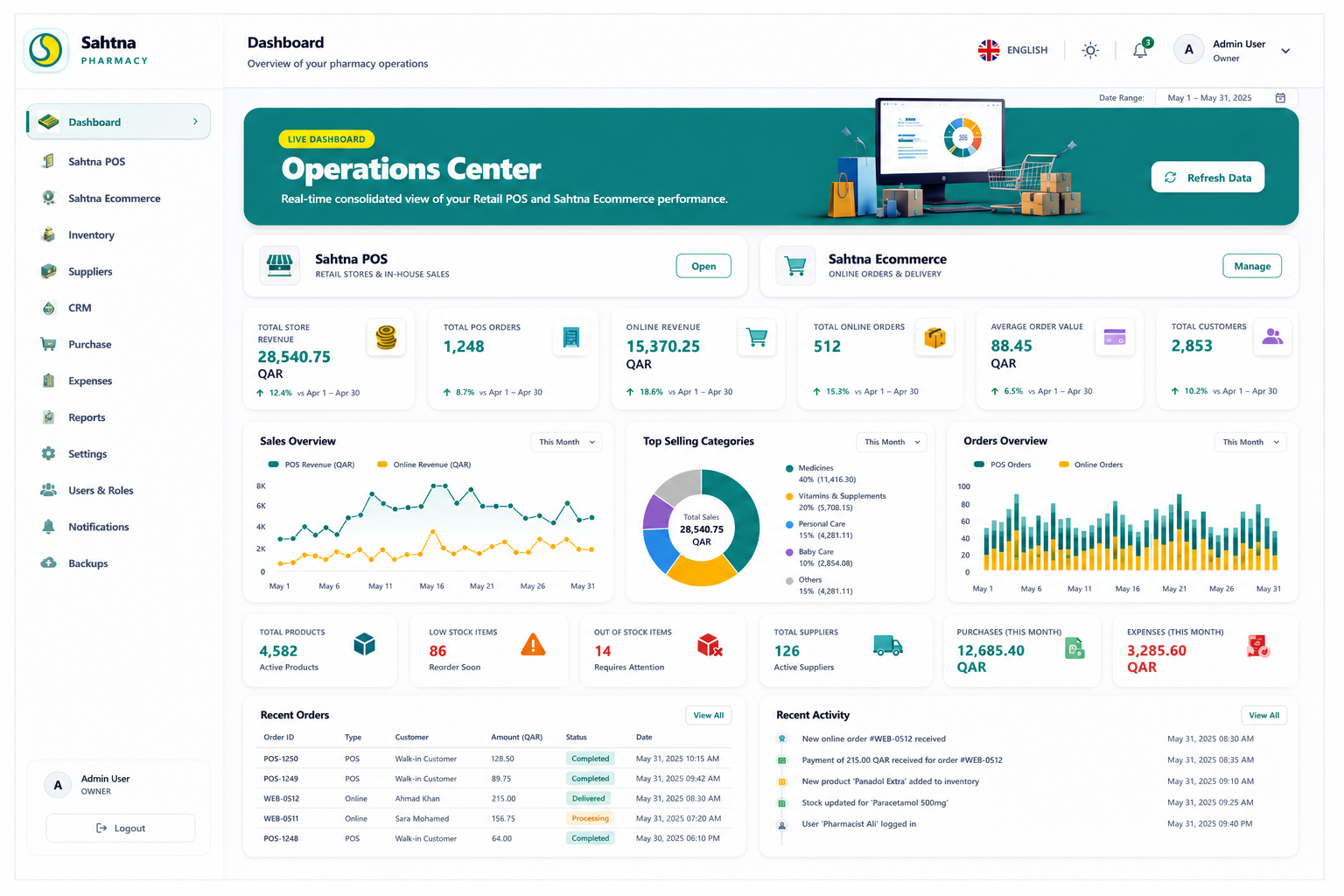
For example:
HR Dashboard
Employees: 420
New hires: 18
Open positions: 12
Leave requests: 9
Attendance exceptions: 14
Pending approvals: 7
The value is not the dashboard itself.
The value is the ability to make decisions using current information.
HR Software for Small Businesses in Qatar
Small businesses do not necessarily need a large enterprise HR platform.
A smaller company may only need:
Employee database
Attendance
Leave
Documents
Basic payroll support
Employee portal
Reports
Starting with a smaller system can reduce cost and implementation complexity.
The system can later be expanded.
For example:
Phase 1
Employee management
↓
Phase 2
Attendance + Leave
↓
Phase 3
Payroll integration
↓
Phase 4
Recruitment
↓
Phase 5
Employee mobile app
↓
Phase 6
AI + Analytics
This approach can be more practical than attempting to build every feature at once.
HR Software for Medium and Large Enterprises
Large organizations may require more advanced functionality.
These businesses may need:
Multiple companies
Multiple branches
Multiple departments
Complex approval hierarchies
Advanced permissions
Payroll integrations
Attendance integrations
Recruitment
Performance management
Training
Employee self-service
Mobile applications
Analytics
APIs
AI
ERP integration
In such environments, HR software may become part of a much larger business-management ecosystem.
This is where custom software development can be valuable when standard HR products cannot support the organization's specific workflows.
Ready-Made HR Software vs. Custom HR Software
This is one of the most important decisions.
Ready-Made HR Software
Advantages:
Faster implementation
Existing features
Lower initial development effort
Established workflows
Regular product updates
Disadvantages:
Limited customization
Subscription costs
Workflow restrictions
Integration limitations
Possible dependency on the vendor
Custom HR Software
Advantages:
Built around your workflows
Flexible features
Custom integrations
Custom dashboards
Full control over functionality
Easier to integrate with proprietary business systems
Disadvantages:
Higher initial development effort
Longer planning and development
Requires maintenance
Requires professional security and testing
Which One Should You Choose?
Choose ready-made software when your HR requirements are relatively standard.
Consider custom HR software when:
Your workflows are highly specialized.
You have multiple business systems.
Existing HR platforms do not integrate properly.
You require custom employee portals.
You need a unique approval structure.
You require specialized reporting.
You want HR integrated with your complete business platform.
The decision should be based on business requirements rather than simply software price.
How Much Does HR Management Software Cost in Qatar?
There is no single price for HR software.
The cost can depend on whether you are purchasing a subscription or developing a custom platform.
For custom software, major cost factors include:
Number of Modules
A basic employee-management system is much simpler than an enterprise HR platform containing recruitment, payroll, attendance, performance, mobile applications and AI.
Number of Users
A system for 20 employees has different infrastructure and licensing requirements from one serving thousands of users.
Integrations
Integrating HR with accounting, payroll, attendance, biometric devices or ERP systems can increase development complexity.
Mobile Applications
Android and iOS applications add development and maintenance requirements.
Security
Sensitive HR information requires appropriate authentication, authorization, encryption, backups and monitoring.
AI
AI assistants, document processing and analytics can add another layer of architecture.
Galaxium Coding's existing guide on custom software development costs in Qatar explains how modules, users, integrations, databases, mobile applications and AI can affect overall software-development complexity.
The most reliable approach is to define the requirements first and then request a project estimate.
How to Implement HR Software Successfully
Buying software is only the beginning.
Successful implementation requires planning.
Step 1: Document Existing HR Processes
Before selecting software, document:
How employees are added
How leave is requested
How attendance is recorded
How payroll information is prepared
How documents are stored
How approvals work
How recruitment is managed
Step 2: Identify Problems
Ask:
Where are errors occurring?
Which processes take the most time?
Where is information duplicated?
Which approvals are delayed?
Which reports are difficult to create?
Step 3: Define Requirements
Separate requirements into:
Must have
Should have
Future
This prevents unnecessary complexity.
Step 4: Select the Technology
Choose between:
Ready-made HR software
Cloud platform
On-premise system
Custom HR software
Hybrid approach
Step 5: Plan Data Migration
Existing employee information may be stored in spreadsheets or other systems.
Before migration:
Clean duplicate records
Standardize fields
Remove unnecessary data
Verify employee information
Define access permissions
Step 6: Test the System
Test:
Login
Permissions
Attendance
Leave
Payroll workflows
Notifications
Reports
Integrations
Mobile functionality
Security
Step 7: Train Employees
HR software only works if employees actually use it.
Training should cover:
Employee portal
Leave requests
Attendance
Documents
Manager approvals
HR administration
Step 8: Monitor and Improve
After launch, review:
User adoption
Errors
Support requests
Workflow delays
Security events
Reporting needs
Software should evolve with the organization.
Common Mistakes When Choosing HR Software
1. Choosing Based Only on Price
The cheapest software may not provide the functionality your business actually needs.
2. Ignoring Security
HR databases contain sensitive information.
Security should be evaluated before implementation, not after a problem occurs.
3. Buying Too Many Features
A company with 30 employees may not need an enormous enterprise platform.
Buy according to actual requirements.
4. Ignoring Integrations
If HR software cannot communicate with existing systems, employees may continue entering information manually.
5. Forgetting Mobile Users
Employees and managers increasingly expect mobile access.
6. Not Planning Data Migration
Moving messy spreadsheets into a new system without cleaning them first can transfer existing problems into the new platform.
7. Ignoring User Experience
If the system is difficult to use, employees may continue relying on email, WhatsApp and spreadsheets.
8. Treating AI as a Replacement for HR
AI should support HR teams rather than automatically replacing human judgment in sensitive employment matters.
How to Choose an HR Software Development Company in Qatar
If you decide to build a custom HR platform, the development company matters.
Ask potential providers:
Do they understand business software?
HR software requires more than attractive screens.
The provider should understand:
Databases
Authentication
APIs
Business logic
Permissions
Workflow automation
Security
Reporting
Can they integrate existing systems?
Ask about integrations with:
Payroll
Accounting
Attendance
ERP
CRM
Mobile apps
APIs
Can the system scale?
A system designed for 50 employees should not become unusable when the company grows to 500.
What happens after launch?
Ask about:
Maintenance
Security updates
Bug fixes
Backups
Monitoring
Technical support
Future development
You can also review Galaxium Coding's projects and portfolio when evaluating examples of software and digital solutions.
Why Custom HR Software Can Be Valuable for Qatar Businesses
Qatar has businesses ranging from small startups to large enterprises operating across multiple locations and industries.
Not every organization has the same HR workflow.
A construction company may require:
Site attendance
Shift management
Workforce tracking
Document expiry notifications
A hospitality business may need:
Shift scheduling
Attendance
Leave
Employee onboarding
A technology company may prioritize:
Remote employees
Performance management
Recruitment
Employee self-service
A large enterprise may need:
Multi-branch management
Complex permissions
ERP integration
Advanced reporting
AI
This is why a one-size-fits-all approach is not always ideal.
Custom software can be designed around the company's actual operations.
The Future of HR Management Software in Qatar
HR technology is moving beyond simple employee databases.
The next generation of HR systems is likely to combine:
HR + Automation + AI + Mobile + Analytics + Business Software
Instead of HR software being a separate system, it can become part of a connected business ecosystem.
For example:
Recruitment
↓
Employee Onboarding
↓
HR
↓
Attendance
↓
Payroll
↓
Performance
↓
Training
↓
Analytics
↓
Management
The more connected these processes become, the less manual data entry is required.
AI can then sit on top of the connected data and help employees and managers retrieve information, generate reports and automate selected workflows.
Final Thoughts
HR management software in Qatar is no longer simply about storing employee names and salaries.
Modern HR platforms can manage the entire employee lifecycle.
From recruitment and onboarding to attendance, leave, documents, payroll, performance, training and analytics, the right system can reduce manual work and give businesses greater control over their workforce.
For smaller businesses, a simple cloud HR platform may be enough.
For larger organizations, an integrated HR ecosystem may be more appropriate.
And when standard software cannot accommodate unique workflows, custom HR software can provide greater flexibility.
The most important step is to start with the business problem.
Define your processes.
Identify where manual work is creating inefficiency.
Determine which systems need to communicate.
Then select or build the technology around those requirements.
For Qatar businesses looking to create a customized HR platform, business management system or integrated digital solution, contact Galaxium Coding to discuss the project requirements and possible technology approach.
Frequently Asked Questions
What is HR management software?
HR management software is a digital platform that helps organizations manage employee information, attendance, leave, recruitment, documents, payroll-related processes, performance and other HR activities.
Why should businesses in Qatar use HR software?
HR software can reduce manual administrative work, centralize employee information, automate approvals and provide better visibility into workforce operations.
Can HR software manage attendance in Qatar?
Yes. Depending on the system, HR software can manage check-in/check-out, shifts, overtime, absences and attendance reporting. It can also integrate with biometric or other attendance systems.
Can HR software support payroll?
Many HR platforms include payroll functionality or integrate with payroll systems. Qatar-based businesses should ensure their payroll workflow supports applicable local requirements, including relevant WPS processes where applicable.
Is HR software required by law in Qatar?
HR software itself is not the same thing as a legal requirement. Businesses must comply with applicable labour, wage, employment and data-protection requirements. Software is a tool that can help organizations manage those processes.
Is employee data secure in HR software?
It can be, provided the system is designed and operated with appropriate security controls such as access management, encryption, secure authentication, backups and monitoring.
Qatar's Personal Data Privacy Protection Law provides a framework for protecting personal data.
Can employees use HR software from their phones?
Yes. Modern HR platforms can provide responsive web portals or dedicated mobile applications for employees and managers.
Should a small business buy HR software?
If manual HR processes are consuming significant time or causing errors, even a small business can benefit from HR software. However, the system should be appropriately sized for the company's actual requirements.
How much does HR software cost in Qatar?
There is no universal price. Cost depends on whether the company uses ready-made software or builds a custom system, as well as the number of users, modules, integrations, security requirements, mobile applications and AI functionality.
Can HR software integrate with accounting and ERP systems?
Yes. Modern HR platforms can use APIs and integrations to exchange information with accounting, payroll, ERP, attendance and other business systems.
Can AI be added to HR software?
Yes. AI can support HR search, employee assistants, recruitment workflows, document processing, reporting and selected automation tasks. Sensitive employment decisions should remain subject to appropriate human oversight.