How AI Automation Is Helping Small Businesses Compete With Big Companies in 2026
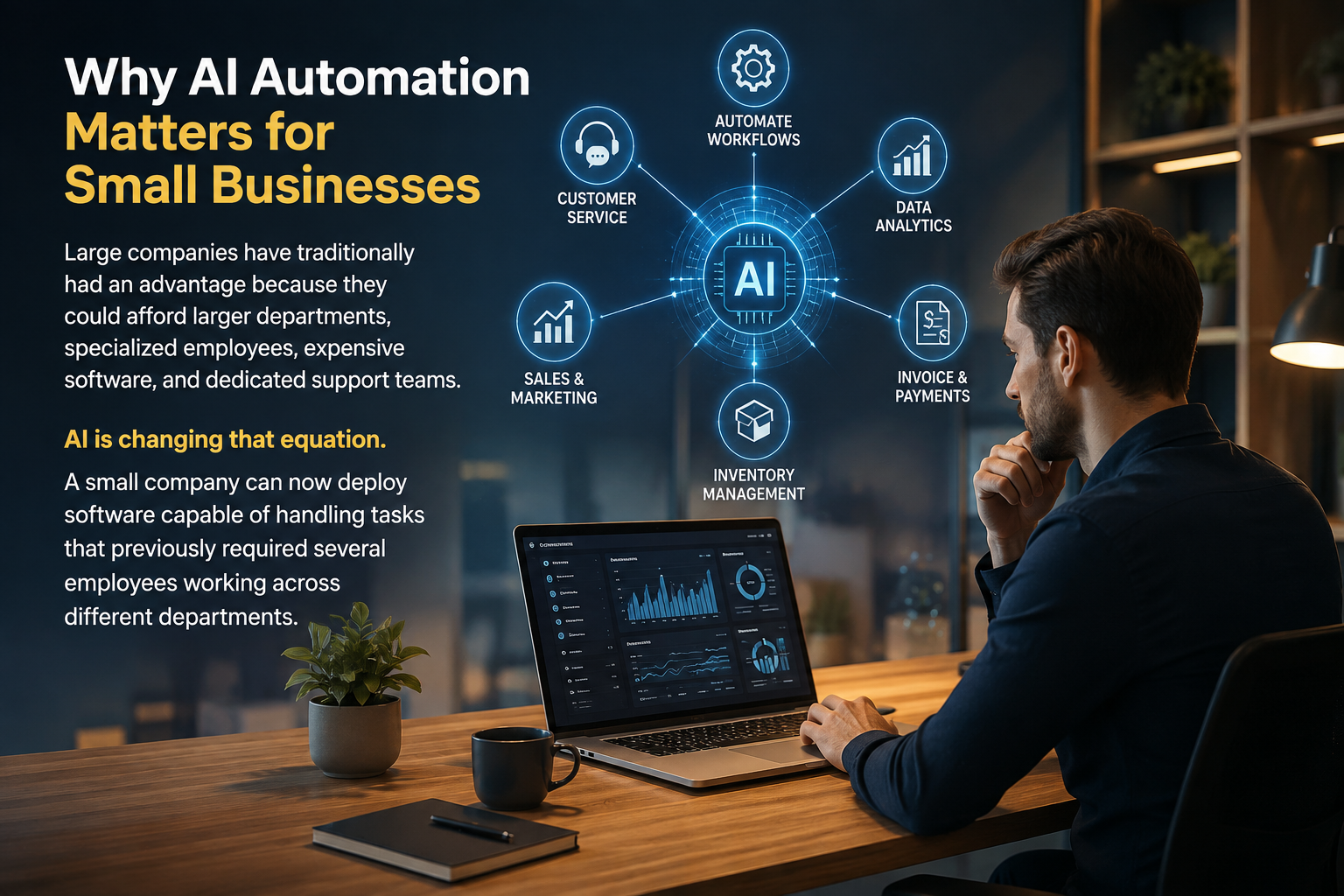
AI automation helps small businesses improve productivity, streamline operations, and compete in a digital-first economy.
How AI Automation Is Helping Small Businesses Compete With Big Companies in 2026
Small businesses no longer need huge teams, expensive infrastructure, or massive budgets to compete with larger companies. In 2026, AI automation is changing the way businesses operate by helping small teams work faster, respond to customers instantly, reduce repetitive tasks, and make better decisions.
From automated customer support and appointment scheduling to sales follow-ups, HR processes, accounting workflows, and business reporting, artificial intelligence is becoming a practical business tool rather than something reserved for large corporations.
For small and growing businesses in Qatar and around the world, the opportunity is particularly significant: AI can help a small team operate like a much larger organization.
What Is AI Automation?
AI automation combines artificial intelligence with software automation to complete tasks that would traditionally require human involvement.
Traditional automation follows predefined rules. For example:
If a customer submits a form, send them an email.
AI automation can go much further. It can understand customer messages, analyze information, make recommendations, generate responses, and trigger the appropriate business process.
For example, a customer might send:
“I need an AC technician tomorrow afternoon because my office isn't cooling properly.”
An AI-powered system could understand the request, identify the service required, check available technicians, suggest an appointment, create a service request, notify the appropriate employee, and send confirmation to the customer.
The goal isn't simply to replace employees.
The goal is to allow employees to spend less time on repetitive administrative work and more time on activities that actually grow the business.
Why AI Automation Matters for Small Businesses
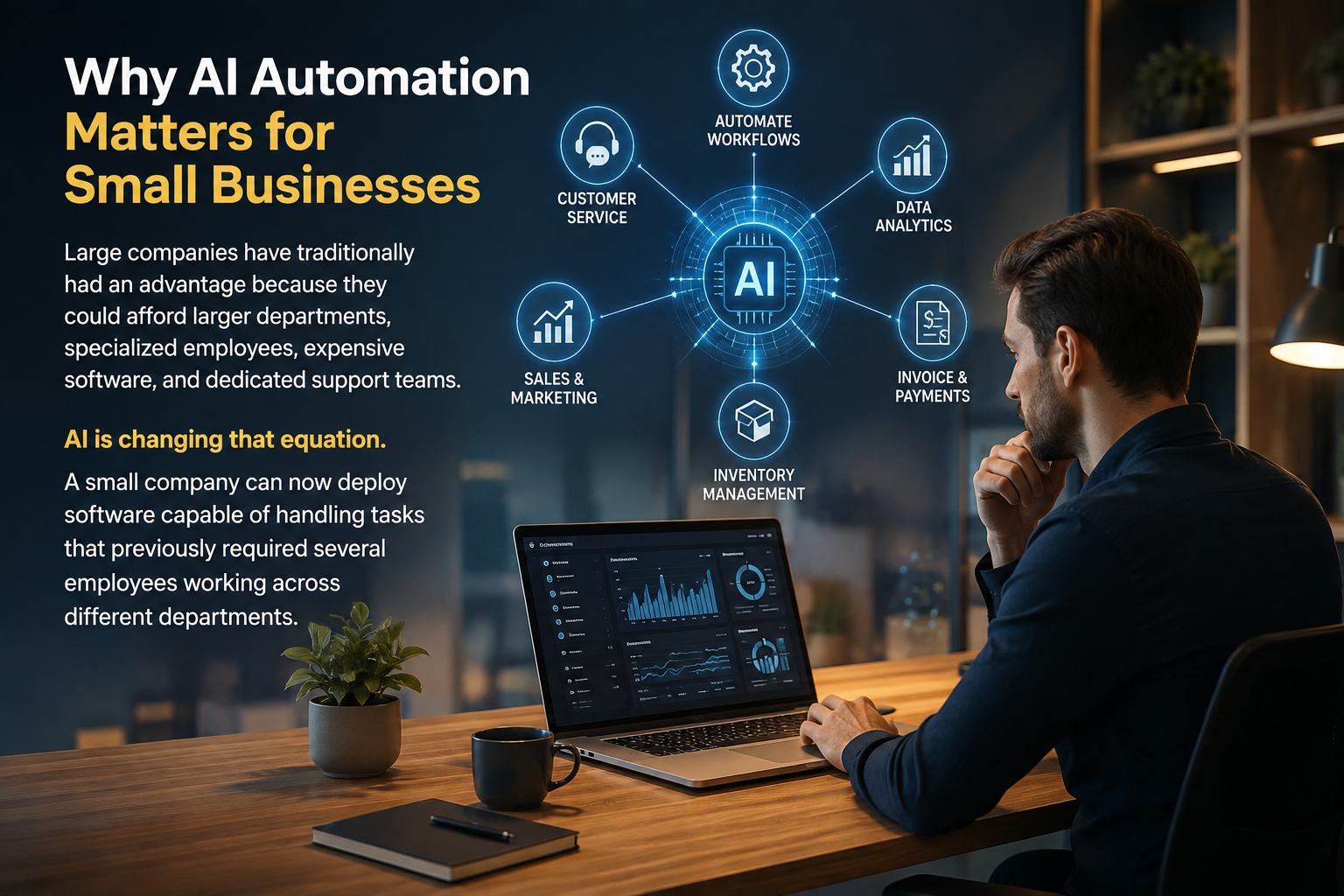
Large companies have traditionally had an advantage because they could afford larger departments, specialized employees, expensive software, and dedicated support teams.
AI is changing that equation.
A small company can now deploy software capable of handling tasks that previously required several employees working across different departments.
For example, a growing company might use AI to help with:
Customer inquiries
Lead qualification
Sales follow-ups
Appointment scheduling
Email responses
Document processing
Employee onboarding
HR questions
Invoice processing
Inventory monitoring
Business reports
Data analysis
Marketing content
Customer feedback
This means a business with a relatively small team can potentially provide a faster and more organized customer experience.
1. AI Can Provide 24/7 Customer Support
Customers don't always contact businesses during working hours.
Someone may visit your website at midnight, send a WhatsApp message early in the morning, or ask a question while your employees are busy serving other customers.
An AI-powered customer service system can respond immediately.
It can answer common questions such as:
What services do you provide?
How much does a service cost?
What are your working hours?
Where are you located?
Can I book an appointment?
What documents do I need?
What is the status of my request?
More advanced AI systems can also understand natural language instead of forcing customers to select rigid menu options.
This can significantly improve response times while reducing the workload on customer service employees.
2. AI Can Help Businesses Capture More Sales Leads
Getting a lead is only the beginning.
Businesses often lose potential customers because nobody follows up quickly enough.
Imagine someone visits your website and asks about a service.
Instead of waiting several hours for a salesperson to respond, an AI system can immediately:
Understand the customer's request.
Ask relevant questions.
Identify what the customer needs.
Collect contact information.
Qualify the lead.
Notify the sales team.
Schedule a meeting or call.
Store the information inside the CRM.
The sales team can then focus on qualified opportunities instead of manually handling every initial inquiry.
For small businesses, this can make a significant difference.
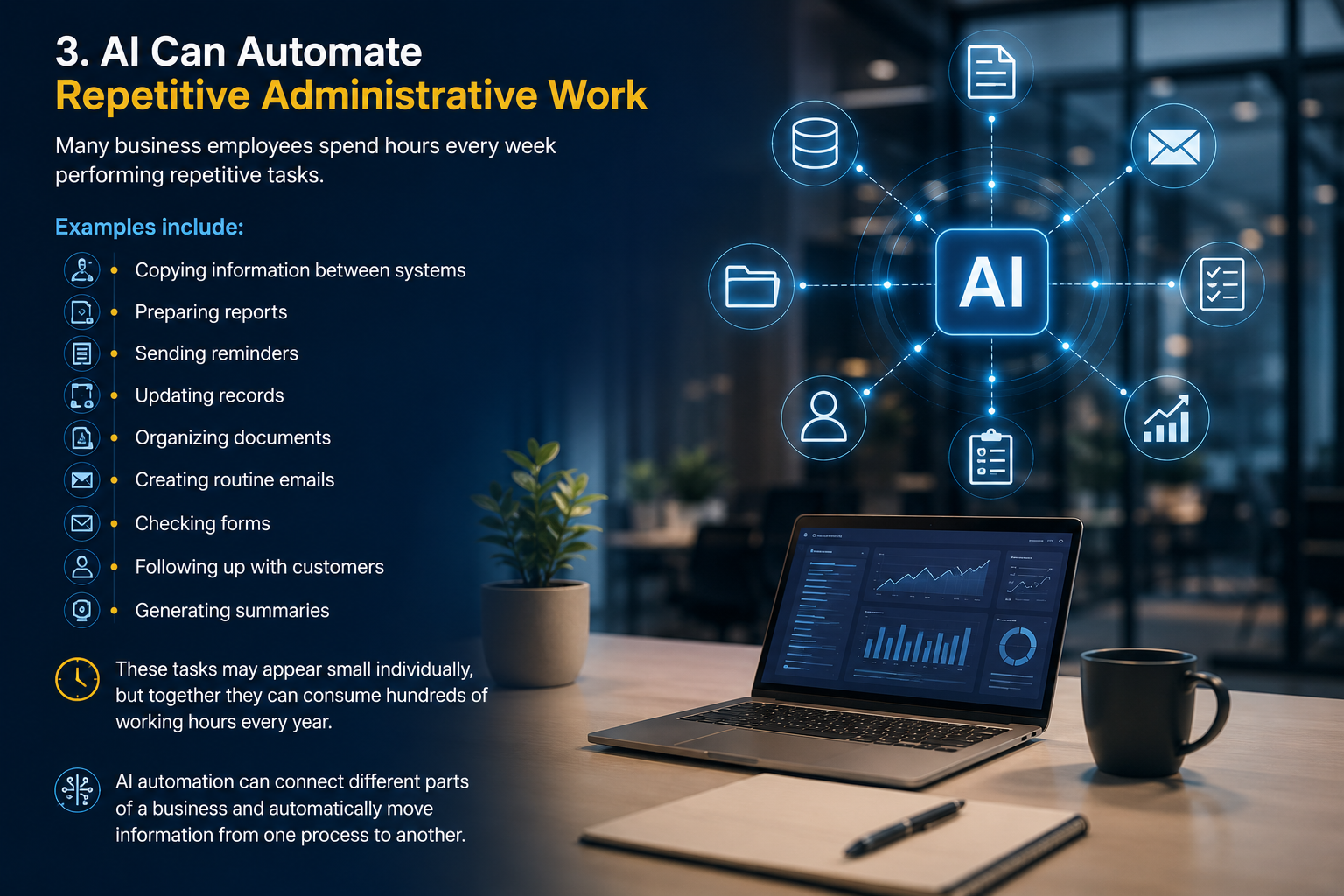
3. AI Can Automate Repetitive Administrative Work
Many business employees spend hours every week performing repetitive tasks.
Examples include:
Copying information between systems
Preparing reports
Sending reminders
Updating records
Organizing documents
Creating routine emails
Checking forms
Following up with customers
Generating summaries
These tasks may appear small individually, but together they can consume hundreds of working hours every year.
AI automation can connect different parts of a business and automatically move information from one process to another.
For example:
New customer → quotation → approval → invoice → payment → project → notification
Instead of employees manually updating each stage, an integrated business system can automate much of the workflow.
4. AI Can Make Small Sales Teams More Powerful
A small sales team doesn't necessarily need to make hundreds of phone calls or manually send hundreds of follow-up messages.
AI can assist sales teams by analyzing leads and identifying which opportunities deserve attention first.
For example, an AI system could categorize leads as:
High Priority
Customer requested a quotation and is ready to purchase.
Medium Priority
Customer is interested but still comparing options.
Low Priority
Customer requested general information and isn't currently ready to buy.
Sales employees can then prioritize their time accordingly.
AI can also help generate personalized follow-up messages based on previous conversations.
5. AI Can Improve HR and Employee Management
AI automation isn't limited to customers and sales.
It can also transform internal business operations.
A modern HR system can help automate processes such as:
Employee onboarding
Leave requests
Attendance management
Employee documentation
Performance tracking
KPI monitoring
Training reminders
HR inquiries
Employee evaluations
Instead of employees repeatedly asking HR the same questions, an AI assistant can provide immediate answers based on the company's approved policies and information.
For larger organizations, AI can also help managers identify trends in workforce data and create useful management reports.
6. AI Can Help Businesses Understand Their Data
Businesses collect enormous amounts of information.
Sales data.
Customer data.
Financial data.
Employee data.
Inventory data.
Project data.
But having data isn't enough.
Businesses need to understand what the data means.
AI can analyze business information and turn it into useful insights.
For example, instead of simply displaying:
Monthly Sales: QAR 250,000
an intelligent dashboard could help answer:
Which products generated the most revenue?
Which customers purchased the most?
Which salespeople performed best?
Which month had the highest growth?
Which expenses increased?
Which products are becoming less popular?
This allows business owners and managers to make decisions based on information rather than guesswork.
7. AI Can Reduce Operating Costs
One of the biggest advantages of automation is efficiency.
When software handles repetitive processes, employees can dedicate more time to valuable work.
For example, instead of an employee spending three hours preparing a weekly report, an automated system could generate the report automatically.
Instead of a receptionist answering the same questions repeatedly, an AI assistant could handle common inquiries.
Instead of sales employees manually tracking every follow-up, software can automatically schedule reminders.
The savings aren't necessarily about reducing the number of employees.
In many cases, the bigger benefit is getting more productivity from the existing team.
8. AI Gives Small Businesses Access to Enterprise-Level Capabilities
This may be the most important change happening in 2026.
Advanced technology is becoming increasingly accessible.
A small business can now use tools that previously required significant investment in infrastructure and specialized teams.
For example, a growing company could build a technology ecosystem containing:
Website + Mobile App + CRM + ERP + AI Assistant + Automation + Analytics
These systems can communicate with each other and create a connected digital business environment.
This allows smaller companies to compete on speed, customer experience, efficiency, and innovation rather than simply competing on size.
AI Automation Opportunities for Businesses in Qatar
Qatar has a rapidly developing digital economy, and businesses across different industries are investing in technology.
AI automation can be particularly useful for companies operating in areas such as:
Real Estate
AI can help manage property inquiries, qualify potential buyers or tenants, schedule viewings, and organize customer information.
Construction
Businesses can automate project updates, procurement workflows, employee management, documentation, and reporting.
Healthcare
AI-powered systems can assist with appointment scheduling, customer communication, reminders, and administrative processes.
Retail
AI can help with customer support, inventory monitoring, sales analysis, and personalized customer experiences.
Cleaning and Maintenance
Service companies can automate booking requests, technician assignments, customer notifications, quotations, and service follow-ups.
Professional Services
Law firms, consulting companies, accounting firms, and other professional businesses can use automation for document workflows, client communication, scheduling, and internal management.
AI Automation Doesn't Mean Automating Everything
There is an important distinction between automation and intelligent business transformation.
A business shouldn't automate a process simply because it can.
Before implementing AI, companies should ask:
Does this process consume significant time?
Is it repetitive?
Does it involve large amounts of data?
Can software perform it reliably?
Would automation improve the customer or employee experience?
If the answer is yes, that process may be a strong candidate for automation.
Human employees should continue handling situations that require empathy, creativity, judgment, negotiation, and complex decision-making.
The strongest approach is often:
AI + Automation + Human Expertise
rather than AI alone.
How to Start AI Automation in Your Business
You don't need to transform your entire company overnight.
A better approach is to start with one process.
Step 1: Identify a Repetitive Problem
Look for tasks your employees perform every day.
Step 2: Measure the Time Being Lost
Calculate approximately how many hours your team spends on the process every week.
Step 3: Determine Whether AI Is Appropriate
Not every process requires artificial intelligence. Sometimes traditional automation is enough.
Step 4: Connect Your Existing Systems
Your website, CRM, accounting software, HR system, mobile app, and other platforms should ideally work together.
Step 5: Start Small
Automate one workflow, measure the results, and expand gradually.
Step 6: Monitor the Results
Track metrics such as:
Response time
Cost savings
Number of leads handled
Employee productivity
Customer satisfaction
Conversion rate
This gives you measurable evidence of whether the automation is actually helping.
The Future Belongs to Businesses That Work Smarter
The competitive advantage of the future won't necessarily belong to the companies with the largest offices or the biggest teams.
It will increasingly belong to companies that can use technology effectively.
AI automation allows small businesses to respond faster, operate more efficiently, understand their customers better, and provide services around the clock.
For entrepreneurs, this creates an exciting opportunity.
You don't necessarily need hundreds of employees to build a sophisticated digital business.
You need the right technology, the right processes, and a clear strategy.
Build Your AI-Powered Business With Galaxium Coding
At Galaxium Coding, we help businesses turn technology into practical business solutions.
From custom software and websites to mobile applications, AI agents, business automation, and integrated management systems, our goal is to help businesses reduce manual work and build smarter digital operations.
Whether you're running a startup, a growing company, or an established organization, the first step doesn't have to be complicated.
Identify one problem. Automate one process. Measure the result. Then scale.
The businesses that start adopting intelligent technology today will be in a much stronger position to compete tomorrow.
Your business doesn't need to become bigger to become more powerful. It needs to become smarter.