AI Agents in Qatar 2026: How Businesses Can Automate Sales, Customer Service & Daily Operations
AI agents are transforming how businesses in Qatar automate sales, customer service and daily operations in 2026.
AI Agents in Qatar 2026: How Businesses Can Automate Sales, Customer Service & Daily Operations
Artificial intelligence is no longer limited to chatbots that answer simple questions.
In 2026, businesses are moving toward a more powerful form of AI: AI agents.
Unlike a traditional chatbot that mainly responds to messages, an AI agent can be designed to understand a goal, make decisions within defined boundaries, use connected business systems and perform tasks automatically.
For businesses in Qatar, this creates a major opportunity.
Imagine a customer contacting your company at 2:00 AM. Instead of waiting until the next morning, an AI agent could answer the customer, understand what they need, check available information, qualify the lead, schedule an appointment and update your CRM.
That is the difference between simply using AI and integrating AI into your business operations.
Qatar is already placing artificial intelligence at the center of its digital transformation. The country's National AI Strategy and Digital Agenda 2030 are designed to accelerate AI adoption, digital innovation and economic transformation across sectors.
For businesses, the question is no longer:
"Should we use AI?"
The better question is:
Where can AI create measurable value inside our business?
What Is an AI Agent?
An AI agent is a software system designed to perform tasks toward a defined objective using artificial intelligence.
A traditional software system generally follows fixed instructions:
Input → Rules → Output
An AI agent can operate more dynamically:
Goal → Understand → Decide → Use Tools → Take Action → Evaluate Result
For example, a customer might say:
"I need to book an appointment tomorrow afternoon."
An AI agent could:
Understand the request.
Identify the customer's preferred time.
Check the company's availability.
Find an available appointment.
Confirm the booking.
Add it to the company's system.
Send confirmation to the customer.
Notify the relevant employee.
The exact capabilities depend on how the system is designed and what business systems it is connected to.
AI Agent vs. Chatbot: What's the Difference?
This is one of the most important distinctions businesses should understand.
A basic chatbot might answer:
Customer: What time do you close?
Bot: We close at 10 PM.
An AI agent can potentially do much more.
Customer: I want to visit tomorrow after work. Can you book me an appointment?
The agent could understand the request, check availability, interact with a booking system and complete the workflow.
Traditional Chatbot
Answers questions
Provides information
Follows predefined flows
Usually has limited actions
AI Agent
Understands goals
Can reason within defined boundaries
Can use business tools
Can interact with databases and APIs
Can trigger workflows
Can update systems
Can perform multi-step tasks
This is why AI agents are becoming increasingly relevant to businesses looking for automation rather than simply conversation.
Why AI Agents Matter for Businesses in Qatar
Qatar is investing heavily in digital transformation and AI.
The country's Digital Agenda 2030 aims to build a thriving digital economy through strategic pillars that include digital infrastructure, innovation, emerging technologies and accelerated digital adoption. The International Media Office states that Qatar's agenda targets 26,000 ICT-sector jobs by 2030 and a projected cumulative annual digital economic impact of QAR 40 billion.
Qatar's National AI Strategy is built around areas including education, data access, employment, business, research and ethics.
This creates an environment where businesses increasingly need to think about how technology can improve:
Productivity
Customer experience
Operational efficiency
Decision-making
Data management
Sales
Digital services
AI agents can become part of that transformation.
10 Practical Ways Businesses Can Use AI Agents
1. Automate Customer Service
Customer service teams often spend significant amounts of time answering repetitive questions.
An AI agent can be designed to handle common requests such as:
Business hours
Services
Pricing information
Appointment requests
Order information
Delivery questions
Frequently asked questions
Basic customer support
Instead of employees repeatedly answering the same questions, the AI can handle appropriate requests automatically.
For more complicated matters, the system can escalate the conversation to a human employee.
2. Automate Sales Enquiries
Not every enquiry is immediately ready to become a customer.
An AI agent can help businesses qualify incoming leads.
For example:
Customer:
"I need a website for my company."
The AI could ask:
What type of business do you operate?
Do you already have a website?
Do you need e-commerce?
Do you need a mobile application?
What features do you require?
When would you like to launch?
The answers can then be organized and transferred to a CRM or sales team.
Instead of your salesperson receiving:
"I need a website."
They could receive:
Qualified Lead
Company: ABC Trading
Industry: Retail
Requirement: E-commerce website
Mobile App: Yes
Estimated timeline: 2 months
Contact preference: WhatsApp
That is a much more useful sales opportunity.
3. Automate Appointment Booking
AI agents can also be connected to appointment systems.
A customer could say:
"I want to speak with a lawyer tomorrow."
The agent can potentially:
Ask what type of consultation is required.
Check available times.
Present available options.
Book the appointment.
Send confirmation.
Create a reminder.
This can work particularly well for:
Law firms
Clinics
Salons
Consultants
Real estate companies
Service companies
Professional firms
4. AI Voice Agents for Phone Calls
The next evolution is not limited to text.
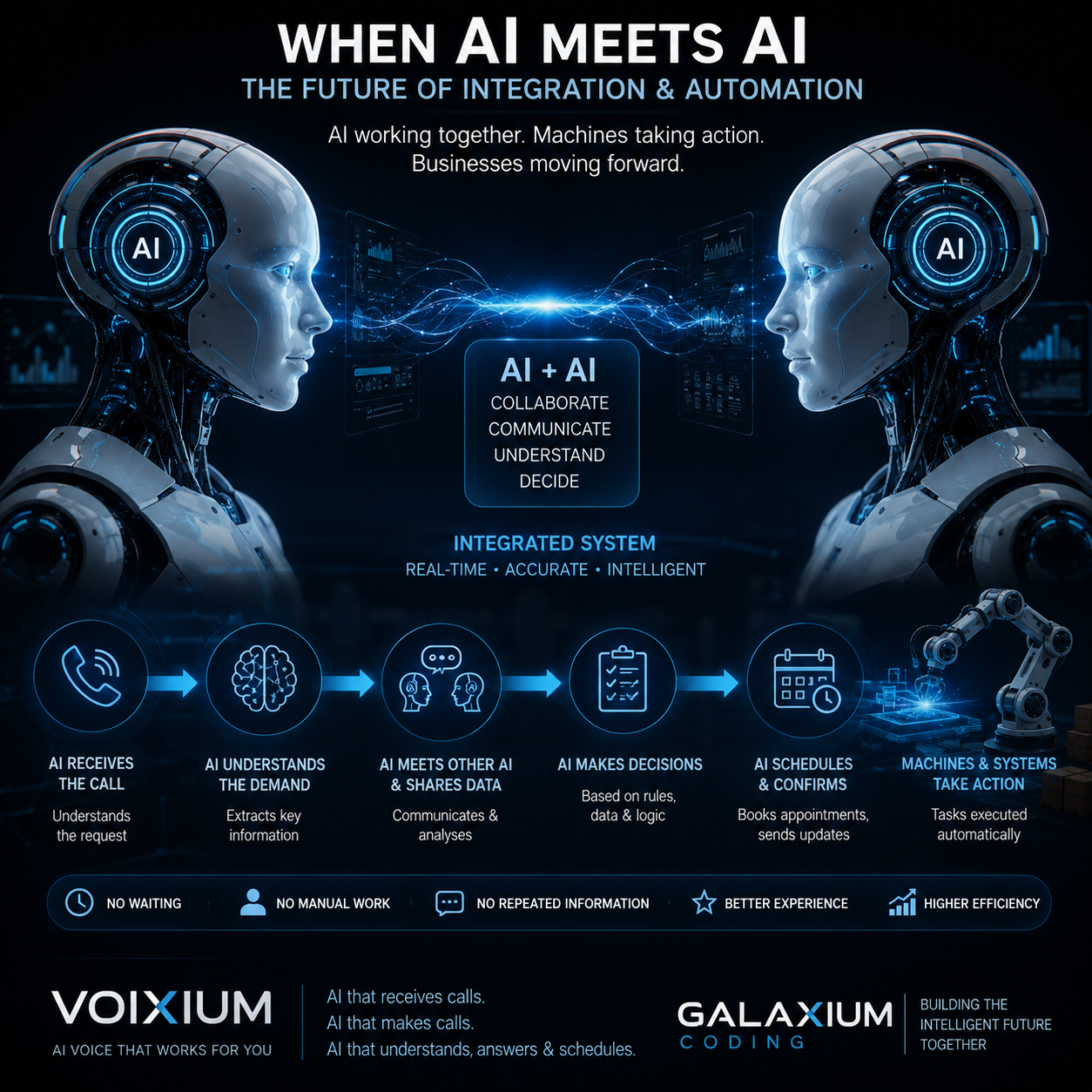
Businesses can build AI voice agents capable of handling phone conversations.
For example:
Customer calls → AI answers → understands request → accesses permitted information → performs an action → transfers to employee when necessary.
A voice agent can potentially assist with:
Incoming calls
Appointment scheduling
Customer enquiries
Lead qualification
Call routing
Frequently asked questions
Follow-up calls
Call summaries
This is particularly interesting for businesses that receive a large number of calls every day.
5. WhatsApp AI Automation
For many businesses, customer communication happens through messaging platforms.
An AI-powered WhatsApp workflow can potentially help businesses:
Customer Message → AI Understands → Retrieves Information → Responds → Takes Action
For example:
"Where is my order?"
The AI can potentially identify the customer, retrieve the relevant order information from an integrated system and provide the appropriate response.
The important part is the integration.
An AI agent becomes significantly more useful when it can securely interact with the systems that contain the information the customer needs.
6. Automate Follow-Ups
Many businesses lose opportunities because leads are not followed up consistently.
Consider a customer who asks for a quotation but doesn't respond.
Instead of relying entirely on a salesperson to remember the lead, an automated workflow could:
Day 1: Send quotation
Day 2: Follow up
Day 5: Send reminder
Day 10: Notify salesperson
The exact timing and messages should be designed around the business and its communication policies.
AI can help personalize the communication rather than sending the same generic message to everyone.
7. Automate Internal Business Operations
AI agents don't have to communicate only with customers.
They can also assist employees.
For example, an employee could ask:
"Show me this month's pending invoices."
The system could retrieve the appropriate information from an authorized business system.
Another employee could ask:
"Which products are running low?"
The agent could retrieve inventory information and provide a summary.
This creates a more natural way for employees to interact with business data.
8. AI for HR
AI agents can also support HR workflows.
Potential applications include:
Employee FAQs
Leave requests
Policy information
Interview scheduling
Candidate screening workflows
Onboarding assistance
Document collection
Employee notifications
For example, instead of an employee searching through an HR manual:
"How many annual leave days do I have?"
An integrated HR assistant could provide the appropriate information based on the employee's authorized data and company policies.
Sensitive HR decisions should remain subject to appropriate human oversight and organizational controls.
9. AI for E-Commerce
Online businesses can use AI agents throughout the customer journey.
A customer could ask:
"I need something for sensitive skin under QAR 100."
The AI could potentially:
Understand the customer's requirements.
Search the product catalogue.
Filter relevant products.
Explain differences.
Recommend suitable options.
Help the customer proceed with the purchase.
The system can become even more powerful when connected to inventory, orders and customer accounts.
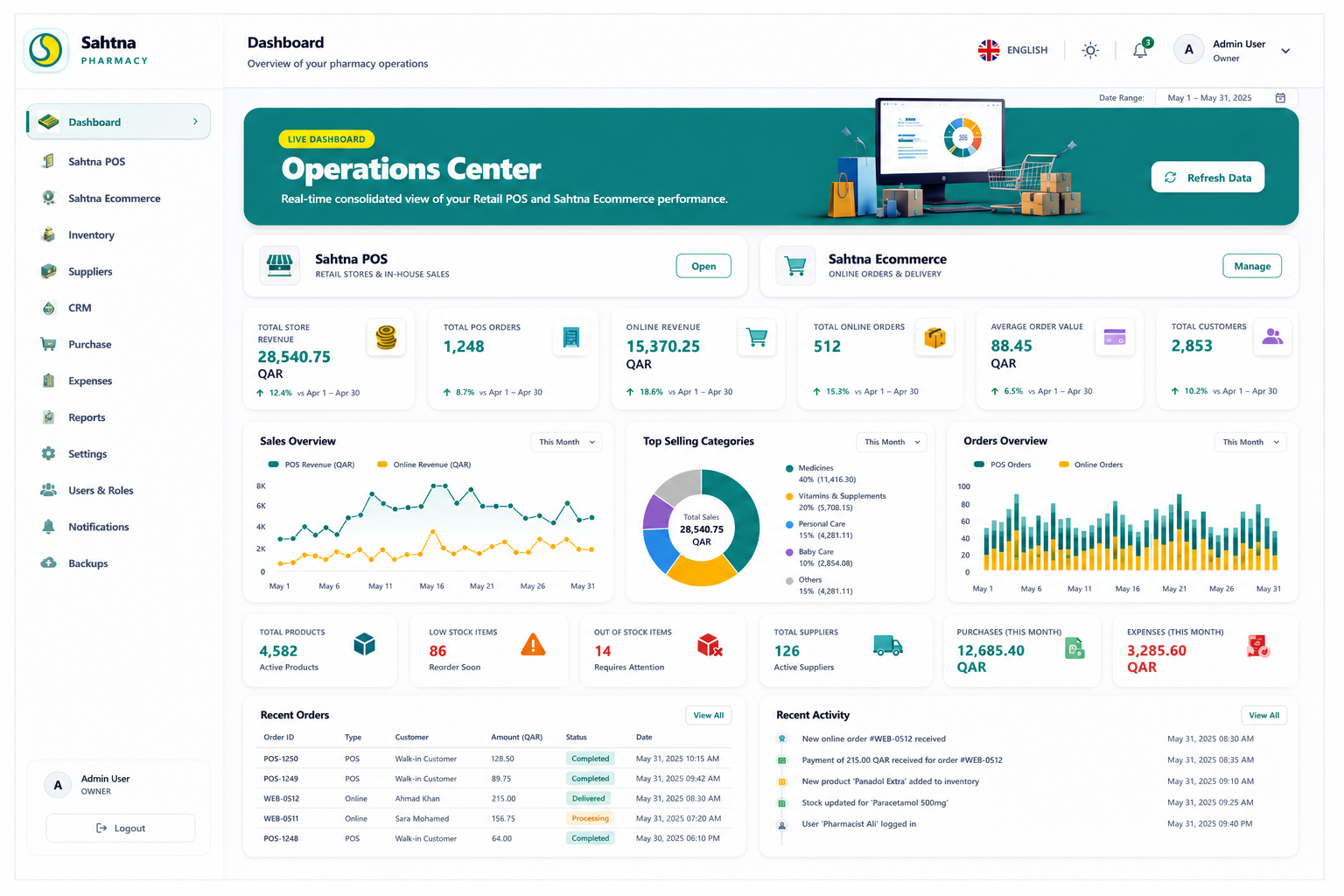
10. AI-Powered Business Dashboards
Imagine opening your business dashboard in the morning and asking:
"What happened yesterday?"
Instead of manually reviewing multiple screens, an AI system could summarize authorized business data.
For example:
Sales: Increased
Orders: Increased
Low Stock: 12 products
Pending Payments: 7
New Leads: 34
Customer Complaints: 3
Priority: Follow up with five high-value leads
The goal isn't simply to create another dashboard.
The goal is to make the information easier to understand and act upon.
How an AI Agent Connects to Your Business
An AI agent by itself is only part of the solution.
The real power comes from integration.
A typical architecture might look like:
Customer
↓
Website / WhatsApp / Mobile App / Phone
↓
AI Agent
↓
AI Model
↓
Business Tools & APIs
↓
CRM / ERP / HR / Inventory / Accounting / Database
↓
Action
For example:
Customer asks about an order
↓
AI understands request
↓
AI identifies customer
↓
System checks order database
↓
AI retrieves permitted information
↓
AI responds
This is what turns AI from a simple chatbot into a business automation system.
AI Agents Can Work Across Multiple Departments
One of the biggest advantages is that businesses don't necessarily need a separate AI system for every department.
A properly designed platform can connect multiple workflows.
Sales
Lead qualification → CRM → Follow-up
Customer Service
Questions → AI → Support → Escalation
HR
Employee request → HR system → Response
Inventory
Stock request → Inventory system → Information
Finance
Invoice request → Accounting system → Information
Management
Business data → AI analysis → Summary
This creates a more connected digital business.
What Technology Is Behind AI Agents?
A modern AI-agent solution can involve multiple technologies.
Depending on the project, the technology stack may include:
Artificial Intelligence Models
Large language models can provide natural-language understanding and generation.
APIs
APIs allow the AI system to communicate with existing software.
Databases
Business information can be stored and retrieved from authorized databases.
CRM Integration
AI can read or update appropriate customer and lead information.
ERP Integration
AI can interact with business processes and data where appropriate.
Cloud Infrastructure
Cloud services can provide scalable computing, storage and deployment.
Authentication
Users and systems need appropriate authentication and authorization.
Monitoring
AI systems should be monitored to identify errors, unexpected behavior and performance issues.
Human Escalation
Important or sensitive situations should be transferred to qualified employees.
AI Agents Need Guardrails
AI should not simply be given unlimited access to a company's systems.
This is one of the most important considerations when implementing AI.
Businesses should define:
What the AI can access
What the AI cannot access
What actions it can perform
Which actions require approval
What information it can reveal
How conversations are logged
How users are authenticated
How sensitive information is protected
When a human must take over
Qatar's AI policy work emphasizes responsible, ethical and coordinated AI deployment, including areas such as data, infrastructure, human capabilities, institutional capabilities and AI governance.
The objective should never be:
"Give AI access to everything."
The objective should be:
"Give AI the right access to perform the right tasks safely."
AI Agents and Arabic Businesses in Qatar
Another important consideration for Qatar is language.
Businesses may communicate with customers in:
English
Arabic
Both English and Arabic
A modern AI solution can be designed around multilingual communication.
For businesses serving Qatar's diverse population, this can improve accessibility and create a more natural customer experience.
However, multilingual AI should be tested carefully, particularly when conversations involve legal, financial, medical or other sensitive information.
How Much Does an AI Agent Cost in Qatar?
There is no single price for an AI agent.
The cost depends on the complexity of the system.
A simple AI assistant that answers information from a controlled knowledge base is very different from an AI agent connected to:
CRM
ERP
WhatsApp
Voice calls
Inventory
Accounting
Customer accounts
Multiple APIs
Internal databases
The project cost can therefore depend on:
AI model requirements
Number of integrations
User interface
Automation complexity
Security requirements
Voice or text
Data requirements
Hosting
Testing
Ongoing maintenance
Businesses should focus on the business value and workflow being automated, rather than choosing an AI solution solely because it has the lowest initial price.
How to Start Using AI in Your Business
You don't need to automate your entire company on day one.
A better approach is to start with one process.
Step 1 — Identify a Repetitive Problem
Ask:
What does my staff do repeatedly every day?
Examples:
Answering the same questions
Entering customer information
Following up with leads
Booking appointments
Checking orders
Generating reports
Step 2 — Measure the Current Process
Find out:
How many employees are involved?
How many hours are spent?
How many requests are received?
How many leads are lost?
How frequently do errors occur?
This gives you a baseline.
Step 3 — Design the AI Workflow
Determine:
Input → AI → Data → Decision → Action → Human Escalation
Step 4 — Integrate Your Existing Systems
You may already have:
Website
Mobile application
CRM
ERP
HR system
Accounting system
Inventory system
Database
You don't necessarily need to replace everything.
AI can potentially be integrated into your existing technology ecosystem.
Step 5 — Test Before Launch
AI systems should be tested against real-world scenarios.
Test:
Normal questions
Unexpected questions
Incorrect information
Arabic conversations
English conversations
Sensitive requests
System failures
API failures
Human escalation
Step 6 — Launch and Improve
After deployment, monitor:
Response quality
Customer satisfaction
Conversion rates
Time saved
Automation success rate
Escalation rate
Errors
Then continuously improve the system.
The Future of Business Is Not AI vs. Humans
It is AI + Humans.
AI can handle repetitive digital tasks.
Humans provide:
Judgment
Creativity
Relationships
Leadership
Accountability
Complex decision-making
The most successful businesses will not necessarily be those that replace the most employees with AI.
They may be the businesses that learn how to give their employees better technology.
An employee who previously spent three hours answering repetitive questions could instead spend that time solving higher-value problems.
That is where automation creates real business value.
Why Qatar Is an Interesting Market for AI
Qatar has been building a strong foundation for AI and digital transformation.
The country established its Artificial Intelligence Committee in 2021, and its AI initiatives are aligned with Qatar National Vision 2030 and the Digital Agenda 2030.
Qatar also launched Qai in December 2025 as a national AI company focused on developing, operating and investing in AI infrastructure, technology and systems.
The direction is clear:
Digital infrastructure
↓
Data
↓
AI
↓
Automation
↓
Smarter businesses
For Qatar's private sector, this represents an opportunity to move beyond simply having a website or software system and toward building intelligent digital operations.
Is Your Business Ready for an AI Agent?
Ask yourself these questions:
Do customers ask the same questions repeatedly?
Yes → AI opportunity
Do employees manually enter the same information?
Yes → Automation opportunity
Do salespeople spend hours following up with leads?
Yes → AI sales opportunity
Do customers call outside working hours?
Yes → AI voice opportunity
Do you use WhatsApp heavily?
Yes → WhatsApp AI opportunity
Do you have CRM, ERP or other business software?
Yes → AI integration opportunity
Do managers spend hours creating reports?
Yes → AI analytics opportunity
You may already have everything you need to begin.
AI Is Not Just a Chatbot
This is perhaps the most important point.
A chatbot answers.
An AI agent can be designed to understand, decide and act within defined permissions.
That difference can transform how businesses approach automation.
The future is not:
Website + Chatbot
It is:
Website + Software + Data + AI + Automation + Human Intelligence
And this is where businesses can begin building a serious competitive advantage.
At Galaxium Coding, we develop custom software, websites, mobile applications, AI solutions and business automation systems for modern businesses.
Our approach is not simply to add an AI chatbot to a website.
We look at the bigger picture:
What is your business trying to achieve?
Which processes are consuming time?
Where are customers being lost?
Which systems need to communicate with each other?
Where can AI create measurable value?
From AI assistants and chatbots to custom software integrations, automation workflows and AI-powered business systems, the right solution depends on the business.
If you have an existing software platform, you may not need to start again.
Your existing system could potentially become the foundation for a smarter AI-powered business.
Final Thoughts
2026 is not the year businesses should ask whether artificial intelligence is coming.
AI is already here.
The more important question is:
How will your business use it?
Qatar is building an increasingly sophisticated digital ecosystem, with AI positioned as an important part of national transformation and economic development.
For businesses, the opportunity is to start small, solve real problems and build intelligently.
Automate one process.
Measure the result.
Improve it.
Then expand.
The companies that combine human expertise with intelligent technology will be better positioned for the next stage of digital business.